

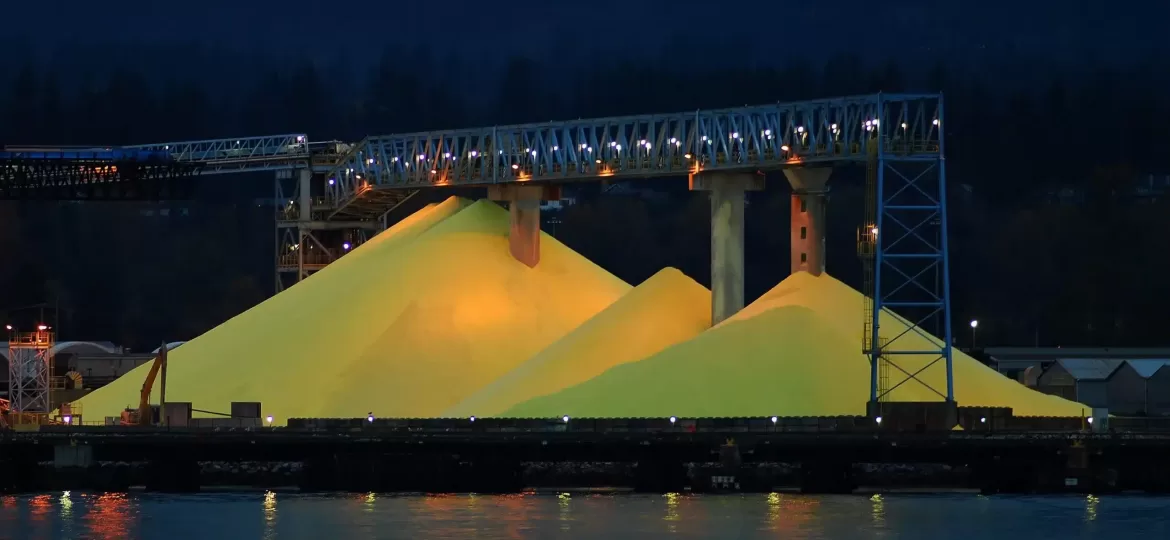
Russia plays a major role in the global sulphur market. The country produces large volumes of technical sulphur as a by-product of oil refining and gas processing. Therefore, many industries follow Russian sulphur flows closely.
However, the market has changed. Sanctions risks, export limits, and logistics issues now affect trade routes and payment terms. As a result, buyers must work with clear specifications, strong documents, and compliant supply plans.
This article explains where sulphur is used, which countries buy Russian sulphur, who exports it, what quality specs matter, and how companies build a compliant sourcing model.
1) Where Do Buyers Use Sulphur?
Sulphur supports many industries. Most of the time, buyers use it to produce sulfuric acid. Then, sulfuric acid supports fertilizer and chemical production.
1.1 Sulfuric Acid Production (Main Use)
Sulphur feeds sulfuric acid plants. These plants supply:
- fertilizer factories,
- mining operations,
- chemical producers.
Because sulfuric acid drives many industrial chains, sulphur demand stays high in many regions.
1.2 Fertilizer Industry (Strong Demand Driver)
Fertilizer companies use sulphur mainly to produce phosphate fertilizers such as:
- DAP (Diammonium Phosphate)
- MAP (Monoammonium Phosphate)
- TSP (Triple Superphosphate)
Moreover, many NPK producers also depend on sulphur-based chemicals.
1.3 Other Industrial Uses
Industries also use sulphur in:
- rubber production (vulcanization),
- metal processing,
- industrial chemicals.
For this reason, sulphur connects both agriculture and industry.
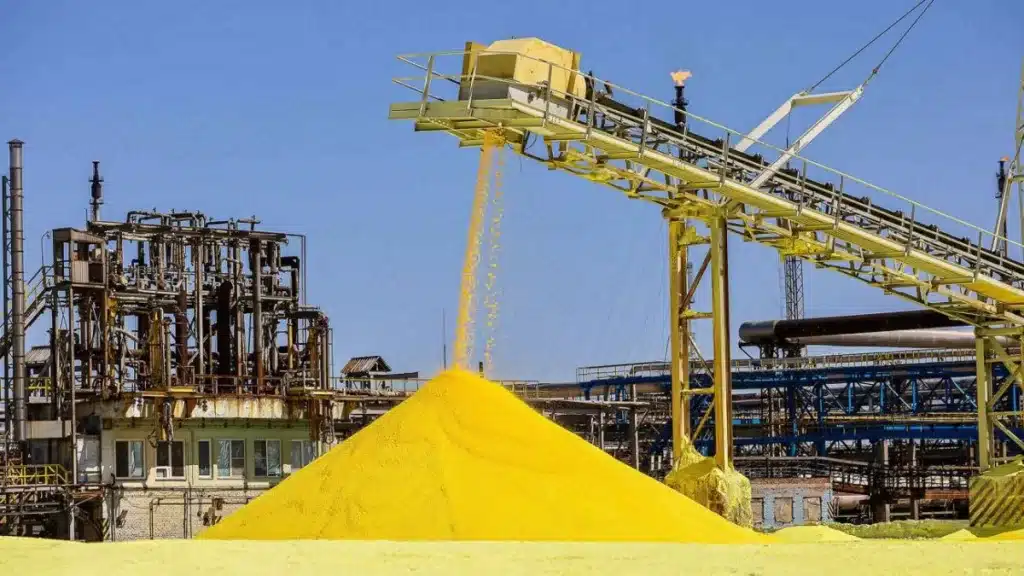
2) Russia’s Position in the Global Sulphur Market
Russia exports technical sulphur to global buyers. At the same time, export levels can change quickly. Refinery output, transport limits, and political decisions drive this volatility.
Public references show the scale of exports:
- Russia exported about 1.805 million tons of crude/unrefined sulphur in 2021 (HS 250310).
- Market reporting mentioned around 1.038 million metric tons of exports in 2024.
In short, Russia stays important. Yet buyers must manage risk more carefully than before.
3) Countries That Import Russian Sulphur (Trade Overview)
Many datasets show destinations as rankings rather than full tonnage by country. Still, market reports and trade portals highlight several key buyer markets.
In addition, OEC provides a bilateral trade overview for Russia and sulphur.
Table 1 — Russian Sulphur Export Destinations (Indicative)
| Destination Country | Market Role | Export Quantity (Public Source) | Notes |
|---|---|---|---|
| Brazil | Major buyer market | Not Public (country split not consistently disclosed) | Reported as a key destination in 2024 market discussions |
| China | Major buyer market | Not Public (country split not consistently disclosed) | Reported as a key destination in 2024 market discussions |
| India | Large import market | N.A. | Strong fertilizer and chemical demand |
| Morocco | Fertilizer downstream hub | N.A. | Strong sulfuric acid and phosphate system |
| Turkey / EAEU region | Regional trade route | N.A. | Routes depend on restrictions and logistics |
Because country-level tonnage splits often remain private, buyers should confirm routes and volumes directly with suppliers and terminals.
4) Russian Sulphur Exporters and Suppliers (With Public Volume Mentions)
Sulphur trade often uses traders, terminals, and logistics firms. Therefore, the exporter name in paperwork may differ from the producer name.
Still, some sources mention major export entities and volumes.
Table 2 — Key Russian Sulphur Exporting Entities
| Exporting Company / Entity | Type | Export Volume (Public Reference) | Notes |
|---|---|---|---|
| Gazprom Export | Gas exporter | About 1.3 million tons in H1 2020 | Source gives a clear export-scale figure |
| Russian refining & gas sector (total) | National total | Around 1.038 million tons in 2024 | Source reports total exports, not company split |
| VOSTOK LLC (market example) | Supplier reference | Not Public | Lists granular/lump/ground sulphur trade forms |
As a result, buyers should focus on verified documentation and inspection reports, not only the seller’s name.
5) Sulphur Quality Specs (Including Russian Export Specs)
Sulphur buyers usually choose high purity grades. They also check particle size and moisture because these affect handling and plant feeding.
Common Market Benchmarks
Many industrial buyers request granular sulphur with purity around 99.5% minimum.
Russia-Linked Export Spec Example
A commercial export reference mentions a “Technical Gas Granular Sulphur Grade 9998” and a related technical standard:
- TU 2112-133-31323949-2005
Table 3 — Russian Sulphur Specs (Commercially Seen)
| Parameter | Common Buyer Target | Russia Export Reference |
|---|---|---|
| Purity (S Content) | 99.5% min | Grade naming “9998” (99.98) |
| Form | Granular or lump | Granular, lump, ground |
| Standard | Contract-based | TU 2112-133-31323949-2005 |
| Packaging | Bulk or big bag | Big bags 750–1500 kg |
In practice, buyers should request:
- COA (Certificate of Analysis)
- third-party inspection (SGS or similar)
- moisture and ash limits
- particle size agreement
Otherwise, quality disputes may disrupt the shipment.
6) Export Restrictions and Supply Risks
Russia can change sulphur export rules. In addition, disruptions in refineries can reduce export supply.
A report discussed Russia’s sulphur export ban/restriction framework with exceptions for certain regions.
Meanwhile, refinery disruptions also impacted trade flows and created supply uncertainty.
Therefore, buyers must track policy updates and plant operations closely.
7) Important Compliance Note: ATABAŞ GRUP’s Sanctions-Aligned Sulphur Supply Model
ATABAŞ GRUP stopped direct sulphur trade with Russia due to sanctions and compliance risks.
However, ATABAŞ GRUP continues to secure sulphur supply by buying from alternative countries that Russia sells to. This strategy allows ATABAŞ GRUP to maintain supply while following sanctions rules and compliance requirements.
This approach helps ATABAŞ GRUP:
- follow sanctions-compliant trade routes,
- reduce legal and banking risk,
- protect supply continuity for customers,
- keep international trade operations stable.
Conclusion
Russia remains an important sulphur supplier, yet the market now requires stronger control and strict compliance. Therefore, buyers should focus on:
- product quality specs and inspection,
- clear documents and payment safety,
- stable logistics planning,
- sanctions-compliant sourcing strategies.
ATABAŞ GRUP builds its sulphur supply with a compliance-first structure. As a result, the company protects both customers and operations under changing global trade conditions.
