Sugar Beet Molasses Exports to Europe Have Started
Exports of sugar beet molasses from Türkiye to Europe have officially begun. This development reflects the growing demand for high-quality, sustainable raw materials across European industries, including bioethanol, animal nutrition, and fermentation.
What Is Molasses?
Molasses is a dark, viscous byproduct generated during sugar production. When producers process sugar beets or sugarcane, they extract crystallized sugar, leaving behind a nutrient-rich liquid known as molasses.
Although molasses contains a high percentage of sugar, producers cannot crystallize it further. As a result, industries widely use it in agricultural, industrial, and fermentation applications.
Key Properties of Molasses
Molasses has several distinctive physical and chemical characteristics:
- It appears as a dense, dark brown to black liquid.
- It contains a high sugar concentration, typically between 40–50%.
- It provides valuable minerals and vitamins.
- Its viscous structure gives it a thick consistency and low fluidity.
- It delivers a sweet flavor with a slightly bitter aftertaste.
Industrial and Agricultural Applications of Molasses
Animal Feed
Producers add molasses to animal feed formulations as an efficient energy source. It improves feed palatability while increasing nutritional value for livestock.
Alcohol and Bioethanol Production
Fermentation facilities use molasses as a primary raw material for ethanol production. Many countries rely on it to support renewable and alternative fuel programs.
Food Industry
Food manufacturers use molasses as a natural sweetener in syrups, bakery products, and confectionery items.
Yeast and Fermentation Industry
Yeast producers utilize molasses as a key carbon source to support microbial growth and fermentation efficiency.
Chemical and Cosmetic Industry
Manufacturers incorporate molasses into soap production, cosmetic formulations, and selected chemical compounds.
Soil Fertilization
Organic farmers apply molasses as a liquid fertilizer and soil conditioner to stimulate microbial activity and improve soil health.
Advantages of Molasses
Molasses offers several strategic advantages across industries:
- It delivers high nutritional and energy value.
- As a byproduct, it supports environmentally responsible production.
- It plays a critical role in fermentation-based industries.
- It enhances soil quality and agricultural productivity when used correctly.

Molasses Consumption in Europe: Key Companies and Applications
European industries consume large volumes of molasses for energy, food, and fermentation processes. The table below outlines major users, estimated annual consumption, and primary applications:
| Company Name | Annual Molasses Consumption (Tons) | Primary Applications |
|---|---|---|
| Südzucker AG | 500,000 | Bioethanol, animal feed, yeast |
| Tereos Group | 450,000 | Bioethanol, animal feed, food |
| Nordzucker AG | 300,000 | Bioethanol, animal feed |
| British Sugar | 250,000 | Animal feed, bioethanol, food |
| ABF Ingredients | 200,000 | Yeast production, food additives |
Consumption figures are approximate and may vary depending on annual production and market conditions.
Leading Countries in Global Molasses Consumption
Several countries play a major role in global molasses utilization:
- Brazil uses large volumes of molasses for bioethanol production as the world’s leading sugarcane producer.
- India channels molasses into alcohol production and animal feed through its extensive sugar industry.
- The United States, through companies such as ADM and Cargill, integrates molasses into feed, industrial, and fermentation products.
Top Molasses Exporting Countries and Logistics
Molasses exports support global industrial demand. The following table summarizes leading exporting countries and their estimated annual volumes:
| Country | Annual Export Volume (Tons) | Main Transportation Method |
|---|---|---|
| India | 1,539,140 | Maritime shipping |
| Indonesia | 570,832 | Maritime shipping |
| Guatemala | 351,710 | Maritime shipping |
| Australia | 349,954 | Maritime shipping |
| Mozambique | Data not specified | Maritime shipping |
Export volumes may change based on production levels and global demand.
Transportation Methods
Exporters primarily transport molasses via maritime shipping due to its high volume and international reach. Bulk carriers and tankers enable efficient, cost-effective delivery to global markets.
Offering Turkish-Origin Beet Molasses
We offer high-quality Turkish-origin sugar beet molasses for a wide range of industrial applications, including bioethanol production, animal feed, and yeast manufacturing. Our production process follows strict quality control standards to ensure consistent performance and reliability.
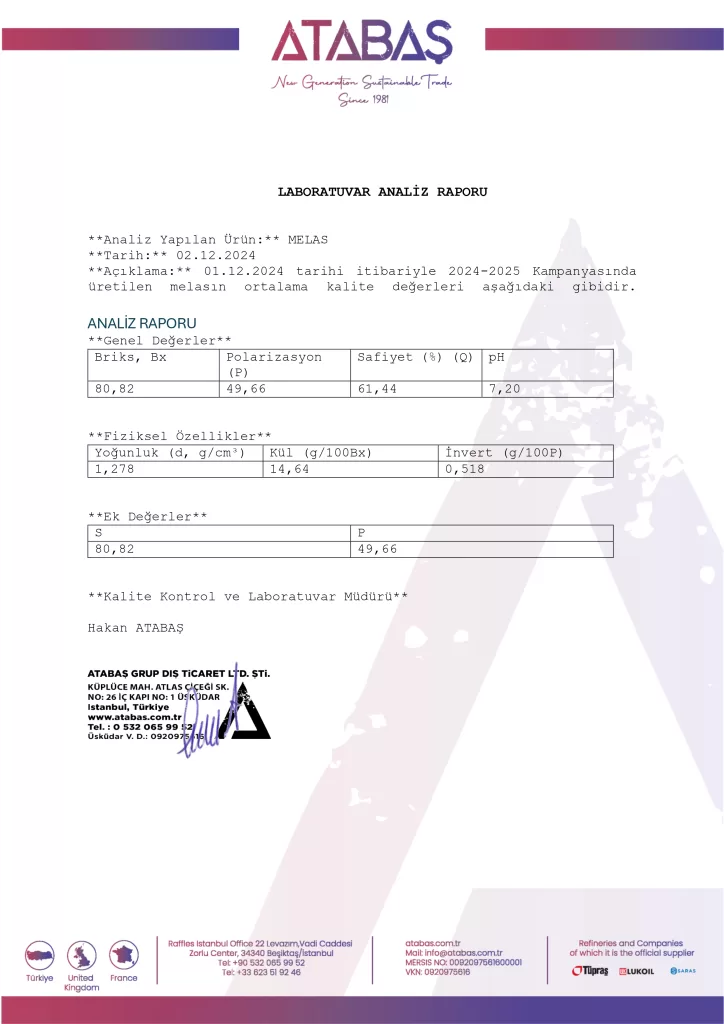
Molasses Analysis Report
For detailed technical specifications, chemical composition, and quality parameters of our molasses, please refer to the attached analysis report (PDF).