

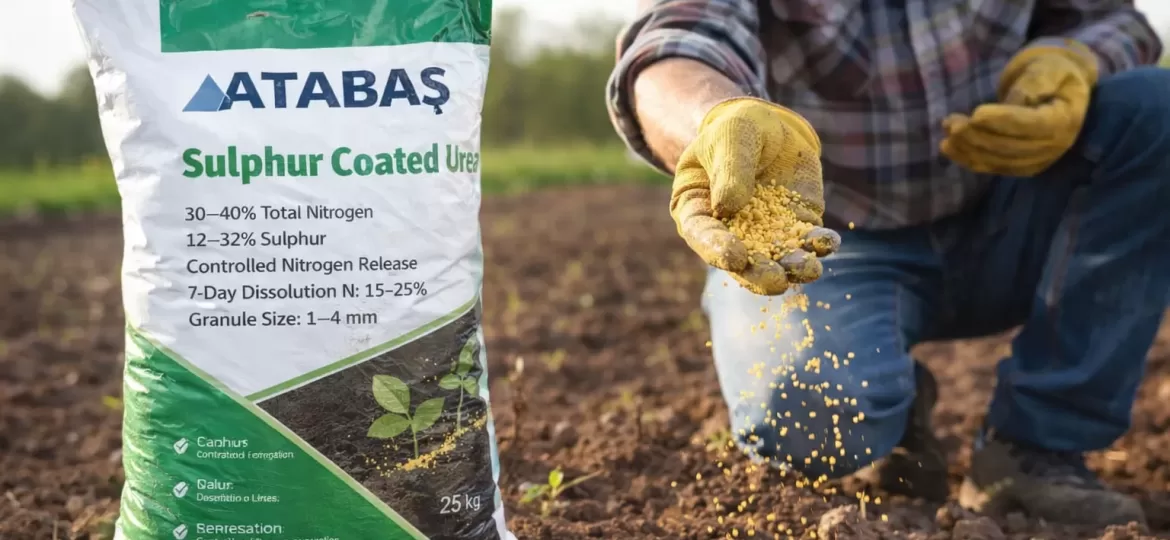
Sulphur Coated Urea: A Modern Controlled-Release Fertilizer Transforming Global Agriculture
Modern agriculture no longer measures success only by yield. Today, growers also focus on fertilizer efficiency, crop quality, soil performance, and environmental impact. In this landscape, Sulphur Coated Urea has become one of the strongest controlled-release nitrogen solutions. It combines the proven power of urea with the added value of sulphur.
Conventional urea dissolves fast. As a result, nitrogen losses often occur through leaching or volatilization. Sulphur Coated Urea, however, uses a controlled-release design. It releases nitrogen slowly and steadily. This release pattern helps crops absorb nitrogen at the right time. At the same time, it reduces waste and lowers the need for repeated applications. For this reason, the coating is designed to release nitrogen gradually over time.
Across the world, growers now adopt Sulphur Coated Urea at a faster pace. Demand rises especially in regions with high irrigation, sandy soils, and hot climates. These conditions typically increase nitrogen loss. Therefore, controlled-release fertilizers reduce this problem. They deliver nutrients when crops need them, not when the soil washes them away.
Why Sulphur Coated Urea Is Used and Why It Matters
Farmers use Sulphur Coated Urea to deliver nitrogen in a controlled way. In addition, they use it to supply sulphur, which plants need for protein formation and healthy growth. Many soils now lack sulphur. Over time, modern fertilizer use and cleaner air reduced sulphur inputs. Because of this, sulphur shortage can limit plant growth even when nitrogen levels look sufficient.
Sulphur Coated Urea delivers nitrogen and sulphur in one granule. Consequently, it improves nutrient balance and supports steady uptake. This is especially important for crops that need more sulphur. These crops include cereals, corn, vegetables, and oilseed crops. Moreover, sulphur supports amino acids like cysteine and methionine. These compounds directly affect protein quality and crop performance.
Growers also prefer Sulphur Coated Urea for economic reasons. Although the price per ton is often higher than standard urea, many farms reduce the total cost per hectare. They apply fertilizer fewer times and lose less nitrogen. As a result, customer satisfaction increases. Farmers get stable results and better field consistency.
How Sulphur Coated Urea Supports Seeds, Germination, and Early Root Development
Early growth stages often decide the final outcome of many crops. At this stage, nutrient stress can reduce germination and weaken roots. Standard urea dissolves quickly. If placed too close to the seed, it may create high ammonia levels. This can damage seedlings and slow early growth.
Sulphur Coated Urea reduces this risk. Because the coating delays nitrogen release, it creates a more stable nutrient zone around the seed. As a result, many growers see better germination consistency. Healthy roots improve water uptake and nutrient access. Therefore, this supports crop performance across the full season.
Sulphur nutrition also helps early plant metabolism. In addition, it supports plant structure and growth. Field results depend on soil, climate and crop management. They also see less early stress. Still, good application practice remains essential. Correct placement and correct dose matter. When used properly, Sulphur Coated Urea offers a safer release pattern than fast-release nitrogen sources.
How Sulphur Coated Urea Releases Nutrients and What Happens in the Soil After Application
Sulphur Coated Urea works through clear physical and biological steps. First, soil moisture enters the coating through tiny pores and micro-cracks. Then, urea dissolves slowly inside the granule. After that, nitrogen moves out over time. As a result, the crop receives nitrogen in a steady flow instead of a sudden spike.
After release, urea turns into ammonium. Later, soil microbes convert ammonium into nitrate. Because the product releases nitrogen slowly, plants absorb more of it. Consequently, nitrogen loss drops. This matters even more in irrigated systems and light soils.
The sulphur coating also changes in the soil. Soil microbes convert elemental sulphur into sulphate. Plants absorb sulphate as their usable sulphur form. In some soils, this process can slightly improve nutrient availability. Furthermore, it can support long-term soil fertility. Stable nutrient supply also supports microbial balance. In contrast, harsh nitrogen shocks can disturb soil biology.
It is important to clarify one point. Sulphur Coated Urea is not a pesticide and does not kill insects. In many systems, this may reduce pest pressure indirectly.
Customer Satisfaction and Measurable Performance Improvements
Customer satisfaction with Sulphur Coated Urea comes from stable performance. Professional growers evaluate the product through yield, crop quality, and field uniformity. In addition, they look at nitrogen efficiency and loss reduction.
In practical use, many growers report:
-
gradual nitrogen release
-
lower burn risk
-
better nutrient efficiency
-
reduced nitrogen loss under suitable conditions
Performance depends on soil type, climate, crop variety, and farm practices. Even so, controlled-release fertilizers often improve nitrogen efficiency. The advantage becomes stronger when nitrogen losses are normally high.
The product is typically used in:
-
irrigated farming systems
-
sandy soils
-
warm climates
-
intensive cultivation programs
These benefits explain why global demand keeps rising. Therefore, many markets now treat Sulphur Coated Urea as a strategic fertilizer. It fits modern farming goals and supports sustainable production.
Technical Reference Specification (Analytical Table)
The table below defines the core quality and controlled-release parameters for Sulphur Coated Urea:
| Parameter | Unit | Reference Range | Explanation |
|---|---|---|---|
| Total Nitrogen (N) | % w/w | 30 – 40 | Total nitrogen content; lower than urea due to sulphur coating ratio |
| Sulphur (S) | % w/w | 12 – 32 | Coating ratio and sulphur nutrient value; affects release speed |
| Moisture | % w/w | ≤ 0.5 | Supports storage stability, flowability, and anti-caking behavior |
| Main Granule Size | mm | 1 – 4 | Improves spreading uniformity and dissolution control |
| Additives / Sealants | % w/w | ~ 5 | Strengthens coating and reduces dust |
| 7-Day Dissolution Nitrogen | % of total N | 15 – 25 | Confirms controlled-release performance |
This reference profile supports a professional-grade controlled-release fertilizer. Moreover, it supports export markets that require stable quality.
Conclusion: Why Sulphur Coated Urea Is the Future of Efficient Fertilization
Global agriculture now demands efficiency and stable results. At the same time, it demands better soil care and lower nutrient waste. Sulphur Coated Urea meets these needs. It delivers nitrogen slowly and adds sulphur nutrition. In addition, it supports early growth and reduces nitrogen losses. As a result, it improves nutrient efficiency and crop uniformity.
Rising fertilizer costs push farms to avoid waste. Meanwhile, environmental rules tighten across many regions. For these reasons, controlled-release fertilizers now play a bigger role. Many professional farming systems already rely on them. Sulphur Coated Urea stands out as a balanced and scalable solution. It offers measurable agronomic value and strong customer satisfaction when used correctly.
For buyers, distributors, and institutional customers, this product offers more than performance. Ultimately, it offers a modern fertilizer strategy aligned with the future of agriculture.
