

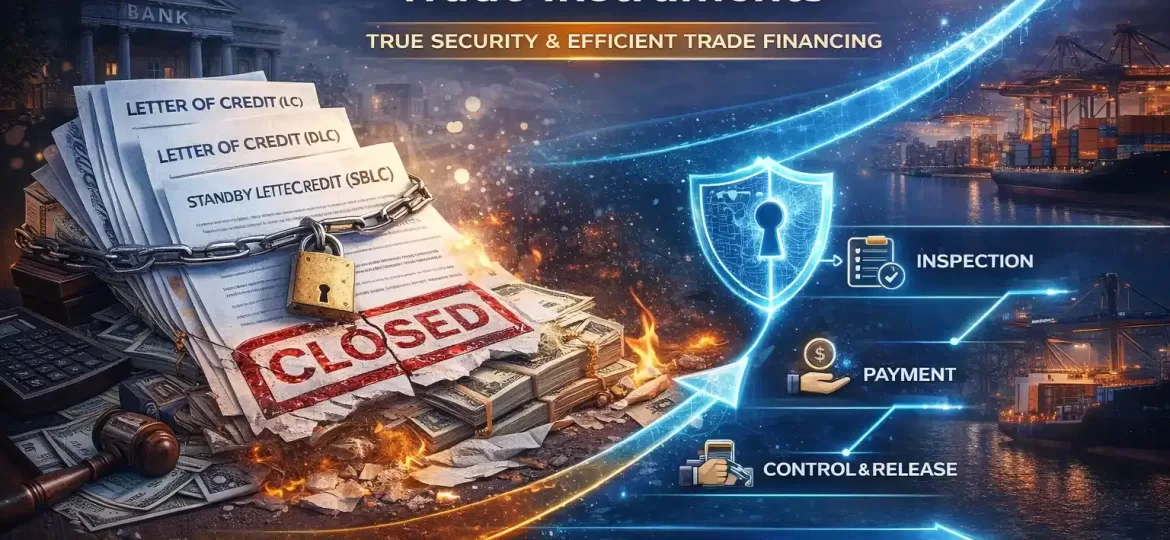
International trade has long relied on bank instruments such as LC (Letter of Credit), DLC (Documentary Letter of Credit) and SBLC (Standby Letter of Credit). While these tools are often presented as secure solutions, in practice they have become slow, costly, complex and increasingly risky.
In today’s global markets, speed, transparency and physical control of goods are far more valuable than paperwork-driven banking mechanisms. This article explains why traditional bank instruments are losing relevance and why prepayment-based, product-controlled trade models are emerging as a safer and more realistic alternative.
LC, DLC and SBLC: Complex Structures with Hidden Risks
Although LC, DLC and SBLC appear secure in theory, real-life execution reveals serious structural weaknesses:
- Lengthy procedures: Bank correspondence, confirmations and amendments can take weeks or even months.
- Different bank conditions: Each bank applies its own rules, interpretations and risk appetite.
- Document dependency: Minor clerical or formatting errors may block or delay payment.
- Payment delays: Even compliant documents do not guarantee timely settlement.
- High costs: Opening, confirmation, amendment and commission fees significantly reduce profitability.
Instead of facilitating trade, these instruments often slow it down and create uncertainty.
Even Corporate Companies Face Serious Problems
Contrary to popular belief, LC, DLC and SBLC are not risk-free even for large multinational corporations. Common issues include:
- Bank interpretation conflicts
- Confirmation and compliance disputes
- Document discrepancies
- Blocked or postponed payments
- Extended cash cycle periods
Moreover, these instruments are highly exposed to fraud. Practices such as:
- Discounting or breaking LCs
- Monetizing SBLCs
- Using DLCs as unsecured financing tools
create serious financial and legal risks for both buyers and sellers.
Weak Interbank Coordination
One of the biggest structural flaws of bank instruments is poor interbank coordination:
- Banks within the same country may apply different procedures.
- Communication gaps between issuing, confirming and correspondent banks are common.
- During financial stress, banks may unilaterally suspend or delay transactions.
This effectively places commercial trade under banking discretion, which contradicts the fundamentals of real commerce.
A More Realistic and Secure Alternative: Inspect, Test, Pay
Modern commodity trade increasingly favors a straightforward and transparent model:
Prepayment + Physical Inspection + Testing + Warehouse / Port Delivery
Under this model:
- The product is physically available at port or warehouse.
- Independent inspection and testing (SGS, Intertek, etc.) is performed.
- Product quality and quantity are verified.
- Payment is made.
- Buyer takes control of the goods and arranges logistics.
This approach minimizes risk, removes unnecessary banking layers and prioritizes real goods over documents.
Comparison of Trade and Payment Methods
| Instrument | What It Is | How It Works | Purpose | Key Challenges |
|---|---|---|---|---|
| LC (Letter of Credit) | A bank’s conditional payment guarantee | Payment is released once documents strictly comply | Reduce counterparty risk | Slow process, document errors, high costs, payment delays |
| DLC (Documentary LC) | LC based entirely on document compliance | Banks check documents, not goods | Control shipment conditions | Document dependency, disputes, bank interpretation risks |
| SBLC (Standby LC) | A secondary payment guarantee | Activated only upon default | Credit support instrument | Fraud risk, monetization abuse, legal complexity |
| Prepayment | Direct payment for goods | Payment after inspection and testing | Fast, transparent trade | Requires product availability and trust |
Why Prepayment-Based Trade Is More Effective
- Goods are real and physically verifiable.
- Quality is confirmed through independent inspection.
- Payment directly corresponds to actual product delivery.
- Fraud and manipulation risks are significantly reduced.
- Trade execution is faster and clearer.
This model is especially effective in commodities, steel, chemicals, energy and agricultural products.
Conclusion: From Paper-Based to Product-Based Trade
LC, DLC and SBLC instruments no longer align with the realities of modern global trade. Despite their theoretical security, they are:
- Slow
- Costly
- Bureaucratic
- Vulnerable to abuse
The future of international trade lies in transparent, fast and product-focused payment models.
Inspect the goods. Test the quality. Pay. Take delivery.
Simple, realistic and secure.
