

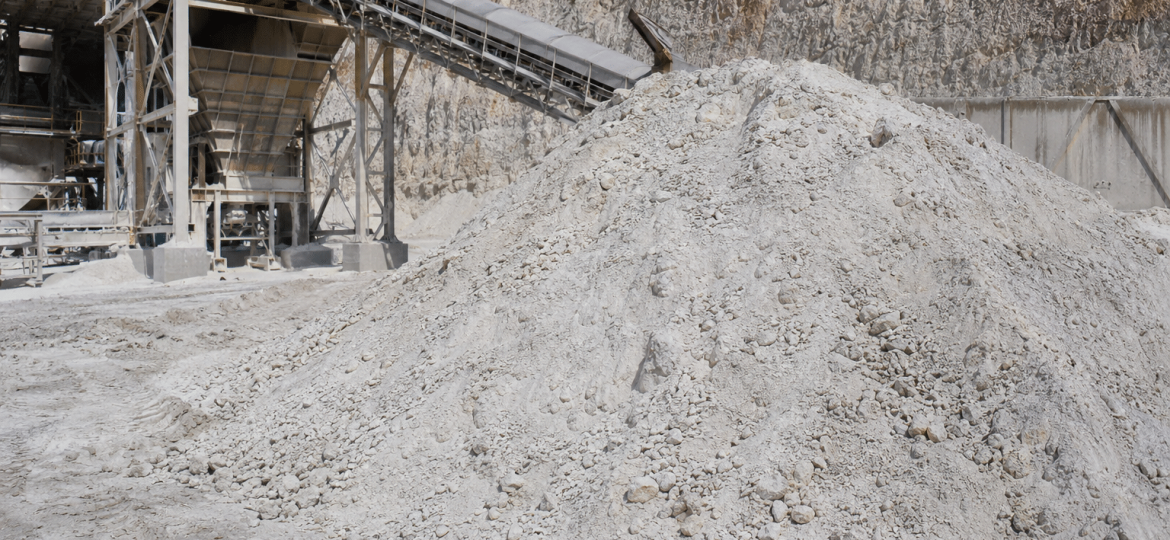
Bentonite export from Türkiye plays a key role in the global supply of raw materials for drilling, steel, foundry and building projects. Moreover, Türkiye has rich clay deposits that support the supply of many bentonite grades.
Because bentonite can absorb water and swell, many industries use it as a binder and sealant. For example, oilfield teams use sodium bentonite to prepare water-based drilling mud.
Furthermore, foundries use this clay to bind sand. Meanwhile, steel plants use selected grades to make iron ore pellets.
However, natural clay deposits differ in mineral content and swelling power. Therefore, buyers should check the product grade before placing an order.
Türkiye has a strong mining sector, mineral plants and major ports. Consequently, the country offers good access to global bentonite markets.
ATABAŞ GLOBAL brings together mineral supply, global trade and freight services. As a result, we develop supply plans based on the needs of each buyer.
1. What Is Bentonite?
Bentonite is a natural clay that mainly contains smectite minerals, such as montmorillonite.
In most cases, this clay forms when volcanic ash changes over time. Moreover, its layered structure allows water and ions to enter between the mineral sheets.
As a result, suitable grades can absorb water, swell and form thick fluids.
However, these traits depend on the type of clay and its mineral content.
General Product Information
| Product Information | Description |
|---|---|
| Commercial Name | Bentonite |
| Mineral Family | Smectite Clay |
| Main Mineral | Montmorillonite |
| CAS Number | 1302-78-9 |
| EC Number | 215-108-5 |
| HS Code | 250810 |
| Chemical Composition | Hydrated aluminium silicate with variable mineral content |
| Colour | White, cream, grey, beige or brown |
| Physical Form | Powder, grains or lumps |
| Water Behaviour | Water uptake and swelling |
| Main Grades | Sodium and Calcium Bentonite |
| Other Grades | Activated and White Bentonite |
| Main Uses | Drilling, foundry, steel and building |
| Drilling Standard | API Specification 13A |
| Common Packing | 25 kg bags and Big Bags |
Unlike pure chemicals, bentonite does not have one fixed chemical formula.
Therefore, its exact makeup depends on the mine and the treatment method.
Bentonite and Montmorillonite
Montmorillonite is a clay mineral, whereas bentonite is a natural clay that mainly contains smectite.
Furthermore, bentonite may contain quartz, feldspar, calcite and other minerals.
Because these minerals affect product quality, labs use tests to check their content.
However, high clay purity alone does not guarantee good results in every use.
Therefore, buyers should also check swelling, flow and bonding strength.
2. Bentonite Export from Türkiye
Türkiye holds a strong place in global bentonite trade.
According to the US Geological Survey (USGS), Türkiye ranked third among world bentonite producers in 2024. Moreover, the country made up about 13% of global output.
Its large clay deposits serve drilling, foundry and other industrial needs.
Consequently, bentonite export forms a key part of Türkiye’s mineral trade.
Turkish Bentonite Production Statistics
| Year | Production Volume (MT) |
|---|---|
| 2020 | 1,658,837 |
| 2021 | 2,020,356 |
| 2022 | 2,018,993 |
| 2023 | 2,494,366 |
| 2024 | 2,528,368 |
Source: USGS – Mineral Industry of Türkiye.
Türkiye’s bentonite output grew between 2020 and 2024.
Furthermore, the country produced more than 2.5 million metric tons in 2024.
However, these figures include all bentonite grades.
Therefore, they do not show the exact amount of drilling-grade clay on the market.
Major Bentonite Deposits in Türkiye
Türkiye has rich bentonite deposits in several parts of the country.
For example, the Black Sea region and Central Anatolia contain major clay resources.
| Region | Main Commercial Uses |
|---|---|
| Tokat – Reşadiye | Drilling and iron ore pellets |
| Çankırı | Foundry and drilling |
| Ankara – Kalecik | Foundry and drilling |
| Ordu – Ünye and Fatsa | Calcium clay and absorbents |
| Edirne – Enez | Bleaching earth |
| Çorum | Foundry grades |
| Balıkesir | Bleaching and other uses |
| Kütahya | Industrial clay |
| Manisa | Clay products |
| Konya | Bentonite resources |
Source: İstanbul Mineral Exporters’ Association – Bentonite.
Tokat-Reşadiye has clay deposits that can serve drilling and steel plants.
Meanwhile, Ordu has rich calcium bentonite resources.
However, each mine may yield clay with different traits.
Therefore, buyers should check the source and test data for each grade.
Advantages of Turkish Bentonite Export
Türkiye has strong trade links with Europe, Asia, Africa and the Middle East.
Moreover, local mineral plants offer several forms of bentonite.
For example, buyers can request fine powder, grains or natural clay lumps.
Furthermore, they can arrange trial orders or large monthly shipments.
However, stock and freight costs may change over time.
Therefore, ATABAŞ GLOBAL checks supply and freight options before making an offer.
3. Global Bentonite Export Market and Trade Statistics
Bentonite serves a wide range of industries around the world.
For example, drilling, steel and foundry plants use large amounts of clay.
Furthermore, building and absorbent products support global demand.
The international HS code 250810 covers bentonite.
However, this code does not list each product grade on its own.
Global Bentonite Export Statistics – 2025
| Country | Export Volume (MT) | Export Value (USD) |
|---|---|---|
| United States | 564,863 | 175,932,220 |
| Türkiye | Not reliably reported | 153,296,440 |
| Netherlands | 233,416 | 104,567,170 |
| India | 1,660,130 | 97,479,190 |
| China | 269,400 | 45,022,220 |
| Spain | 81,721 | 31,786,980 |
| Czech Republic | 116,937 | 28,547,150 |
Source: World Bank WITS – Global Bentonite Exports 2025.
The United States leads the reported country rankings by export value.
Meanwhile, Türkiye holds second place.
Furthermore, the Netherlands and India play key roles in global trade.
However, the European Union also reports joint trade totals.
Therefore, this table leaves out the EU total to avoid counting the same trade twice.
Understanding Global Bentonite Export Data
Trade records show the value and weight of goods that cross borders.
However, clay grades and sale terms may differ between orders.
For example, treated clay may have a higher value per ton than raw clay.
Moreover, some countries export goods that they first bought from abroad.
Therefore, export rankings do not always match mine output rankings.
Türkiye’s 2025 record shows a zero total weight despite a high export value.
Consequently, the table does not use zero as the true shipment weight.
4. Global Bentonite Import Markets
Many industries rely on bentonite for their daily work.
For example, foundries use clay to bind sand, while oilfield teams use it in drilling mud.
Furthermore, absorbent products and building projects create demand.
Therefore, global bentonite trade serves several distinct markets.
Global Bentonite Import Statistics – 2025
| Country | Import Volume (MT) | Import Value (USD) |
|---|---|---|
| Germany | 425,889 | 129,607,770 |
| Netherlands | 372,432 | 90,676,870 |
| Canada | 288,567 | 59,609,920 |
| Poland | 440,537 | 50,757,640 |
| France | Not reported | 43,408,400 |
| Italy | 231,550 | 36,533,560 |
| Japan | 106,150 | 36,447,280 |
| Indonesia | 446,201 | 34,907,140 |
| Colombia | 107,828 | 34,682,240 |
| China | 201,323 | 33,151,890 |
| Chile | 103,715 | 31,707,340 |
| Belgium | 81,798 | 31,602,260 |
| United Kingdom | Not reported | 29,035,820 |
| India | 143,574 | 28,648,240 |
| Saudi Arabia | Not reported | 27,241,960 |
Source: World Bank WITS – Global Bentonite Imports 2025.
Germany leads the reported country rankings by import value.
Meanwhile, the Netherlands, Canada and Poland also import large amounts of clay.
However, these figures include several product grades.
Therefore, they do not show drilling bentonite demand alone.
European Bentonite Markets
Europe has strong steel, foundry and building sectors.
For example, Germany and Italy use clay in many factory processes.
Meanwhile, the Netherlands acts as a major mineral trade hub.
Furthermore, absorbent goods and waste control projects support demand.
However, buyers may need strict quality and safety records.
Therefore, bentonite export to Europe requires clear product data.
Middle Eastern Bentonite Markets
Oil and gas projects create strong demand for drilling fluids in the Middle East.
For example, Saudi Arabia, Oman, Kuwait, Qatar and the United Arab Emirates have large oilfield supply networks.
Moreover, building firms use bentonite for deep foundation work.
However, drilling and building grades have different needs.
Consequently, suppliers should check the final use before making an offer.
Asian, African and American Markets
Steel plants in Asia use bentonite to bind iron ore.
Meanwhile, oilfield and building projects support clay demand in parts of Africa.
Furthermore, markets across North and South America use bentonite for drilling, steel and waste control.
However, long freight routes may raise costs.
Therefore, buyers should choose suitable cargo sizes and shipping terms.
5. Türkiye Bentonite Export Statistics and Customs Regulations
Türkiye has strong trade links with many global mineral markets.
Moreover, its export data shows a steady demand for Turkish clay products.
However, mine output and trade volume are different measures.
Türkiye Bentonite Trade – 2024 and 2025
| Trade Indicator | 2024 | 2025 |
|---|---|---|
| Export Value | USD 149,399,680 | USD 153,296,440 |
| Export Volume | 1,076,990 MT | Not reliably reported |
| Import Value | USD 2,061,760 | Not verified |
| Import Volume | 3,043.93 MT | Not verified |
| HS Code | 250810 | 250810 |
Sources: Türkiye Bentonite Exports 2024, Türkiye Bentonite Imports 2024 and Türkiye Bentonite Exports 2025.
Türkiye exported more than one million tons of bentonite in 2024.
Moreover, its export value rose in 2025.
However, missing weight data prevents a full review of annual shipment growth.
Leading Bentonite Export Destinations from Türkiye – 2025
| Destination | Export Value (USD) |
|---|---|
| Netherlands | 29,936,850 |
| Germany | 13,740,740 |
| Italy | 11,937,930 |
| Spain | 10,320,440 |
| Algeria | 8,674,420 |
| India | 6,947,840 |
| France | 6,008,160 |
| Austria | 5,793,050 |
| Brazil | 5,405,900 |
| Poland | 4,573,650 |
| South Africa | 4,381,770 |
| Saudi Arabia | 4,029,830 |
| Portugal | 3,578,320 |
| Egypt | 3,250,650 |
| United Kingdom | 2,809,970 |
Source: World Bank WITS – Türkiye Bentonite Export Destinations 2025.
The Netherlands ranks first among Turkish bentonite export markets by value.
Meanwhile, Germany, Italy and Spain also hold strong positions.
Furthermore, Türkiye ships clay to markets in Africa, Asia and South America.
However, trade records do not show the final use of each cargo.
Bentonite Export HS Code and GTIP
Natural bentonite generally falls under HS 250810.
However, chemical treatment may change the correct customs code.
| Product | Possible HS Code |
|---|---|
| Natural Bentonite | 250810 |
| Kaolin | 250700 |
| Other Natural Clays | 250840 |
| Certain Activated Natural Mineral Products | 380290 |
| Clay Blends | Depends on product content |
Moreover, Türkiye uses additional digits within its GTIP system.
Therefore, suppliers should check the full customs code before shipment.
Bentonite Export Quotas and Trade Rules
Trade figures do not represent legal export quotas.
Furthermore, each country may apply its own import duties and product rules.
However, this article has not confirmed a specific general bentonite export quota.
Therefore, buyers should check current trade rules for their chosen grade and market.
Official sources include the Republic of Türkiye Ministry of Trade and the WTO Quantitative Restrictions Database.
6. Bentonite Export Grades and Commercial Types
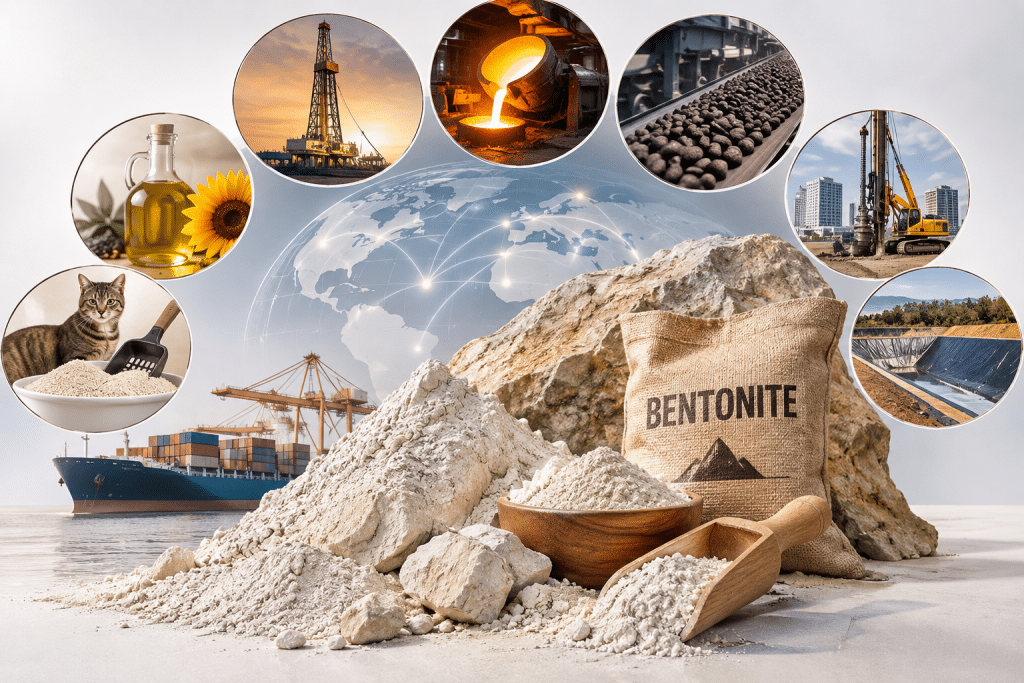
Natural bentonite comes in several grades.
For example, sodium bentonite often has a high swell rate.
In contrast, calcium bentonite generally swells less but can absorb water.
Moreover, producers can treat natural clay to improve certain traits.
Therefore, each grade serves different industrial needs.
Sodium Bentonite Export
Sodium bentonite contains sodium as a main exchangeable ion.
Because water can enter between its mineral layers, the clay can swell.
Furthermore, suitable grades can form thick fluids when mixed with water.
For example, drilling teams use sodium bentonite in water-based mud.
Moreover, sealing systems and steel plants use selected grades.
However, salt and mineral content can affect its performance.
Therefore, buyers should check actual test results.
Calcium Bentonite Export
Calcium bentonite contains calcium as a main exchangeable ion.
Unlike most sodium grades, it often has a lower swell rate.
However, calcium clay can absorb water and bind certain substances to its surface.
For example, some grades serve cat litter and oil treatment products.
Furthermore, producers can use calcium clay to make activated bentonite.
Consequently, it has several industrial uses.
Sodium-Activated Bentonite
Producers can treat suitable calcium clay with soda ash.
As a result, the clay may swell more and form stronger bonds.
Moreover, this method can help create grades for foundries and other plants.
However, treated clay may not behave in the same way as natural sodium bentonite.
Therefore, buyers should compare actual test data.
Further reading: Alkali Activation of Natural Calcium Bentonite for Foundry Applications.
Acid-Activated Bentonite and Bleaching Earth
Acid treatment changes the surface of suitable clay.
Consequently, the treated clay may bind certain unwanted compounds from oils.
For example, oil plants use selected bleaching earth grades to remove colour.
However, acid treatment differs from soda ash treatment.
Furthermore, each method creates a product with distinct traits.
Therefore, buyers should confirm the grade and safety needs before purchase.
White Bentonite Export
White bentonite refers to light-coloured clay.
For example, certain Turkish deposits yield white and cream clay.
Furthermore, these grades can serve paper, ceramics, detergents and absorbent goods.
However, colour alone does not prove high purity.
Consequently, buyers should check whiteness, iron content and other test results.
Organophilic Bentonite
Producers can treat bentonite with organic compounds.
As a result, some grades can work in oil-based systems.
For example, these clays can help control flow in paints and greases.
Furthermore, selected grades serve oil-based drilling fluids.
However, ordinary sodium bentonite does not behave in the same way.
Therefore, buyers should check which liquids suit the treated clay.
Commercial Bentonite Grade Comparison
| Commercial Grade | Main Property | Typical Use |
|---|---|---|
| Sodium Bentonite | High swelling | Drilling and sealing |
| Calcium Bentonite | Water uptake and surface binding | Absorbents |
| Sodium-Activated Bentonite | Better swelling | Foundry |
| Acid-Activated Bentonite | Surface binding | Oil treatment |
| White Bentonite | Light colour | Paper and other goods |
| Organophilic Bentonite | Oil-based use | Coatings and drilling |
| API Bentonite | Defined drilling grade | Oil and gas |
| OCMA Bentonite | Defined mud tests | Drilling |
| Foundry Bentonite | Sand bonding | Metal casting |
| Pelletizing Bentonite | Ore bonding | Iron ore pellets |
| Civil Engineering Bentonite | Swelling and sealing | Building projects |
| Granular Bentonite | Water uptake | Cat litter |
However, some of these grade groups may overlap.
Therefore, one clay source can serve several markets after suitable treatment.
7. Bentonite Chemical Properties and Production Process
Bentonite has a layered clay structure.
Moreover, its mineral sheets can take up water and exchange ions.
Because these traits affect its use, buyers should check both the chemical and physical data.
Bentonite Mineral and Chemical Composition
Montmorillonite belongs to the layered silicate mineral group.
Furthermore, its structure contains silica and aluminium-rich sheets.
Other elements may include iron, magnesium, calcium and sodium.
| Chemical Component | Indicative Range |
|---|---|
| Silicon Dioxide (SiO₂) | 50–70% |
| Aluminium Oxide (Al₂O₃) | 10–25% |
| Iron Oxide (Fe₂O₃) | 0.5–8% |
| Magnesium Oxide (MgO) | 1–6% |
| Calcium Oxide (CaO) | 0.5–8% |
| Sodium Oxide (Na₂O) | 0.2–4% |
| Potassium Oxide (K₂O) | 0.1–3% |
| Loss on Ignition | Grade-specific |
However, these ranges provide a broad guide rather than fixed product limits.
Moreover, total sodium and calcium oxide levels do not show the full ion balance.
Therefore, buyers should request actual mineral and chemical test data.
Swelling Capacity and Water Uptake
Water can enter between suitable clay layers.
As a result, the clay may grow in size.
Furthermore, sodium-rich grades often swell more than calcium-rich grades.
For example, this trait helps bentonite seal gaps in suitable barrier systems.
However, salts in water may reduce the swelling rate.
Therefore, labs should use defined water and test methods.
Cation Exchange Capacity
Cation exchange capacity (CEC) measures the ability of clay to exchange positive ions.
Moreover, this property helps assess the active clay content.
For example, it can help buyers select clay for absorbent goods and waste control.
However, test methods may give different results.
Consequently, buyers should confirm the units and method before comparing grades.
Bentonite Mining and Processing
First, mining teams remove clay from suitable deposits.
Next, workers sort the raw clay and remove unwanted material.
Afterwards, plants dry and grind the clay to reach the target grain size.
Furthermore, some grades require soda ash, acid or other forms of treatment.
Finally, plants test and pack the finished product.
However, the exact steps depend on the clay source and final grade.
Grinding and Grain Size Control
Many drilling and foundry grades use fine powder.
In contrast, absorbent goods often use larger grains.
Moreover, grain size affects dust, flow and mixing.
Therefore, plants use suitable mills and screens to reach the target size.
8. API and OCMA Standards for Drilling Bentonite Export
Drilling bentonite must meet clear flow and fluid-loss limits.
Furthermore, API Specification 13A defines test needs for several drilling materials.
However, field results may differ from lab results.
Therefore, buyers should check both standard tests and actual well needs.
API 13A Bentonite Technical Specifications
| Test Parameter | API Bentonite Reference |
|---|---|
| Viscometer Reading at 600 rpm | Minimum 30 |
| Yield Point / Plastic Viscosity Ratio | Maximum 3 |
| Filtrate Volume | Maximum 15 mL |
| Residue Above 75 µm | Maximum 4.0% |
These figures provide reference limits for standard API bentonite.
However, labs must follow the correct test method.
Furthermore, API 13A covers more than one clay grade.
Therefore, buyers should confirm the required standard edition.
OCMA Bentonite Technical Specifications
| Test Parameter | OCMA Reference |
|---|---|
| Viscometer Reading at 600 rpm | Minimum 30 |
| Yield Point / Plastic Viscosity Ratio | Maximum 6 |
| Filtrate Volume | Maximum 16 mL |
| Residue Above 75 µm | Maximum 2.5% |
Source: API and OCMA Bentonite Specifications.
Although both grades serve drilling fluids, their test limits differ.
For example, OCMA allows a different yield point to plastic viscosity ratio.
Therefore, buyers should not treat the two grades as equal.
Plastic Viscosity and Yield Point
Labs use rotational viscometers to check mud flow.
For example, readings at 600 and 300 rpm help determine plastic viscosity.
Plastic Viscosity (PV) = R600 − R300
Yield Point (YP) = R300 − PV
Moreover, the YP/PV ratio helps describe mud flow.
However, the values depend on the test method.
Consequently, buyers should compare results under the same test conditions.
Fluid Loss and Coarse Grain Tests
Fluid-loss tests measure how much liquid passes through a filter.
Furthermore, suitable bentonite helps form a filter cake.
As a result, the cake can limit fluid loss.
Meanwhile, wet sieve tests measure coarse grains above a set size.
However, these grains may contain minerals other than sand.
Therefore, coarse grain content and sand content are not always the same.
API Compliance and Manufacturer Licensing
A bentonite grade may meet API 13A test limits without carrying an API Monogram.
Moreover, a general quality record does not prove that a plant holds an API licence.
Therefore, buyers should check the licence when their contract calls for one.
In addition, batch test results should support the agreed product limits.
Further details are available from the American Petroleum Institute.
9. Industrial Applications of Bentonite
Bentonite serves many industries due to its swelling and bonding power.
Furthermore, certain grades can absorb water or bind compounds to their surface.
However, each use calls for a suitable grade.
Therefore, buyers should check the needs of their own process.
Oil and Natural Gas Drilling
Oilfield teams use suitable sodium bentonite to build thick drilling fluids.
Moreover, these fluids help carry rock cuttings out of the well.
Furthermore, the clay helps form a filter cake along the well wall.
However, salt and heat can affect the clay.
Therefore, drilling teams may also use other mud additives.
Foundry and Metal Casting
Foundries use bentonite to bind sand in moulds.
Because wet clay helps hold sand grains together, it supports mould strength.
Furthermore, suitable grades help moulds keep their shape.
However, too much clay or water may affect the final casting.
Therefore, foundries should check bonding strength and active clay content.
Iron Ore Pellet Production
Steel plants use bentonite to bind fine iron ore.
For example, the clay helps form green pellets before firing.
Moreover, it supports pellet strength during handling and drying.
However, bentonite also adds minerals to the ore.
Consequently, plants should balance pellet strength with iron content and purity.
Civil Engineering and Foundation Work
Building firms use bentonite fluids during certain deep foundation tasks.
For example, the clay can help support the walls of deep soil cuts.
Furthermore, it can serve bored piles and diaphragm walls.
However, soil type and groundwater may affect the results.
Therefore, teams should check the slurry needs of each project.
Horizontal Directional Drilling
Horizontal directional drilling (HDD) often uses bentonite mud.
Moreover, the fluid helps carry soil and rock out of the borehole.
Furthermore, it can help support the borehole walls.
However, some soil types may need extra polymers.
Therefore, operators should choose clay that suits the full mud system.
Geosynthetic Clay Liners and Environmental Sealing
Sodium bentonite can form part of geosynthetic clay liners (GCLs).
Because the clay swells when wet, it can help limit water flow.
For example, these liners can serve landfill sites and waste storage areas.
However, chemicals and physical stress may affect the barrier.
Therefore, teams should check water flow through the liner under actual project conditions.
Cat Litter and Absorbent Products
Bentonite is a key raw material for mineral cat litter.
For example, suitable sodium grades can form clumps when wet.
Meanwhile, calcium grades may offer good water uptake.
Moreover, grain size and dust levels affect the final product.
Therefore, buyers should check clump strength and water uptake.
Oil Refining and Bleaching Earth
Oil plants use suitable treated clay to remove unwanted colour and other compounds.
Furthermore, acid-treated clay can bind certain substances to its surface.
For example, approved bleaching earth can serve plant oil refining.
However, raw clay does not always meet food safety rules.
Therefore, buyers should request approved grades and suitable test records.
Animal Feed Applications
Some approved bentonite grades can serve animal feed.
For example, certain products act as binders under local rules.
However, ordinary industrial clay does not meet all feed safety needs.
Moreover, toxin control claims require proof and legal approval.
Therefore, buyers should check the allowed use of each grade.
Agriculture and Soil Management
Selected grades may help soil hold water.
Furthermore, bentonite can act as a carrier in certain farm products.
However, the results depend on soil type and clay quality.
Consequently, users should choose a grade that suits their actual needs.
Paints, Coatings and Lubricants
Some bentonite grades help control the flow of paints.
Meanwhile, organophilic clay can help thicken greases and other oil-based goods.
However, raw sodium bentonite may not work well in oil.
Therefore, plants should select a grade that suits their liquid mix.
Paper, Ceramics and Detergents
Selected clay grades serve paper, ceramics and detergents.
For example, producers may use them to bind solids or control flow.
Furthermore, white clay can help when product colour matters.
However, iron and other minerals may affect the final goods.
Therefore, plants should check purity, grain size and colour.
Water Treatment and Waste Control
Bentonite can bind certain unwanted compounds from water.
Moreover, treated grades may offer useful surface properties.
However, results depend on water quality and the type of waste.
Furthermore, raw clay does not always meet drinking water rules.
Therefore, buyers should request suitable test data and product approval.
10. Bentonite Export Quality Control and Laboratory Testing
Steady clay quality helps plants maintain stable output.
Moreover, changes in moisture and grain size can affect product use.
Therefore, suppliers should check each batch before shipment.
Mineral Content and Purity Tests
Labs use X-ray diffraction (XRD) to identify minerals.
Meanwhile, X-ray fluorescence (XRF) helps measure chemical content.
However, chemical data alone cannot show the full active clay content.
Consequently, buyers may need both test methods.
Bentonite Physical and Performance Tests
| Quality Parameter | Main Purpose |
|---|---|
| Moisture Content | Water content |
| Particle Size | Grain size |
| Swelling Index | Swell rate |
| Cation Exchange Capacity | Ion exchange |
| Methylene Blue Test | Active clay content |
| pH | Acid or base level |
| Bulk Density | Weight per unit volume |
| Water Absorption | Water uptake |
| Viscosity | Mud flow |
| Filtrate Volume | Fluid loss |
| Green Compression Strength | Sand bonding |
| Hydraulic Conductivity | Water flow through clay |
| Whiteness | Product colour |
However, not all grades need every test.
Therefore, buyers should select methods that suit their final use.
International Bentonite Testing Standards
API Specification 13A covers drilling fluid materials.
Meanwhile, ASTM D5890 provides a test method for the swell index of clay used in geosynthetic clay liners.
Furthermore, ASTM D5891 covers fluid-loss tests for these clay materials.
However, building tests do not replace oilfield tests.
Therefore, the purchase terms should state the correct test method and limits.
Further details are available from ASTM International.
Pre-Shipment Bentonite Quality Checks
First, suppliers should check the grade and batch number.
Next, labs can test moisture, grain size and mineral content.
Furthermore, drilling buyers may need mud flow and fluid-loss results.
Meanwhile, foundries may need sand bonding tests.
However, a general Technical Data Sheet (TDS) cannot replace batch results.
Therefore, suppliers should provide a Certificate of Analysis (COA).
In addition, buyers can request third-party quality and weight checks.
11. Bulk Bentonite Export Packaging, Storage and Logistics
Good packing helps protect clay during storage and freight.
Because bentonite takes up water, dry storage is important.
Moreover, each cargo type has its own handling needs.
Bentonite Export Packaging Options
| Packaging Type | Common Net Weight |
|---|---|
| Small Bag | 25 kg |
| Large Sack | 50 kg |
| Big Bag | 500 kg |
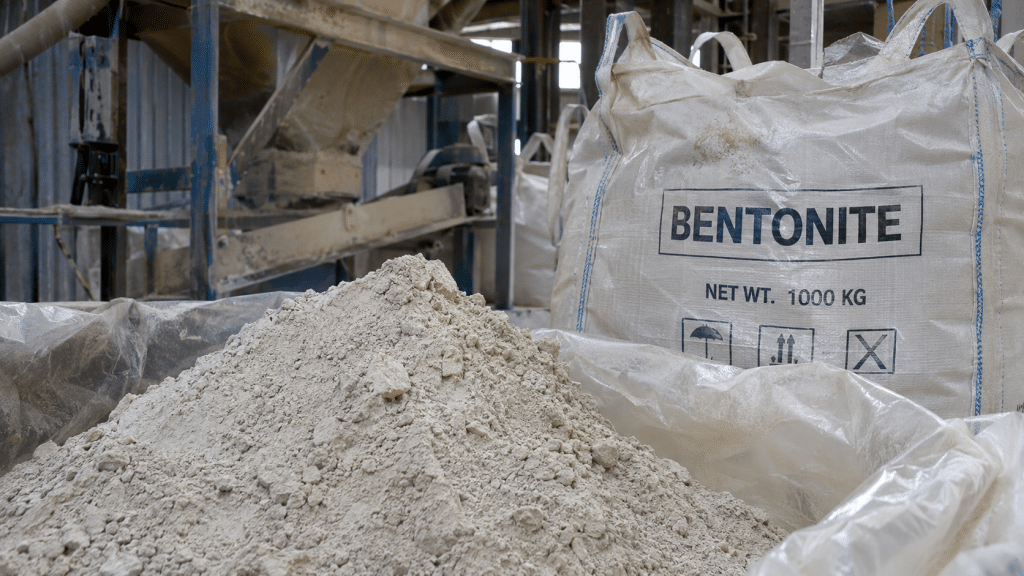
| Jumbo Bag | 1,000 kg |
| Large FIBC | 1,250–1,500 kg, if available |
| Loose Bulk | Based on cargo size |
Small bags may suit plants that use clay in small amounts.
Meanwhile, Big Bags can make bulk handling easier.
Furthermore, loose bulk cargo may suit large plants with the right storage and loading tools.
However, available packing depends on the grade and supplier.
Therefore, buyers should confirm packing before placing an order.
Bentonite Storage and Safe Handling
Warehouses should keep packed bentonite in dry areas.
Moreover, workers should protect bags from water and damage.
Because fine clay dust can harm the lungs, proper dust control is important.
Furthermore, some grades may contain crystalline silica.
Therefore, workers should follow the current Safety Data Sheet (SDS) and local safety rules.
Further details are available from OSHA – Crystalline Silica.
Container and Bulk Vessel Transport
Packed bentonite can travel in dry freight containers.
For example, 20-foot containers often suit heavy clay cargo.
However, bag size, pallets and weight limits affect loading.
Furthermore, large buyers may request loose bulk vessel shipments.
Therefore, suppliers should plan the cargo according to port and plant needs.
Turkish Ports and Bentonite Export Logistics
ATABAŞ GLOBAL reviews freight routes through Mersin, İzmir, Gebze, İstanbul and other suitable Turkish port regions.
Moreover, Black Sea ports may suit certain clay mines.
For container shipments, we work with major shipping firms such as CMA CGM, Maersk, MSC and Hapag-Lloyd.
However, the best route depends on the mine, cargo size and delivery point.
Therefore, we review road and sea freight costs together.
12. International Bentonite Export and Supply with ATABAŞ GLOBAL
A reliable clay supply needs steady quality, fair trade terms and timely freight.
Moreover, each industry has different grade needs.
Therefore, ATABAŞ GLOBAL reviews orders based on the buyer’s final use.
We assess requests for sodium, calcium, activated, drilling and foundry bentonite grades.
International Delivery Terms
Buyers can request several Incoterms based on their freight needs.
For example, EXW allows buyers to collect goods at the agreed place.
Under FCA terms, however, the seller hands the goods to the chosen carrier at the named place.
FOB requires the seller to place the cargo on board the ship.
Similarly, CFR requires the seller to arrange and pay for sea freight to the named port.
Under CIF terms, the seller also arranges the required cargo insurance.
Nevertheless, risk passes to the buyer once the goods are on board at the loading port.
Furthermore, FCA, CPT and CIP may better suit container cargo.
Therefore, both parties should agree on the named place and delivery terms.
Further details are available from the International Chamber of Commerce.
Bentonite Export Documents
A Technical Data Sheet provides general product limits.
Meanwhile, a Certificate of Analysis shows actual batch test results.
The Safety Data Sheet also explains product risks and safe handling.
Furthermore, trade shipments may need the following records:
- Proforma Invoice
- Commercial Invoice
- Packing List
- Certificate of Origin
- Bill of Lading
- Customs Export Declaration
- Inspection Certificate, if required
- Insurance Certificate, where needed
In addition, buyers may request mineral tests and API records.
However, document needs differ by grade and market.
Therefore, both parties should agree on the required records before shipment.
Origin Records and Trade Rules
The country of shipment may differ from the country of origin.
Therefore, buyers should check the actual source of the goods.
Moreover, an A.TR movement certificate shows the free circulation of eligible goods rather than their origin.
Furthermore, some markets may require other origin records.
ATABAŞ GLOBAL reviews product origin, trade rules and sanctions before confirming orders.
Consequently, each shipment must meet the relevant trade rules.
Long-Term Bentonite Export and Bulk Supply
Regular shipments help plants maintain their clay stocks.
For example, foundries and steel plants may need monthly deliveries.
Similarly, oilfield firms may require regular supplies during a drilling project.
However, mine output and freight costs can change.
Therefore, early orders can help improve supply plans.
Furthermore, clear quality limits help maintain steady product grades.
How to Request a Bentonite Export Quotation
First, buyers should state the required clay grade.
Next, they should confirm the final use and target quality.
Furthermore, details about swelling, moisture and grain size help define the product.
For example, oilfield buyers may request API or OCMA grades.
Meanwhile, foundries may require sand bonding tests.
In addition, buyers should provide the total order size and monthly needs.
Finally, packing, delivery place, trade terms and shipment dates help us prepare an offer.
For bentonite export from Türkiye, drilling clay, industrial mineral supply and global freight services, contact ATABAŞ GLOBAL.
13. Frequently Asked Questions About Bentonite Export
Bentonite Properties and Commercial Grades
What is bentonite?
Bentonite is a natural clay that mainly contains smectite minerals. Moreover, it can absorb water and swell.
What is the CAS number of bentonite?
The common CAS number for bentonite is 1302-78-9.
What is the main mineral in bentonite?
Montmorillonite is often the main mineral. However, bentonite may contain other minerals.
What is the difference between sodium and calcium bentonite?
Sodium clay often swells more. In contrast, calcium clay can offer good water uptake with less swelling.
What is sodium-activated bentonite?
It is calcium-rich clay that producers treat to improve its sodium-type traits.
Bentonite Export Markets and Customs Rules
Which country leads global bentonite exports?
The United States leads the reported 2025 rankings by value. Meanwhile, Türkiye ranks second.
How much bentonite does Türkiye export?
Türkiye exported about 1.077 million tons in 2024. Furthermore, its export value reached about USD 153.30 million in 2025.
Where does Türkiye produce bentonite?
Major deposits occur in Tokat, Çankırı, Ankara, Ordu, Edirne and other regions.
What is the HS code for bentonite?
Natural bentonite generally falls under HS 250810. However, treated clay may require another code.
Does Türkiye have bentonite export quotas?
This article has not confirmed a general export quota. Nevertheless, buyers should check current trade rules.
API Bentonite and Industrial Uses
What is API bentonite?
API bentonite is a clay grade that meets the relevant API 13A drilling material limits.
What is the difference between API and OCMA bentonite?
Both grades serve drilling fluids. However, their flow and fluid-loss limits differ.
Which grade serves oilfield drilling?
Suitable sodium bentonite and selected treated grades commonly serve water-based drilling mud.
Can bentonite serve iron ore pellet production?
Yes. Suitable clay grades help bind fine iron ore into pellets.
Why do foundries use bentonite?
Foundries use it to bind sand. Moreover, it helps moulds retain their shape.
Can bentonite serve building projects?
Yes. For example, selected grades serve deep foundation work and sealing systems.
Specialty Bentonite and Quality
What is white bentonite?
White bentonite is a light-coloured clay. Furthermore, selected grades serve paper and other colour-sensitive goods.
What is acid-activated bentonite?
It is clay that producers treat with acid. As a result, its surface properties may suit oil treatment.
What is organophilic bentonite?
It is treated clay that can work in selected oil-based systems.
Can industrial bentonite serve food or animal feed?
Not without the required approval. Therefore, buyers must check the grade and local safety rules.
Can buyers request independent bentonite tests?
Yes. Buyers can request third-party mineral and quality tests under the agreed trade terms.
Bulk Bentonite Supply and Shipping
What packing options are available?
Common options include 25 kg bags, 50 kg sacks, Big Bags and loose bulk cargo.
How should warehouses store bentonite?
Warehouses should keep the clay dry. Moreover, workers should follow the current Safety Data Sheet.
Does ATABAŞ GLOBAL arrange regular bentonite supply?
We assess bulk supply plans based on grade, stock, monthly demand and delivery needs.
How can international buyers request a bentonite quotation?
First, buyers should confirm the required grade. Next, they should provide quantity, packing and delivery details. Finally, ATABAŞ GLOBAL can assess suitable supply and freight options.
