

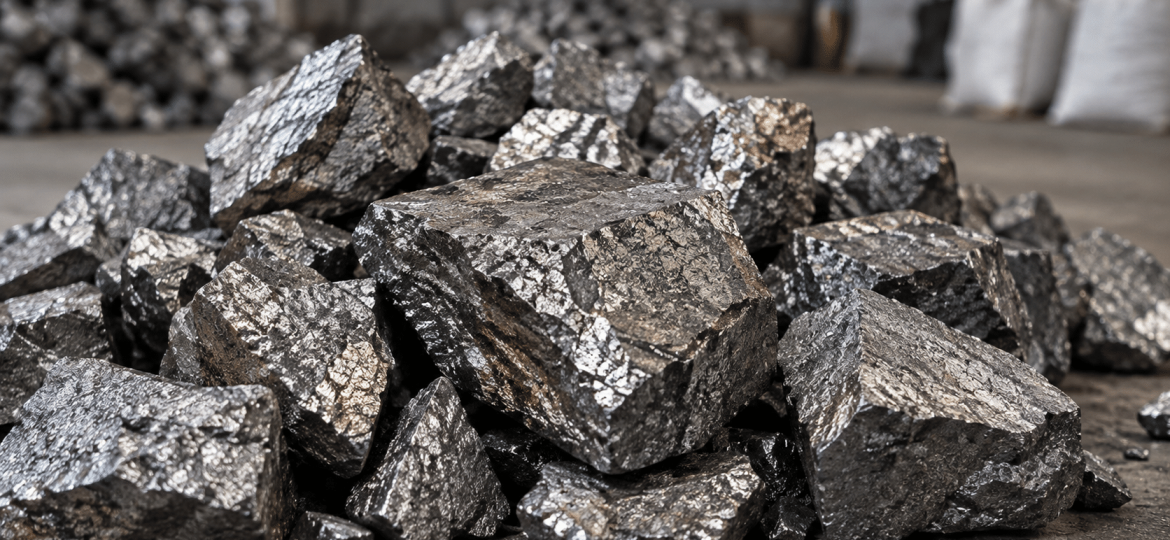
Ferro Phosphorus is an iron-phosphorus alloy mainly used in metallurgy, steelmaking, foundries, and several specialized industrial processes. Its controlled phosphorus content makes it a useful alloying material when manufacturers need to adjust the chemical or physical properties of iron-based products.
The material also supports applications beyond conventional metallurgy. For example, selected grades can serve in high-density materials, chemical production, powder metallurgy, and other technical processes. Therefore, buyers usually evaluate chemical composition, particle size, consistency, packaging, and intended application before choosing a grade.
What Is Ferro Phosphorus?
Ferro Phosphorus is a ferroalloy composed mainly of iron and phosphorus. Commercial grades commonly contain significant amounts of iron phosphides, including Fe₂P and Fe₃P. Typical grades contain around 18% or 25% phosphorus, although the exact chemistry depends on the producer and customer requirements.
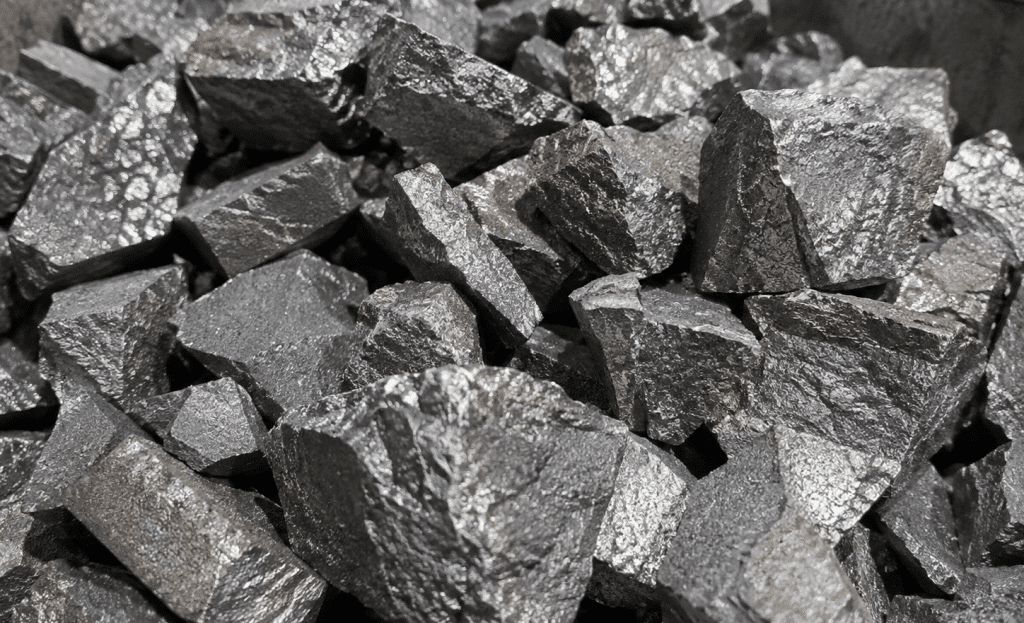
The alloy generally appears as a grey, solid material. Moreover, it has a melting range of approximately 1050–1100°C. Its phosphorus content gives it specific value in metallurgical processes where manufacturers need a controlled phosphorus source.
In industrial production, the material can also occur as a by-product of elemental phosphorus manufacturing. Producers can then process, size, test, and prepare it for commercial applications.
Ferro Phosphorus Specifications
Specifications can change according to the production route, application, origin, and contractual requirements. Therefore, buyers should always confirm the final specification through the supplier’s technical data sheet, certificate of analysis, or agreed purchase specification.
| Property | Typical / Commercial Reference |
|---|---|
| Main Components | Iron (Fe) and Phosphorus (P) |
| Phosphorus (P) | Common grades around 18% or 25% |
| Main Iron Phosphides | Fe₂P and Fe₃P |
| Appearance | Grey solid / lumps or processed particles |
| Melting Range | Approx. 1050–1100°C |
| CAS Number | 8049-19-2 |
| Particle Size | Available according to application and buyer requirements |
| Packaging | According to supplier and customer requirements |
| Chemical Analysis | Subject to agreed grade and Certificate of Analysis |
| Origin | Depends on producer and supply source |
Because industrial requirements differ, phosphorus level and particle size should be selected according to the final process. In addition, buyers may request limits for secondary elements or a specific size distribution.
Key Properties and Industrial Advantages
The main value of this alloy comes from its ability to introduce phosphorus into an iron-based system in a controlled form. As a result, manufacturers can use it to influence fluidity, wear behavior, mechanical characteristics, or other process-related properties.
In cast iron applications, phosphorus can improve molten-metal fluidity. Consequently, the material may help manufacturers produce complex castings more effectively. In certain applications, phosphorus can also contribute to wear resistance and machinability.
In powder metallurgy, phosphorus can support both sintering and selected magnetic properties. However, manufacturers must control the phosphorus level carefully because excessive phosphorus may increase brittleness.
The material can also function as a phosphorus source in selected metallurgical and chemical processes.
Where Is Ferro Phosphorus Used?
Its applications extend across several industries. Nevertheless, metallurgy remains one of the most important areas.
| Industry / Application | Main Function |
|---|---|
| Steelmaking | Controlled addition of phosphorus to selected steel compositions |
| Foundries | Helps adjust phosphorus content and can improve cast-iron fluidity |
| Powder Metallurgy | Used in selected sintered iron and steel applications |
| Wear-Resistant Materials | Supports specific wear and machining characteristics |
| High-Density Concrete | Can serve as a dense aggregate in specialized shielding materials |
| Chemical Industry | Raw material for selected phosphorus-based chemical processes |
| Specialized Alloys | Provides a controlled phosphorus source |
| Battery Material Supply Chain | May serve as a feedstock route in selected lithium iron phosphate processes |
Therefore, purchasing decisions should focus on the final application rather than phosphorus percentage alone.
Ferro Phosphorus in Steelmaking and Foundry Applications
Steel and foundry operations require accurate control over melt chemistry. For that reason, ferroalloys play an important role in reaching target compositions.
In suitable steel grades, a controlled phosphorus addition can modify specific material properties. Manufacturers must still manage the dosage carefully because high phosphorus levels can reduce toughness in many steel systems.
Foundries can use phosphorus to increase the fluidity of cast iron. Better fluidity helps molten metal reach narrow or complex areas of a mould. As a result, this property can be valuable for detailed casting geometries.
Furthermore, selected cast-iron formulations may benefit from changes in wear resistance or machinability. The required addition rate, however, depends on the alloy design and production process.
Role in Powder Metallurgy
Powder metallurgy represents another technical application. Iron phosphide can act as a solid-solution hardener and can support the sintering process.
Controlled phosphorus additions may also contribute to useful magnetic properties in powder-metallurgy steels. However, process control remains essential. Excessive phosphorus or poor distribution can create unwanted segregation and increase brittleness.
Therefore, manufacturers should evaluate particle size, composition, mixing conditions, sintering parameters, and target phosphorus content together.
Other Industrial Applications
The alloy has several less conventional applications as well.
For example, manufacturers can use it as an aggregate in high-density concrete designed for radiation shielding. Its density makes it an alternative to some conventional metallic aggregates in specialized construction systems.
Chemical producers may also use the material in processes related to phosphorus compounds. In addition, it can form part of selected production routes associated with phosphorus pentasulfide.
Another developing field relates to lithium iron phosphate, or LFP, battery materials. Certain production routes can use iron-phosphorus feedstocks as part of the raw-material chain. However, battery applications require strict control over purity and process conditions.
Quality Factors Buyers Should Consider
Industrial buyers should evaluate more than price when sourcing this material. Consistent chemistry can directly affect production stability and final product quality.
Important purchasing factors include phosphorus content, impurity limits, particle-size distribution, moisture conditions, packaging, batch consistency, documentation, origin, and delivery terms.
Moreover, buyers should define the intended application before requesting an offer. A foundry, steel producer, chemical plant, and powder-metallurgy company may require different specifications.
A Certificate of Analysis can help verify the chemical composition of each supplied batch. Likewise, suitable commercial and logistics documentation supports smoother international deliveries.
Packaging, Storage and Handling
Packaging depends on particle size, shipment volume, customer requirements, and transport conditions. Suppliers may offer industrial bags, big bags, drums, or other suitable packing formats.
Storage conditions require particular attention. The material should remain dry and protected from unnecessary moisture exposure. Very fine material may also require additional dust-control measures.
Furthermore, industrial users should follow the current Safety Data Sheet supplied for the specific product. Ferro-phosphorus materials can require special precautions because contact with water under certain conditions may generate hazardous phosphine gas. Fine powders can also present additional handling risks.
For this reason, trained personnel should follow appropriate occupational safety, storage, ventilation, and handling procedures.
Global Import Markets
International trade statistics require careful interpretation. Ferro Phosphorus does not always appear as an isolated six-digit HS category in global databases. HS 720299 covers “Ferro-alloys, nes” (other ferro-alloys) and therefore includes products beyond this specific alloy.
Consequently, the following table should be used as a market-direction indicator for the broader HS 720299 category, rather than as an exact ranking of Ferro Phosphorus imports.
| Leading Import Market | 2024 HS 720299 Import Value | Reported Quantity |
|---|---|---|
| China | USD 257.91 million | 148.39 million kg |
| India | USD 101.53 million | 68.69 million kg |
| European Union | USD 74.57 million | 37.45 million kg |
| United States | USD 51.26 million | 21.97 million kg |
| Japan | USD 42.98 million | 22.34 million kg |
| Germany | USD 31.01 million | 15.90 million kg |
| Türkiye | USD 28.40 million | 14.17 million kg |
The figures show strong demand for the wider “other ferro-alloys” category across Asia, Europe, North America, and Türkiye. However, companies should use product-specific customs records or detailed national tariff codes when they need an exact Ferro Phosphorus market analysis.
Global Export Markets
The same classification limitation applies to export statistics. Nevertheless, HS 720299 data can provide useful information about major supply centers and international ferroalloy trade flows.
| Leading Export Market | 2024 HS 720299 Export Value | Reported Quantity |
|---|---|---|
| China | USD 441.33 million | 136.99 million kg |
| Brazil | USD 165.79 million | Not reported in source |
| Slovenia | USD 34.15 million | 14.07 million kg |
| France | USD 32.81 million | 41.16 million kg |
| United States | USD 31.76 million | 10.84 million kg |
| India | USD 20.18 million | 11.68 million kg |
| Spain | USD 13.56 million | 4.74 million kg |
China leads the reported HS 720299 export value by a wide margin. Brazil also holds a strong position. Meanwhile, European producers and trading hubs such as Slovenia, France, and Spain participate actively in international supply.
Again, these figures represent the broader customs category. They should not be interpreted as product-exclusive Ferro Phosphorus shipment volumes.
Türkiye and International Trade Opportunities
Türkiye occupies an important position between European, Middle Eastern, North African, Central Asian, and Black Sea markets. This geographic position can support flexible sourcing and distribution strategies for industrial raw materials.
In 2024, Türkiye imported approximately USD 28.40 million of products classified under HS 720299. China represented the largest reported source, followed by Slovenia, Iran, India, and Russia. China alone supplied about USD 22.46 million within this broader category.
At the same time, 2024 trade data show shipments from Türkiye under HS 720299 reaching markets such as Italy, Yemen, Ukraine, North Macedonia, Algeria, Saudi Arabia, Morocco, Hungary, Austria, and Greece.
Therefore, Türkiye can serve both as an industrial consumption market and as a strategic commercial bridge for regional supply chains.
How to Select the Right Grade
The correct grade depends on the customer’s production target. Buyers should first determine the required phosphorus range. Next, they should define particle size, impurity limits, annual or monthly consumption, packaging, and delivery conditions.
A professional purchasing request should ideally include:
- Required phosphorus content
- Maximum acceptable impurity levels
- Preferred particle or lump size
- Required quantity
- Packaging preference
- Destination port or delivery location
- Required certificates and documents
- Incoterms or preferred delivery terms
Providing this information at the beginning can shorten the quotation process. Moreover, it helps suppliers identify a suitable source and reduces the risk of specification mismatches.
Ferro Phosphorus Supply with Atabaş Global
Atabaş Global Dış Ticaret A.Ş. supports international industrial raw-material sourcing and trade with a focus on reliable commercial coordination.
For Ferro Phosphorus inquiries, our team can evaluate the requested chemical composition, particle size, quantity, packaging, destination, and commercial terms. We can then coordinate the supply process according to the agreed product requirements and available sources.
For international buyers, consistency matters as much as availability. Therefore, clear specifications, suitable documentation, efficient logistics planning, and transparent communication remain central to a professional supply process.
Contact Atabaş Global to discuss your required grade, quantity, destination, and delivery terms.
