

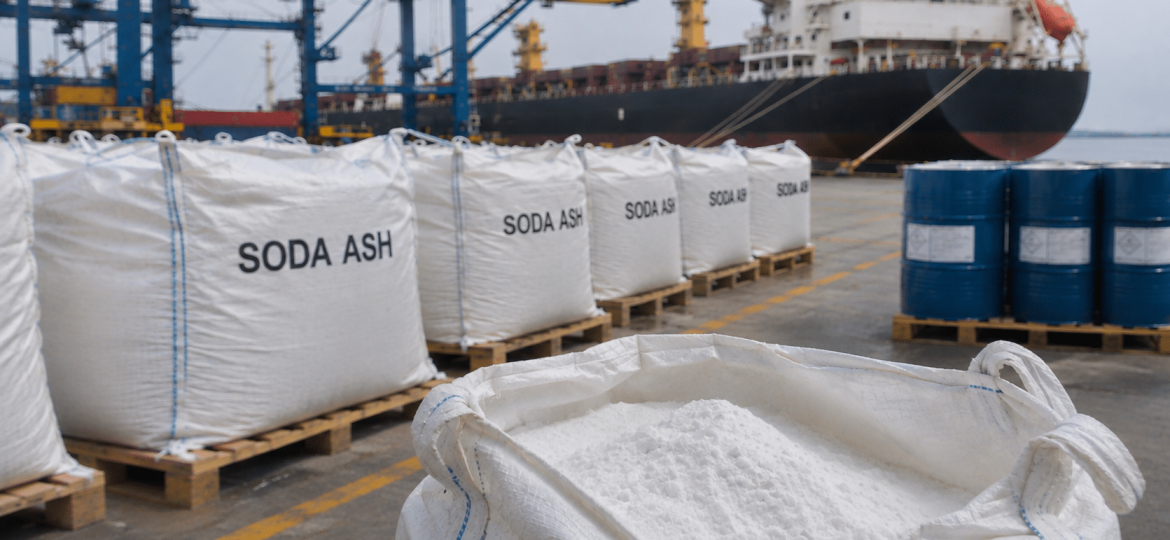
Soda ash export from Türkiye plays an important role in the global supply of raw materials for glass, detergents, chemicals and other industrial products. Moreover, Türkiye’s natural trona reserves and large production plants support international sodium carbonate trade.
Because many industries require stable supplies of alkaline materials, soda ash remains an essential industrial chemical. For example, glass manufacturers use it to lower the melting point of silica and support efficient glass production.
Furthermore, detergent producers use sodium carbonate to soften water and control alkalinity. In addition, chemical plants use it to produce several other sodium compounds.
However, different industrial processes require different product grades. Therefore, buyers should assess purity, bulk density, particle size and impurity levels before placing an order.
Türkiye offers natural and synthetic production sources, major ports and extensive industrial supply networks. Consequently, these advantages support large-scale soda ash export to international markets.
ATABAŞ GLOBAL combines industrial raw material supply with international trade and shipping services. As a result, we develop supply plans based on the technical and commercial needs of global buyers.
1. What Is Soda Ash (Sodium Carbonate)?
Soda ash is the commercial name for anhydrous sodium carbonate, an alkaline inorganic compound with the chemical formula Na₂CO₃.
In particular, manufacturers use this white, water-soluble material in glassmaking, cleaning products and chemical production.
Although sodium carbonate occurs naturally in certain mineral deposits, manufacturers can also produce it through chemical processes.
Consequently, the international market includes both natural and synthetic soda ash.
General Product Information
| Product Information | Description |
|---|---|
| Commercial Name | Soda Ash |
| Chemical Name | Sodium Carbonate |
| Alternative Name | Disodium Carbonate |
| Chemical Formula | Na₂CO₃ |
| CAS Number | 497-19-8 |
| EC Number | 207-838-8 |
| Molecular Weight | 105.99 g/mol |
| HS Code | 283620 |
| Appearance | White |
| Physical Form | Powder or granules |
| Water Solubility | Water-soluble |
| Chemical Character | Alkaline |
| Main Grades | Light and Dense Soda Ash |
| Production Types | Natural and Synthetic |
| Food Additive Code | E500(i) |
| Main Industry | Glass Manufacturing |
Sodium carbonate forms an alkaline solution when it dissolves in water. Therefore, many industrial processes use it to raise or control pH.
Moreover, its ability to react with calcium and magnesium ions supports water softening.
Differences Between Soda Ash, Baking Soda and Caustic Soda
Although these materials contain sodium, they have different chemical structures and industrial functions.
| Product | Chemical Formula | CAS Number |
|---|---|---|
| Soda Ash | Na₂CO₃ | 497-19-8 |
| Sodium Bicarbonate | NaHCO₃ | 144-55-8 |
| Caustic Soda | NaOH | 1310-73-2 |
Sodium bicarbonate provides milder alkalinity than sodium carbonate. In contrast, caustic soda is a much stronger base with different handling and safety needs.
Therefore, buyers should not treat these materials as direct substitutes.
Furthermore, hydrated sodium carbonate, such as washing soda, contains water within its crystal structure.
Consequently, customers should confirm whether they require anhydrous soda ash or a hydrated sodium carbonate product.
2. Soda Ash Export from Türkiye
Türkiye holds an important position in the global soda ash market due to its natural mineral resources and established chemical industry.
Moreover, large production facilities support both domestic consumption and international supply.
According to the US Geological Survey (USGS), Türkiye produced an estimated 6.1 million metric tons of soda ash in 2024.
Therefore, the country represents a major production and export centre for sodium carbonate.
Turkish Soda Ash Production Centres
Türkiye’s main natural soda ash production areas lie near Ankara.
For example, Beypazarı and Kazan contain major trona deposits that support large industrial plants.
Meanwhile, Mersin has an established chemical industry with synthetic soda ash production.
| Production Centre | Main Producer | Production Route |
|---|---|---|
| Beypazarı, Ankara | Eti Soda | Natural trona |
| Kazan, Ankara | Kazan Soda | Natural trona |
| Mersin | Şişecam | Synthetic soda ash |
These facilities provide a strong industrial base for Turkish soda ash export.
However, production capacity does not automatically indicate available commercial stock.
Therefore, buyers should confirm the actual grade, origin and shipment date for each order.
Sources: USGS – Mineral Industry of Türkiye and WE Soda – Manufacturing Operations.
Natural Soda Ash Production in Türkiye
Eti Soda and Kazan Soda use solution extraction to recover natural trona from underground deposits.
In 2024, Kazan Soda produced approximately 2.87 million metric tons of soda ash. Meanwhile, Eti Soda produced approximately 1.79 million metric tons.
Together, these facilities also produce sodium bicarbonate.
However, soda ash and sodium bicarbonate are separate products. Therefore, combined plant output figures should not serve as soda ash production totals.
Furthermore, natural trona provides a feedstock that can offer production cost and energy benefits compared with certain synthetic routes.
Consequently, Türkiye’s natural mineral resources support its position in global sodium carbonate trade.
Advantages of Turkish Soda Ash Export
Türkiye connects European, Asian, African and Middle Eastern markets through sea, road and rail routes.
Moreover, major ports offer access to container and bulk cargo services.
For example, Derince provides dedicated bulk soda ash loading infrastructure. Meanwhile, other Turkish ports support different cargo and shipping plans.
In addition, buyers may request warehouse collection, packed cargo or regular bulk shipments.
However, freight costs and vessel schedules can change throughout the year.
Therefore, ATABAŞ GLOBAL reviews suitable supply and transport options before confirming commercial offers.
3. Global Soda Ash Export Market and Trade Statistics
Soda ash represents an important internationally traded industrial chemical.
Furthermore, global glass production, detergent demand and chemical manufacturing support its trade.
Unlike products without a separate customs code, sodium carbonate has a dedicated six-digit HS classification.
Consequently, HS 283620 provides a useful basis for reviewing international soda ash trade.
Global Soda Ash Export Statistics – 2025
| Country | Export Volume (MT) | Export Value (USD) |
|---|---|---|
| United States | 6,806,110 | 1,471,297,240 |
| Türkiye | Not reliably reported | 906,536,810 |
| China | 2,193,950 | 398,406,980 |
| Bulgaria | 853,875 | 190,303,950 |
| Bosnia and Herzegovina | 414,706 | 121,542,200 |
| Germany | 290,506 | 108,719,630 |
| France | Not reported | 97,895,940 |
Source: World Bank WITS – Disodium Carbonate Exports 2025.
The United States leads the reported national export rankings by value. Meanwhile, Türkiye ranks second, followed by China.
Moreover, Bulgaria and several other European countries maintain significant export activity.
However, the European Union also publishes combined trade figures.
Therefore, the table excludes the EU aggregate to avoid counting member country trade twice.
Understanding Global Soda Ash Export Data
International trade statistics show the value and weight of goods that cross national borders.
However, customs records may also include goods that a country previously imported.
Therefore, export volume does not always equal domestic production volume.
Furthermore, HS 283620 does not separate light soda ash from dense soda ash in its six-digit trade totals.
Consequently, buyers should combine customs statistics with grade-specific market research.
Türkiye’s 2025 record also shows zero total weight alongside a substantial export value. For this reason, the table does not present zero as the actual shipment volume.
Natural and Synthetic Soda Ash Export Markets
Natural soda ash production relies on suitable mineral deposits or carbonate-rich brines.
In contrast, synthetic soda ash production relies on chemical processes that use raw materials such as salt and limestone.
Because these routes have different feedstock and energy needs, production costs can vary.
Nevertheless, both natural and synthetic products can meet demanding industrial specifications.
Therefore, buyers should assess product quality rather than production route alone.
Further market information is available from USGS – Soda Ash Statistics and Information.
4. International Soda Ash Import Markets and Industrial Demand
Global demand for sodium carbonate closely follows glass, chemical and cleaning product manufacturing.
For example, flat glass plants require regular supplies of dense soda ash.
Meanwhile, detergent factories often use light soda ash.
Furthermore, solar glass and selected lithium processing operations create additional demand.
Consequently, buyers across several regions rely on stable international supply.
European Soda Ash Import Markets
Europe has established glass, detergent and chemical industries.
For instance, the Netherlands, Spain, Italy and Germany represent important destinations for soda ash trade.
Furthermore, glass plants often require strict limits for iron, chloride and other impurities.
Because product consistency affects factory operations, buyers may require long-term supply contracts.
Moreover, European chemical rules can affect product records and market access.
Therefore, exporters should assess technical and legal requirements together.
Asian Soda Ash Export Opportunities
India, China and Southeast Asian countries have large industrial markets for sodium carbonate.
For example, manufacturers in India use soda ash in glass, detergents and other chemical products.
Similarly, Thailand, Indonesia and Vietnam have industrial sectors that can support import demand.
However, local production levels and import rules vary by country.
In addition, changes in trade measures can affect the cost and availability of imported material.
Consequently, suppliers should review current customs requirements before confirming orders.
Middle Eastern, African and American Markets
Middle Eastern countries use soda ash in glass, detergents and industrial chemical production.
Moreover, Egypt and other African markets have manufacturing sectors that require imported raw materials.
Brazil also represents an important destination for Turkish sodium carbonate exports.
However, long shipping routes can make freight a significant part of the total cost.
Therefore, suitable cargo sizes and delivery schedules remain important for international buyers.
5. Türkiye Soda Ash Export Statistics and Customs Regulations
Türkiye has maintained a strong position in international disodium carbonate trade.
Furthermore, its export records show substantial shipments to several industrial regions.
However, buyers should distinguish actual trade figures from production capacity and legal trade quotas.
Türkiye Soda Ash Trade – 2024 and 2025
| Trade Indicator | 2024 | 2025 |
|---|---|---|
| Export Value | USD 934,919,340 | USD 906,536,810 |
| Export Volume | 4,810,930 MT | Not reliably reported |
| Import Value | USD 82,555,940 | Not verified |
| Import Volume | 284,040 MT | Not verified |
| HS Code | 283620 | 283620 |
Sources: World Bank WITS – Türkiye Exports 2024, Türkiye Imports 2024 and Global Exports 2025.
Türkiye recorded more than 4.8 million metric tons of soda ash exports in 2024.
Although its reported export value fell slightly in 2025, the country remained a leading international supplier.
However, incomplete weight records prevent a reliable comparison of annual export volumes.
Leading Soda Ash Export Destinations from Türkiye – 2024
| Destination | Export Volume (MT) | Export Value (USD) |
|---|---|---|
| Netherlands | 547,488 | 110,399,850 |
| Spain | 488,196 | 100,444,450 |
| Italy | 379,011 | 80,971,490 |
| Brazil | 462,786 | 78,010,350 |
| Egypt | 339,799 | 66,119,510 |
| India | 379,234 | 65,244,270 |
| Thailand | 236,354 | 42,809,170 |
Source: World Bank WITS – Türkiye Soda Ash Export Destinations.
The Netherlands leads the listed destinations by reported export value. Meanwhile, Spain, Italy and Brazil also receive significant volumes.
Furthermore, shipments to Egypt, India and Thailand show the broad geographical reach of Turkish supply.
However, these figures do not identify the final buyer or industrial application of each shipment.
Soda Ash Export HS Code and GTIP
The international HS code for disodium carbonate is 283620.
| Product | HS Code |
|---|---|
| Sodium Carbonate | 283620 |
| Sodium Bicarbonate | 283630 |
| Solid Sodium Hydroxide | 281511 |
| Sodium Hydroxide Solution | 281512 |
Both light and dense anhydrous soda ash generally fall under HS 283620.
However, national tariff systems may use additional digits.
Therefore, exporters should confirm the applicable Turkish GTIP and destination tariff code before shipment.
Furthermore, formulated chemical blends may require a different classification.
Official customs information is available from the Republic of Türkiye Ministry of Trade.
Soda Ash Export Quotas and India’s 2026 Import Proposal
Export statistics do not represent legal trade quotas.
However, importing countries may introduce safeguards, duties or other measures to protect domestic producers.
On 4 November 2026, India’s Directorate General of Trade Remedies (DGTR) issued final findings recommending two years of quantitative restrictions on soda ash imports.
The proposed measures cover both light and dense soda ash, including natural and synthetic products.
For Turkish-origin material, the proposed limits are:
| Proposed Period | Turkish-Origin Soda Ash |
|---|---|
| First Year | 128,697 MT |
| Second Year | 135,132 MT |
| Two-Year Total | 263,829 MT |
Furthermore, the proposal provides for quarterly quota allocations.
However, the final findings represent a recommendation to the Indian government rather than automatic implementation.
Therefore, buyers must verify the actual legal status, applicable duties and quota availability before arranging shipments.
Sources: India DGTR – Soda Ash Safeguard Investigation and WTO Quantitative Restrictions Database.
6. Soda Ash Export Grades and Technical Specifications
Commercial sodium carbonate mainly comes in two physical grades: light and dense soda ash.
Although both grades share the same chemical formula, they differ in bulk density, particle size and handling properties.
Therefore, buyers should select the grade that suits their production equipment and industrial process.
Light Soda Ash Export
Light soda ash generally consists of fine white powder with relatively low bulk density.
For example, typical commercial grades have a bulk density of around 0.45–0.65 g/cm³.
Because its fine particles provide a large surface area, the material can dissolve readily under suitable conditions.
Furthermore, detergent and chemical plants often use this grade.
However, fine powder may create more dust during handling.
Consequently, buyers should assess particle size, moisture and packing before placing light soda ash export orders.
Dense Soda Ash Export
Dense soda ash generally contains larger and more compact particles.
For example, commercial products often have a bulk density of around 0.9–1.2 g/cm³.
Moreover, the higher density can reduce storage volume per ton.
Glass manufacturers commonly select this grade for raw material mixing and furnace feeding.
Because dense particles may reduce dust and material separation during handling, they can offer practical benefits for glass plants.
Therefore, dense soda ash export plays an important role in global glass industry supply.
Light and Dense Soda Ash Comparison
| Technical Property | Light Soda Ash | Dense Soda Ash |
|---|---|---|
| Chemical Formula | Na₂CO₃ | Na₂CO₃ |
| Appearance | Fine white powder | White granules |
| Typical Bulk Density | 0.45–0.65 g/cm³ | 0.9–1.2 g/cm³ |
| Common Industrial Purity | 99.2–99.5% or higher | 99.2–99.5% or higher |
| Particle Size | Generally finer | Generally coarser |
| Dust Generation | Usually higher | Usually lower |
| Main Uses | Detergents and chemicals | Glass manufacturing |
| Water Solubility | Soluble | Soluble |
These ranges provide a general commercial guide. However, they do not define fixed limits for every supplier.
Furthermore, specific industrial processes may require different particle sizes and impurity levels.
Therefore, buyers should review the actual Technical Data Sheet (TDS) before selecting a grade.
Natural Dense Soda Ash Technical Specifications
The following values illustrate the chemical requirements in a published Turkish natural dense soda ash specification.
| Technical Parameter | Example Specification |
|---|---|
| Sodium Carbonate (Na₂CO₃) | Minimum 99.5% |
| Sodium Oxide Equivalent (Na₂O) | Minimum 58.2% |
| Sodium Chloride (NaCl) | Maximum 0.10% |
| Sodium Sulfate (Na₂SO₄) | Maximum 0.10% |
| Total Iron (Fe) | Maximum 10 ppm |
| Water-Insoluble Matter | Maximum 0.05% |
| Arsenic (As) | Maximum 1 ppm |
| Lead (Pb) | Maximum 1 ppm |
| Mercury (Hg) | Maximum 1 ppm |
| pH, 1% Solution | 11.4 |
Source: WE Soda – Eti Soda Dense Soda Ash Technical Specification.
However, these values represent a specific commercial product rather than a universal soda ash standard.
Furthermore, the sodium oxide value expresses an equivalent chemical content. Therefore, it does not indicate that the product contains that amount of free sodium oxide.
Food and Specialty Sodium Carbonate Grades
Selected sodium carbonate grades serve food, pharmaceutical and other sensitive industrial processes.
For example, food-grade sodium carbonate carries the additive code E500(i).
However, industrial-grade soda ash does not automatically meet food safety requirements.
Moreover, pharmaceutical and analytical grades may require separate purity and quality checks.
Consequently, buyers should provide the relevant standard before requesting specialty soda ash export quotations.
Further information is available from the European Union Food Additive Specifications.
7. Soda Ash Production Process and Chemical Properties
Manufacturers mainly produce soda ash through natural mineral processing or synthetic chemical production.
Because each route uses different raw materials, their production steps and energy needs also differ.
Nevertheless, both routes produce sodium carbonate with the same chemical formula.
Natural Soda Ash Production from Trona
Trona is a natural mineral that contains sodium carbonate, sodium bicarbonate and water within its crystal structure.
Its chemical formula is Na₃H(CO₃)₂·2H₂O.
First, producers recover the mineral through conventional or solution mining.
Next, they process the recovered material to separate unwanted substances.
Afterwards, heat treatment and further refining help produce sodium carbonate.
Finally, drying, screening and quality checks prepare the product for shipment.
However, the exact order of these steps varies between plant designs.
Consequently, natural soda ash producers use different processing methods to reach their target quality.
Synthetic Soda Ash and the Solvay Process
The Solvay process represents a major route for synthetic soda ash production.
In general, the process uses salt, limestone, ammonia and carbon dioxide.
First, chemical reactions form sodium bicarbonate from a treated brine solution.
Next, heat converts sodium bicarbonate into sodium carbonate.
Furthermore, the process recovers and reuses much of the ammonia.
The main overall conversion can be expressed as:
2NaCl + CaCO₃ → Na₂CO₃ + CaCl₂
However, this equation only describes the overall chemical conversion, not every process stage.
Therefore, synthetic plants require suitable control systems for chemical recovery, energy use and waste management.
Dense Grade Production and Physical Control
Producers can convert suitable light soda ash into a denser product through further processing.
For example, hydration followed by drying can help form larger and denser particles.
Moreover, screening helps achieve the desired grain size.
Because particle size affects material flow, producers monitor physical properties alongside chemical purity.
Consequently, consistent grading supports glass batch preparation and bulk soda ash export.
Environmental Performance of Soda Ash Production
Natural production can require less energy than some conventional synthetic processes.
However, actual environmental impact depends on mining methods, fuel sources, electricity and plant efficiency.
Furthermore, synthetic plants can improve their performance through process recovery and cleaner energy sources.
Therefore, buyers should request verified product-level environmental data when carbon emissions form part of their purchase criteria.
8. Industrial Applications of Soda Ash
Sodium carbonate serves many manufacturing sectors due to its alkaline properties and ability to react with other materials.
Moreover, different industrial uses require different levels of purity and physical quality.
Therefore, buyers should match the soda ash grade with the intended application.
Glass Manufacturing
Glass production represents a major use of dense soda ash.
Because pure silica requires high melting temperatures, manufacturers add sodium carbonate to help form a glass melt at lower temperatures.
Furthermore, soda ash provides sodium oxide within the final glass structure.
Main applications include flat glass, container glass, automotive glass and household glassware.
However, the required impurity limits vary between glass types.
Consequently, glass plants often require steady chemical composition and controlled particle size.
Solar Panel Glass
Solar panel manufacturers use suitable flat glass to protect photovoltaic cells.
Moreover, this glass often requires high light transmission.
Because iron can affect glass colour and light transmission, buyers may specify low iron content in raw materials.
Therefore, solar glass producers should review sodium carbonate purity and iron limits carefully.
Soap and Detergent Manufacturing
Detergent producers commonly use light soda ash as an alkaline ingredient.
For example, sodium carbonate helps remove hardness ions from water.
Furthermore, it can support the cleaning action of detergent formulations by maintaining suitable pH levels.
However, product performance depends on the full detergent recipe.
Consequently, manufacturers should select grades according to their formulation and production method.
Sodium Silicate Production
Soda ash serves as a feedstock for sodium silicate.
For instance, manufacturers can react sodium carbonate with silica at high temperatures to produce silicate materials.
Moreover, sodium silicate serves adhesives, foundries, detergents and other industrial processes.
Therefore, soda ash quality can influence the final product and plant operation.
Water and Wastewater Treatment
Treatment plants use suitable sodium carbonate grades to raise pH and add alkalinity.
Furthermore, sodium carbonate can help remove calcium hardness through chemical precipitation.
However, the required dose depends on water chemistry and treatment targets.
In addition, drinking water treatment may require approved product grades.
Therefore, buyers should confirm the relevant local safety and quality requirements.
Lithium Carbonate and Battery Materials
Certain lithium processing plants use soda ash to recover lithium carbonate from suitable solutions.
For example, carbonate ions can react with dissolved lithium ions to form lithium carbonate solids.
Moreover, sodium carbonate quality may affect impurity levels in the resulting material.
However, battery-grade production requires strict control of several chemical inputs.
Consequently, standard industrial soda ash may not suit every battery material process without further testing.
Pulp and Paper Manufacturing
Paper and pulp plants use sodium compounds in several chemical systems.
Moreover, sodium carbonate can serve chemical recovery and selected pH control processes.
However, individual mills use different production methods.
Therefore, buyers should define the specific application before choosing a product grade.
Textile Processing
Textile manufacturers use sodium carbonate in certain dyeing and fabric treatment processes.
For example, it can help provide the alkaline conditions required by reactive dyes.
Furthermore, it may serve selected washing and preparation steps.
However, the correct amount depends on the fibre, dye and process.
Consequently, textile plants should follow their established technical requirements.
Food and Beverage Manufacturing
Approved food-grade sodium carbonate can serve as an acidity regulator or processing ingredient in permitted applications.
However, food additive rules differ between products and markets.
Moreover, industrial purity alone does not establish food-grade compliance.
Therefore, food manufacturers should request suitable safety records and grade-specific approval.
Metallurgy and Industrial Chemical Processing
Selected metal processing operations use sodium carbonate as an alkaline reagent or flux.
Furthermore, chemical plants use it to make other sodium-based materials.
For example, soda ash can serve as a feedstock for sodium bicarbonate.
However, each process requires suitable purity and impurity limits.
Consequently, technical product selection remains important across these industries.
Drilling Fluids and Environmental Applications
Drilling fluid engineers may use soda ash to treat calcium hardness and adjust water alkalinity.
Meanwhile, selected environmental processes use sodium carbonate to neutralise acidic streams.
However, excessive dosing can cause unwanted changes in fluid chemistry.
Therefore, treatment teams should determine the required amount through suitable tests.
9. Soda Ash Export Quality Control and International Standards
Consistent sodium carbonate quality supports reliable industrial production.
Moreover, even small differences in iron, moisture or particle size can affect certain manufacturing processes.
Therefore, suppliers should review both chemical and physical properties before shipment.
Chemical Purity and Impurity Control
Sodium carbonate content provides a key measure of product quality.
However, high total purity does not automatically guarantee suitability for every industrial use.
For example, glass manufacturers may require very low iron levels.
Similarly, chemical plants may specify strict chloride or sulfate limits.
Furthermore, food and pharmaceutical applications may require additional trace element tests.
Consequently, buyers should define the full impurity profile rather than only a minimum Na₂CO₃ percentage.
Bulk Density and Particle Size Tests
Bulk density describes the mass of loose material within a given volume.
Because light and dense grades have different packing characteristics, this measurement helps identify the required physical grade.
Moreover, screen tests measure the distribution of particle sizes.
However, bulk density differs from the true density of sodium carbonate crystals.
Therefore, buyers should confirm the exact test method when comparing product data.
Food, Water Treatment and Industrial Standards
Industrial soda ash tests may follow methods such as ASTM E359, alongside relevant supplier and customer standards.
Furthermore, food-grade products must meet the applicable food additive requirements.
Selected water treatment products may also require NSF/ANSI/CAN 60 approval or an equivalent local standard.
However, approval for one use does not establish approval for all other uses.
Therefore, suppliers should provide records that cover the intended product and application.
Pre-Shipment Tests for Soda Ash Export
First, suppliers should confirm the product name, physical grade and batch number.
Next, laboratories can measure sodium carbonate content and moisture.
Furthermore, chloride, sulfate, iron and insoluble matter tests help establish product quality.
Depending on the order, customers may also request screen analysis, bulk density and trace element tests.
However, a general Technical Data Sheet cannot replace actual batch results.
Therefore, suppliers should provide a batch-specific Certificate of Analysis (COA).
In addition, independent inspection can support agreed quality and weight checks before loading.
10. Bulk Soda Ash Export Packaging, Storage and Shipping
Correct packing and cargo handling help maintain sodium carbonate quality during transport.
Because soda ash can absorb moisture, buyers should protect it from damp conditions.
Furthermore, suitable storage and loading plans help reduce product loss and contamination.
Commercial Soda Ash Packaging Options
| Packaging Type | Common Net Weight |
|---|---|
| Multiwall Paper Bag | 25 kg |
| Industrial Woven Bag | 50 kg |
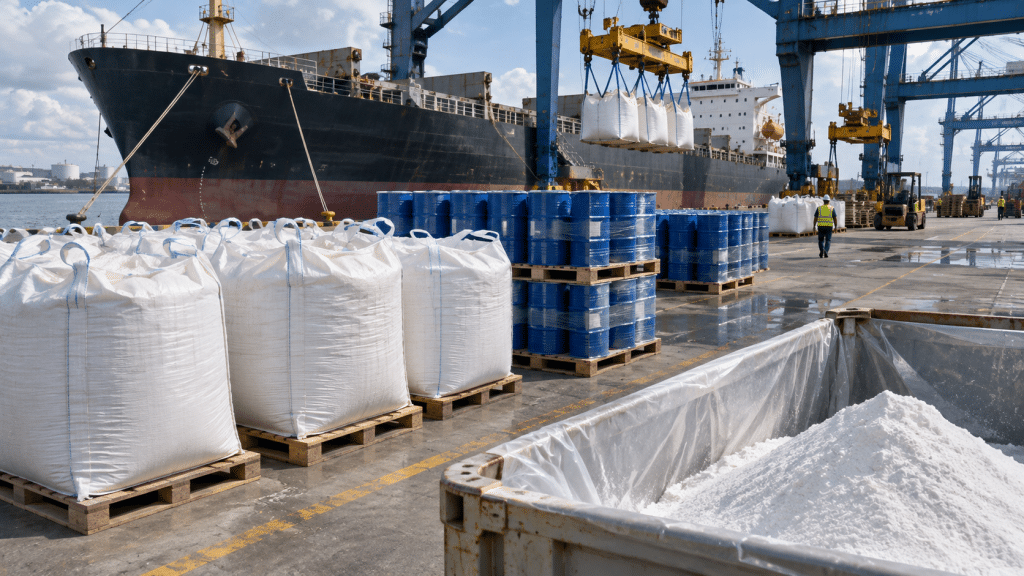
| Big Bag | 500 kg |
| Jumbo Bag | 1,000 kg |
| Large FIBC | 1,250–1,500 kg, if available |
| Loose Bulk Cargo | According to shipment size |
Smaller bags can provide flexibility for industrial users with limited storage facilities.
In contrast, Big Bags can reduce the number of individual packages during bulk handling.
Moreover, loose bulk cargo may suit large glass plants with dedicated storage and unloading systems.
However, available packing options depend on the producer and product grade.
Therefore, buyers should confirm packaging before placing an order.
Soda Ash Storage and Safe Handling
Soda ash requires clean, dry and suitable storage areas.
Furthermore, warehouse teams should protect bags from water, humidity and damage.
Because sodium carbonate dust may irritate the eyes and respiratory tract, workers should follow the product Safety Data Sheet (SDS).
In particular, suitable eye protection and dust controls play an important role during handling.
Moreover, contact with acids can release carbon dioxide.
Therefore, storage and handling plans should reflect the actual chemical safety requirements.
Official chemical information is available from ECHA.
Container and Bulk Vessel Shipping
Packed soda ash can travel in suitable dry freight containers.
For example, 20-foot containers may suit dense cargo with relatively high weight.
However, light soda ash may require more space for the same net weight.
Therefore, the loading plan should account for bulk density, bag size and container limits.
Furthermore, large industrial buyers may request loose bulk vessel shipments.
Such shipments require suitable loading, unloading and cargo protection arrangements.
Consequently, the best shipping method depends on order size and destination facilities.
Turkish Ports and Soda Ash Export Logistics
ATABAŞ GLOBAL evaluates international shipping options through Mersin, İzmir, Gebze and İstanbul port regions, among other suitable loading points.
Moreover, Derince has dedicated infrastructure for large soda ash cargoes.
For container shipments, we work with established shipping firms such as CMA CGM, Maersk, MSC and Hapag-Lloyd.
However, not every port or carrier suits every cargo type.
Therefore, we review the loading point, shipment size, destination and current shipping schedules before confirming delivery plans.
11. Soda Ash Export Documents and International Trade Compliance
Correct product and trade records help support customs clearance and industrial purchasing.
Furthermore, certain buyers require specific technical documents before supplier approval.
Therefore, both parties should agree on the document package before shipment.
Technical and Commercial Documents
A Technical Data Sheet describes the general product specification. Meanwhile, a Certificate of Analysis shows the test results for a specific batch.
The Safety Data Sheet also provides chemical hazard and handling information.
Furthermore, international shipments commonly require the following commercial and transport records:
- Proforma Invoice
- Commercial Invoice
- Packing List
- Certificate of Origin
- Bill of Lading or other transport document
- Customs Export Declaration
- Inspection Certificate, if required
- Insurance Certificate, where applicable
In addition, specialty products may require food safety, water treatment or other quality approvals.
However, the required records vary according to the destination and purchase contract.
International Delivery Terms for Soda Ash Export
International buyers can request different Incoterms according to their transport needs.
For example, EXW allows collection from an agreed supply point.
Under FCA terms, however, the seller delivers goods to the nominated carrier at the named place.
FOB requires delivery on board the vessel at the loading port. Similarly, CFR requires the seller to arrange and pay for sea freight to the named destination port.
Under CIF terms, the seller also arranges the required marine insurance.
Nevertheless, cargo risk transfers to the buyer when the goods reach the vessel on board at the loading port.
Furthermore, CPT, CIP and DAP provide additional delivery options.
For container shipments, FCA, CPT or CIP may better reflect the actual cargo handover.
Therefore, buyers should compare soda ash export offers using the same delivery terms.
Further information is available from the International Chamber of Commerce – Incoterms Rules.
Origin Records and Chemical Regulations
The country of shipment does not always represent the country of production.
Therefore, buyers should confirm the actual origin of each cargo.
Moreover, an A.TR movement certificate concerns the free circulation of eligible goods and does not establish their country of origin.
Depending on the destination, shipments may require a Certificate of Origin or other eligible preferential trade documents.
Furthermore, European imports may require a review of REACH and CLP obligations.
ATABAŞ GLOBAL follows applicable international trade restrictions and sanctions requirements.
Consequently, we review product origin, trade partners and shipping plans before confirming transactions.
12. Bulk Soda Ash Export and Supply with ATABAŞ GLOBAL
Reliable sodium carbonate supply requires more than a competitive product price.
Moreover, industrial buyers need stable quality, suitable packing and dependable delivery dates.
Therefore, ATABAŞ GLOBAL reviews technical and commercial needs together.
We assess light and dense soda ash inquiries for glass plants, detergent manufacturers, chemical producers and other industrial customers.
Long-Term Soda Ash Export and Supply
Regular deliveries can help manufacturers maintain suitable raw material stock levels.
For example, glass plants may require monthly bulk shipments to support continuous production.
Similarly, detergent factories may prefer regular container deliveries of light soda ash.
However, supply availability and vessel schedules can change during the year.
Therefore, early purchase planning can support more reliable delivery arrangements.
Furthermore, clear product limits help maintain quality between shipments.
Consequently, long-term supply plans should reflect actual factory consumption and stock capacity.
Information Required for a Soda Ash Export Quotation
A detailed Request for Quotation (RFQ) helps us identify suitable sodium carbonate products.
First, buyers should confirm whether they require light or dense soda ash.
Next, they should provide the required Na₂CO₃ purity and impurity limits.
Furthermore, bulk density, particle size and moisture specifications help define the physical grade.
For example, glass producers may request a specific maximum iron content.
In addition, customers should provide the intended industrial use and any required certification.
After confirming product details, buyers should share the order size, monthly demand and packing requirements.
Finally, the destination, delivery terms, inspection needs and shipment schedule help us assess the full commercial offer.
For soda ash export from Türkiye, light and dense sodium carbonate supply, industrial raw materials and international shipping solutions, contact ATABAŞ GLOBAL.
13. Frequently Asked Questions About Soda Ash Export
Product Properties and Commercial Grades
What is soda ash?
Soda ash is anhydrous sodium carbonate with the formula Na₂CO₃. Moreover, it serves glass, detergent and chemical manufacturing.
What is the CAS number of soda ash?
The CAS number for anhydrous sodium carbonate is 497-19-8.
What is the difference between light and dense soda ash?
Both grades share the same chemical formula. However, they differ in bulk density, particle size and handling properties.
Is natural soda ash different from synthetic soda ash?
Natural soda ash comes from suitable mineral deposits or brines, whereas synthetic soda ash comes from chemical production. Nevertheless, both routes can produce high-purity sodium carbonate.
Is soda ash the same as sodium bicarbonate?
No. Soda ash has the formula Na₂CO₃, while sodium bicarbonate has the formula NaHCO₃.
Soda Ash Export Markets and Customs Rules
Which country leads global soda ash exports?
The United States leads the reported 2025 national export rankings by value. Meanwhile, Türkiye ranks second.
How much soda ash does Türkiye export?
Türkiye recorded approximately 4.81 million metric tons of exports in 2024. Furthermore, its reported export value reached approximately USD 906.5 million in 2025.
What is the HS code for soda ash?
Sodium carbonate falls under HS 283620. However, buyers should confirm the additional national tariff digits.
Does India have soda ash import quotas?
India’s DGTR recommended two-year import restrictions on 4 November 2026. However, buyers must confirm whether the government has brought the proposed measures into force.
Industrial Applications and Product Selection
Which soda ash grade serves glass manufacturing?
Glass manufacturers generally prefer dense soda ash due to its physical handling properties. Nevertheless, actual requirements depend on the glass production process.
Which soda ash grade serves detergent production?
Detergent producers commonly use light soda ash. However, some processes can also use dense material.
Can soda ash serve water treatment?
Suitable grades can help control pH and remove calcium hardness. Furthermore, drinking water applications may require specific product approvals.
Can soda ash serve food production?
Approved food-grade sodium carbonate can serve permitted food applications under the additive code E500(i). However, industrial grades do not automatically meet food safety requirements.
Does soda ash serve battery production?
Certain lithium processing operations use sodium carbonate to produce lithium carbonate. Moreover, these applications may require strict impurity limits.
Packaging and Bulk Soda Ash Supply
What packing options are available?
Common options include 25 kg bags, industrial sacks and Big Bags. Furthermore, large buyers may request loose bulk shipments.
How should warehouses store soda ash?
Warehouses should protect the product from moisture and contamination. In addition, workers should follow the current product Safety Data Sheet.
Can buyers request independent product tests?
Yes. Customers can request independent quality and weight checks according to agreed purchase terms.
Does ATABAŞ GLOBAL arrange regular soda ash supply?
We assess regular supply plans based on product grade, availability, monthly demand and destination.
How can international buyers request a soda ash quotation?
First, customers should provide the required grade and technical limits. Next, they should confirm quantity, packaging and destination. Finally, ATABAŞ GLOBAL can assess suitable supply and shipping options.
