

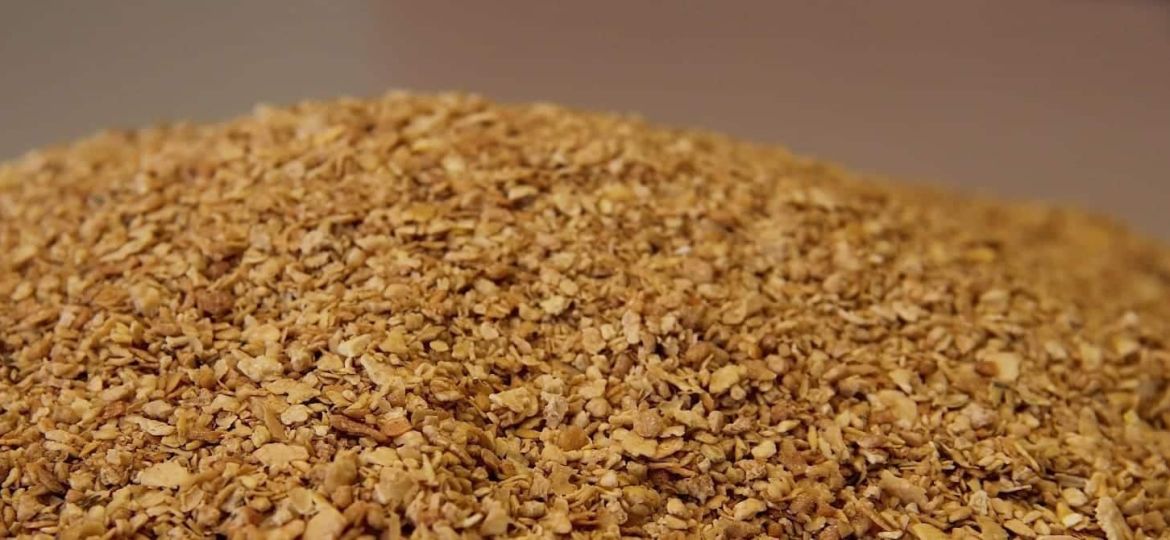
Soybean meal is a concentrated plant protein ingredient widely used in animal nutrition. Feed producers value it for its protein concentration, useful amino acid profile, broad availability, and compatibility with many compound feed formulas.
However, protein percentage alone does not determine quality. Fiber, moisture, amino acid availability, heat treatment, hull content, origin, and storage conditions can also influence nutritional performance.
For this reason, professional buyers should compare complete specifications rather than relying on a single protein value. This guide explains the differences between standard 44% and high-protein grades while also examining composition, processing, quality control, feed applications, purchasing, and storage.
1. What Is Soybean Meal?
Soybean meal is the protein-rich material that remains after processors remove most of the oil from soybeans. Manufacturers process this remaining fraction to create an important ingredient for animal feed production.
Its nutritional value comes primarily from concentrated plant protein and a useful amino acid profile. In particular, its lysine contribution makes the ingredient valuable in many cereal-based formulations.
Commercial products do not all share identical characteristics. For example, standard material often contains around 44% crude protein, whereas dehulled high-protein grades commonly offer approximately 47.5% to 49%, depending on the contractual specification.
Therefore, buyers should consider several parameters together:
- Crude protein
- Crude fiber
- Moisture
- Fat
- Ash
- Amino acid profile
- Processing quality
- Hull content
- Physical condition
- Product origin
A complete analytical profile provides a more reliable basis for purchasing than the product name alone.
2. How Is This Protein-Rich Feed Ingredient Produced?
Production starts with cleaned soybeans. First, processors remove foreign material and prepare the beans for efficient oil extraction. They may then crack, condition, flake, and dehull the beans according to the desired final grade.
Next, the extraction process removes most of the soybean oil. This step leaves a solid fraction with a much higher relative concentration of protein.
After extraction, processors apply controlled heat treatment. This stage is particularly important because raw soybeans naturally contain anti-nutritional factors. Appropriate processing helps control these compounds while preserving nutritional quality.
Finally, manufacturers grind and condition the material to achieve suitable physical characteristics for transportation, storage, and feed production.
Consequently, processing quality directly influences the commercial and nutritional performance of the finished product.
3. Typical Technical Specifications
Specifications vary by origin, processor, contract, and analytical basis. Nevertheless, the table below provides a useful comparison between standard and dehulled high-protein commercial grades.
| Parameter | Standard Grade | High-Protein Grade |
|---|---|---|
| Crude Protein | Min. 44.0% | Approx. 47.5-49.0% min. |
| Crude Fiber | Max. 7.0% | Approx. 3.3-3.5% max. |
| Moisture | Max. 12.0% | Max. 12.0% |
| Crude Fat | Typically low after oil extraction | Typically low after oil extraction |
| Physical Form | Meal | Meal |
| Typical Appearance | Light tan to brown | Light tan to brown |
| Hull Content | Higher | Lower |
| Protein Density | Standard | Higher |
| Fiber Level | Higher | Lower |
| Main Market | Compound feed | Nutrient-dense feed formulas |
These figures serve as general commercial references rather than guaranteed values for every shipment.
Therefore, purchasers should always compare contractual requirements with the actual Certificate of Analysis. Moreover, analytical methods and reporting basis should remain consistent when comparing products from different suppliers.
4. What Is the Difference Between 44% and 48% Grades?
The most visible difference involves protein and fiber concentration.
Standard 44% material generally contains a greater proportion of soybean hulls. Because hulls contribute more fiber and less protein than the inner portions of the bean, their presence changes the final nutritional profile.
In contrast, high-protein material normally undergoes more extensive dehulling. Consequently, it usually provides more protein and less fiber per unit of product.
| Comparison Factor | 44% Grade | Approx. 48% Grade |
| Crude Protein | Lower | Higher |
| Crude Fiber | Higher | Lower |
| Hull Contribution | Greater | Reduced |
| Protein Density | Standard | Higher |
| Nutrient Concentration | High | Generally higher |
| Best Choice | Depends on formulation | Depends on formulation |
Nevertheless, 48% does not automatically mean “better.”
A nutritionist may choose a 44% grade when it fits the nutritional and economic targets of the ration. Conversely, a more concentrated formula may benefit from a dehulled high-protein option.
Therefore, formulation requirements should determine the choice.
5. Why Is the Protein Content So High?
Soybeans naturally contain substantial amounts of protein. During processing, manufacturers remove most of the oil, which increases the relative concentration of protein in the remaining solid fraction.
Furthermore, dehulling can raise protein concentration because the hull fraction contains more fiber and proportionally less protein.
This explains why dehulled grades generally provide higher crude protein and lower crude fiber.
However, crude protein does not tell the entire nutritional story. It estimates protein concentration through nitrogen analysis, but it does not independently measure amino acid digestibility or heat damage.
As a result, advanced feed evaluation considers both the amount and the nutritional quality of the protein.
6. Nutritional Profile and Important Feed Values
Protein receives the most attention, but several additional parameters influence nutritional value.
The following components deserve particular consideration:
| Nutritional Parameter | Why It Matters |
| Crude Protein | Indicates overall protein concentration |
| Lysine | Important essential amino acid in many feed formulas |
| Methionine | Important for amino acid balancing |
| Threonine | Contributes to balanced protein nutrition |
| Tryptophan | Essential amino acid |
| Crude Fiber | Influences nutrient density |
| Fat | Contributes energy |
| Ash | Represents the total mineral fraction |
| Moisture | Influences dry matter and storage |
| Dry Matter | Supports accurate nutrient comparisons |
In addition, digestibility matters because animals cannot necessarily use every measured nutrient with equal efficiency.
Therefore, modern formulation increasingly considers digestible amino acids rather than relying solely on total crude protein.
7. Why Is It Widely Used in Animal Nutrition?
Several characteristics explain the ingredient’s major role in compound feed.
First, it provides concentrated plant protein. Second, its amino acid profile complements many cereal grains. Third, feed manufacturers have extensive nutritional data and practical experience with its use.
Additional advantages include:
- High protein density
- Useful lysine contribution
- Established nutritional matrices
- Compatibility with cereal-based diets
- Multiple commercial grades
- Broad international availability
- Familiar analytical methods
- Efficient use in balanced formulations
Moreover, nutritionists can combine it with energy sources, minerals, vitamins, and complementary amino acids to create diets for specific production goals.
Still, the correct inclusion level varies by animal species, age, production stage, and complete ration composition.
8. Which Animal Feed Applications Use It?
This plant protein source supports several major feed categories.
Poultry Nutrition
Broiler and layer diets often require concentrated protein and carefully balanced essential amino acids. Therefore, this ingredient can play an important role alongside corn, wheat, and other energy sources.
Swine Diets
Pig diets can use it to supply protein and amino acids throughout different growth phases. However, nutritionists adjust inclusion according to age, performance targets, and the complete nutritional matrix.
Dairy and Beef Cattle
Cattle rations may include it as a supplemental protein source. In this case, formulators also consider forage quality, energy supply, and other protein ingredients.
Aquaculture Feed
Some fish and aquaculture diets incorporate processed soy protein ingredients. Nevertheless, species-specific digestibility and formulation requirements influence appropriate inclusion.
Consequently, there is no universal inclusion percentage that applies to every animal or ration.
9. Which Factors Determine Feed-Grade Quality?
A strong quality profile requires more than a high crude protein result.
Buyers and nutritionists should examine nutritional, processing, physical, and storage characteristics together.
Important factors include:
- Protein concentration
- Fiber content
- Moisture
- Amino acid composition
- Amino acid digestibility
- Heat-processing quality
- Protein solubility
- Urease activity
- Control of anti-nutritional factors
- Physical consistency
- Freshness
- Contaminant control
- Storage condition
Processing deserves special attention. Insufficient heating may fail to control certain anti-nutritional factors effectively. Excessive heat, however, can negatively affect protein quality and amino acid availability.
Therefore, successful processing requires controlled thermal treatment rather than simply applying more heat.
10. Why Do Urease Activity and Protein Solubility Matter?
Quality-control laboratories can use processing indicators to understand how thermal treatment may have affected the material.
Urease activity can help identify insufficient heat processing. High residual activity may indicate that processing did not adequately treat the raw soybean material.
Protein solubility provides another useful perspective. Excessive heat can alter proteins and reduce nutritional quality, particularly when severe processing affects important amino acids.
Consequently, laboratories may evaluate these indicators alongside crude protein, moisture, fiber, and other analytical parameters.
Neither measurement should stand alone. Instead, combining several analytical indicators provides a more complete picture of processing quality.
11. Does Country of Origin Affect Nutritional Value?
Origin can influence composition, although origin alone does not define quality.
Soybean genetics, climate, growing conditions, agricultural practices, soil, harvest conditions, and processing technology can all contribute to differences between products.
As a result, materials with similar crude protein declarations may differ in:
- Amino acid concentration
- Digestibility
- Fiber
- Sugar fractions
- Energy value
- Moisture
- Processing characteristics
- Physical quality
Therefore, professional buyers often compare laboratory data and supplier consistency rather than making decisions solely on geographical origin.
Furthermore, maintaining consistent raw material characteristics can help nutritionists manage feed matrices more accurately.
12. What Should Buyers Check Before Purchasing?
Professional purchasing starts with a clear specification.
First, determine the required protein range. Next, establish maximum acceptable limits for fiber and moisture. Then, define any additional nutritional or quality-control parameters relevant to the intended feed program.
A practical purchasing checklist includes:
- Crude protein
- Crude fiber
- Moisture
- Crude fat
- Ash
- Amino acid data where required
- Processing-quality indicators
- Physical condition
- Country or region of origin
- Contaminant requirements
- Packaging or bulk-delivery conditions
- Analytical documentation
In addition, buyers should define whether analytical limits apply on an as-is or dry-matter basis.
This detail matters because moisture can influence direct comparisons between samples.
Therefore, clearly written contractual specifications reduce uncertainty and help buyers compare offers more accurately.
13. Which Documents and Laboratory Tests Are Important?
A reliable quality-control program combines supplier documentation with appropriate analytical verification.
The Certificate of Analysis (CoA) provides analytical information for the relevant batch or shipment when the supplier issues batch-specific results.
Depending on contractual and regulatory requirements, purchasers may also request documentation concerning origin, quality systems, contaminants, or feed compliance.
Common laboratory parameters can include:
- Crude protein
- Crude fiber
- Moisture
- Crude fat
- Ash
- Amino acid profile
- Urease activity
- Protein solubility
- Relevant microbiological parameters
- Mycotoxins when required
- Other contaminants when applicable
However, testing every possible parameter for every shipment may not always provide the most efficient quality strategy.
Instead, purchasers can establish a risk-based program according to supplier performance, origin, intended use, and regulatory requirements.
14. How Should the Product Be Stored?
Good storage practices help protect nutritional and physical quality.
First, warehouses should keep the product dry and protect it from rain, condensation, and other sources of moisture. In addition, storage areas should remain clean and appropriately managed against pests.
Important storage controls include:
- Moisture prevention
- Clean warehouse conditions
- Protection from water ingress
- Pest-management programs
- Appropriate ventilation
- Stock rotation
- Prevention of cross-contamination
- Regular visual inspections
- Temperature monitoring when relevant
- Good handling practices
Furthermore, moisture management deserves particular attention because unfavorable conditions can encourage deterioration during extended storage.
For that reason, quality management should continue after delivery rather than ending when the product enters the warehouse.
15. Frequently Asked Questions About This Feed Protein
What is soybean meal?
Soybean meal is a protein-rich material obtained after processors remove most of the oil from soybeans. Feed manufacturers use it primarily as a source of plant protein and amino acids.
How much protein does it contain?
Commercial standard grades often contain around 44% crude protein, whereas dehulled high-protein products commonly fall around 47.5% to 49%, depending on the specification.
What does a 44% grade mean?
It generally indicates a commercial specification with crude protein around a minimum of 44%. This grade usually contains more hull material and fiber than high-protein dehulled alternatives.
What does a 48% grade mean?
The term commonly describes a high-protein, low-fiber commercial category. However, exact contractual limits can vary. Therefore, buyers should check the supplier specification and CoA.
Is 48% always better than 44%?
No. Higher protein concentration can benefit certain formulations, but the most suitable option depends on nutritional requirements, digestibility, fiber, energy contribution, consistency, and economics.
Why is this ingredient important in poultry diets?
Its concentrated protein and useful amino acid profile complement many cereal ingredients. Consequently, nutritionists can use it as part of balanced broiler and layer formulas.
Can cattle consume it?
Yes. Nutritionists can incorporate it into suitable cattle diets as a protein source. However, they should formulate the complete ration according to animal requirements.
Can aquaculture diets contain it?
Yes, some aquaculture formulas use processed soy-derived protein. Nevertheless, species, digestibility, processing, and formulation strategy determine appropriate use.
Why does crude fiber matter?
Fiber influences overall nutrient density. Dehulled high-protein grades generally contain less fiber, which helps concentrate protein and other nutrients.
Why is moisture important?
Moisture affects dry matter concentration, commercial weight, handling, and storage stability. Therefore, purchasing specifications normally establish a maximum acceptable moisture value.
Does crude protein alone define quality?
No. Crude protein provides an important analytical value, but amino acid composition, digestibility, processing quality, fiber, moisture, and consistency also matter.
What should a buyer compare?
Buyers should compare protein, fiber, moisture, processing indicators, analytical basis, origin, supplier consistency, and relevant documentation.
What documents should a supplier provide?
Requirements vary by contract and market. However, buyers commonly use product specifications and Certificates of Analysis alongside any required feed-safety, origin, or regulatory documents.
What is the difference between standard and dehulled material?
Dehulling removes more of the fiber-rich outer fraction. Consequently, dehulled products generally contain more protein and less crude fiber.
What is the best way to evaluate soybean meal?
Use a multi-factor approach rather than focusing on one number:
Protein + amino acid value + fiber + moisture + processing quality + consistency.
This method provides a more meaningful basis for evaluating nutritional and commercial value.
