

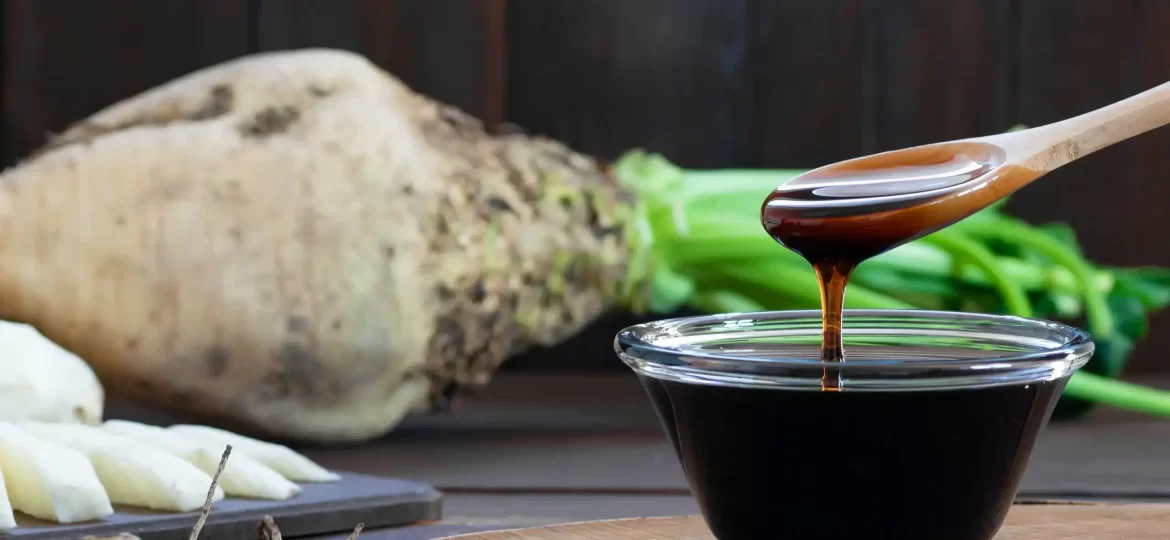
Sugar beet molasses is a dark, thick syrup that comes from sugar beet processing. Sugar producers obtain it after they remove most of the crystallized sugar from beet juice. However, the remaining syrup still contains sugar, minerals, water and other natural compounds.
Because of this composition, many industries use sugar beet molasses as a useful raw material. For example, common applications include animal feed, yeast production, ethanol production and other fermentation processes.
The exact composition can vary from one product to another. Beet quality, processing methods, sugar recovery and storage conditions can all affect the final product. Therefore, buyers should always compare the supplier’s current specification and Certificate of Analysis (CoA) with their own requirements.
This guide explains sugar beet molasses, including its production, composition, typical specifications, uses, quality factors, storage and purchasing points.
1. What Is Sugar Beet Molasses?
Sugar beet molasses is a concentrated syrup that remains near the end of the beet sugar production process. It comes from sugar beet (Beta vulgaris), a crop that naturally stores sucrose in its roots.
During production, sugar factories extract sucrose from sliced sugar beets. They then clean and concentrate the juice before forming sugar crystals. After several stages of sugar recovery, a thick liquid remains.
This final syrup still contains sucrose, minerals and other soluble compounds. However, the factory can no longer recover all of the remaining sucrose efficiently through normal crystallization.
In simple terms, sugar beet molasses is a concentrated liquid from beet sugar production that contains residual sugar and other soluble components.
Its composition varies between factories and batches. Therefore, commercial users should treat it as a specification-based raw material rather than a product with one fixed composition.
2. How Is Sugar Beet Molasses Produced?
Production starts with harvested sugar beets. First, the sugar factory cleans the beets to remove soil and other unwanted material. Next, machines cut the roots into thin strips called cossettes.
The factory then uses water to extract sugar from the cossettes. This step produces raw juice that contains sucrose and many other soluble compounds from the beet.
Next, the factory cleans the juice and removes some unwanted material. Evaporation then removes water and increases the sugar concentration.
After that, the crystallization process begins. Sugar crystals form in the concentrated juice, and the factory separates these crystals from the surrounding syrup.
The factory can repeat parts of this process to recover more sucrose. Eventually, however, the remaining syrup contains enough non-sugar material to make further normal sugar recovery less practical.
The resulting dark and concentrated liquid becomes sugar beet molasses.
3. What Does Sugar Beet Molasses Contain?
Sugar beet molasses contains much more than sugar and water. In fact, it has a complex mix of carbohydrates, minerals and other soluble compounds.
Sucrose usually makes up an important part of its sugar content. In addition, the product contains water and smaller amounts of other carbohydrate-related compounds.
The mineral fraction may contain potassium, calcium, magnesium and other elements. Their levels depend on the sugar beet, growing conditions and production process.
Beet molasses can also contain organic acids and nitrogen-containing compounds. As a result, its chemical profile differs greatly from refined white sugar.
Common component groups include:
- Sucrose
- Water
- Other carbohydrate compounds
- Potassium and other minerals
- Organic acids
- Nitrogen-containing compounds
- Other soluble non-sugar material
However, exact values can vary significantly. For this reason, buyers who need precise data should use the supplier’s specification and batch-specific CoA.
4. What Are the Typical Specifications of Sugar Beet Molasses?
There is no single global specification for every sugar beet molasses product. Instead, values change according to the raw material, factory process, concentration, analytical method and intended use.
The following table gives a practical overview of common properties. It does not represent guaranteed limits for every commercial product.
| Parameter | Typical Characteristic |
|---|---|
| Product name | Sugar Beet Molasses |
| Botanical source | Sugar beet (Beta vulgaris) |
| Physical form | Thick, viscous liquid |
| Color | Dark brown to very dark brown |
| Odor | Characteristic |
| Dry matter | High; supplier-specific |
| Moisture | Depends on product concentration |
| Total sugar | Process- and supplier-specific |
| Sucrose | Usually a major part of the residual sugar |
| Reducing sugars | Variable |
| Ash | Significant; product-specific |
| pH | Depends on process and product |
| Density | Changes with composition and temperature |
| Viscosity | High; strongly affected by temperature |
| Water behavior | Mixes readily with water under suitable conditions |
| Storage | Follow supplier recommendations |
| Shelf life | Depends on product and storage conditions |
Therefore, buyers should not use this table as a purchase specification. Instead, they should check the limits in the supplier’s current technical data.
The test method also matters. Two laboratories may report values on different bases or use different methods. Consequently, buyers should compare results only after checking units, test methods and reporting basis.
5. How Much Sugar Does Sugar Beet Molasses Contain?
Sugar beet molasses still contains a notable amount of sugar after the factory removes commercial sugar crystals. However, there is no correct single percentage that applies to every product.
Sucrose generally forms a major part of the remaining sugar fraction. Other carbohydrate compounds may also occur in smaller amounts.
Several factors affect the final sugar level. These include beet quality, factory efficiency, crystallization conditions, dry matter and the amount of sugar that the factory recovered earlier in the process.
This variation matters in commercial applications. For example, a fermentation plant needs to know how much useful carbohydrate a batch can provide.
Furthermore, total sugar does not always describe fermentation performance on its own. The type of carbohydrate and the needs of the microorganism also matter.
Therefore, industrial buyers should check actual analytical results instead of relying on a generic sugar percentage.
6. What Is Sugar Beet Molasses Used For?
Sugar beet molasses has several commercial uses. Its residual sugar content makes it especially useful in applications that need an available carbohydrate source.
Major applications include:
- Animal feed
- Compound feed
- Yeast production
- Ethanol production
- Industrial fermentation
- Biotechnology processes
- Selected agricultural uses
- Other suitable industrial processes
However, one grade may not suit every application.
For example, feed producers need material that meets the relevant feed requirements. Meanwhile, fermentation plants may focus on sugar profile, dry matter, minerals and batch consistency.
Therefore, buyers should select the grade according to its intended use.
7. Why Is Sugar Beet Molasses Used in Animal Feed?
Feed producers can use sugar beet molasses as both a nutritional and functional ingredient.
First, its carbohydrate content can provide energy within a balanced feed formula. In addition, its sweet character may help improve palatability in suitable diets.
The thick liquid can also provide useful physical effects during feed production. For example, it may help reduce dust and support binding in some feed mixtures.
Key benefits can include:
- A source of carbohydrates
- Improved palatability
- Lower dust levels
- Binding support
- Easier handling of some feed mixtures
Nevertheless, feed producers must control the amount they use. The right level depends on the animal species, production stage, complete diet and properties of the molasses.
Moreover, producers must follow the feed rules that apply in the target market. A qualified feed professional should determine suitable inclusion levels for a specific diet.
8. Why Is Sugar Beet Molasses Useful for Fermentation?
Sugar beet molasses can provide microorganisms with a useful source of carbon. Therefore, several industrial fermentation processes use it as a feedstock.
Yeast production represents one important application. Ethanol production can also use suitable molasses as a carbohydrate source.
However, fermentation performance depends on more than total sugar.
Operators may need to consider:
- Available sugar profile
- Dry matter
- Mineral content
- pH
- Nitrogen-containing compounds
- Other non-sugar components
- Microorganism type
- Process conditions
- Batch consistency
For this reason, fermentation plants often test a new molasses source before full-scale use.
In addition, some processes may require dilution, pH adjustment or other preparation steps. The exact treatment depends on the microorganism and production system.
Therefore, actual process trials provide better evidence of suitability than sugar content alone.
9. What Is the Difference Between Sugar Beet Molasses and Cane Molasses?
Sugar beet molasses and cane molasses both come from sugar production. However, they come from different plants and have different chemical profiles.
Sugar beet molasses comes from sugar beet. In contrast, cane molasses comes from sugar cane.
This difference affects more than the name. Each plant contributes a different mix of non-sugar compounds to the final syrup. Processing methods also influence the final composition.
| Feature | Sugar Beet Molasses | Cane Molasses |
| Source | Sugar beet | Sugar cane |
| Physical form | Thick, dark liquid | Thick, dark liquid |
| Sugar profile | Depends on beet processing | Depends on cane processing |
| Non-sugar compounds | Characteristic of beet source and process | Characteristic of cane source and process |
| Feed use | Common | Common |
| Fermentation use | Common when suitable | Common when suitable |
| Flavor profile | Characteristic beet molasses flavor | Characteristic cane molasses flavor |
| Direct substitution | Requires technical evaluation | Requires technical evaluation |
As a result, manufacturers should not automatically replace one type with the other.
Instead, they should compare actual specifications. Application trials may also help when flavor, fermentation behavior or process performance matters.
10. What Determines Sugar Beet Molasses Quality?
The intended use determines which quality factors matter most.
For instance, a fermentation company may focus on available sugars and batch consistency. A feed producer may focus on nutritional value, handling properties and feed compliance.
Common quality checks include:
- Dry matter
- Total sugar
- Sucrose
- Reducing sugars
- Ash
- Moisture
- pH
- Density
- Viscosity
- Color
- Odor
- Relevant contaminants
- Batch consistency
Color alone does not define quality. Likewise, a higher sugar value does not automatically make one product better for every application.
Instead, a good commercial product should meet the agreed specification and perform consistently in its intended process.
11. Which Technical Parameters Should Buyers Check?
Buyers should focus on the parameters that directly affect their application.
Dry matter indicates product concentration. Therefore, it can affect formulation calculations, transport efficiency and handling.
Sugar content matters especially in fermentation and feed applications. However, buyers should also check which analytical method the supplier uses.
Ash gives useful information about the product’s inorganic fraction. Still, users should interpret it together with the rest of the analysis.
pH may affect processing and fermentation conditions.
Density helps with mass and volume calculations. Since temperature can affect density, technical documents should state the relevant measurement conditions where needed.
Viscosity plays a major role in pumping and transfer. In particular, low temperatures can make a thick molasses product harder to move.
Finally, buyers should check whether results use an as-is or dry-matter basis. Otherwise, direct comparisons can lead to incorrect conclusions.
12. How Should Sugar Beet Molasses Be Stored?
Proper storage helps maintain product quality and makes handling easier.
Operators should use clean and suitable tanks or containers. They should also protect the molasses from contamination and unwanted material.
Temperature deserves special attention because it affects viscosity. As the product gets colder, it generally becomes harder to pump.
Therefore, a storage system should consider:
- Tank design
- Suitable pumps
- Pipe size
- Transfer conditions
- Temperature control where required
- Cleaning
- Contamination prevention
- Stock rotation
If heating becomes necessary for transfer, operators should follow the supplier’s guidance. Excessive or long heating can change product characteristics.
Moreover, no single storage temperature or shelf life applies to every product. Buyers should always follow the current supplier instructions for the specific grade.
13. How Is Sugar Beet Molasses Transported?
Suppliers can deliver sugar beet molasses in different formats depending on volume, grade and customer needs.
Large industrial users often receive molasses in bulk. Other customers may use suitable intermediate containers or other packaging formats offered by the supplier.
Because the product has high viscosity, transport planning should include loading and unloading requirements.
Buyers should consider:
- Delivery format
- Quantity
- Tank or container suitability
- Loading conditions
- Unloading equipment
- Pumps and hoses
- Product temperature where relevant
- Cleaning requirements
- Traceability
- Relevant feed or other transport rules
Good planning can reduce unloading delays. It can also help prevent contamination and product loss.
In addition, buyers should confirm handling requirements before delivery, especially when cold conditions may increase viscosity.
14. How Should Buyers Choose a Sugar Beet Molasses Supplier?
Buyers should start with their technical needs rather than price alone.
First, define the application. Next, identify the quality parameters that directly affect the process. Then compare suppliers using the same criteria.
Useful documents may include:
- Product specification
- Certificate of Analysis (CoA)
- Botanical source information
- Country of origin
- Grade or intended-use statement
- Safety Data Sheet when applicable
- Feed compliance documents when required
- GMO information when relevant
- Relevant contaminant information
- Storage guidance
- Shelf-life information
Consistency also matters. A low-cost product may create higher operating costs if its composition changes greatly between deliveries.
Therefore, process-sensitive buyers may benefit from testing samples before placing large orders.
A reliable supplier should also provide clear technical information and maintain agreed product limits from batch to batch.
15. Why Is Sugar Beet Molasses an Important Raw Material?
Sugar beet molasses gives manufacturers a useful way to use the remaining value in a stream from beet sugar production.
Its sugar content supports applications such as animal feed, yeast production, ethanol production and industrial fermentation. At the same time, its physical properties can provide useful functions in some formulations.
However, buyers should remember one key point: sugar beet molasses does not have one fixed universal composition.
The sugar beet crop, factory process, sugar recovery rate and final concentration can all affect its properties. Therefore, technical specifications matter.
For the best results, buyers should define their application first. Next, they should establish the required quality limits and review the supplier’s current specification. Finally, they should check batch-specific CoA data when critical parameters matter.
This specification-based approach helps manufacturers choose sugar beet molasses that fits their process, quality targets and commercial requirements.
