

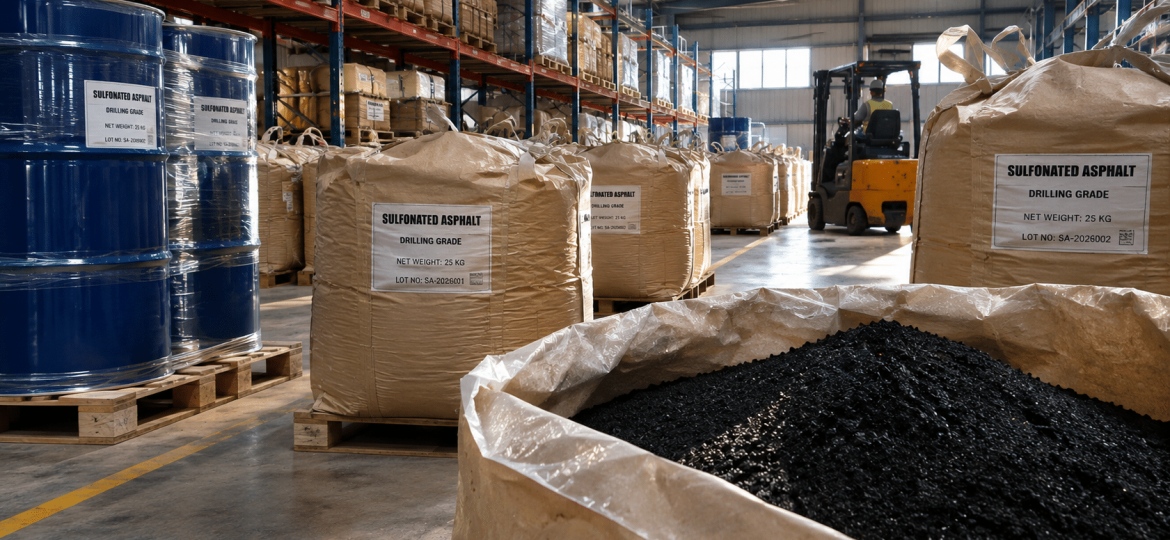
Sulfonated asphalt prices depend on raw material costs, chemical treatment, water solubility, product grade and delivery terms. Moreover, differences between sodium and potassium-based products create distinct price levels within the global drilling chemical market.
Because drilling projects often face weak rock and reactive shale, engineers use special additives to improve drilling fluid performance. For example, sulfonated asphalt can help reduce shale swelling, control fluid loss and improve well stability.
Furthermore, selected grades can help reduce friction between the drill string and the well wall. As a result, these products may support more efficient drilling under suitable conditions.
However, not every commercial grade offers the same level of performance. Therefore, buyers should review technical data and test results before comparing product prices.
In addition, order size, packing, product origin and freight costs influence the final purchase cost.
ATABAŞ GLOBAL combines industrial chemical supply with global trade and shipping services. Consequently, we assess product quality, technical needs and delivery options before preparing commercial offers.
1. What Is Sulfonated Asphalt?
Sulfonated asphalt is a chemically modified asphalt product that mainly serves the oil and gas drilling sector.
Unlike ordinary asphalt, it contains chemical groups that improve its interaction with water. Consequently, suitable grades can partly dissolve or disperse in water-based drilling fluids.
Moreover, selected products contain oil-compatible fractions. Therefore, some grades can also serve oil-based and synthetic-based mud systems.
Drilling teams mainly use this material for shale control, fluid-loss control and lubrication.
Because these functions can help improve well stability, sulfonated asphalt plays an important role in selected drilling fluid systems.
General Product Information
| Product Information | Description |
|---|---|
| Commercial Name | Sulfonated Asphalt |
| Alternative Name | Sulphonated Asphalt |
| Chemical Name | Asphalt Sulfonate |
| Common Chemical Form | Sodium Asphalt Sulfonate |
| Alternative Form | Potassium Asphalt Sulfonate |
| Common CAS Number | 68201-32-1, sodium salt |
| EC Number | 269-212-0, sodium salt |
| Possible HS Code | 271500 |
| Ionic Character | Anionic |
| Appearance | Dark brown to black |
| Physical Form | Powder or flakes |
| Water Solubility | Partial to high |
| Oil Solubility | Grade-specific |
| Main Industry | Oil and gas drilling |
| Main Functions | Shale control and fluid-loss control |
| Common Packing | 25 kg bags |
However, the CAS and EC numbers above refer to the sodium salt form rather than every commercial asphalt sulfonate product.
Furthermore, mixed products may require a different customs code.
Therefore, buyers should confirm the actual product identity through its Safety Data Sheet (SDS).
Differences Between Sulfonated Asphalt, Bitumen and Gilsonite
Petroleum bitumen mainly serves road building, roofing and waterproofing. In contrast, sulfonated asphalt mainly serves drilling fluid systems.
Similarly, Gilsonite is a natural solid asphalt that comes from mineral deposits. However, untreated Gilsonite does not have the same water-related properties as sulfonated asphalt.
Because these products differ in structure and performance, buyers should not treat them as direct substitutes.
Moreover, their production costs and industrial uses also differ.
Consequently, ordinary bitumen and natural asphalt prices cannot directly establish sulfonated asphalt prices.
For further details, see our articles on Gilsonite (Natural Asphalt) and Petroleum Bitumen.
2. Physical and Chemical Properties Affecting Sulfonated Asphalt Prices
The physical and chemical properties of sulfonated asphalt determine how it behaves in drilling fluids.
For example, water-soluble content affects its use in water-based mud.
Meanwhile, oil-compatible fractions may support selected oil-based systems.
Therefore, engineers should assess the complete product profile before selecting a grade.
Physical Properties and Powder Structure
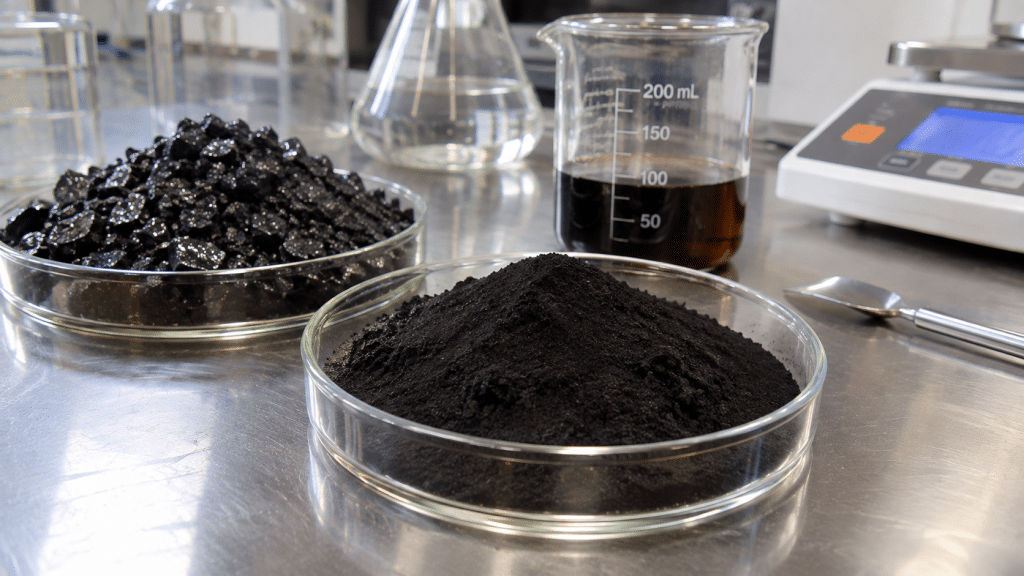
Sulfonated asphalt generally appears as a dark brown or black powder.
Moreover, some suppliers offer small flakes or other solid forms.
Because powder size affects mixing and handling, manufacturers may offer different particle sizes.
Fine powders can disperse more easily under suitable mixing conditions. However, very fine particles may also increase dust during handling.
Furthermore, moisture and storage conditions can affect powder flow.
Consequently, buyers should review particle size, moisture and bulk density when comparing sulfonated asphalt prices.
Chemical Structure and Sulfonate Groups
Asphalt contains a complex mix of organic compounds.
Therefore, sulfonated asphalt does not have one fixed molecular formula or molecular weight.
During chemical treatment, manufacturers introduce sulfonic acid groups into suitable asphalt compounds.
Afterwards, they can form salts such as sodium or potassium sulfonates.
The general chemical group structures include:
- Sodium sulfonate: R–SO₃Na
- Potassium sulfonate: R–SO₃K
In these expressions, R represents a variable organic group within the modified asphalt material.
Moreover, these groups can improve the material’s interaction with water.
However, the final product may also contain oil-soluble and insoluble fractions.
As a result, its chemical content can vary between manufacturers.
Water Solubility and Oil Solubility
Water solubility plays a major role in product selection.
For example, some commercial grades contain at least 70% water-soluble material.
Similarly, selected products specify oil-soluble content of 25% or more.
However, these values depend on the test method and product grade.
Furthermore, water-soluble and oil-soluble fractions do not necessarily form mutually exclusive groups.
Therefore, buyers should not simply add the two values to calculate total product purity.
Consequently, proper test methods are essential when comparing sulfonated asphalt prices and technical quality.
3. Technical Specifications and Sulfonated Asphalt Prices
Technical quality directly affects the commercial value of drilling additives.
For example, products with tighter moisture limits may require more drying.
Similarly, grades with specific solubility targets may require closer process control.
Therefore, buyers should compare products with similar technical limits.
General Sulfonated Asphalt Technical Specifications
The following table presents an example commercial specification for a sodium-based drilling grade.
| Technical Parameter | Example Specification |
|---|---|
| Appearance | Black powder |
| Moisture | Maximum 8% |
| pH | 8–9 |
| Sodium Sulfonate Content | Minimum 10% |
| Water-Soluble Content | Minimum 70% |
| Oil-Soluble Content | Minimum 25% |
| HTHP Fluid Loss | Maximum 25 mL |
Source: Trustin – Sulphonated Asphalt Technical Specification.
However, these values describe a commercial product rather than a universal international standard.
In particular, HTHP fluid-loss results depend on the test fluid, dose, heat, pressure and test period.
Therefore, customers should request the actual test procedure alongside the reported value.
Moreover, the Technical Data Sheet (TDS) and Certificate of Analysis (COA) should reflect the agreed grade.
Commercial Grade Comparison and Sulfonated Asphalt Prices
Different manufacturers offer products for different drilling conditions.
The following table compares published data from three commercial product examples.
| Property | SLB ASPHASOL SUPREME | Baker Hughes SULFATROL XCEED | Trustin Commercial Grade |
|---|---|---|---|
| Appearance | Black-gray powder | Black powder | Black powder |
| Water Solubility | 65–80% at 22°C | Above 65% | Min. 70% |
| Oil Solubility | Not stated | Not stated | Min. 25% |
| Specific Gravity | 1.40–1.65 | 0.8–1.0 | Not stated |
| pH | 7–10, 2% solution | 8.5 | 8–9 |
| Moisture | Not stated | Not stated | Max. 8% |
| Heat Stability | Product-specific | Up to 204°C | Not stated |
| Packing | 22.7 kg sacks | 22.7 kg sacks | 25 kg bags |
Sources: SLB ASPHASOL SUPREME, Baker Hughes SULFATROL XCEED and Trustin Technical Specification.
These products illustrate the range of technical properties available in the market.
However, the test conditions may differ between suppliers.
Therefore, the table should not serve as a direct ranking of product performance.
Moisture, Density and Particle Size
Moisture affects the amount of dry product that buyers receive per ton.
Furthermore, high moisture may cause lumps or poor powder flow.
Bulk density also affects warehouse space, bag size and container loading.
However, bulk density and specific gravity describe different physical properties.
Therefore, buyers should not use these values as direct substitutes.
Similarly, particle size can influence powder handling and mixing.
Consequently, these factors may affect both technical results and bulk sulfonated asphalt prices.
4. Production Process and Sulfonated Asphalt Prices
Manufacturers produce sulfonated asphalt through controlled chemical treatment.
Because ordinary asphalt has limited water solubility, producers modify its chemical structure for use in drilling fluids.
Moreover, the process allows manufacturers to develop products with different performance levels.
Raw Materials and Chemical Treatment
Suitable petroleum asphalt can serve as the main raw material.
First, producers select an asphalt feedstock based on the target grade.
Next, chemical treatment introduces sulfonic groups into the material.
Afterwards, further treatment can form sodium or potassium salts.
However, actual production methods vary between plants.
Furthermore, manufacturers may use different feedstocks and chemical treatment routes.
Therefore, raw material quality plays an important role in the final product.
Drying, Grinding and Quality Control
After chemical treatment, manufacturers prepare the material for drying.
Moreover, they control the drying process to achieve the required moisture level.
Grinding and screening then help produce the desired powder size.
Finally, labs check the finished product before packing.
The general production process follows this sequence:
Asphalt Selection → Chemical Treatment → Salt Formation → Drying → Grinding → Screening → Quality Control → Packaging
However, some plants may combine or change individual production steps.
Consequently, the final cost depends on the process design and target product grade.
Manufacturing Costs and Sulfonated Asphalt Prices
Asphalt feedstock represents an important production cost.
Furthermore, process chemicals, energy and labour contribute to the final cost.
For example, special grades may require tighter control during chemical treatment.
Similarly, additional drying and grinding can increase energy use.
Higher quality targets may also require more lab tests and batch checks.
Therefore, manufacturing costs vary between commercial grades.
However, a higher production cost does not always guarantee better drilling performance.
Consequently, buyers should review the actual technical benefits before paying more for a special grade.
5. Sulfonated Asphalt Prices by Commercial Grade
Suppliers offer several types of sulfonated asphalt for different drilling needs.
For example, some drilling projects require strong shale control.
In contrast, other projects need better fluid-loss control under high heat and pressure.
Moreover, certain fluid systems require suitable oil compatibility.
Therefore, each commercial grade serves a different technical purpose.
Sodium Sulfonated Asphalt Prices
Sodium sulfonated asphalt is a widely used form of this drilling additive.
In particular, sodium sulfonate groups help improve the material’s interaction with water.
Furthermore, suitable grades can support shale control and fluid-loss reduction.
For example, drilling teams may use sodium-based products in freshwater and selected saltwater muds.
However, actual performance depends on the full drilling fluid system.
Consequently, sodium sulfonated asphalt prices vary according to moisture, solubility and technical test limits.
Potassium Sulfonated Asphalt Prices
Potassium sulfonated asphalt provides a potassium-based form of the modified material.
Because certain reactive clays respond to potassium ions, these grades may offer additional shale control benefits.
Moreover, suitable potassium products can help manage fluid loss and improve mud lubrication.
However, not every rock formation responds to potassium in the same way.
Therefore, engineers should test the product under relevant well conditions.
In addition, potassium-based process chemicals can affect production costs.
As a result, potassium sulfonated asphalt prices may differ from sodium-based product prices.
High Water-Soluble and Specialty Grades
Some suppliers offer grades with higher water-soluble content.
For example, selected products may contain more than 70% water-soluble material.
Furthermore, specialty grades may offer improved heat resistance or fluid-loss control.
However, higher water solubility alone does not prove better drilling performance.
Therefore, buyers should review the full product profile.
Similarly, oil-compatible grades require tests that reflect the intended mud system.
Consequently, specialty products should meet specific project needs rather than only a general purity target.
Commercial Grade Selection
| Commercial Grade | Main Industrial Purpose |
|---|---|
| Sodium Sulfonated Asphalt | General shale and fluid-loss control |
| Potassium Sulfonated Asphalt | Selected reactive shale systems |
| High Water-Soluble Grade | Water-based drilling fluids |
| Oil-Compatible Grade | Selected oil-based mud systems |
| HPHT Grade | High-heat and high-pressure wells |
| Fine Powder Grade | Controlled powder size and mixing |
| Flake Grade | Alternative product handling |
| Blended Asphalt Sulfonate | Special drilling fluid needs |
However, commercial grade names may have different meanings between suppliers.
Therefore, actual specifications should form the basis for comparing sulfonated asphalt prices.
6. Global Sulfonated Asphalt Prices and Market Trends
Sulfonated asphalt does not have a single global exchange price.
Instead, manufacturers and trading firms prepare offers according to product grade, order size and delivery terms.
Furthermore, raw material costs, drilling activity and freight rates can influence market prices.
Consequently, buyers should compare offers under equivalent technical and commercial conditions.
International Sulfonated Asphalt Price Indicators in 2026
Public supplier listings provide a general view of advertised product prices.
For example, selected Chinese suppliers publish different FOB prices for standard sodium, potassium and specialty grades.
| Advertised Product | Price Range (USD/MT) | Delivery Basis |
|---|---|---|
| Standard Sodium Sulfonated Asphalt | 550–570 | FOB |
| General Sodium Sulfonated Asphalt | 600–850 | FOB |
| High-Temperature Sodium Grade | 610–630 | FOB |
| Potassium Sulfonated Asphalt | 700–900 | FOB |
| Selected Specialty Grade FF-I | 1,350–1,400 | FOB |
| Advertised High-Purity Grade | 3,500–3,600 | FOB |
Sources: Tianjin Summit Chemical – Sulfonated Asphalt Listings and Made-in-China – Sulfonated Asphalt Suppliers.
Additional specialty grade reference: Shandong Deshunyuan Petroleum – Product Listings.
These listings were available in November 2026.
However, advertised prices do not represent confirmed sales or verified stock offers.
Furthermore, the listings have different order sizes, product claims and technical limits.
Therefore, buyers should request current quotations before making purchase decisions.
Price note: These figures represent public supplier listings. They do not represent ATABAŞ GLOBAL offers or a verified global market benchmark.
Average Export Unit Values by Country – 2025
International trade data provides a separate market reference for bituminous products.
For example, dividing the reported export value by the shipment weight gives an average trade value per metric ton.
| Country | Export Volume (MT) | Export Value (USD) | Average Value (USD/MT) |
|---|---|---|---|
| United States | 102,524.00 | 97,522,180 | 951 |
| Canada | 170,120.00 | 97,293,060 | 572 |
| Germany | 144,918.00 | 91,776,710 | 633 |
| Belgium | 137,639.00 | 52,306,960 | 380 |
| Netherlands | 38,708.30 | 46,835,190 | 1,210 |
| Poland | 35,024.10 | 30,904,450 | 882 |
Source: World Bank WITS – HS 271500 Global Export Statistics 2025.
However, HS 271500 covers a wide range of bituminous mixtures.
Therefore, these figures include products for several industrial uses.
Moreover, customs records do not identify drilling-grade sulfonated asphalt separately.
Consequently, these average values cannot establish actual sulfonated asphalt prices.
Sulfonated Asphalt Prices in Türkiye
Türkiye offers access to industrial chemical suppliers, warehouses and major shipping routes.
Moreover, buyers may compare local stock and imported product options.
However, final prices depend on grade, origin, availability and order size.
For example, warehouse collection prices may differ from FOB or CIF offers.
Similarly, exchange rates and freight costs can affect delivered prices.
In addition, special packing and independent tests may add to the total purchase cost.
Therefore, buyers should request current sulfonated asphalt prices based on their actual needs.
For further market information, see our article on Sulfonated Asphalt Export from Türkiye and International Trade.
7. Main Factors Affecting Sulfonated Asphalt Prices
Several technical and trade factors determine the final cost of this material.
For example, changes in asphalt prices may affect production costs.
Meanwhile, drilling activity can influence demand.
Therefore, buyers should assess both market conditions and technical requirements.
Petroleum Asphalt and Chemical Costs
Petroleum asphalt provides the main feedstock for many commercial grades.
Because crude oil markets can influence asphalt costs, changes in energy markets may affect supplier offers.
Furthermore, chemical treatment requires additional process materials.
Sodium and potassium-based chemicals can also have different costs.
Moreover, manufacturers may face changes in energy, labour and plant operating costs.
Consequently, changes in production inputs can influence sulfonated asphalt prices.
Product Quality and Technical Performance
Different drilling projects require different levels of performance.
For instance, one project may need strong shale control in freshwater mud.
In contrast, another project may require fluid-loss control at high heat and pressure.
Furthermore, some buyers may specify strict moisture and solubility limits.
However, special grades do not automatically offer better value in every well.
Therefore, buyers should compare technical results rather than purchase prices alone.
Global Drilling Demand and Sulfonated Asphalt Prices
Oil and gas drilling creates the main industrial demand for this product.
Moreover, offshore and deep well projects may increase demand for specialty additives.
For example, new drilling programs can create large purchase orders for mud chemicals.
However, regional demand may change according to energy investment and project schedules.
Similarly, stock levels may vary between product grades.
Consequently, buyers should review current availability when planning regular purchases.
Bulk Sulfonated Asphalt Prices, Packing and Freight
Large orders may reduce certain packing, handling and freight costs per ton.
Furthermore, regular monthly orders can help suppliers plan stock and future shipments.
However, special packing or independent quality checks may increase the total cost.
For example, moisture-resistant bags and pallet wrapping may add to packing expenses.
In addition, sea freight and road transport charges affect delivered prices.
Therefore, buyers should compare bulk offers using the same delivery terms.
8. Industrial Applications of Sulfonated Asphalt
Sulfonated asphalt mainly serves drilling and well building operations.
Moreover, its shale control, fluid-loss and lubrication properties can support several mud systems.
However, each project requires a suitable product grade.
Therefore, drilling teams should assess the intended use before selecting an additive.
Oil and Natural Gas Drilling
Oilfield teams use sulfonated asphalt to help control reactive shale.
For example, suitable grades can help reduce water entry into sensitive rock.
Furthermore, the material may help seal small cracks and improve filter cake quality.
Because well stability depends on several factors, engineers should test the complete mud system.
Consequently, proper grade selection can support drilling fluid performance.
Water-Based Drilling Fluids
Water-based mud systems represent a major application for sulfonated asphalt.
Because some clay-rich rocks swell after contact with water, drilling teams use suitable shale control additives.
Moreover, modified asphalt can help limit water entry into sensitive formations.
However, salt levels, pH and other additives may affect its performance.
Therefore, engineers should select products that suit the complete fluid mixture.
Oil-Based Drilling Fluids
Certain sulfonated asphalt grades can serve oil-based drilling muds.
For example, selected products may help control filtration in invert emulsion systems.
Furthermore, oil-compatible fractions can support the intended fluid properties.
However, some grades may increase gel strength or cause unwanted changes in mud flow.
Consequently, pilot tests remain important before large-scale use.
Synthetic-Based Drilling Fluids
Selected synthetic-based systems may also benefit from suitable asphalt sulfonate products.
Moreover, engineers may use them to support fluid-loss control.
However, compatibility depends on the base fluid, other additives and operating conditions.
In addition, offshore projects may require specific environmental approval.
Therefore, buyers should confirm technical and local regulatory needs before purchase.
Onshore Drilling Operations
Onshore wells encounter many types of rock and soil.
For instance, drilling teams may face shale zones that weaken after contact with drilling mud.
Suitable asphalt sulfonate grades can help manage these conditions.
Furthermore, their lubricating properties may support drill string movement.
However, well design and mud pressure also affect drilling results.
Consequently, engineers should assess each application individually.
Offshore and Deepwater Drilling
Offshore projects often require stable drilling fluids under demanding conditions.
Moreover, long supply routes can make regular chemical deliveries important.
For example, offshore operators may require products that work in saltwater or other selected mud systems.
However, local discharge rules may limit the use of certain additives.
Therefore, operators should confirm technical suitability and environmental acceptance.
High-Pressure and High-Temperature Drilling
Deep wells may expose drilling fluids to high heat and pressure.
As a result, certain standard additives can lose performance over time.
Selected sulfonated asphalt grades may support filtration control under these conditions.
For example, some commercial products have published heat stability limits of up to 204°C.
However, this value does not apply to every product.
Therefore, buyers should request grade-specific HPHT test results.
Horizontal and Directional Drilling
Long and deviated wells can create friction between the drill string and the well wall.
Consequently, drilling teams may require suitable lubricating additives.
Sulfonated asphalt may help reduce friction in compatible mud systems.
Furthermore, it can support fluid-loss control in selected weak rock zones.
However, actual performance depends on the well design and fluid mixture.
Therefore, engineers should assess the full drilling program before use.
Geothermal Energy Drilling
Geothermal drilling may involve high temperatures and difficult rock conditions.
Because long heat exposure can affect drilling additives, engineers must review the tested limits of each product.
Furthermore, selected asphalt sulfonate grades may support filtration control.
However, standard oilfield products do not automatically suit every geothermal well.
Consequently, project-specific tests remain necessary.
9. Technical Performance and Sulfonated Asphalt Prices
The commercial value of sulfonated asphalt depends partly on its ability to improve drilling fluid performance.
For example, one grade may provide better shale control under certain conditions.
Meanwhile, another grade may offer stronger filtration control.
Therefore, technical results should form part of every purchase comparison.
Shale Control and Wellbore Stability
Reactive shale may swell or weaken after contact with water.
Moreover, this process can affect the shape and strength of the drilled hole.
Suitable sulfonated asphalt grades can help limit water entry and seal small cracks.
As a result, they may reduce certain problems linked to weak shale.
However, rock stress and mud pressure also influence well stability.
Consequently, engineers should use asphalt sulfonate as part of a complete fluid management plan.
Fluid-Loss Control and Filter Cake Formation
Fluid loss occurs when liquid passes from drilling mud into nearby rock.
Furthermore, excessive filtration can affect sensitive well sections.
Suitable sulfonated asphalt grades can help improve the sealing layer along the well wall.
As a result, they may reduce fluid loss under relevant test conditions.
However, filter cake quality also depends on other additives, solids, heat and pressure.
Therefore, buyers should compare actual filtration test results before selecting a grade.
Lubricity, Torque and Drag
Torque describes the force needed to turn the drill string.
Meanwhile, drag refers to resistance during movement through the well.
Because friction can increase drilling loads, suitable lubricating additives may provide operational benefits.
For example, certain sulfonated asphalt products can improve drilling mud lubricity.
However, no single additive can guarantee a fixed reduction in torque or drag for every well.
Consequently, buyers should request relevant lubricity test results.
Main Technical Benefits
| Product Function | Potential Industrial Benefit |
|---|---|
| Shale Control | Helps limit shale swelling |
| Fluid-Loss Control | Helps reduce filtration into rock |
| Filter Cake Improvement | Supports well wall sealing |
| Lubrication | Helps reduce friction |
| Solids Control Support | May limit unwanted shale dispersion |
| Heat Resistance | Supports selected high-temperature systems |
| Water Compatibility | Allows use in water-based mud |
| Oil Compatibility | Supports selected nonaqueous fluids |
However, actual results depend on product grade and operating conditions.
Therefore, these benefits should not serve as guaranteed performance claims for every commercial product.
10. API Test Methods, Quality and Sulfonated Asphalt Prices
Drilling companies often use established test methods to check mud performance.
Moreover, clear test procedures help buyers compare products from different suppliers.
However, sulfonated asphalt does not have a dedicated API 13A product grade category comparable to PAC-LV or PAC-HV.
Therefore, purchase contracts should define the exact test methods and acceptance limits.
API Drilling Fluid Test Methods
API RP 13B-1 provides field test methods for water-based drilling fluids.
Similarly, API RP 13B-2 covers field tests for oil-based drilling fluids.
These methods can support checks on mud flow, density and filtration.
Furthermore, labs may perform additional tests based on project requirements.
However, the use of an API test method does not prove that the product holds an API certification.
Consequently, buyers should verify the actual scope of each supplier claim.
Further information is available from the American Petroleum Institute.
HPHT Fluid-Loss and Heat Stability Tests
High-pressure and high-temperature tests help engineers assess drilling fluid behaviour under controlled conditions.
For example, a lab may compare the fluid loss of a base mud with the fluid loss after adding a selected product.
However, the test must use defined heat, pressure, dose and time conditions.
Similarly, heat stability results depend on the exposure period and fluid content.
Therefore, a single temperature value cannot fully describe product performance.
Consequently, buyers should consider complete test reports when comparing specialty sulfonated asphalt prices.
Pre-Shipment Laboratory Tests
First, suppliers should confirm the product identity and physical form.
Next, labs can measure moisture, pH and water-soluble content.
Furthermore, oil solubility and sulfonate content help define the product grade.
Depending on the order, buyers may also request particle size, fluid-loss or lubricity tests.
However, a general Technical Data Sheet cannot replace actual batch results.
Therefore, suppliers should provide a batch-specific Certificate of Analysis.
In addition, independent labs can perform agreed tests before shipment.
Consequently, proper quality checks can reduce the risk of trade disputes.
11. Calculating Sulfonated Asphalt Prices and Total Usage Costs
The purchase price per ton does not always show the full cost of using a drilling additive.
Because different grades may require different doses, technical performance can influence the actual usage cost.
Moreover, freight, packing and inspection charges can affect the delivered price.
Therefore, buyers should consider both product cost and application cost.
Product Dosage and Drilling Fluid Costs
Drilling engineers select the product dose according to the mud system and well conditions.
For example, SLB publishes a normal treatment range of approximately 8.6–17.1 kg/m³ for shale control with its ASPHASOL SUPREME grade.
Meanwhile, Baker Hughes provides a range of approximately 5.7–17.2 kg/m³ for its SULFATROL XCEED grade in selected water-based muds.
However, these values apply to specific commercial products.
Therefore, they should not serve as universal dosage instructions.
Furthermore, pilot tests can help engineers determine a suitable dose for the intended fluid system.
Comparing Sulfonated Asphalt Prices and Usage Costs
Consider two hypothetical products with different prices and treatment needs.
| Cost Factor | Product A | Product B |
|---|---|---|
| Example Purchase Price (USD/MT) | 650 | 850 |
| Example Product Dose (kg/m³) | 15 | 10 |
| Product Cost per m³ of Mud | USD 9.75 | USD 8.50 |
| Cost for 1,000 m³ of Mud | USD 9,750 | USD 8,500 |
Although Product A has a lower purchase price, Product B has a lower usage cost in this example.
Consequently, Product B would reduce the example additive cost by USD 1,250 for 1,000 m³ of drilling mud.
However, this calculation assumes that both products achieve the same technical result.
Therefore, buyers must confirm equal performance before drawing a commercial conclusion.
Calculation note: These figures use hypothetical prices and doses. They do not represent current offers or recommended field treatment rates.
Example FOB and CIF Sulfonated Asphalt Price Calculation
International shipping costs can affect the final purchase price.
For example, inland transport, port handling and freight may increase the total cost of a warehouse offer.
| Cost Component | Example Cost (USD/MT) |
|---|---|
| Packed Product at Warehouse | 650 |
| Inland Transport | 35 |
| Export and Port Costs | 25 |
| Quality Inspection | 10 |
| Illustrative FOB Cost | 720 |
| Ocean Freight | 90 |
| Marine Insurance | 5 |
| Illustrative CIF Cost | 815 |
Furthermore, import duties, local taxes and delivery charges may affect the final landed cost.
Therefore, CIF does not necessarily include every cost at the buyer’s site.
However, buyers should avoid adding charges that the supplier already includes in the offer.
Consequently, the final calculation should follow the actual sales contract.
Price disclaimer: This example uses hypothetical costs and does not represent an ATABAŞ GLOBAL quotation.
International Delivery Terms and Sulfonated Asphalt Prices
Buyers can request several delivery terms according to their needs.
For example, EXW allows collection from the agreed supply point.
Under FCA terms, however, the seller delivers the goods to the chosen carrier at the named place.
FOB requires delivery on board the ship at the loading port.
Similarly, CFR requires the seller to arrange and pay for sea freight to the named destination port.
Under CIF terms, the seller also arranges the required marine insurance.
Nevertheless, cargo risk passes to the buyer when the goods are on board the ship at the loading port.
Furthermore, CPT, CIP and DAP offer other delivery options.
For container cargo, FCA, CPT and CIP may better reflect the actual handover point.
Therefore, buyers should compare sulfonated asphalt prices using the same delivery terms.
Further information is available from the International Chamber of Commerce – Incoterms Rules.
12. Bulk Sulfonated Asphalt Prices and Supply with ATABAŞ GLOBAL
Reliable drilling chemical supply requires more than a competitive price.
Moreover, buyers need steady product quality, safe packing and reliable shipment dates.
Therefore, ATABAŞ GLOBAL reviews technical and commercial needs together.
Packaging and Bulk Supply Options
Suppliers commonly offer sulfonated asphalt in multiwall paper bags.
Furthermore, suitable inner liners can help protect the powder from moisture.
For example, buyers may request 25 kg bags or palletized industrial sacks.
In addition, Big Bags may be available for selected products.
| Packaging Type | Common Net Weight |
|---|---|
| Multiwall Paper Bag | 25 kg |
| Woven Bag with Inner Liner | 25 kg |
| Industrial Sack | 50 lb / 22.68 kg |
| Big Bag | 500 kg, if available |
| Jumbo Bag | 1,000 kg, if available |
However, packing options depend on the supplier and product grade.
Therefore, customers should confirm packing requirements before placing an order.
Warehouse Storage and Product Safety
Sulfonated asphalt requires suitable dry storage conditions.
Moreover, warehouse teams should protect bags from water, excessive heat and physical damage.
Because fine powders may create workplace exposure and dust hazards, workers should follow the product Safety Data Sheet.
Furthermore, suitable ventilation and protective equipment can help support safe handling.
However, product content and hazard classes may vary between manufacturers.
Therefore, suppliers should use the current grade-specific SDS for storage, handling and shipping decisions.
Shipping Costs and Global Sulfonated Asphalt Supply
ATABAŞ GLOBAL arranges international shipments through Mersin, İzmir, Gebze and İstanbul port regions.
Moreover, we work with established shipping firms such as CMA CGM, Maersk, MSC and Hapag-Lloyd.
Our customs brokers also support trade records and customs procedures.
For example, buyers may request single container orders or regular monthly shipments.
However, the best transport plan depends on cargo weight, packing and destination.
Furthermore, ATABAŞ GLOBAL follows applicable international trade restrictions and sanctions requirements.
Consequently, we review product origin, suppliers, buyers and shipping plans before confirming transactions.
How to Request Current Sulfonated Asphalt Prices
A detailed Request for Quotation (RFQ) helps us select a suitable product.
First, buyers should identify the required sodium or potassium grade.
Next, they should provide the required water and oil-soluble content.
Furthermore, moisture, pH and sulfonate content help define product quality.
For example, some drilling projects may require specific HPHT fluid-loss or lubricity test results.
In addition, buyers should provide information about the intended mud system and heat limits.
After confirming technical needs, customers should share the total order size and expected monthly demand.
Packing, destination and delivery terms also help establish freight costs.
Finally, both parties should agree on inspection needs, shipment dates and trade records.
Because clear product details reduce uncertainty, they help us prepare more accurate commercial offers.
For current sulfonated asphalt prices, sodium and potassium grades, bulk drilling chemical supply and international shipping solutions, contact ATABAŞ GLOBAL.
13. Frequently Asked Questions About Sulfonated Asphalt Prices
Product Properties and Chemical Grades
What is sulfonated asphalt?
Sulfonated asphalt is a modified asphalt product for drilling fluids. Moreover, it can help control shale swelling, fluid loss and friction.
What is the CAS number of sulfonated asphalt?
Sodium asphalt sulfonate commonly uses CAS 68201-32-1. However, buyers should confirm the actual product identity through its Safety Data Sheet.
Does sulfonated asphalt dissolve in water?
Suitable grades can partly dissolve or disperse in water. Nevertheless, soluble content depends on the product and test method.
Is sulfonated asphalt the same as Gilsonite?
No. Gilsonite is a natural asphalt, whereas sulfonated asphalt undergoes chemical treatment to change its water-related properties.
What is the difference between sodium and potassium sulfonated asphalt?
The products contain different salt forms. Moreover, potassium grades may offer additional benefits in selected reactive clay systems.
Global Sulfonated Asphalt Prices and Purchase Costs
What are the current sulfonated asphalt prices?
Selected public supplier listings in November 2026 show standard sodium grades at approximately USD 550–850 per ton FOB. However, actual prices depend on grade, availability and order terms.
How much does potassium sulfonated asphalt cost?
Selected supplier listings show FOB prices of USD 700–900 per ton. Nevertheless, buyers should request current offers for their specific grade.
Why do specialty sulfonated asphalt prices vary?
Special grades may require different raw materials, chemical treatment and quality checks. Consequently, their production costs and market prices may differ.
Can bulk orders reduce sulfonated asphalt prices?
Large orders may reduce certain handling and freight costs per ton. However, final prices depend on stock, grade and delivery terms.
Is there a single global sulfonated asphalt price?
No single exchange price applies to every commercial grade. Therefore, buyers should compare offers under equivalent technical and trade conditions.
Industrial Applications and Drilling Performance
Where do companies use sulfonated asphalt?
Main uses include oil and gas drilling, offshore wells and deep drilling projects. Furthermore, selected grades may serve geothermal and other specialist wells.
Does sulfonated asphalt reduce drilling fluid loss?
Suitable grades can help improve filter cake quality and reduce filtration. However, actual results depend on the complete mud system.
Can sulfonated asphalt withstand high temperatures?
Some commercial grades offer improved heat stability, with published limits reaching 204°C. Nevertheless, buyers should confirm the actual product limits.
Can sulfonated asphalt work in oil-based drilling mud?
Selected grades can serve oil-based and synthetic-based muds. Therefore, engineers should confirm fluid compatibility through suitable tests.
Does sulfonated asphalt reduce torque and drag?
It may improve drilling fluid lubrication and reduce friction. However, the actual result depends on well conditions and mud properties.
Quality, Standards and Product Selection
Does sulfonated asphalt have an API 13A product standard?
It does not have a dedicated product grade category comparable to PAC-LV or PAC-HV. However, established API drilling fluid test methods can support performance checks.
Which HS code applies to sulfonated asphalt?
HS 271500 may apply to certain products. Nevertheless, the correct code depends on chemical content and national customs rules.
Can buyers request independent laboratory tests?
Yes. Buyers can request independent quality checks according to agreed purchase terms. Moreover, suppliers can arrange relevant test reports.
Bulk Sulfonated Asphalt Supply and Shipping
What packaging options are available?
Common options include 25 kg bags and 50 lb industrial sacks. Furthermore, Big Bags may be available for selected grades.
Does ATABAŞ GLOBAL offer regular bulk supply?
ATABAŞ GLOBAL reviews recurring supply plans based on stock, grade, monthly demand and shipping dates. Consequently, each plan reflects the customer’s needs.
How can international buyers obtain a quotation?
First, buyers should provide the required grade and technical limits. Next, they should confirm quantity, packing and destination. Finally, ATABAŞ GLOBAL can assess suitable commercial and shipping options.
