

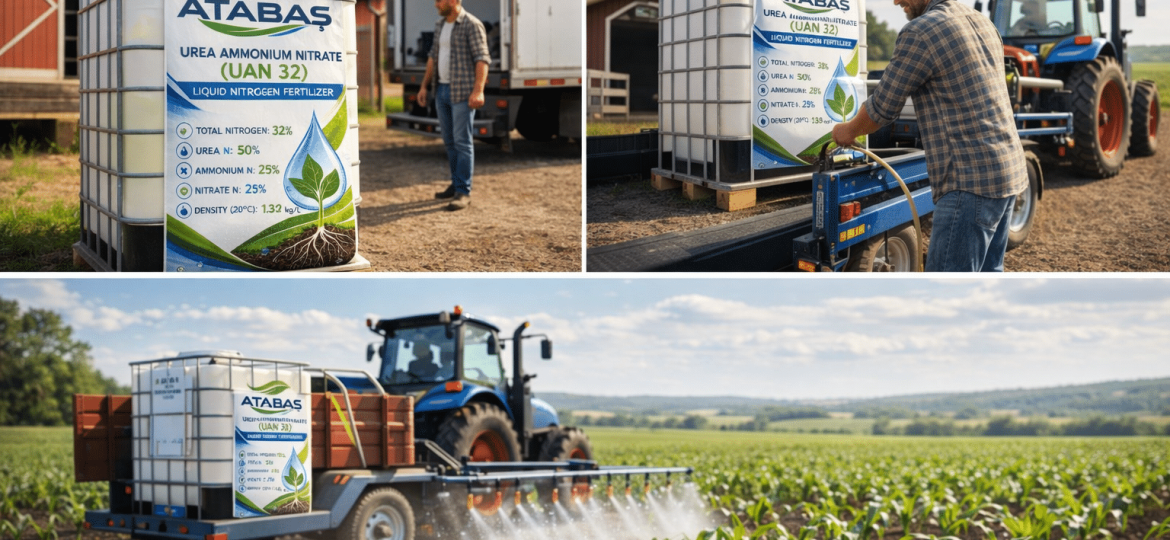
Urea Ammonium Nitrate UAN Which Country to Buy From is a strategic question for fertilizer importers, agricultural distributors, and commodity traders. Choosing the right origin affects pricing stability, supply security, freight cost, and long term profitability. Therefore, buyers must evaluate production structure, gas economics, export reliability, and geopolitical exposure before signing contracts.
Urea Ammonium Nitrate, commonly known as UAN, represents one of the most widely used liquid nitrogen fertilizers in modern agriculture. Large scale farming operations prefer UAN because it allows uniform application, efficient nitrogen uptake, and flexible blending options. Moreover, liquid systems integrate easily into precision agriculture models.
Selecting a supplier country requires more than comparing FOB prices. Instead, buyers must analyze upstream ammonia supply, natural gas cost structure, export policy behavior, and regional demand cycles.
What Is Urea Ammonium Nitrate UAN
UAN is a liquid nitrogen solution produced by blending:
- Urea
- Ammonium nitrate
- Water
Producers begin with ammonia synthesis derived from natural gas. They convert ammonia into urea and ammonium nitrate, then mix both components in specific ratios to achieve targeted nitrogen concentration. As a result, UAN contains three nitrogen forms: urea nitrogen, ammoniacal nitrogen, and nitrate nitrogen. This combination supports both immediate and gradual nitrogen availability for crops.
Unlike granular fertilizers, UAN remains in liquid form throughout storage and transportation. Consequently, it requires dedicated tank systems and corrosion resistant infrastructure. Buyers must confirm storage compatibility before procurement.
UAN Technical Grades and Product Specifications
Global markets trade UAN in three primary grades. Each grade offers different nitrogen concentration and crystallization behavior.
UAN Product Specification Table
| Grade | Total Nitrogen | Urea Nitrogen | Ammonium Nitrogen | Nitrate Nitrogen | Density at 20 C | Main Use |
|---|---|---|---|---|---|---|
| UAN 28 | 28 percent | Approx 50 percent of total N | Approx 25 percent | Approx 25 percent | 1.28 kg per liter | Cold regions |
| UAN 30 | 30 percent | Approx 50 percent | Approx 25 percent | Approx 25 percent | 1.30 kg per liter | General agriculture |
| UAN 32 | 32 percent | Approx 50 percent | Approx 25 percent | Approx 25 percent | 1.32 kg per liter | High nitrogen demand crops |
Farmers in colder climates prefer UAN 28 because it reduces crystallization risk. In contrast, UAN 32 dominates high demand markets due to higher nitrogen concentration. Therefore, climate and storage temperature must guide grade selection.
Application Areas and Crop Usage
UAN supports multiple crop types across industrial agriculture systems. Its liquid nature allows flexible application methods, including soil injection and fertigation.
UAN Crop Application Table
| Crop | Common Grade | Application Method | Primary Benefit |
|---|---|---|---|
| Corn | UAN 32 | Soil injection | Supports high nitrogen demand |
| Wheat | UAN 30 | Surface application | Balanced nutrient release |
| Cotton | UAN 32 | Side dressing | Nitrogen supply in vegetative stage |
| Soybean | UAN 28 | Supplemental feeding | Corrects nitrogen deficiency |
| Industrial crops | UAN 30 | Fertigation | Precision nutrient control |
Large scale corn production in the United States drives global UAN demand. Consequently, North American planting cycles heavily influence international pricing.
Leading UAN Producing Countries
When evaluating Urea Ammonium Nitrate UAN Which Country to Buy From, buyers should assess production scale, gas economics, and export reliability.
United States
The United States leads global UAN production. Integrated producers such as CF Industries operate large ammonia and nitrogen complexes supported by domestic shale gas. Strong pipeline infrastructure and river barge systems enhance distribution efficiency.
However, seasonal planting demand increases domestic consumption sharply. As a result, export availability may tighten during peak agricultural periods. Buyers seeking long term stability often prefer US supply despite occasional seasonal premiums.
Russia
Russia ranks among the largest nitrogen fertilizer exporters worldwide. Competitive natural gas pricing supports cost efficient ammonia production. Russian FOB prices often attract price sensitive buyers.
Nevertheless, geopolitical exposure and sanction risks require careful contract structuring. Buyers must diversify payment mechanisms and secure appropriate insurance coverage.
Trinidad and Tobago
Trinidad and Tobago operates as a significant ammonia exporter due to abundant natural gas resources. Its Atlantic access facilitates shipment to the Americas and Europe.
Although total capacity remains smaller than the United States, the country offers diversification opportunities for international traders.
Algeria
Algeria benefits from competitive gas pricing and Mediterranean port access. Export oriented nitrogen production supports regional buyers in Southern Europe and North Africa.
While pricing remains competitive, availability may depend on domestic allocation priorities.
Egypt
Egypt continues expanding nitrogen fertilizer production capacity. Its geographic position offers logistical advantages for Mediterranean and Middle Eastern markets.
Domestic agricultural needs sometimes influence export volumes. Therefore, structured long term contracts improve supply reliability.
Key Decision Factors for Country Selection
Buyers should evaluate several critical variables before selecting an origin.
Natural Gas Cost Structure
Since ammonia production relies heavily on natural gas, countries with structural gas advantages maintain lower production costs. Monitoring global gas indices helps forecast pricing direction.
Export Policy Stability
Governments occasionally restrict fertilizer exports during food security concerns. Stable regulatory environments reduce disruption risk.
Freight Economics
Liquid fertilizers require dedicated tank vessels and storage infrastructure. Shipping distance directly affects landed cost. Therefore, sourcing from geographically closer producers may improve margin structure.
Seasonal Demand Patterns
Planting cycles influence regional demand spikes. Purchasing during low demand months often provides better pricing opportunities.
Risk Assessment in UAN Trade
UAN markets react quickly to upstream volatility. Natural gas price fluctuations can alter ammonia production cost within weeks. Furthermore, geopolitical tensions may disrupt supply chains or payment channels.
Additionally, liquid fertilizer storage requires temperature management and corrosion protection. Infrastructure limitations can increase operational risk.
Traders who diversify sourcing countries reduce exposure to single region disruptions. Balanced procurement strategy enhances resilience during volatile market conditions.
Regional Sourcing Strategy
European importers frequently source from Algeria or Egypt due to freight efficiency. North American buyers typically prioritize domestic US supply for logistical simplicity. Mediterranean buyers benefit from geographic proximity to North African producers. Meanwhile, global traders seeking price arbitrage often evaluate Russia and Trinidad, although they implement structured risk controls.
Conclusion
The question Urea Ammonium Nitrate UAN Which Country to Buy From does not have a single universal answer. Each origin presents unique advantages and risk profiles. The United States offers reliability and scale. Russia provides cost competitiveness with geopolitical considerations. Trinidad and Tobago supports diversification. Algeria and Egypt deliver freight advantages for regional markets.
Ultimately, successful procurement depends on balancing cost, logistics, regulatory stability, and long term supply security. Buyers who combine market intelligence with disciplined risk management secure competitive nitrogen supply while protecting operational continuity.
