

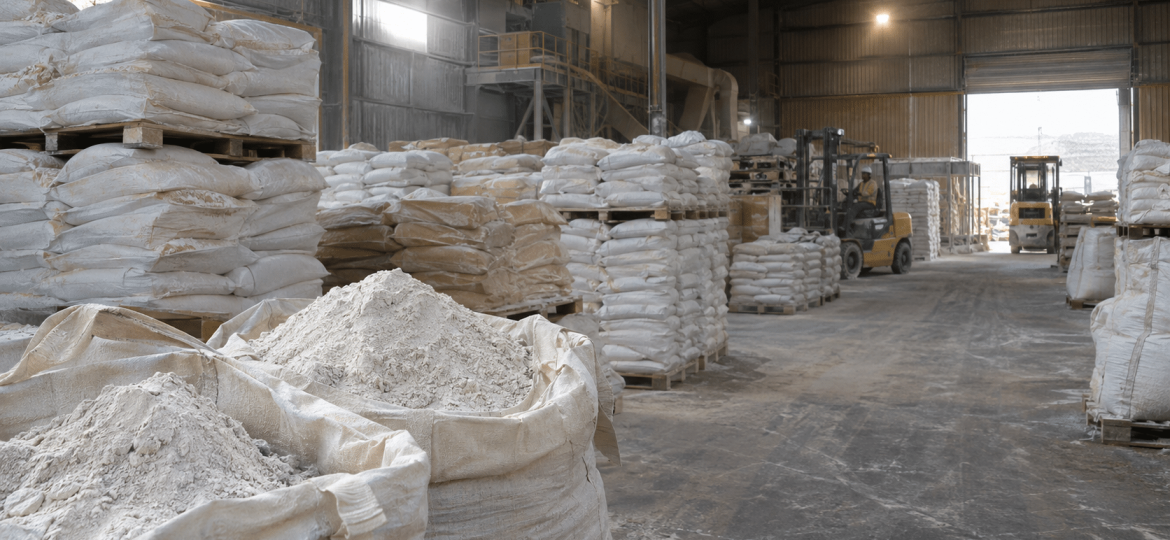
Barite export from Türkiye plays a key role in the global supply of industrial minerals for oil and gas drilling, paints, plastics, rubber and heavy concrete. Moreover, Türkiye has natural barite deposits that support the supply of several commercial grades.
Because barite has a high density and low water solubility, many industries use it as a weight agent or mineral filler. For example, oilfield teams use ground barite to increase the density of drilling mud.
Meanwhile, paint and plastic plants use selected grades to improve the physical traits of their products. Furthermore, barite can serve radiation shielding and heavy concrete projects.
However, natural barite deposits differ in purity, density, colour and mineral content. Therefore, buyers should check the actual product grade before placing an order.
Türkiye has a strong mining sector, mineral processing plants and access to major ports. Consequently, these advantages support barite export to global industrial markets.
ATABAŞ GLOBAL combines industrial mineral supply with global trade and freight services. As a result, we assess product quality, order size and shipping needs together.
1. What Is Barite (Barium Sulfate)?
Barite is a natural mineral that mainly consists of barium sulfate (BaSO₄). Moreover, it belongs to the sulfate mineral group.
Unlike many common minerals, barite has a relatively high density. Consequently, it offers useful properties for drilling fluids, heavy concrete and several industrial goods.
Furthermore, pure barium sulfate has very low water solubility.
However, natural barite may contain quartz, calcite, iron minerals and other materials. Therefore, its actual properties depend on the deposit and processing method.
General Product Information
| Product Information | Description |
|---|---|
| Commercial Name | Barite |
| Alternative Name | Barytes |
| Chemical Name | Barium Sulfate |
| Chemical Formula | BaSO₄ |
| CAS Number | 7727-43-7 |
| EC Number | 231-784-4 |
| HS Code | 251110 |
| Molar Mass | 233.39 g/mol |
| Mineral Family | Sulfates |
| Crystal System | Orthorhombic |
| Pure Mineral Density | Approximately 4.5 g/cm³ |
| Mohs Hardness | 3–3.5 |
| Colour | White, cream, grey, brown or pale yellow |
| Physical Form | Lumps, grains or powder |
| Water Solubility | Very low |
| Main Use | Drilling fluid weight agent |
| Drilling Standard | API Specification 13A |
| Common Packing | 25 kg bags and Big Bags |
However, commercial mineral density may fall below the density of pure barium sulfate.
Therefore, buyers should request actual density and purity test results.
Natural Barite and Precipitated Barium Sulfate
Natural barite comes from mineral deposits. In contrast, producers make precipitated barium sulfate through chemical processes.
Moreover, these products may differ in purity, grain size, colour and surface traits.
For example, natural ground barite commonly serves drilling and industrial filler markets. Meanwhile, precipitated grades may serve high-quality paints, plastics and other specialty goods.
However, the same chemical formula does not make all grades equal.
Consequently, buyers should select the material according to its final use.
2. Barite Export from Türkiye
Türkiye has several natural barite deposits and an established mineral trade sector.
Furthermore, mining and grinding plants can prepare different product forms for local and global buyers.
For example, customers may require natural lumps, drilling powder or fine white barite.
However, each grade needs suitable raw material and quality checks.
Therefore, barite export from Türkiye covers several distinct industrial markets.
Turkish Barite Mining Regions
Important barite resources occur in several parts of Türkiye.
| Region | Mining Area |
|---|---|
| Konya | Beyşehir and surrounding areas |
| Isparta | Şarkikaraağaç and nearby deposits |
| Antalya | Gazipaşa region |
| Muş | Regional barite deposits |
| Kahramanmaraş | Selected mineral deposits |
| Giresun | Barite-bearing mineral resources |
However, deposits may differ greatly in mineral purity, colour and density.
Furthermore, the presence of a mineral resource does not confirm active production or current stock.
Therefore, customers should verify the actual mine source and product data.
Advantages of Turkish Barite Export
Türkiye connects European, Middle Eastern, African and Asian markets through major trade routes.
Moreover, its mineral plants can process suitable raw barite into different grain sizes.
For example, oilfield customers may request API-grade ground barite. Meanwhile, paint plants may need fine, light-coloured powder.
Furthermore, buyers can request trial orders or regular bulk shipments.
However, stock levels and freight costs depend on the actual grade and destination.
Consequently, ATABAŞ GLOBAL reviews each inquiry before confirming commercial terms.
3. Global Barite Export Market and Trade Statistics
Barite is an important mineral in global oilfield and industrial trade.
Moreover, international customs code HS 251110 covers natural barium sulfate, also known as barytes.
However, the code does not separate drilling grades from other natural barite products.
Therefore, customs data provides a broad view of the natural barite market.
Global Barite Export Statistics – 2025
| Country | Export Volume (MT) | Export Value (USD) |
|---|---|---|
| India | 2,013,890 | 144,310,540 |
| China | 786,871 | 143,066,910 |
| Morocco | 1,102,420 | 129,874,510 |
| Netherlands | 108,687 | 43,869,860 |
| Kazakhstan | 276,473 | 42,577,320 |
| Türkiye | Not reported | 33,655,790 |
| Spain | 40,449.50 | 22,988,320 |
| Bulgaria | 76,834.50 | 11,383,060 |
Source: World Bank WITS – Global Barite Exports 2025.
India leads the reported 2025 national export rankings by value. Meanwhile, China and Morocco also hold strong market positions.
Furthermore, Türkiye remains an important source of natural barite.
However, the European Union reports joint trade totals separately.
Therefore, the table presents selected countries and excludes the EU total to avoid double counting.
Global Barite Export Statistics – 2024
| Country | Export Volume (MT) | Export Value (USD) |
|---|---|---|
| India | 1,769,340 | 151,245,070 |
| China | 856,981 | 143,993,470 |
| Morocco | 931,626 | 105,246,440 |
| Türkiye | 338,910 | 68,584,370 |
| Netherlands | 97,770.70 | 37,853,890 |
| Kazakhstan | 191,833 | 29,022,850 |
Source: World Bank WITS – Global Barite Exports 2024.
Türkiye ranked fourth among the reported national exporters by value in 2024.
However, export rankings do not always match mine output rankings.
For example, some countries export mineral products that they first bought from abroad.
Moreover, processed mineral grades may have higher unit values than raw lumps.
Consequently, trade values do not directly show the amount of each commercial grade.
4. Global Barite Import Markets
Oil and gas drilling creates a major share of global barite demand.
Furthermore, paint, plastic, rubber and building projects support other markets.
However, the type of barite that each industry requires may differ.
Therefore, buyers should assess grade-specific demand alongside general trade data.
Global Barite Import Statistics – 2025
| Country | Import Volume (MT) | Import Value (USD) |
|---|---|---|
| United States | 2,195,940 | 271,326,790 |
| Saudi Arabia | 985,459 | 122,611,830 |
| Argentina | 293,288 | 47,989,410 |
| Kuwait | 88,706.70 | 34,734,540 |
| Norway | 142,191 | 32,712,350 |
| Italy | 101,422 | 29,504,140 |
| Netherlands | 153,687 | 28,920,940 |
| Germany | 44,908.10 | 20,040,110 |
| Thailand | 231,021 | 19,028,270 |
| Canada | 179,108 | 18,276,180 |
| Spain | 63,275.40 | 16,647,030 |
| Indonesia | 82,891.10 | 15,075,780 |
| Türkiye | Not reliably reported | 13,106,600 |
| Oman | 84,019 | 10,655,910 |
Source: World Bank WITS – Global Barite Imports 2025.
The United States leads the reported national import rankings by value.
Meanwhile, Saudi Arabia represents another major market.
Furthermore, Norway, Kuwait and several European countries import large amounts of natural barite.
However, these figures cover all natural barite grades rather than drilling-grade products alone.
Middle Eastern Barite Markets
Oilfield projects create strong demand for drilling materials across the Middle East.
For example, Saudi Arabia, Kuwait, Oman, Qatar and the United Arab Emirates have established oilfield supply networks.
Moreover, large drilling programs may require regular mineral shipments.
However, customers may also require approved suppliers and specific quality tests.
Therefore, barite export to these markets requires clear grade and batch data.
European Barite Markets
Europe has established paint, plastic, rubber and industrial mineral markets.
For example, selected plants use fine barite as a filler.
Meanwhile, offshore drilling projects create demand for suitable high-density grades.
Furthermore, heavy concrete projects may require barite grains or crushed mineral products.
However, each use calls for different quality limits.
Consequently, buyers should select grades based on their own process.
American, African and Asian Markets
The United States represents a major market for drilling-grade barite.
Meanwhile, oilfield projects in Guyana, Argentina and other markets support mineral demand.
Furthermore, energy and building projects create supply needs across parts of Africa and Asia.
However, barite has a high cargo weight, which can raise inland freight costs.
Therefore, buyers should compare supply sources and shipping routes carefully.
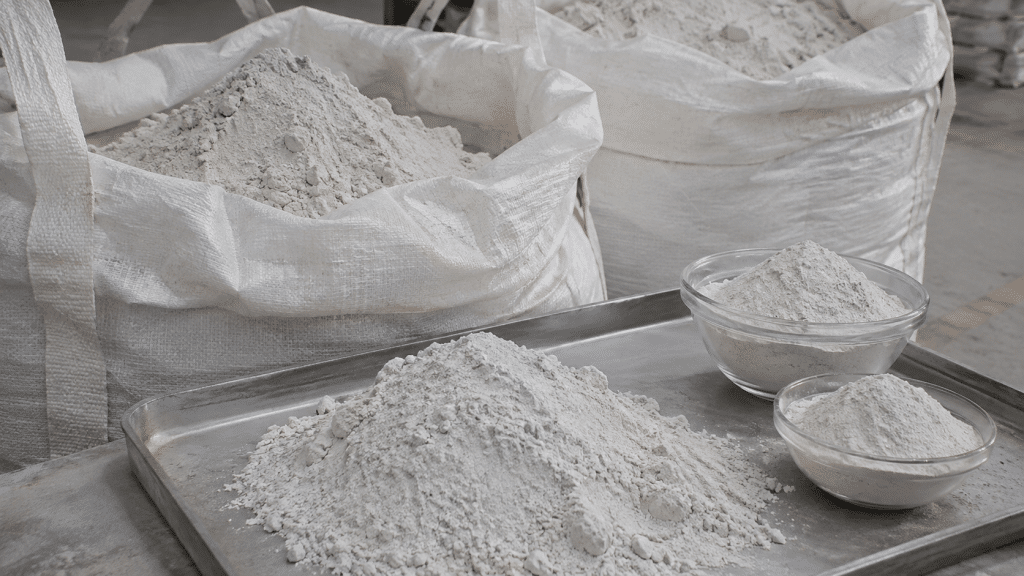
5. Türkiye Barite Export Statistics and Customs Regulations
Türkiye takes part in both the export and import of natural barite.
Moreover, the country has trade links with major oilfield and industrial markets.
However, trade records do not always identify the mine origin or final product grade.
Türkiye Barite Trade – 2024 and 2025
| Trade Indicator | 2024 | 2025 |
|---|---|---|
| Export Value | USD 68,584,370 | USD 33,655,790 |
| Export Volume | 338,910 MT | Not reported |
| Import Value | USD 28,362,650 | USD 13,106,600 |
| Import Volume | 189,334 MT | Not reliably reported |
| HS Code | 251110 | 251110 |
Sources: Türkiye Barite Exports 2024, Türkiye Barite Exports 2025, Türkiye Barite Imports 2024 and Türkiye Barite Imports 2025.
Türkiye reported lower barite export and import values in 2025 than in 2024.
However, missing weight data prevents a reliable review of annual shipment volumes.
Therefore, the table does not treat missing or zero weight entries as actual zero trade.
Türkiye Barite Export Destinations – 2025
| Destination | Export Volume (MT) | Export Value (USD) |
|---|---|---|
| Guyana | 7,525.50 | 4,152,420 |
| Egypt | Not reliably reported | 2,816,650 |
| Germany | Not reported | 2,688,220 |
| Italy | Not reliably reported | 2,464,560 |
| Norway | 3,050 | 2,291,500 |
| Kyrgyzstan | 4,696.84 | 2,117,970 |
Source: World Bank WITS – Türkiye Barite Export Destinations 2025.
Guyana leads Türkiye’s reported barite export destinations by value in 2025.
Meanwhile, Egypt, Germany, Italy and Norway also represent key markets.
Furthermore, these trade links show the broad reach of barite supply from Türkiye.
However, customs records do not show the exact final use of each cargo.
Barite Export HS Codes and GTIP
Natural barite and chemically produced barium sulfate fall under different customs groups.
| Product | HS Code |
|---|---|
| Natural Barite (Barytes) | 251110 |
| Natural Barium Carbonate (Witherite) | 251120 |
| Chemically Produced Barium Sulfate | 283327 |
| Other Formulated Mineral Products | Based on product content |
Moreover, Türkiye uses additional digits within its GTIP system.
Therefore, suppliers should check the full product code before shipment.
Barite Export Quotas and Trade Rules
Reported trade volumes do not represent legal export quotas.
Furthermore, each country may apply its own customs duties and product rules.
However, this article does not establish whether a specific export restriction applies to a given cargo.
Therefore, buyers should check current trade rules before placing an order.
Official sources include the Republic of Türkiye Ministry of Trade and the WTO Quantitative Restrictions Database.
6. Barite Export Grades and Commercial Types
Barite comes in several natural and processed forms.
For example, drilling grades focus mainly on density and grain size. In contrast, filler grades may require high purity and whiteness.
Furthermore, specialty products can have strict limits for certain metals and other minerals.
Consequently, the final use should guide grade selection.
API 4.1 Drilling Barite Export
API 4.1 barite refers to a drilling-grade mineral with a minimum density of 4.10 g/cm³ under the relevant test method.
Moreover, this grade must meet the other applicable API test limits.
For example, grain size and soluble alkaline earth metals form part of the quality checks.
However, density alone does not establish API compliance.
Therefore, buyers should request complete batch test results.
API 4.2 Drilling Barite Export
API 4.2 barite requires a minimum density of 4.20 g/cm³ under the applicable test method.
Because this grade has a higher minimum density, it can help achieve mud weight targets with a smaller mineral volume than lower-density grades.
Furthermore, oilfield buyers often specify this grade in their purchase terms.
However, the full API test results remain important.
Consequently, buyers should check more than the stated density.
Micronized Barite
Producers grind and screen natural barite to create fine mineral powder.
For example, paint and plastic plants may request defined D50 and D97 grain sizes.
Moreover, fine grinding can help the powder disperse within suitable product mixes.
However, very fine powder may behave differently from standard drilling barite.
Therefore, customers should state their required grain size and test method.
White Barite Export
White barite refers to light-coloured natural barium sulfate.
Furthermore, suitable white grades can serve paints, plastics and other colour-sensitive goods.
However, colour alone does not prove high chemical purity.
For example, a light-coloured mineral may still contain quartz or other minerals.
Consequently, buyers should request whiteness, BaSO₄ content and impurity test results.
Natural Barite Lumps
Raw or crushed barite can serve mineral grinding plants and other industrial users.
Moreover, customers may purchase lumps for further treatment near their own factories.
However, raw ore may contain unwanted rock and other minerals.
Therefore, buyers should confirm lump size, density and chemical content before shipment.
Precipitated Barium Sulfate
Producers make precipitated barium sulfate through chemical reactions rather than direct mineral grinding.
Consequently, they can achieve selected purity and grain size targets.
Furthermore, these grades may serve fine coatings, plastics and specialty goods.
However, precipitated barium sulfate falls under a different customs code from natural barite.
Therefore, its trade figures should not be added directly to natural barite export data.
Commercial Barite Grade Comparison
| Commercial Grade | Main Property | Typical Use |
|---|---|---|
| API 4.1 Barite | Minimum density of 4.10 g/cm³ | Oilfield drilling |
| API 4.2 Barite | Minimum density of 4.20 g/cm³ | Oilfield drilling |
| High-Density Natural Barite | Grade-specific density | Industrial weight agents |
| White Barite | Light colour | Paints and plastics |
| Micronized Barite | Fine grain size | Coatings and fillers |
| Barite Lumps | Natural or crushed ore | Grinding plants |
| Granular Barite | Controlled grain size | Heavy concrete |
| Chemical-Grade Barite | Defined mineral purity | Barium compound production |
| Precipitated Barium Sulfate | Controlled purity and grain size | Specialty goods |
However, these grade groups may overlap.
Consequently, buyers should define the exact product needs rather than rely on a commercial name alone.
7. Barite Chemical Properties and Production Process
Barite has a stable mineral structure with a high barium sulfate content.
Moreover, its high density makes it useful where products need extra weight.
However, the amount of BaSO₄ and other minerals varies between deposits.
Therefore, each commercial grade needs suitable chemical and physical tests.
Chemical Composition of Barium Sulfate
The chemical formula of pure barite is:
BaSO₄
Pure barium sulfate contains barium, sulfur and oxygen.
| Component | Theoretical Mass Content |
|---|---|
| Barium (Ba) | 58.84% |
| Sulfur (S) | 13.74% |
| Oxygen (O) | 27.42% |
| Barium Oxide Equivalent (BaO) | 65.70% |
| Sulfur Trioxide Equivalent (SO₃) | 34.30% |
However, these values describe pure BaSO₄ rather than every natural barite product.
Furthermore, the oxide values express the chemical makeup on an oxide basis. They do not mean that free BaO and SO₃ occur in the mineral.
Consequently, buyers should request the actual chemical test report.
Barite Purity and Mineral Content
Natural barite may contain several other minerals.
For example, quartz can increase silica content. Meanwhile, calcite and dolomite can affect overall density.
Furthermore, iron minerals may change product colour.
However, the effect of each mineral depends on its amount and the final use.
Therefore, buyers should assess density and chemical content together.
Barite Mining and Ore Recovery
Most commercial barite supply begins with the recovery of natural ore.
First, mining teams recover suitable mineral material.
Next, they sort the ore and remove unwanted rock.
Afterwards, the material moves to a processing plant.
However, the quality of raw ore may vary within the same mine.
Consequently, sorting and blending help maintain a more stable product grade.
Mineral Separation and Grinding
Producers may use washing, gravity separation or flotation to improve mineral quality.
Furthermore, suitable treatment can remove some unwanted minerals.
Afterwards, grinding and screening help reach the target grain size.
However, not every ore needs the same treatment.
Therefore, plants choose processing methods based on raw ore quality and the final product.
General Barite Production Stages
A typical natural barite supply chain may include:
- Mineral mining
- Raw ore sorting
- Crushing
- Mineral separation
- Washing, where needed
- Drying
- Grinding
- Screening
- Quality checks
- Packing and storage
However, some customers purchase crushed ore without further grinding.
Consequently, production steps depend on the final grade and buyer needs.
8. API 4.1 and API 4.2 Standards for Drilling Barite Export
Drilling barite must meet defined quality limits.
Furthermore, API Specification 13A provides technical rules for several drilling fluid materials, including barite.
Because drilling fluids need stable weight and flow, density and grain size play key roles in product selection.
Therefore, buyers should request the applicable standard edition and complete test results.
API Drilling Barite Technical Specifications
| Test Parameter | API Barite 4.1 | API Barite 4.2 |
|---|---|---|
| Density | Min. 4.10 g/cm³ | Min. 4.20 g/cm³ |
| Water-Soluble Alkaline Earth Metals, as Calcium | Max. 250 mg/kg | Max. 250 mg/kg |
| Residue Above 75 µm | Max. 3.0% | Max. 3.0% |
| Particles Below 6 µm | Max. 30% | Max. 30% |
These figures provide commonly cited API reference limits for the two barite categories.
However, labs must follow the correct test methods.
Furthermore, oilfield contracts may include additional quality limits.
Therefore, buyers should confirm the current API requirements before approving a grade.
Official standards information is available from the American Petroleum Institute.
Barite Density and Mud Weight
Barite adds weight to drilling fluids due to its high mineral density.
Consequently, suitable barite grades help drilling teams reach the required mud weight.
However, the final mud density also depends on the amount of water, oil and other solids in the fluid.
Furthermore, high mineral density alone does not prevent solids from settling.
Therefore, engineers should assess the full drilling fluid system.
Grain Size and Barite Sag
Barite sag occurs when weight material settles within a drilling fluid.
Moreover, fluid flow, well angle, solids content and grain size can affect this process.
For example, poor solids suspension can lead to uneven mud density.
However, grain size alone does not determine sag risk.
Consequently, drilling teams should assess the complete fluid design and operating conditions.
API Compliance and Manufacturer Licensing
A barite grade may meet the technical limits of API 13A without carrying an API Monogram.
Furthermore, a general quality certificate does not prove that a plant holds an API licence.
Therefore, buyers should verify the manufacturer’s licence when the contract requires one.
In addition, actual batch test results should support the agreed grade.
9. Industrial Applications of Barite
Barite serves several industries because of its high density, low water solubility and mineral stability.
Moreover, selected fine grades can serve as fillers in many manufactured goods.
However, each use calls for different product traits.
Therefore, customers should select grades according to the final process.
Oil and Natural Gas Drilling
Oilfield teams use barite as a weight agent in drilling mud.
Because the mineral adds weight to the fluid, it helps engineers maintain the required pressure balance in the well.
Furthermore, barite can serve both water-based and oil-based mud systems.
However, the complete fluid design must meet actual well conditions.
Consequently, engineers often use barite alongside other drilling fluid additives.
Paints and Coatings
Paint plants use selected barite grades as mineral fillers.
For example, fine white grades can support surface finish and product density.
Furthermore, suitable particle sizes can help achieve the required coating properties.
However, natural mineral impurities may affect colour and gloss.
Therefore, buyers should check whiteness, grain size and chemical purity.
Plastics and Polymer Products
Plastic plants use barite to increase the density of selected goods.
Moreover, fine grades may serve filled polymer mixes.
However, the mineral can affect processing flow and physical strength.
Consequently, producers should test the filler within their own polymer system.
Rubber Products
Barite can serve as a filler or weight agent in certain rubber goods.
For example, selected grades may help control product weight.
Furthermore, rubber plants can use fine mineral powder in suitable mixes.
However, filler content affects the final product traits.
Therefore, buyers should check grain size and compatibility with the rubber mix.
Brake Pads and Friction Materials
Selected barite grades serve certain brake pads and clutch products.
Moreover, the mineral can form part of the filler system.
However, friction goods require strict heat and wear tests.
Consequently, barite alone cannot establish the safety or quality of the finished product.
Heavy Concrete and Radiation Shielding
Barite can serve as a heavy aggregate in concrete.
Because of its high density, suitable barite concrete can help reduce the passage of X-rays and gamma rays.
For example, engineers may use heavy concrete in certain medical, research and nuclear facilities.
However, the required barrier depends on radiation type, energy and concrete design.
Therefore, qualified engineers must define the shielding needs of each project.
Offshore Pipeline Weight Coating
Subsea pipelines may require heavy concrete coatings to help control buoyancy.
Furthermore, suitable barite grades can add weight to selected concrete mixes.
However, the finished coating must meet strict strength and durability limits.
Consequently, buyers should request aggregate grades that suit the approved coating design.
Barium Chemical Production
Natural barite can serve as a raw material for certain barium compounds.
Moreover, chemical plants may require ore with strict purity limits.
However, high sulfate content alone does not establish suitability for every chemical process.
Therefore, customers should define the required chemical and mineral limits.
Glass and Ceramics
Selected barium-based materials serve specialty glass and ceramic goods.
Furthermore, suitable grades can help producers achieve specific physical traits.
However, raw barite does not suit every glass or ceramic mix.
Consequently, plants should confirm the exact chemical form required for their process.
Sound Control and Heavy Polymer Sheets
High-density mineral fillers can add mass to certain sound control products.
For example, barite can serve selected heavy polymer sheets and noise barrier goods.
However, the performance of a sound barrier depends on its full design.
Therefore, producers should test the finished product rather than rely on mineral density alone.
Medical Barium Sulfate
Pharmaceutical-grade barium sulfate can serve as a contrast agent in certain medical imaging procedures.
However, medical products require strict purity, safety and approval standards.
Natural industrial barite and drilling-grade barite must never be used as medical contrast agents.
Therefore, only approved pharmaceutical products should serve medical applications.
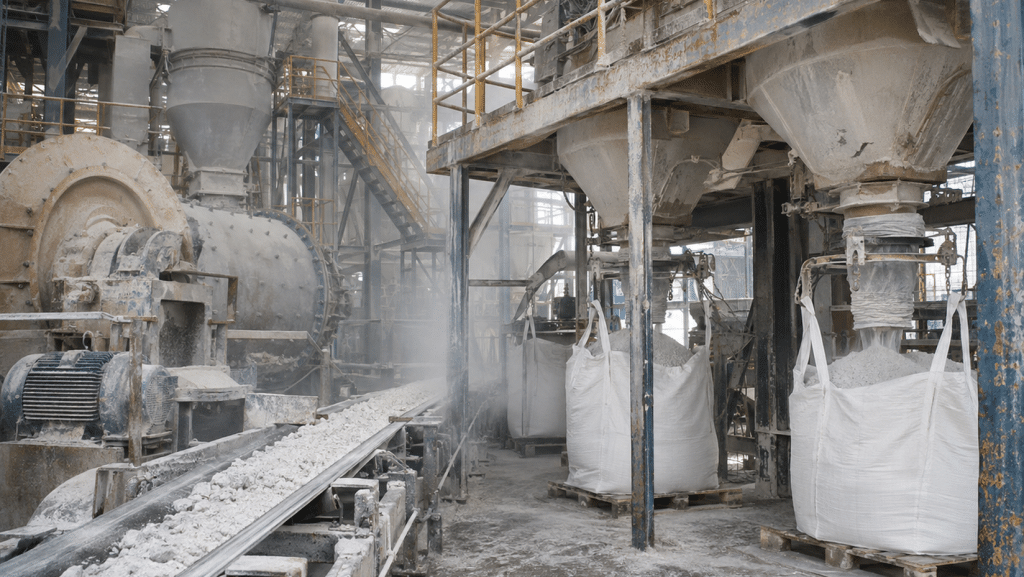
10. Barite Export Quality Control and Laboratory Testing
Stable mineral quality helps buyers maintain consistent factory and drilling results.
Moreover, changes in density, purity and grain size can affect product use.
Therefore, suppliers should check each batch against the agreed quality limits.
Barite Chemical and Mineral Tests
Labs can use X-ray fluorescence (XRF) to measure chemical content.
Meanwhile, X-ray diffraction (XRD) helps identify mineral phases.
However, these methods provide different types of data.
Consequently, buyers may need both tests to assess the mineral fully.
Barite Quality and Performance Tests
| Quality Parameter | Main Purpose |
|---|---|
| BaSO₄ Content | Chemical purity |
| Specific Gravity | Mineral density |
| SiO₂ | Silica content |
| Fe₂O₃ | Iron content |
| CaO | Calcium oxide equivalent |
| Moisture | Water content |
| Grain Size | Powder or lump size |
| D50 and D97 | Fine powder size profile |
| Whiteness | Colour-sensitive uses |
| Soluble Alkaline Earth Metals | Drilling grade quality |
| Mercury and Cadmium | Environmental quality checks |
| Bulk Density | Storage and freight planning |
| Oil Absorption | Filler use in coatings |
However, not every commercial grade needs all these tests.
For example, drilling buyers may focus on API limits. Meanwhile, coating plants may need whiteness and fine grain size data.
Therefore, test methods should match the final use.
Chemical Purity and Heavy Metal Limits
Natural barite may contain trace amounts of several metals.
Furthermore, offshore projects can have strict limits for mercury, cadmium and other substances.
However, the allowed limits may differ between markets and projects.
Therefore, buyers should check local rules and the actual batch results.
Pre-Shipment Barite Quality Checks
First, suppliers should confirm the product grade and batch number.
Next, labs can check the agreed density, purity and grain size limits.
Furthermore, customers may request third-party quality and weight checks.
However, a general Technical Data Sheet cannot replace actual batch results.
Consequently, suppliers should provide a Certificate of Analysis for the shipment.
11. Bulk Barite Export Packaging, Storage and Logistics
Barite has a high density compared with many industrial minerals.
Consequently, cargo weight plays a key role in packing and freight plans.
Moreover, fine mineral powder needs protection from moisture and contamination.
Therefore, suppliers should choose packing according to the product form and cargo size.
Barite Export Packaging Options
| Packing Type | Common Net Weight |
|---|---|
| Small Industrial Bag | 25 kg |
| Industrial Sack | 50 kg |
| Big Bag | 500 kg |
| Jumbo Bag | 1,000 kg |
| Large FIBC | 1,250 kg |
| Heavy-Duty Big Bag | 1,500 kg, if available |
| Loose Bulk | Based on cargo size |
Small bags can suit plants that use limited amounts of mineral powder.
Meanwhile, Big Bags can reduce the number of packages in large orders.
Furthermore, loose bulk cargo may suit grinding plants and other large industrial users.
However, bag strength and safe working load must match the actual cargo weight.
Therefore, buyers should confirm packing before shipment.
Barite Storage and Safe Handling
Warehouses should store packed barite in dry areas.
Moreover, workers should protect bags from physical damage and contamination.
Because fine mineral dust can harm the lungs, suitable dust control is important.
Furthermore, some natural barite grades may contain crystalline silica.
Therefore, workers should follow the current Safety Data Sheet and local workplace rules.
Further information is available from OSHA – Crystalline Silica.
Container Loading and Bulk Vessel Transport
Packed barite can travel in suitable dry freight containers.
For example, 20-foot containers often suit heavy mineral cargo.
However, high mineral density can cause the cargo to reach weight limits before filling the container.
Furthermore, pallets, bag size and local road limits affect the loading plan.
Meanwhile, large buyers may request loose bulk vessel shipments.
Consequently, suppliers should confirm cargo weight and unloading needs before booking freight.
Turkish Ports and Barite Export Logistics
ATABAŞ GLOBAL reviews suitable freight routes through Mersin, İzmir, Gebze, İstanbul and other Turkish port regions.
Moreover, the best loading port depends on the mine source and processing plant.
For container shipments, we work with established shipping firms such as CMA CGM, Maersk, MSC and Hapag-Lloyd.
However, carrier schedules and cargo acceptance rules may change.
Therefore, we review inland freight, port handling and sea transport together.
12. International Barite Export and Supply with ATABAŞ GLOBAL
Reliable barite supply requires stable mineral quality, suitable packing and timely freight.
Moreover, oilfield and factory buyers may need regular shipments.
Therefore, ATABAŞ GLOBAL reviews technical needs and trade terms together.
We assess inquiries for natural barite, API drilling barite, fine mineral powder, white barite and selected specialty grades based on supply availability.
International Delivery Terms
Buyers can request different Incoterms according to their freight needs.
For example, EXW allows goods collection at the agreed supply point.
Meanwhile, FCA allows the seller to hand the goods to the chosen carrier at the named place.
Under FOB terms, the seller delivers the cargo on board the vessel at the loading port.
Similarly, CFR requires the seller to arrange and pay for sea freight to the named destination port.
Under CIF terms, the seller also arranges the required cargo insurance.
However, under FOB, CFR and CIF, cargo risk passes to the buyer once the goods are on board the vessel at the loading port.
Furthermore, FCA, CPT and CIP may better suit certain container shipments.
Therefore, both parties should agree on the exact delivery point and trade terms.
Further information is available from the International Chamber of Commerce.
Barite Export Documents
A Technical Data Sheet (TDS) provides general product data.
Meanwhile, a Certificate of Analysis (COA) shows actual batch test results.
The Safety Data Sheet (SDS) also explains product risks and safe handling.
Furthermore, global mineral shipments may require the following documents:
- Proforma Invoice
- Commercial Invoice
- Packing List
- Certificate of Origin
- Bill of Lading
- Customs Export Declaration
- Inspection Certificate, if required
- Insurance Certificate, where needed
In addition, drilling buyers may request API test records and manufacturer licence details.
However, document needs differ by market and grade.
Therefore, both parties should agree on the required records before shipment.
Product Origin and Trade Compliance
The country of shipment may differ from the country of mineral origin.
Therefore, buyers should check the actual source of the goods.
Moreover, an A.TR movement certificate concerns the free circulation of eligible goods rather than their country of origin.
Furthermore, certain markets may require other origin records or product approvals.
ATABAŞ GLOBAL reviews product origin, trade rules and sanctions before confirming transactions.
Long-Term Barite Export and Bulk Supply
Regular shipments help oilfield and industrial buyers maintain suitable mineral stocks.
For example, drilling firms may need monthly deliveries during long projects.
Similarly, paint and plastic plants may require steady supplies throughout the year.
However, mine output, stock levels and freight costs can change.
Therefore, early purchase plans can help reduce supply risks.
Furthermore, clear grade limits help maintain steady product quality.
How to Request a Barite Export Quotation
First, customers should confirm their required barite grade and final use.
Next, they should provide the target density and BaSO₄ content.
Furthermore, details about grain size, moisture, whiteness and impurities help define the product.
For example, oilfield buyers should specify API 4.1 or API 4.2 requirements.
Meanwhile, paint plants may need D50, D97 and colour limits.
In addition, buyers should confirm total order size, monthly demand and packing.
Finally, delivery place, trade terms, inspection needs and shipment dates help us prepare a suitable commercial offer.
For barite export from Türkiye, API drilling barite, natural barium sulfate and international bulk mineral supply, contact ATABAŞ GLOBAL.
13. Frequently Asked Questions About Barite Export
Barite Properties and Commercial Grades
What is barite?
Barite is a natural mineral that mainly consists of barium sulfate. Moreover, it has a high mineral density.
What is the chemical formula of barite?
The chemical formula is BaSO₄.
What is the CAS number of barite?
The common CAS number for barium sulfate is 7727-43-7.
What is the density of pure barite?
Pure barite has a density of approximately 4.5 g/cm³. However, commercial grades may have lower values.
Does barite dissolve in water?
Barite has very low water solubility. Consequently, it remains mainly in solid form in water.
API Drilling Barite Standards
What is API 4.1 barite?
API 4.1 barite is a drilling grade with a minimum density of 4.10 g/cm³ and other defined quality limits.
What is API 4.2 barite?
API 4.2 barite is a drilling grade with a minimum density of 4.20 g/cm³ and other defined quality limits.
What is the difference between API 4.1 and API 4.2 barite?
The main difference is their minimum density. However, both grades must meet the applicable API test requirements.
Does high BaSO₄ content guarantee API compliance?
No. Therefore, buyers should also check density, grain size and soluble mineral content.
Can barite serve oil-based drilling fluids?
Yes. Suitable drilling grades can serve both oil-based and water-based mud systems.
Global Barite Export and Customs Rules
Which countries are major barite exporters?
India, China and Morocco lead the reported 2025 national rankings by export value.
How much barite does Türkiye export?
Türkiye exported 338,910 metric tons in 2024. Furthermore, its reported export value reached USD 33.66 million in 2025.
What is the HS code for natural barite?
Natural barite falls under HS 251110.
What is the HS code for precipitated barium sulfate?
Chemically produced barium sulfate generally falls under HS 283327.
Does Türkiye have barite export quotas?
This article has not verified a dedicated general export quota. Therefore, buyers should check current trade rules before shipment.
Barite Industrial Applications
Why do drilling teams use barite?
Barite increases drilling fluid density. Consequently, it helps engineers achieve required mud weight targets.
Can barite serve paint production?
Yes. For example, selected fine white grades can serve as mineral fillers in paints and coatings.
Can barite serve radiation shielding?
Yes. Suitable heavy concrete can contain barite. However, qualified engineers must define the final shielding design.
What is micronized barite?
Micronized barite is finely ground natural barite with a controlled grain size.
Is natural barite the same as precipitated barium sulfate?
Both mainly contain BaSO₄. However, their production methods, grain size and commercial uses may differ.
Bulk Barite Supply and Shipping
What packing options are available for barite?
Common options include 25 kg bags, 50 kg sacks, Big Bags and loose bulk cargo.
Can buyers request 1,500 kg Big Bags?
Yes, subject to supply availability and suitable bag strength. Furthermore, the cargo plan must meet weight limits.
How should warehouses store barite?
Warehouses should keep packed barite dry. Moreover, workers should follow the current Safety Data Sheet.
Can buyers request independent barite testing?
Yes. Buyers can request third-party density, purity, grain size and weight checks under agreed trade terms.
How can buyers request barite prices from ATABAŞ GLOBAL?
First, customers should confirm the grade and quality limits. Next, they should provide quantity, packing and delivery details. Finally, ATABAŞ GLOBAL can assess suitable supply and freight options.
