

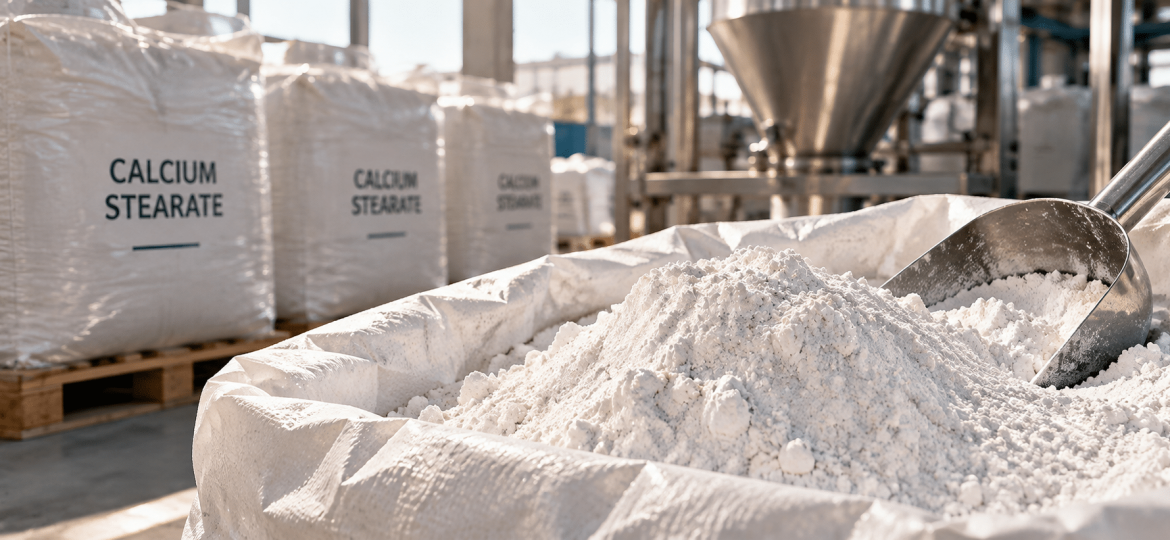
Calcium Stearate is a widely used metallic soap found in plastics, PVC, rubber, construction materials, coatings and other industrial products. In particular, manufacturers value it for its lubricating, release and water-repellent properties.
In addition, the material can work as a processing aid or acid scavenger in selected applications. However, performance depends on the grade and product quality. Therefore, buyers should check the technical data and intended use before selecting a product.
1. What Is Calcium Stearate?d
Calcium Stearate is the calcium salt of stearic acid. Its chemical formula is Ca(C₁₈H₃₅O₂)₂, while its molecular weight is about 607.0 g/mol.
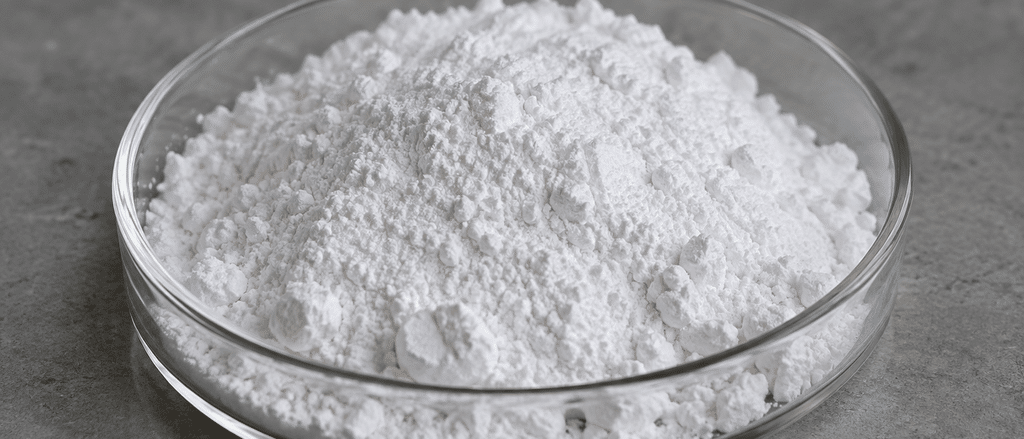
The product usually appears as a fine white or off-white powder. Moreover, it is practically insoluble in water.
Because of these properties, it can provide lubrication, release and water resistance in many industrial processes. As a result, it is used in both polymer and non-polymer applications.
2. Typical Technical Properties
Exact values vary by producer and grade. Therefore, the figures below should be used only as general industrial references.
| Property | Typical Information |
|---|---|
| Chemical Name | Calcium Stearate |
| Chemical Formula | Ca(C₁₈H₃₅O₂)₂ |
| Molecular Weight | About 607.0 g/mol |
| Appearance | White to off-white powder |
| Calcium Content | Grade dependent |
| Moisture | Grade dependent |
| Free Fatty Acid | Grade dependent |
| Water Solubility | Practically insoluble |
| Physical Form | Powder / granules / dispersion |
| Main Functions | Lubrication / release / processing / water resistance |
For this reason, buyers should always check the producer’s current TDS and shipment-specific COA before purchase or use.
3. Key Properties and Benefits
This additive can provide several useful functions. Moreover, some grades can perform more than one role in the same formulation.
| Property | Main Benefit |
|---|---|
| Lubricity | Helps reduce friction during processing |
| Water Resistance | Helps improve resistance to moisture |
| Release Properties | Helps products separate from molds and surfaces |
| Low Water Solubility | Useful in water-resistant applications |
| Acid Scavenging | Helps control acidic residues in selected polymers |
| Processing Support | Can improve processing behavior |
| Dispersion | Supports an even mix when the correct grade is used |
However, the importance of each feature depends on the final product. For this reason, the selected grade should match the intended application.
4. Where Is It Used?
The material is used across many industries. For example, plastics and rubber are major areas of use. In addition, selected grades are used in construction products, masterbatch, coatings, paper and adhesives.
| Industry | Typical Application | Main Function |
|---|---|---|
| PVC & Plastics | Pipes, profiles and compounds | Lubrication and processing |
| PE & PP | Polymer formulations | Acid scavenging and processing |
| Rubber | Rubber compounds | Release and processing aid |
| Construction | Cement and dry-mix products | Water resistance |
| Masterbatch | Polymer concentrates | Processing support |
| Coatings | Industrial coatings | Functional additive |
| Paper | Processing and coatings | Lubrication and water resistance |
| Adhesives | Selected formulations | Processing support |
Since each industry has different needs, buyers should choose the grade according to the final application.
5. Role in Plastics and PVC
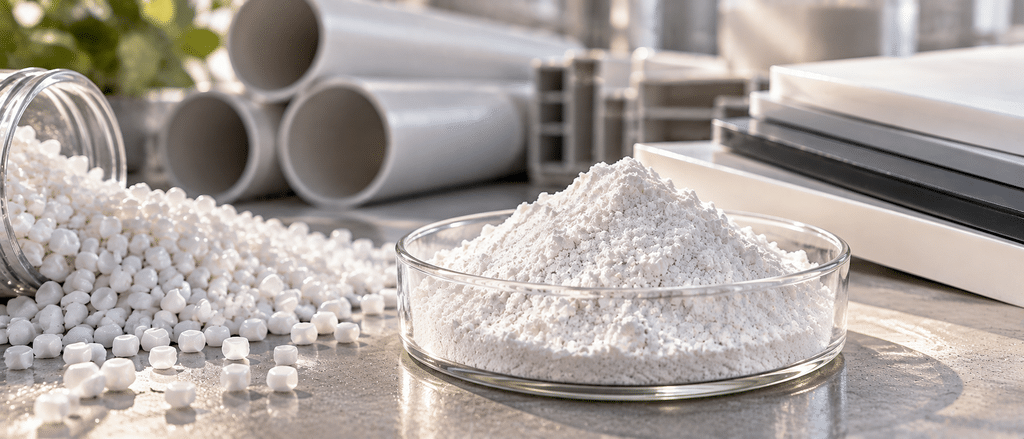
Plastics are one of the main application areas for metallic stearates. In fact, these additives can support several stages of polymer processing.
During production, friction between the polymer, equipment and other ingredients can affect processing. Therefore, suitable metallic stearates can help control friction and improve processing behavior.
In PVC, they are commonly used in lubrication and stabilizer systems. Meanwhile, suitable grades can act as acid scavengers in polyethylene and polypropylene.
In this role, the additive helps control acidic catalyst residues. As a result, the correct grade can support smoother processing and more consistent product quality.
6. Use in Construction Materials
The additive is also used in selected cement-based and dry-mix products.
Because it has water-repellent properties, it can help reduce water absorption when used in a suitable formulation. For example, applications may include:
- cement-based products;
- dry-mix mortars;
- waterproofing products;
- construction compounds;
- selected concrete products.
However, performance depends on dosage and the complete formulation. Therefore, manufacturers should carry out application tests before large-scale use.
7. Calcium vs. Zinc Stearate
Both products belong to the metallic stearate family. However, their performance can differ depending on the application.
| Feature | Calcium Stearate | Zinc Stearate |
|---|---|---|
| Metal Base | Calcium | Zinc |
| Water Solubility | Very low | Very low |
| Lubrication | Good | Strong in many applications |
| Release Performance | Good | Often strong |
| PVC Use | Common | Common |
| Construction Use | Used in selected products | Less common |
| Polyolefin Acid Scavenging | Common | Application dependent |
Therefore, neither product is always better than the other. Instead, the correct choice depends on the polymer, formulation, process and required result.
8. How Is It Produced?
Production generally involves a reaction between stearic acid or stearate species and a suitable calcium source.
The production method can affect particle size, purity, bulk density and free fatty acid content. In addition, raw material quality can influence the final product.
Important quality points include:
- calcium content;
- moisture;
- free fatty acid;
- particle size;
- bulk density;
- purity;
- appearance;
- batch consistency.
For this reason, products sold under the same chemical name may not perform in exactly the same way. Therefore, buyers should compare technical data rather than relying only on the product name.
9. Major Manufacturers
Several established companies produce metallic stearates and related industrial additives. For example, well-known manufacturers include:
| Producer | Main Product Area |
|---|---|
| Baerlocher | Metallic stearates and polymer additives |
| Peter Greven | Metallic soaps and specialty additives |
| FACI | Metallic stearates and industrial additives |
| Valtris Specialty Chemicals | Polymer additives and stabilizer systems |
| PMC Biogenix | Oleochemical and specialty additives |
However, product ranges and available grades may change. Therefore, buyers should check current technical data, production location and availability before placing an order.
10. Major Supply Markets
International trade data for this product must be interpreted carefully. In particular, there is no simple HS code that represents Calcium Stearate alone.
HS 291570 covers palmitic acid, stearic acid, their salts and esters. Therefore, this category includes Calcium Stearate as well as other related products.
As a result, HS 291570 data is useful for understanding the wider market, but it should not be presented as product-only trade data.
Within this broader category, established supply markets include Italy, Malaysia, China, India, Germany and other international chemical-producing markets.
However, origin should not be the only factor when selecting a supplier. Instead, buyers should also consider grade, technical documents, product consistency, supply capacity, delivery time and commercial terms.
11. Supply and Industrial Demand in Türkiye
Türkiye has strong plastics, PVC, rubber, cable, masterbatch and construction industries. Therefore, metallic stearates and related additives serve a broad range of industrial applications.
According to 2024 UN Comtrade data reported through the World Integrated Trade Solution (WITS), Türkiye imported approximately 4,147 MT, worth about USD 9.40 million, under HS 291570. By import value, the leading supply markets were Italy, Malaysia, China, India and Germany.
However, these figures represent the complete HS 291570 category. They do not represent Calcium Stearate alone. Therefore, the figures should be used as an indicator of the wider market for palmitic acid, stearic acid, their salts and esters.
When sourcing the material, buyers should focus on:
- required grade;
- final application;
- calcium content;
- particle size;
- purity;
- technical documents;
- packaging;
- supply capacity;
- delivery terms.
In this way, buyers can compare offers based on both technical and commercial needs rather than price alone.
Source: UN Comtrade / World Integrated Trade Solution (WITS), Türkiye Imports, HS 291570, 2024.
12. Industrial Sourcing with ATABAŞ GLOBAL
Before requesting an offer, buyers should clearly define their requirements.
For example, a PVC producer may require different particle properties from a construction materials producer. Therefore, application details are important when selecting a suitable grade.
ATABAŞ GLOBAL can assess sourcing requests according to the required product and commercial terms.
| Required Information | Example |
|---|---|
| Product | Calcium Stearate |
| Application | PVC / PE / PP / Rubber / Construction |
| Grade | Industrial / application-specific |
| Specification | According to buyer requirements |
| Quantity | MT per shipment / monthly demand |
| Packaging | 20–25 kg bags / Big Bags / producer standard |
| Destination | Country / port |
| Incoterm | EXW / FOB / CFR / CIF |
| Documents | TDS / SDS / COA |
| Supply Program | Spot / monthly / contractual |
Providing these details makes it easier to identify a suitable product. In addition, clear requirements help prepare a more accurate commercial offer.
13. What Should Buyers Check Before Purchasing?
Price is important. However, it should not be the only factor in an industrial purchase.
Buyers should also check:
- calcium content;
- moisture;
- free fatty acid;
- particle size;
- bulk density;
- purity and appearance;
- physical form;
- TDS, SDS and COA;
- producer and origin;
- packaging;
- delivery schedule;
- commercial terms.
In addition, proper storage helps protect product quality. The material should be stored in a dry and clean area, away from moisture and contamination.
Ultimately, the selected grade should match the needs of the final application. From plastics and PVC to rubber and construction materials, Calcium Stearate remains a useful additive for modern industrial production.
For this reason, technical quality, supply reliability and commercial terms should be considered together when making a purchase.
For commercial inquiries, ATABAŞ GLOBAL can assess requirements based on application, grade, specification, quantity, packaging, destination and delivery terms.
Frequently Asked Questions
What is Calcium Stearate?
It is the calcium salt of stearic acid. In industry, it is mainly used for lubrication, processing, release and water resistance.
What are its main uses?
Common applications include PVC, polyethylene, polypropylene, rubber, masterbatch and construction materials. In addition, selected grades are used in coatings and other industrial products.
Is it soluble in water?
No. It is practically insoluble in water. Therefore, it can be useful in selected applications where water resistance is required.
Why is it used in polymers?
Depending on the grade and formulation, it can provide lubrication, processing support and acid-scavenging properties. As a result, it can support stable processing in suitable polymer systems.
What should buyers check before purchasing?
Buyers should review calcium content, moisture, free fatty acid, particle size, purity, physical form and documents such as TDS, SDS and COA. In addition, packaging, availability and delivery terms should be checked.
Is HS 291570 specific to Calcium Stearate?
No. HS 291570 also covers palmitic acid, stearic acid, their salts and esters. Therefore, trade figures under this code should be used only as a wider market indicator.
