

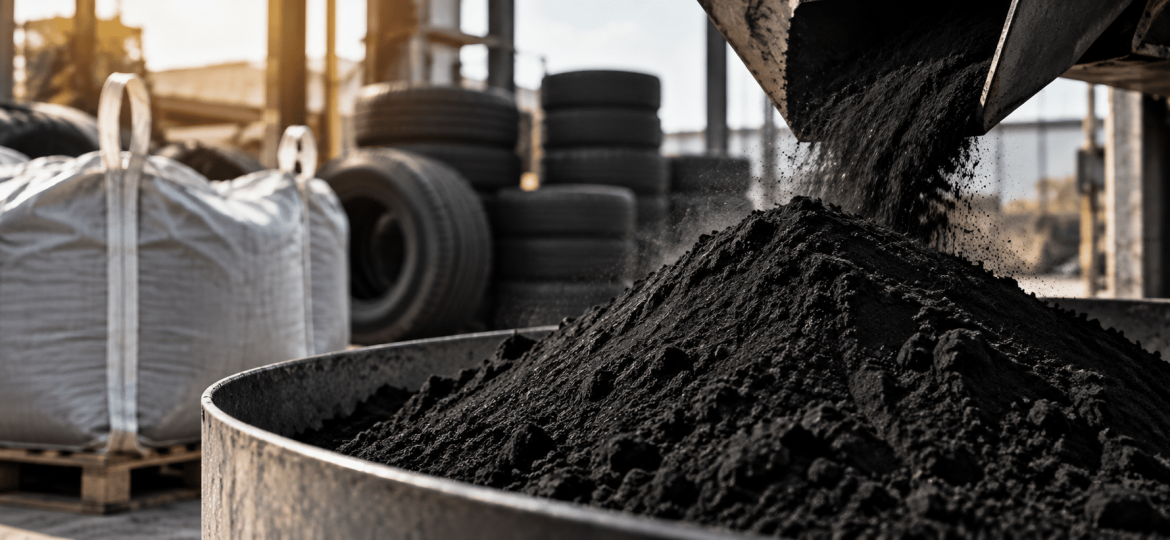
Carbon Black is an engineered carbon material widely used in tires, rubber products, plastics, masterbatch, coatings, inks, cables and other industrial applications.
The material does much more than provide black color. Depending on the grade, it can reinforce rubber, improve wear resistance, provide UV protection and control electrical conductivity.
However, each grade offers different performance. Particle size, surface area, structure and oil absorption can directly affect the final product. Therefore, selecting the right grade is just as important as comparing prices.
1. What Is Carbon Black?
Carbon Black is a fine carbon material produced mainly through the controlled partial combustion or thermal decomposition of hydrocarbon feedstocks.
During production, very small carbon particles form and join together into aggregates. Particle size, surface area, aggregate structure and surface properties determine the material’s performance.
Carbon Black is not the same as ordinary soot. Manufacturers carefully control production conditions to achieve defined technical properties and consistent quality.
As a result, different grades can provide reinforcement, pigmentation, UV protection or electrical conductivity for different industrial applications.
2. Main Carbon Black Grades and Technical Specifications
N220, N330, N550, N660 and N772 are among the widely recognized ASTM-type grades used in the rubber industry.
Each grade provides a different balance of surface area, structure and reinforcement.
| Grade | Iodine Absorption | STSA | OAN | General Characteristic |
|---|---|---|---|---|
| N220 | ~121 mg/g | ~106 m²/g | ~114 ml/100 g | High reinforcement |
| N330 | ~82 mg/g | ~76 m²/g | ~102 ml/100 g | Balanced high reinforcement |
| N550 | ~43 mg/g | ~39 m²/g | ~121 ml/100 g | Medium reinforcement |
| N660 | ~36 mg/g | ~34 m²/g | ~90 ml/100 g | Good processing and flexibility balance |
| N772 | ~30 mg/g | ~30 m²/g | ~65 ml/100 g | Semi-reinforcing applications |
Common Test Methods:
- Iodine Absorption: ASTM D1510
- STSA: ASTM D6556
- OAN: ASTM D2414
These values are representative commercial references. Buyers should always use the manufacturer’s current TDS and shipment-specific COA for final specifications.
3. Key Properties That Determine Carbon Black Performance
Grade selection requires more than checking the product name. Buyers should evaluate several technical parameters together.
| Property | Why It Matters |
|---|---|
| Particle Size | Influences reinforcement and color performance |
| Surface Area | Affects interaction with the polymer |
| Structure | Influences viscosity, dispersion and mechanical performance |
| Iodine Absorption | Provides information about surface characteristics |
| OAN | Helps evaluate aggregate structure |
| Tint Strength | Important for pigmentation |
| Moisture | Affects storage and processing |
| Ash Content | Important for purity control |
| Sieve Residue | Helps control coarse particles and contamination |
For example, smaller particles generally provide a higher surface area. Therefore, they may improve reinforcement or color performance in suitable formulations.
4. Where Is Carbon Black Used?
Tire and rubber production represent major areas of consumption. However, Carbon Black also serves many other industries.
| Industry | Typical Application | Main Function |
|---|---|---|
| Tires | Tread, sidewall and internal components | Reinforcement and durability |
| Mechanical Rubber Goods | Hoses, belts and seals | Strength and wear resistance |
| Plastics | Pipes, films and molded products | Pigmentation and UV protection |
| Masterbatch | Black concentrates | Color and functional performance |
| Coatings | Automotive and industrial coatings | Pigmentation |
| Printing Inks | Packaging and commercial printing | Black color |
| Wire & Cable | Cable compounds | UV protection and conductivity |
| Batteries | Conductive additives | Electrical conductivity |
| Adhesives & Sealants | Industrial formulations | Color and functional properties |
Therefore, a rubber grade and a specialty grade for plastics, pigments or conductive applications may require very different technical properties.
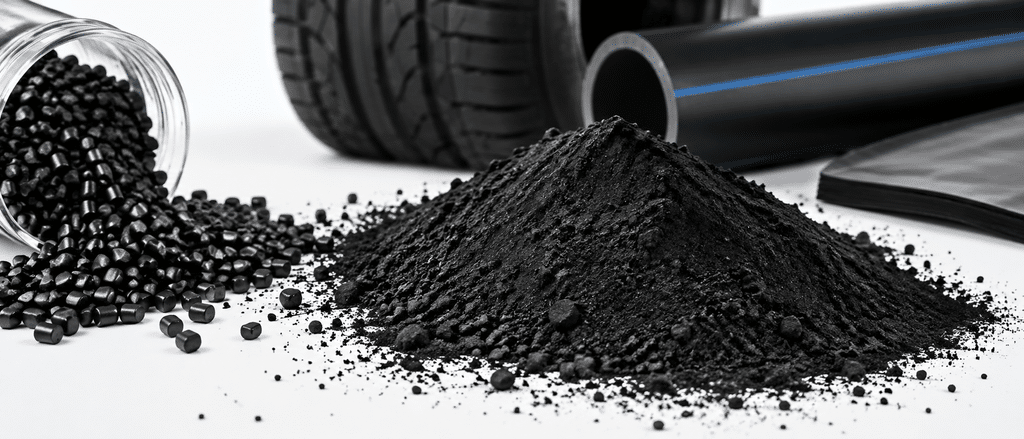
5. What Is the Difference Between N220, N330, N550 and N660?
These common grades meet different performance requirements in rubber and tire manufacturing.
N220 offers a relatively high surface area and strong reinforcement. Therefore, manufacturers may use it in applications where wear resistance is important.
N330 provides a strong balance between reinforcement, mechanical performance and processability. As a result, it is widely used in tires and mechanical rubber goods.
N550 combines medium reinforcement with good processing characteristics.
N660 has a lower surface area and can provide a useful balance of flexibility and processing performance.
| Property | N220 | N330 | N550 | N660 |
|---|---|---|---|---|
| Surface Area | High | Medium-High | Medium-Low | Lower |
| Reinforcement | High | High / Balanced | Medium | Medium |
| Representative Iodine Value | 121 | 82 | 43 | 36 |
| General Focus | Wear resistance | General reinforcement | Processing balance | Flexibility / processing |
Manufacturers should always match the selected grade with the final rubber formulation and required performance.
6. Carbon Black for Plastics, Masterbatch and UV Protection
Plastics represent another important application area.
Specialty grades can provide strong black pigmentation while helping protect polymers against ultraviolet radiation. This feature is particularly important for outdoor pipes, cables, films and infrastructure products.
In addition, conductive grades can change the electrical properties of normally insulating polymers. Consequently, manufacturers can develop antistatic, electro-dissipative or conductive compounds.
For plastic applications, buyers should consider:
- color strength;
- UV resistance;
- dispersion;
- electrical properties;
- processing performance;
- application-specific compliance requirements.
Therefore, a standard rubber grade may not provide the performance required for a specialty plastic application.
7. How Is Carbon Black Produced?
The Furnace Black process is one of the most widely used production methods.
Manufacturers feed hydrocarbon raw materials into a controlled high-temperature reaction zone. Partial combustion and thermal decomposition then create fine carbon particles.
Next, producers control the reaction to achieve the required particle size, surface area and aggregate structure. The system separates the product from process gases and may convert it into pellets for easier transport, storage and dosing.
Key production controls include feedstock quality, reaction conditions, particle structure, pellet quality, moisture, purity and batch consistency.
As a result, controlled production creates an engineered industrial material with defined performance characteristics.
8. Who Are the Major Carbon Black Producers?
The global market includes large international companies as well as strong regional manufacturers.
Major producers include Birla Carbon, Cabot Corporation, Orion S.A., Tokai Carbon and PCBL Chemical.
| Producer | Market Position | Main Product Areas |
|---|---|---|
| Birla Carbon | Major global producer | Tires, rubber and specialty applications |
| Cabot Corporation | Global manufacturing network | Reinforcement and specialty carbon |
| Orion S.A. | Major international producer | Rubber and specialty grades |
| Tokai Carbon | Established carbon materials producer | Rubber and industrial applications |
| PCBL Chemical | Major India-based producer | Tire and specialty products |
Production capacity and grade availability can change over time. Therefore, industrial buyers should verify current availability, manufacturing location and technical specifications before purchasing.
9. Which Countries Import and Export the Most?
For global trade analysis, HS 280300 provides a useful customs reference. However, this heading covers “carbon blacks and other forms of carbon”, not Carbon Black alone.
Therefore, the figures below provide a useful market indicator but should not be interpreted as exact Carbon Black-only trade volumes.
Major Import Markets – 2024
| Market | Import Value | Reported Quantity |
|---|---|---|
| European Union* | US$758.4 million | 460,470 MT |
| China | US$576.3 million | 299,676 MT |
| Thailand | US$542.8 million | — |
| United States | US$444.2 million | — |
| Türkiye | US$419.0 million | 275,822 MT |
| Poland | US$365.4 million | 254,418 MT |
Major Export Markets – 2024
| Market | Export Value | Reported Quantity |
|---|---|---|
| China | US$1.201 billion | 961,943 MT |
| European Union* | US$673.9 million | 234,707 MT |
| India | US$475.4 million | 375,176 MT |
| Germany | US$442.9 million | 177,772 MT |
| South Korea | US$391.2 million | 256,380 MT |
| United States | US$377.6 million | 142,498 MT |
* The European Union is a reporting bloc rather than a single country.
China reported approximately US$1.20 billion and 961,943 MT of exports under HS 280300 in 2024. Meanwhile, Türkiye reported approximately US$419 million and 275,822 MT of imports under the same heading.
10. Carbon Black Market and Supply Sources in Türkiye
Türkiye has a strong tire, automotive, rubber, plastics and cable manufacturing base. Therefore, it represents an important regional import market.
In 2024, Türkiye reported approximately US$419 million and 275,822 MT of imports under HS 280300.
Major reported supply origins included:
| Supplier to Türkiye | 2024 Import Value | Quantity |
|---|---|---|
| Egypt | US$94.3 million | 52,588 MT |
| Italy | US$82.9 million | 41,588 MT |
| India | US$23.7 million | 16,069 MT |
| Germany | US$17.5 million | 6,889 MT |
Again, these figures cover the broader HS 280300 category and should not be interpreted as Carbon Black-only trade data.
Nevertheless, they demonstrate Türkiye’s access to a diverse international supply network.
11. Carbon Black Sourcing with ATABAŞ GLOBAL
Industrial sourcing requires more than comparing origin and price. Buyers should first identify the correct grade and final application.
For example, a tire manufacturer looking for N330 has different technical requirements from a plastics producer seeking a specialty grade for UV protection, pigmentation or conductivity.
Therefore, ATABAŞ GLOBAL evaluates sourcing requirements according to technical and commercial needs.
A professional inquiry should include:
| Required Information | Example |
|---|---|
| Grade | N220 / N330 / N550 / N660 / Specialty |
| Application | Tire / Rubber / Plastic / Cable / Coating |
| Quantity | MT per shipment or monthly requirement |
| Packaging | Bags / Big Bags / producer standard |
| Origin | Preferred origin, if required |
| Destination | Country / port |
| Incoterm | EXW / FOB / CFR / CIF |
| Documentation | TDS / SDS / COA |
| Supply Program | Spot or contractual requirement |
The right sourcing option depends on grade, specification, producer, availability, logistics and commercial terms.
12. What Should Buyers Check Before Purchasing Carbon Black?
Industrial buyers should evaluate technical and commercial factors together.
Key purchasing criteria include:
- ASTM grade and technical specification;
- iodine number, STSA and OAN;
- tint strength and dispersion;
- moisture, ash and sieve residue;
- pellet properties;
- TDS, SDS and COA documentation;
- producer and country of origin;
- packaging;
- delivery schedule and logistics;
- price and payment terms.
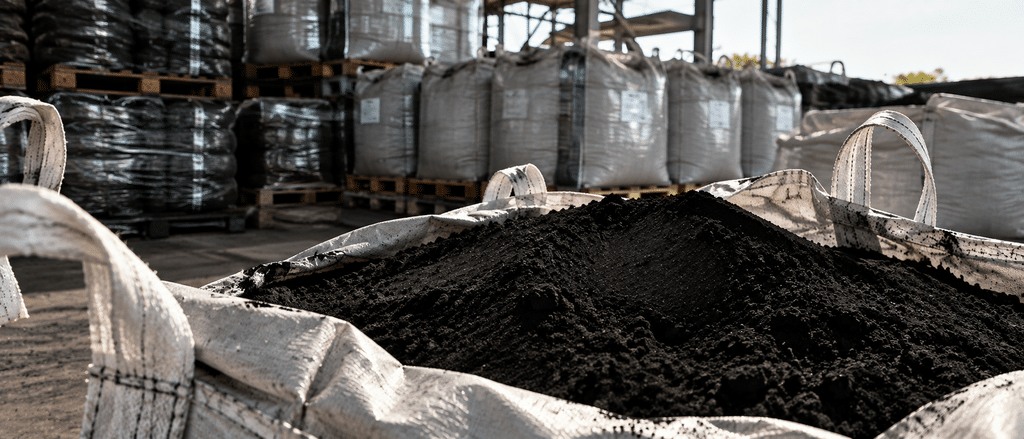
Because Carbon Black is a very fine material, proper packaging and storage also matter. Buyers should keep the product dry, clean and protected from contamination.
Ultimately, successful sourcing requires more than finding the lowest price. The grade, application, technical performance, quality documentation and supply chain should work together.
From tires and mechanical rubber goods to plastics, masterbatch, cables, coatings and advanced conductive applications, Carbon Black remains a strategic industrial raw material.
ATABAŞ GLOBAL can evaluate Carbon Black requirements according to the requested grade, specification, quantity, origin, destination and commercial terms.
Frequently Asked Questions
What is Carbon Black?
Carbon Black is an engineered carbon material produced under controlled industrial conditions. Manufacturers use it for reinforcement, pigmentation, UV protection and electrical performance.
What are N220, N330, N550 and N660?
They are widely used Carbon Black grades, especially in tire and rubber applications. Each grade provides different surface area, structure and reinforcement properties.
Where is Carbon Black mainly used?
Major applications include tires, mechanical rubber goods, plastics, masterbatch, cables, coatings, printing inks and conductive products.
Is Türkiye a major import market?
Türkiye reported approximately US$419 million and 275,822 MT of imports under HS 280300 in 2024.
What is the most important factor when buying Carbon Black?
The selected grade must match the technical requirements of the final application. Buyers should also evaluate the TDS, COA, producer, origin, packaging and commercial terms.
