

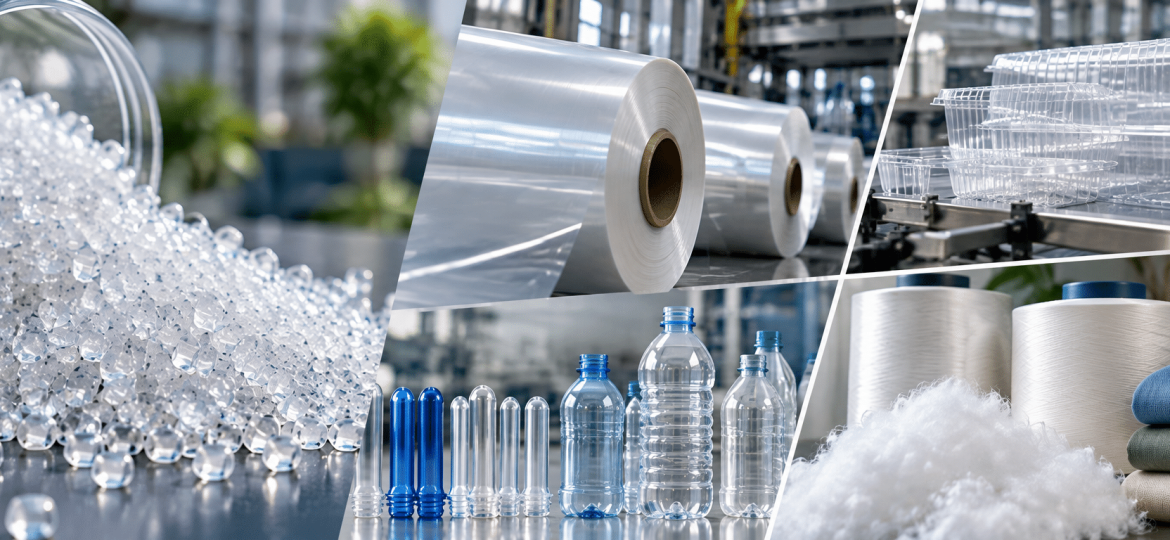
PET (Polyethylene Terephthalate) ranks among the most widely used thermoplastic polymers in modern manufacturing. It combines strength, low weight, clarity, chemical resistance and good barrier performance. Therefore, manufacturers use it extensively in beverage bottles, food packaging, sheets, films, fibers and many other industrial products.
In addition, manufacturers offer different PET grades for different applications. For example, bottle-grade, textile-grade and film-grade materials have different technical requirements. For this reason, buyers should consider the intended application, intrinsic viscosity (IV), processing conditions and technical specifications before selecting a product.
1. What Is PET?
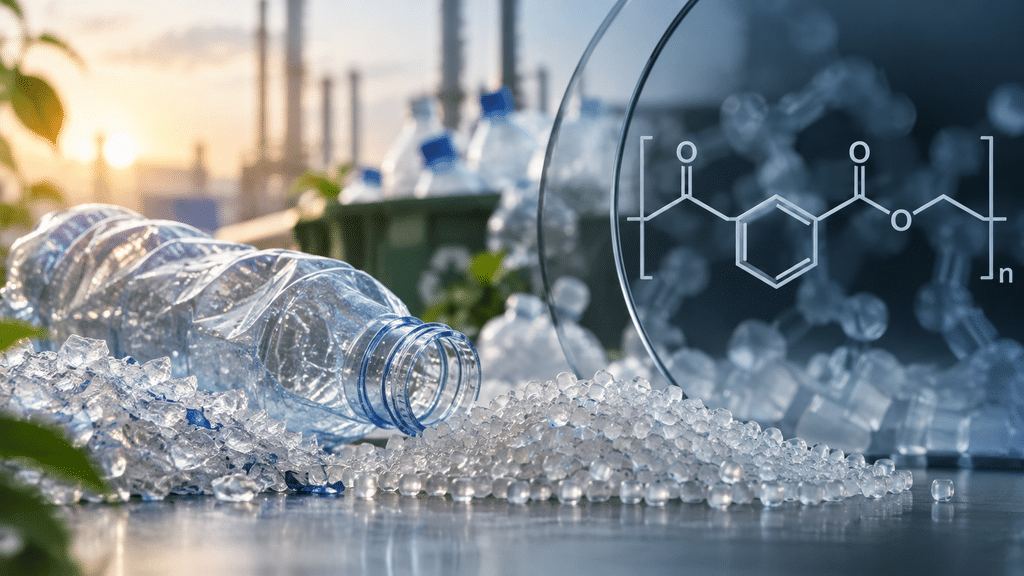
PET is the common abbreviation for Polyethylene Terephthalate. In fact, it belongs to the polyester family and functions as a thermoplastic polymer. In other words, manufacturers can soften it with heat and process it into different forms.
Its repeating chemical unit has the general formula (C₁₀H₈O₄)n.
PET combines mechanical strength with relatively low weight. In addition, suitable grades provide high clarity and good resistance to moisture and many chemicals. As a result, manufacturers use the material in both packaging and industrial applications.
Moreover, its combination of physical and processing properties allows companies to use it across a broad range of manufacturing sectors.
2. Typical Technical Properties
PET properties vary according to grade, producer, processing method and intended use. Therefore, buyers should always check the producer’s current TDS and COA before purchase.
| Property | Typical Information |
|---|---|
| Polymer Name | Polyethylene Terephthalate |
| Abbreviation | PET |
| Polymer Family | Polyester |
| Physical Form | Pellets / granules / flakes |
| Appearance | Clear, translucent or grade dependent |
| Density | About 1.33–1.40 g/cm³ |
| Melting Range | About 245–260 °C |
| Water Absorption | Low |
| Mechanical Strength | High |
| Chemical Resistance | Good resistance to many common substances |
| Recyclability | Widely recyclable where suitable systems exist |
| Main Processing Methods | Injection molding / blow molding / extrusion / thermoforming |
These values provide general references rather than universal specifications. In particular, intrinsic viscosity, color, moisture, acetaldehyde level and thermal properties can vary between grades.
For this reason, buyers should compare the required specification with the producer’s technical documentation before confirming an order. In addition, this comparison helps buyers identify whether the offered material matches the intended processing conditions.
3. Main PET Grades
The final product and manufacturing process mainly determine the correct grade. Therefore, buyers should identify the intended application before selecting a material.
Bottle Grade
Manufacturers develop bottle-grade PET mainly for rigid packaging. For example, beverage and packaging companies commonly use it for water, carbonated drinks, edible oils and other suitable liquid products.
In particular, important parameters may include intrinsic viscosity, color, acetaldehyde level, clarity and processing behavior. Therefore, buyers should review these parameters before choosing a bottle-grade product.
Textile Grade
Manufacturers process textile-grade material mainly into polyester fibers and filaments. Therefore, textile companies use it extensively in fabrics, industrial textiles, carpets, filling materials and related applications.
In addition, the required technical properties can vary according to the fiber or filament production process.
Film Grade
Manufacturers develop film-grade resin for film and sheet applications where dimensional stability, mechanical strength and surface quality play an important role. As a result, processors often focus on consistent performance and surface quality when choosing these grades.
Moreover, processing requirements can influence the final grade selection.
Sheet and Thermoforming Grades
Manufacturers use these grades for trays, containers and other formed packaging products. Consequently, buyers often consider clarity, process stability and mechanical performance when selecting the material.
For this reason, manufacturers should match the resin specification with the intended thermoforming process.
Recycled PET (rPET)
Recycling companies produce rPET from suitable recovered PET material. Depending on the recycling process and required standard, manufacturers can use it in fibers, sheets, packaging and other applications.
However, food-contact applications require additional regulatory and quality controls. Therefore, buyers should confirm the relevant compliance requirements for the intended market and application.
4. Key Properties and Industrial Benefits
PET offers several properties that support its broad industrial use. In addition, its balance of mechanical performance and processability makes it suitable for many manufacturing environments.
| Property | Industrial Benefit |
|---|---|
| High Strength | Supports durable and lightweight products |
| Low Weight | Helps reduce packaging and transport weight |
| Clarity | Supports transparent packaging applications |
| Barrier Performance | Helps protect products from moisture and gases |
| Chemical Resistance | Supports many packaging and industrial uses |
| Dimensional Stability | Helps manufacturers achieve consistent finished products |
| Processability | Supports major industrial processing methods |
| Recyclability | Can contribute to circular material systems |
However, no single grade suits every application. Therefore, buyers should clearly define their technical requirements before commercial sourcing begins.
Moreover, manufacturers should consider processing conditions together with the material specification. As a result, they can select a grade that better matches their final production requirements.
5. Major Applications
Companies use PET across both consumer packaging and industrial manufacturing. For example, the material serves applications ranging from beverage bottles to polyester fibers.
| Industry | Typical Application |
|---|---|
| Beverage | Water and soft drink bottles |
| Food | Containers, trays and selected food packaging |
| Edible Oils | Bottles and rigid packaging |
| Packaging | Jars, containers, sheets and films |
| Textile | Polyester fibers and filaments |
| Industrial Textiles | Technical fibers and fabrics |
| Film | Packaging and industrial films |
| Electrical & Electronics | Selected technical components |
| Automotive | Fibers and selected engineering applications |
| Consumer Products | Various molded and formed products |
Packaging remains one of its most visible applications. Meanwhile, polyester fiber production represents another major area of demand.
In addition, technical and industrial applications continue to benefit from the material’s strength, dimensional stability and processing flexibility. Therefore, PET serves both high-volume consumer markets and specialized industrial applications.
6. PET in Bottle and Packaging Production
Bottle-grade PET plays an important role in the global packaging industry. In particular, beverage manufacturers value the material for its combination of low weight, clarity and mechanical strength.
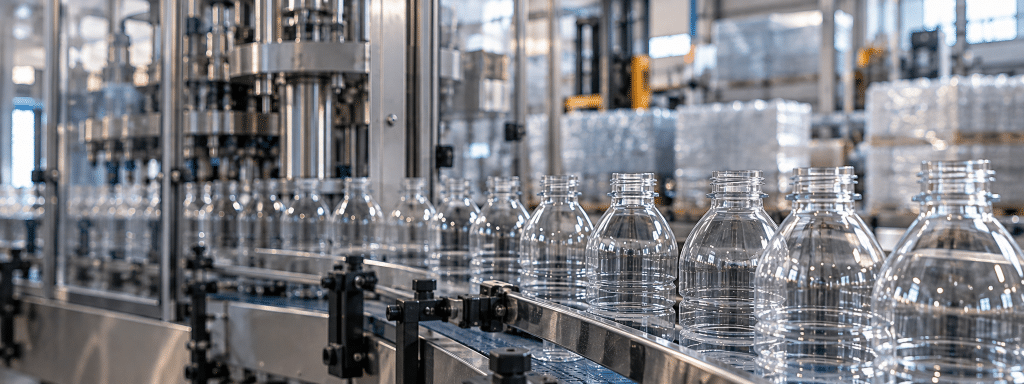
The production process generally begins with PET resin pellets. First, manufacturers dry the material to control moisture. Next, they process the resin into preforms through injection molding. After that, they reheat the preforms and use stretch blow molding to create the final bottle shape.
As a result, manufacturers can produce lightweight containers with good strength and clarity.
For bottle-grade applications, buyers commonly evaluate:
- intrinsic viscosity (IV);
- acetaldehyde content;
- color values;
- moisture;
- melting behavior;
- clarity;
- pellet quality;
- processing consistency.
For this reason, a general description such as “PET resin” often does not provide enough information for a professional commercial inquiry. Instead, buyers should also state the intended application and required grade.
In addition, providing detailed technical requirements at the inquiry stage can reduce the risk of receiving an unsuitable grade. Consequently, suppliers can prepare more accurate technical and commercial offers.
7. Understanding Intrinsic Viscosity (IV)
Intrinsic viscosity, commonly called IV, represents one of the key technical parameters for PET grades.
In simple terms, IV relates to the polymer’s molecular weight and processing behavior. Therefore, different applications may require different IV ranges.
For example, bottle-grade material may require a different IV profile from textile or film grades. However, the correct value depends on the application and producer specification.
For this reason, buyers should avoid selecting material based only on price. Instead, they should confirm the required IV together with other technical parameters in the TDS and COA.
Moreover, buyers should compare IV values within the context of the complete product specification rather than treating IV as the only quality indicator. In this way, they can make a more accurate technical comparison between available grades.

8. Virgin PET and Recycled PET
Manufacturers produce virgin PET from new petrochemical feedstocks through controlled polymer production. As a result, the material generally offers consistent properties and serves applications that require defined technical performance.
In contrast, recycling companies produce recycled PET, commonly known as rPET, from recovered PET products. First, they sort and clean the recovered material. Then, they process it for reuse.
Both materials play important roles in the market. However, buyers should not automatically treat them as direct substitutes.
| Feature | Virgin PET | Recycled PET |
|---|---|---|
| Raw Material | New polymer feedstock | Recovered PET material |
| Consistency | Generally high | Depends on recycling process |
| Color | Grade dependent | Can vary by source and process |
| Main Uses | Packaging, bottles, films, fibers | Fibers, sheets, packaging and other uses |
| Food Contact | Suitable grades are available | Requires a compliant grade and recycling process |
| Supply Form | Mainly resin pellets | Pellets, flakes or other processed forms |
Therefore, buyers should clearly state whether they require virgin resin, recycled pellets or PET flakes.
In addition, buyers should evaluate recycled materials according to the quality requirements of the final application. For food-contact uses, for example, regulatory compliance becomes especially important.
9. Production and Quality Control
PET manufacturing involves several controlled chemical and processing stages. In conventional production, manufacturers mainly use purified terephthalic acid (PTA) and monoethylene glycol (MEG) as key raw materials.
During polymerization, these raw materials form the polyester structure. After this stage, manufacturers can apply further processing to achieve the required molecular weight and final material properties.
Quality control plays an important role because even small differences can affect processing and finished-product performance. Therefore, manufacturers and buyers monitor several technical parameters throughout the supply process.
Key parameters may include:
- intrinsic viscosity;
- moisture;
- color;
- acetaldehyde;
- melting characteristics;
- pellet size and uniformity;
- contamination level;
- thermal stability;
- mechanical performance;
- batch consistency.
For this reason, buyers should review the technical documentation together with the commercial offer. In addition, they should confirm that the offered grade matches the intended production process and final application.
Consequently, a complete technical review can reduce the risk of processing problems after delivery.
10. Major Global Producers and Supply Markets
Major petrochemical and polymer companies across Asia, Europe, the Middle East and the Americas manufacture PET resin.
For example, well-known international producers and polymer groups include:
| Company | Main Area |
|---|---|
| Indorama Ventures | PET resin, fibers and recycling |
| Alpek / DAK Americas | PET resin and polyester materials |
| Far Eastern New Century | Polyester and PET materials |
| Reliance Industries | Polyester and polymer materials |
| LOTTE Chemical | Petrochemicals and polymer materials |
| SABIC | Petrochemicals and polymer solutions |
However, companies may change their product portfolios, plant locations and available grades over time. Therefore, buyers should confirm current TDS documents, production origin and product availability before making commercial decisions.
In addition, buyers should consider more than resin price when selecting a supply market. Freight, availability, lead time, grade consistency, documentation and destination can significantly affect the final landed cost.
For example, a lower product price may not provide the best commercial result when freight costs or delivery times are significantly higher. Therefore, buyers should evaluate the complete supply structure rather than comparing unit prices alone.
Moreover, reliable documentation and consistent product quality can be as important as the initial purchase price.
11. PET Supply and Demand in Türkiye
Türkiye has a strong packaging, beverage, food, textile and plastics industry. As a result, PET and polyester-based materials play an important role in domestic industrial demand.
Several sectors support demand, including:
- bottled water and beverages;
- food and edible oil packaging;
- preform and bottle manufacturing;
- sheet and thermoforming;
- polyester fiber production;
- textile manufacturing;
- industrial packaging;
- recycled polymer processing.
When evaluating international supply, buyers should compare not only price but also grade, IV, producer, origin, technical documentation, packaging, shipment size and delivery conditions.
Moreover, PET trade statistics require careful interpretation. Customs authorities may classify materials under different codes according to technical characteristics such as viscosity. Therefore, companies should present HS-based trade figures together with the exact HS code and product definition rather than describing them as universal PET market data.
For this reason, companies should verify the relevant customs classification before using trade statistics for commercial or market analysis. In addition, the correct classification helps companies compare market information more accurately.
12. Industrial Sourcing with ATABAŞ GLOBAL
A clear technical inquiry helps suppliers identify the right material and reduces unnecessary delays during the quotation process. Therefore, buyers should provide both technical and commercial information from the beginning.
For PET sourcing inquiries, buyers should provide the following information:
| Required Information | Example |
|---|---|
| Product | PET Resin |
| Type | Virgin PET / rPET |
| Application | Bottle / Preform / Sheet / Film / Fiber |
| Grade | Bottle grade / textile grade / application-specific |
| Intrinsic Viscosity | Required IV or producer grade |
| Quantity | MT per shipment / monthly requirement |
| Packaging | Producer standard / Big Bags |
| Destination | Country and port |
| Incoterm | EXW / FOB / CFR / CIF |
| Documents | TDS / SDS / COA |
| Supply Program | Spot / monthly / contractual |
For example, a bottle and preform manufacturer should provide its required IV and technical parameters rather than requesting only “PET resin.”
In addition, information about quantity, destination and delivery terms allows a more accurate commercial evaluation. As a result, suppliers can assess both material suitability and logistics requirements more efficiently.
Therefore, ATABAŞ GLOBAL evaluates sourcing requirements according to the buyer’s application, technical specifications, quantity, packaging, destination and commercial terms.
Moreover, clear specifications help reduce unnecessary revisions during the quotation process.
13. What Should Buyers Check Before Purchasing?
Buyers should select PET according to both technical and commercial requirements. Therefore, they should complete a detailed evaluation before confirming an order.
Before purchasing, buyers should check:
- virgin or recycled material requirement;
- intended application;
- required grade;
- intrinsic viscosity;
- moisture;
- color;
- acetaldehyde level where relevant;
- pellet quality;
- technical specifications;
- TDS, SDS and COA;
- producer and origin;
- packaging;
- available quantity;
- delivery schedule;
- Incoterm and payment terms.
In addition, buyers should pay attention to storage and handling conditions. For example, they should protect PET resin from moisture, contamination and unsuitable storage environments.
Moreover, proper drying before processing plays an important role because excess moisture can affect polymer quality during melt processing. For this reason, processors should follow the relevant technical recommendations for the selected grade.
Ultimately, buyers should not select the material based on price alone. Instead, they should consider grade consistency, technical suitability, documentation, reliable supply and logistics together.
As a result, a complete technical and commercial evaluation can support more reliable purchasing decisions.
For commercial inquiries, ATABAŞ GLOBAL can evaluate PET requirements based on the intended application, required grade, IV, specification, quantity, packaging, destination and delivery terms.
Frequently Asked Questions
What does PET stand for?
PET stands for Polyethylene Terephthalate. Manufacturers widely use this thermoplastic polyester in packaging, bottles, fibers, sheets and films. In addition, its combination of strength and processability supports many industrial applications.
What is bottle-grade PET?
Manufacturers develop bottle-grade PET for preform and bottle production. Therefore, buyers should consider parameters such as IV, acetaldehyde, color and processing consistency.
What is PET IV?
IV means intrinsic viscosity. This important technical parameter relates to the polymer’s molecular weight and processing behavior. Therefore, the required IV can vary according to the intended application.
What is the difference between PET and rPET?
Manufacturers produce virgin PET from new polymer feedstocks. In contrast, recycling companies produce rPET from recovered and reprocessed PET material. Therefore, the recycling process and final grade influence its quality and suitable applications.
Can PET be recycled?
Yes. Suitable collection, sorting and recycling systems allow companies to recycle PET efficiently. As a result, manufacturers can use recycled material in fibers, sheets, packaging and other applications.
Is all PET suitable for food contact?
No. The specific grade, production process and applicable regulations determine food-contact suitability. Therefore, buyers should request the relevant compliance documents from the producer.
What information should be included in a PET inquiry?
A professional inquiry should include the intended application, required grade, IV, quantity, packaging, destination, Incoterm and required technical documents. In addition, clear information about the required supply schedule can support a more accurate commercial offer.
