


Carboxymethyl cellulose export from Türkiye provides global buyers with access to cellulose-based raw materials for many industries. Moreover, CMC plays an important role in food production, oilfield drilling, detergents, textiles, ceramics and paper manufacturing.
Because CMC helps control viscosity and retain water, manufacturers use it in many water-based products. For example, food producers use approved grades to improve texture and stability. Similarly, oilfield companies use technical grades to control drilling fluids and reduce fluid loss.
In addition, detergent producers use CMC to help prevent dirt from settling back onto fabrics. Paper and textile plants also benefit from its binding properties. However, each industry requires different levels of purity and viscosity.
Therefore, buyers should assess product quality before placing an order. Furthermore, suitable packing and transport plans help protect the material during international shipments.
Türkiye offers access to major ports, chemical plants and global shipping networks. As a result, buyers can compare different supply routes and delivery options.
ATABAŞ GLOBAL combines product sourcing with international trade and shipping services. Consequently, we develop supply plans according to the technical and commercial needs of our customers.
1. What Is Carboxymethyl Cellulose (CMC)?
Carboxymethyl cellulose is a modified polymer that producers make from plant-based cellulose. In commercial trade, however, CMC usually refers to sodium carboxymethyl cellulose.
Suppliers also use the names sodium CMC, NaCMC and cellulose gum. Moreover, food producers recognize approved sodium CMC as food additive E466.
Unlike untreated cellulose, sodium CMC can form thick solutions in water. Therefore, manufacturers use it to change the flow and texture of water-based products.
Depending on the grade, CMC may appear as a white, cream or slightly yellow powder. In addition, some suppliers offer granular or fine fibrous forms.
For example, fine powders may suit controlled mixing systems, whereas certain granular grades may offer different mixing properties. Consequently, buyers should choose the correct form according to their production needs.
Product Identification for CMC Export
| Product Information | Description |
|---|---|
| Commercial Name | Carboxymethyl Cellulose |
| Abbreviation | CMC |
| Common Form | Sodium Carboxymethyl Cellulose |
| Alternative Names | NaCMC, Sodium CMC, Cellulose Gum |
| Product Group | Cellulose Ethers |
| HS Code | 391231 |
| CAS Number | 9004-32-4 for Sodium CMC |
| Food Additive Code | E466 / INS 466 |
| Ionic Character | Anionic |
| Appearance | White to slightly yellow |
| Physical Form | Powder, granules or fibres |
| Water Behaviour | Viscous solutions or dispersions |
| Ethanol Solubility | Insoluble |
| Raw Material | Plant-based cellulose |
| Common Packaging | 25 kg bags |
Production and Chemical Structure
Manufacturers commonly obtain cellulose from suitable wood pulp or cotton-based raw materials. First, they prepare the cellulose for chemical treatment.
Next, producers treat the cellulose with an alkali. Afterwards, they use a suitable chemical agent to introduce carboxymethyl groups into its structure.
As a result, the modified cellulose gains new water absorption and flow properties.
Producers then clean and dry the material according to the required grade. Finally, they grind, screen and pack the finished product.
However, production methods and cleaning steps vary between commercial grades. For example, high-purity products may require more washing and tighter quality checks.
Furthermore, the degree of substitution and molecular weight affect the final product. Therefore, two CMC products may have different properties even when they look similar.
Differences Between CMC and Other Cellulose Products
Although CMC belongs to the cellulose ether family, it differs from methyl cellulose (MC), hydroxyethyl cellulose (HEC) and hydroxypropyl methylcellulose (HPMC).
For example, CMC has an anionic character that affects its behaviour in water and salt mixtures.
Similarly, polyanionic cellulose (PAC) belongs to a related product group. However, PAC and standard CMC may have different oilfield quality requirements.
Therefore, buyers should confirm the actual chemical identity and technical grade before purchase.
Moreover, carboxymethyl cellulose export requires clear product identification and suitable grade selection.
- Important: Technical-grade CMC does not automatically meet food or pharmaceutical standards.
2. Advantages of Carboxymethyl Cellulose Export from Türkiye
Türkiye connects European, Asian, African and Middle Eastern markets through established road and sea transport networks. Moreover, its chemical plants and warehouses support international raw material trade.
Because Türkiye has several major ports, suppliers can compare different loading locations. Consequently, buyers may benefit from suitable freight rates and shipping schedules.
Industrial Infrastructure and Bulk CMC Export
Local chemical plants support the production and handling of industrial raw materials. In addition, warehouse facilities allow suppliers to prepare goods before shipment.
For example, exporters can arrange cargo checks and packing at suitable warehouses. Afterwards, transport companies can move the goods to the agreed loading port.
Furthermore, professional customs brokers help exporters prepare the required trade records.
Since international buyers have different purchase needs, suppliers can review several order sizes and delivery plans. As a result, Türkiye offers commercial options for both individual orders and regular supply programs.
Geographical and Logistics Advantages
Türkiye’s location supports trade with several nearby markets. Moreover, its container ports provide access to long-distance shipping routes.
For instance, Mersin offers links to Eastern Mediterranean shipping routes. Similarly, İzmir provides access to Aegean and Mediterranean routes.
Gebze and İstanbul also offer access to major industrial areas and container terminals. Therefore, exporters can compare loading ports according to cargo location and destination.
However, the nearest port does not always offer the lowest total cost. In contrast, a more distant port may provide better freight rates or vessel dates.
Consequently, early transport planning can help buyers manage delivery costs.
Product Origin and Turkish CMC Export
The country of shipment does not always indicate the country of manufacture. Therefore, buyers should review the actual product origin before confirming an order.
In addition, suitable origin records help support customs and trade compliance.
Because product quality and origin affect commercial decisions, ATABAŞ GLOBAL reviews these factors together.
Furthermore, we assess available stock, packing needs and freight options before preparing an offer.
As a result, our carboxymethyl cellulose export services address both technical and commercial requirements.
3. Global Carboxymethyl Cellulose Export Market
Global CMC trade reflects demand from food production, drilling projects and many manufacturing industries. Moreover, differences in quality create several commercial markets.
For example, high-purity grades may serve food and drug producers, whereas technical grades may suit general industrial needs.
Similarly, low-viscosity and high-viscosity products serve different manufacturing processes.
However, customs records do not normally separate CMC according to these properties. Therefore, buyers should consider the scope of the HS code when reviewing international trade data.
Major Carboxymethyl Cellulose Export Markets – 2025
The following table shows selected national exporters of carboxymethyl cellulose and its salts in primary forms under HS 391231.
| Country | Export Volume (MT) | Export Value (USD) |
|---|---|---|
| China | 120,951.00 | 269,085,310 |
| Finland | 43,166.60 | 134,336,870 |
| Netherlands | 14,607.40 | 85,023,790 |
| France | 14,131.00 | 80,498,390 |
| Germany | 13,457.40 | 71,382,560 |
| Türkiye | — | 61,196,740 |
| Japan | 4,001.10 | 41,441,750 |
| Ireland | 2,160.13 | 39,434,980 |
| South Africa | 8,019.25 | 29,369,350 |
| Italy | 8,220.49 | 29,321,870 |
| United States | 3,978.77 | 22,371,780 |
Source: World Bank WITS – Global CMC Export Statistics 2025.
China leads the listed countries by export value. Meanwhile, Finland also holds a strong position in international CMC trade.
Furthermore, Germany, France and the Netherlands contribute to European CMC export activity.
Türkiye records more than USD 61 million in exports within this product group. Consequently, its trade figures demonstrate its role in the international market.
However, shipment volume and export value do not always follow the same pattern. Because commercial grades differ in quality, their values per metric ton may also vary.
For example, a high-purity specialty grade may have a greater unit value than a standard technical grade.
Therefore, export values alone cannot establish the actual market price of a specific product.
Understanding International CMC Trade Statistics
The European Union reported around USD 276.06 million in exports under HS 391231 in 2025. However, the EU represents a regional trade bloc rather than a single country.
For this reason, the national table excludes the EU aggregate.
Furthermore, some countries export goods that they previously imported. Consequently, export figures do not always represent domestic production levels.
Similarly, differences in reporting methods may affect quantity records.
Therefore, buyers should use international trade figures as a general market guide rather than a direct measure of production capacity.
Moreover, carboxymethyl cellulose export opportunities depend on global industrial demand and product quality.
- Statistical scope: HS 391231 covers carboxymethyl cellulose and its salts in primary forms. However, it does not identify every commercial grade separately.
4. Global CMC Export Opportunities and Import Demand
Food plants, energy projects and consumer goods industries contribute to global CMC demand. Moreover, each sector requires different product properties.
For instance, food producers may require high-purity cellulose gum. In contrast, oilfield companies may need grades that control fluid loss.
Similarly, textile and paper producers require suitable binding and flow properties.
Therefore, global CMC demand covers a wide range of products.
Major CMC Importing Countries – 2025
| Country | Import Volume (MT) | Import Value (USD) |
|---|---|---|
| United States | 33,447.20 | 130,170,210 |
| India | 18,496.50 | 77,587,930 |
| China | 7,014.73 | 62,364,560 |
| Germany | 16,417.40 | 60,060,280 |
| South Africa | 17,802.70 | 38,168,920 |
| Netherlands | 7,862.98 | 30,131,240 |
| Brazil | 7,583.16 | 27,231,470 |
| Japan | 5,974.94 | 26,703,740 |
| Thailand | 7,981.93 | 26,410,230 |
| Indonesia | 7,888.90 | 23,961,500 |
| Ireland | 3,422.76 | 23,116,980 |
| South Korea | 4,508.37 | 21,434,080 |
| Italy | 5,104.80 | 21,371,870 |
| Canada | 4,980.61 | 19,490,870 |
| Poland | 4,888.27 | 19,332,070 |
Source: World Bank WITS – Global CMC Import Statistics 2025.
The United States leads the listed markets by import value. Meanwhile, India, China and Germany also show strong import activity.
However, import records do not identify the final use of each shipment. Therefore, exporters should study customer needs alongside national trade figures.
European and North American CMC Markets
European industries use CMC in food, paper, drugs, detergents and other products. Moreover, food and drug producers often require detailed quality records.
Because regional food and chemical rules affect product acceptance, exporters should check the relevant market standards.
North American industries also use CMC in several major sectors. For example, food plants use suitable grades to control texture, while oilfield companies use technical grades in drilling fluids.
In addition, paper plants and detergent producers create demand for cellulose-based additives.
Asia-Pacific and Middle Eastern Markets
Asia-Pacific industries use CMC in textile, ceramic, food and detergent production. Furthermore, selected battery plants use high-purity CMC as a binder.
However, standard technical products do not automatically meet battery quality needs. Therefore, exporters should review each customer’s technical limits.
Middle Eastern markets also use CMC in food, drilling and building materials. For instance, water-based drilling fluid systems may require specific low-viscosity or high-viscosity grades.
Consequently, suppliers should match their products with the requirements of each drilling project.
African and South American Markets
African industries use CMC in detergents, food, mining and other industrial products. Similarly, South American industries use selected grades in food, paper, mining and oilfield operations.
Moreover, demand may vary according to local production and industrial projects.
Because shipping conditions differ between destinations, freight planning also plays an important role in these markets.
Therefore, successful carboxymethyl cellulose export requires both suitable product quality and effective transport planning.

5. Carboxymethyl Cellulose Export Statistics and Trade Regulations in Türkiye
Türkiye takes part in global CMC trade through production, imports, exports and distribution. Furthermore, national trade records show its position in the international cellulose ether market.
However, some reported quantity figures require further checks. Consequently, the following table separates available trade values from uncertain shipment volumes.
Türkiye’s CMC Export and Import Statistics – 2024 and 2025
| Trade Indicator | 2024 | 2025 |
|---|---|---|
| Export Value | USD 74,010,580 | USD 61,196,740 |
| Export Volume | 51,840.40 MT | — |
| Import Value | USD 11,975,280 | USD 13,991,850 |
| Import Volume | 2,604.65 MT | — |
| HS Code | 391231 | 391231 |
Sources: Türkiye Exports 2024, Türkiye Exports 2025, Türkiye Imports 2024 and Global Imports 2025.
Türkiye’s export value fell between 2024 and 2025. In contrast, its import value increased during the same period.
Nevertheless, the country maintained a positive trade balance by value within this product group.
The 2025 records show zero national quantities alongside positive trade values. Moreover, the export records include shipments to individual countries.
Therefore, this analysis excludes those uncertain national quantity totals rather than treating them as actual trade volumes.
Selected CMC Export Destinations from Türkiye – 2025
| Destination | Export Volume (MT) | Export Value (USD) |
|---|---|---|
| United States | 6,921.33 | 11,618,390 |
| Egypt | 3,071.67 | 4,318,220 |
| Peru | 2,969.70 | 4,313,380 |
| Italy | — | 2,706,270 |
| Germany | 1,803.37 | 2,674,770 |
| Poland | 1,570.80 | 1,839,240 |
| Netherlands | 1,119.04 | 1,573,910 |
| Vietnam | 1,152.00 | 1,550,890 |
| Bangladesh | 1,428.00 | 1,453,370 |
| United Arab Emirates | 916.22 | 1,391,790 |
Source: World Bank WITS – Türkiye CMC Exports by Destination 2025.
The United States represents an important market for Türkiye’s CMC exports. Furthermore, Egypt and Peru also show substantial purchase activity.
European countries such as Germany, Poland and the Netherlands appear among the selected destinations. Similarly, Asian and Middle Eastern markets contribute to Türkiye’s international trade activity.
Consequently, these records demonstrate the wide geographical reach of Turkish CMC exports.
CMC Export Quotas and Trade Rules
An export quota sets a legal limit on the amount of goods that companies can sell abroad. In contrast, annual trade data shows past commercial activity.
Therefore, buyers should not interpret historical export volumes as legal export quotas.
This analysis does not establish a verified numerical CMC export quota for Türkiye, China, Finland, the Netherlands, France, Germany, Japan, Ireland, South Africa, Italy or the United States.
However, the absence of a verified quota does not guarantee unrestricted trade.
Moreover, customs rules and chemical safety laws may affect individual shipments.
For example, food grades may require extra records before entering certain markets. Likewise, industrial grades may face different product safety checks.
Since trade rules can change, exporters should review current requirements before confirming orders.
Furthermore, carboxymethyl cellulose export from Türkiye requires attention to the trade rules of each destination market.
Official resources include the Republic of Türkiye Ministry of Trade and the WTO Quantitative Restrictions Database.
6. Carboxymethyl Cellulose Export Grades and Technical Specifications
Industrial customers need different CMC grades because manufacturing processes require specific material properties.
For example, food plants focus on purity and safety. In contrast, oilfield companies may prioritize viscosity and fluid-loss control.
Similarly, detergent and paper producers need suitable binding and flow properties.
Therefore, buyers should define the intended use before requesting a commercial offer.
Commercial CMC Grades for Export
| Product Grade | Main Industrial Use |
|---|---|
| Food Grade | Food and beverages |
| Pharmaceutical Grade | Drug products and excipients |
| Technical Grade | General industrial use |
| CMC-LV / LVT | Low-viscosity drilling fluids |
| CMC-HV / HVT | High-viscosity drilling fluids |
| Detergent Grade | Laundry detergents |
| Ceramic Grade | Ceramic bodies and glazes |
| Textile Grade | Yarn sizing and printing |
| Paper Grade | Paper coating and fibre binding |
| Construction Grade | Selected building materials |
| Cosmetic Grade | Personal care products |
| Battery Grade | Electrode binders |
| Mining Grade | Mineral processing |
| High-Purity Grade | Special industrial uses |
Commercial grade names help buyers identify suitable products. However, these names do not define universal quality limits.
Therefore, manufacturers should request the actual Technical Data Sheet and Certificate of Analysis.
Furthermore, sample tests can help confirm whether a grade meets the needs of a specific production line.
Technical Requirements for Sodium CMC Export
| Technical Parameter | Typical Requirement |
|---|---|
| Appearance | White to slightly yellow powder |
| Chemical Identity | Sodium carboxymethyl cellulose |
| CAS Number | 9004-32-4 |
| Degree of Substitution (DS) | Grade-specific range |
| Viscosity | Low to very high |
| Purity | Required active material content |
| Moisture | Agreed maximum level |
| pH | Based on test conditions |
| Sodium Chloride | Residual salt limit |
| Sodium Glycolate | Relevant residue limit |
| Particle Size | Mesh or micron range |
| Behaviour in Water | Viscous solutions or dispersions |
| Ethanol Solubility | Insoluble |
| Bulk Density | Grade-specific value |
| Microbial Limits | Based on intended use |
| Heavy Metals | Applicable safety limits |
The exact values depend on the commercial grade. Therefore, buyers should not apply food-grade limits to every industrial product.
Similarly, oilfield performance requirements may differ from those of textile or paper grades.
Consequently, clear technical limits play an important role in carboxymethyl cellulose export.
Viscosity and Degree of Substitution
Viscosity describes the resistance of a fluid to flow. For example, a high-viscosity CMC grade generally produces a thicker solution than a low-viscosity grade under the same test conditions.
However, solution strength and temperature can affect the measured value.
Moreover, the test tool, spindle speed and mixing time may influence the result. Therefore, buyers should compare viscosity values using the same test method.
The degree of substitution describes the average number of carboxymethyl groups attached to each cellulose glucose unit.
Because this value influences the chemical structure, it can also affect how CMC behaves in water.
Nevertheless, a higher substitution level does not automatically mean better performance.
Similarly, molecular weight influences solution thickness and flow.
In addition, residual salt and moisture levels may affect certain industrial mixtures.
Consequently, carboxymethyl cellulose export requires a review of all key product properties rather than a single test result.
Purity and Particle Size
Purity indicates the amount of active material within the commercial product. Therefore, products with different purity levels may require different amounts during use.
For example, a manufacturer may need to adjust the amount of CMC when moving from one grade to another.
Furthermore, particle size influences how the powder mixes with water.
However, a finer powder does not always provide better results because mixing conditions also affect dispersion.
For this reason, buyers should evaluate both powder properties and the final solution.
7. CMC Export Standards for Food, Pharmaceutical and Oilfield Grades
Different industries follow different product safety and performance rules. Consequently, suppliers should review the standards that apply to each commercial grade.
Food Grade CMC Export – E466
Food-grade sodium CMC serves as a thickener, stabilizer and suspending agent in permitted food products.
Moreover, international food standards define specific chemical and purity limits.
The following table shows selected requirements from the FAO/WHO JECFA specification.
| JECFA Parameter | Specification |
|---|---|
| Food Additive Code | INS 466 |
| CAS Number | 9004-32-4 |
| Sodium CMC Assay | Minimum 99.5% on dried basis |
| Degree of Substitution | 0.2–1.5 |
| Appearance | White to slightly yellow powder, granules or fibres |
| Behaviour in Water | Viscous aqueous dispersions |
| Main Uses | Thickening, stabilizing and suspending |
Source: FAO/WHO JECFA – Sodium Carboxymethyl Cellulose.
Similarly, the European Union defines purity requirements for E466.
| EU E466 Parameter | Requirement |
|---|---|
| Assay | Minimum 99.5% on anhydrous basis |
| Degree of Substitution | 0.2–1.5 |
| pH of 1% Dispersion | 5.0–8.5 |
| Loss on Drying | Maximum 12% under specified test conditions |
| Other Purity Limits | According to the applicable regulation |
Source: European Union – Regulation (EU) No 231/2012.
However, food additive approval does not allow every possible use or dose.
Therefore, manufacturers must also check the rules for the intended food type.
In addition, food-grade buyers may require suitable microbial reports, food safety records and product origin documents.
Because market rules differ, suppliers should confirm the applicable requirements before shipment.
Pharmaceutical Grade CMC
Drug producers may use sodium CMC as a binder, thickener or suspending agent in suitable products.
For example, certain liquid drug products may require additives that help control thickness and keep particles in suspension.
However, pharmaceutical uses may require different quality limits from standard food grades.
Moreover, buyers may require compliance with USP–NF or European Pharmacopoeia standards.
In addition, microbial quality and production records may affect product approval.
Sodium CMC also differs from croscarmellose sodium, which has a cross-linked structure.
Therefore, buyers should identify the exact material and relevant standard before purchase.
Drilling Grade CMC Export and API Standards
Oilfield companies use suitable CMC grades to control water-based drilling fluids.
For example, low-viscosity products may reduce fluid loss without adding too much thickness.
In contrast, high-viscosity grades may also help increase drilling fluid viscosity.
Furthermore, oilfield users may select PAC products for specific fluid systems.
The following categories support different drilling needs.
| Product | Main Function |
|---|---|
| CMC-LVT | Fluid-loss control with limited viscosity increase |
| CMC-HVT | Fluid-loss and viscosity control |
| PAC-LV | Related low-viscosity cellulose additive |
| PAC-HV | Related high-viscosity cellulose additive |
The American Petroleum Institute lists technical low-viscosity and high-viscosity CMC as separate product groups within API Specification 13A.
Source: American Petroleum Institute – API Specification 13A.
However, suppliers should not claim API compliance or monogram approval without proper records.
Moreover, drilling fluid performance depends on the complete fluid system and well conditions.
Therefore, buyers should review both the product specification and relevant test results.
8. Industrial Applications and Carboxymethyl Cellulose Export Demand
CMC serves many industries because it helps control water-based mixtures. Moreover, its binding and water retention properties support a wide range of manufacturing processes.
However, each industry requires suitable product grades. Therefore, manufacturers should assess the intended use before buying raw materials.
Food and Beverage Industry
Food producers use approved CMC grades to improve texture and stability.
For example, suitable grades may help control the thickness of sauces, dressings and selected dairy products.
Similarly, some dessert producers use CMC to support product texture.
In addition, approved grades may help keep particles in suspension within certain drinks.
However, food producers must follow the rules for each food category.
Therefore, they should confirm both product quality and permitted use before production.
Oil and Gas Industry
Drilling companies use CMC in selected water-based fluid systems.
For instance, suitable grades may help reduce water loss into surrounding formations.
Furthermore, high-viscosity grades may help control fluid thickness.
However, temperature, salt content and other fluid components can affect performance.
Consequently, engineers should test the complete drilling fluid before field use.
Detergent Industry
Laundry detergent producers use CMC as an anti-redeposition additive.
During washing, dirt separates from fabrics. However, some of that dirt may settle back onto textile surfaces.
Suitable CMC grades can help reduce this effect. Therefore, they may support cleaning performance in compatible detergent mixtures.
Moreover, the correct grade depends on the other ingredients within the detergent.
Textile Industry
Textile plants use selected CMC grades in yarn sizing and printing.
For example, suitable products can help bind fibres during certain production stages.
Similarly, CMC can help control the flow of selected textile printing mixtures.
Because textile plants use different materials and methods, viscosity needs may vary.
Therefore, buyers should select grades according to their process conditions.
Paper Industry
Paper producers may use CMC in coating and surface treatment.
Moreover, suitable grades can help improve fibre binding and control coating mixtures.
For instance, water-based paper coatings may require stable flow properties.
However, the type of paper and other coating materials affect the final result.
Consequently, manufacturers should test CMC within the complete coating system.
Ceramic Industry
Ceramic manufacturers use CMC in selected ceramic bodies and glazes.
For example, it may help bind particles during production.
Furthermore, its water retention properties can support certain shaping and coating processes.
However, different ceramic materials require different amounts of binder.
Therefore, manufacturers should assess the correct grade and addition rate.
Cosmetics and Personal Care
Personal care producers use selected CMC grades to control product texture.
For instance, suitable grades may help thicken toothpaste and other water-based products.
Similarly, some lotions and shampoos may contain CMC to support flow and stability.
Nevertheless, cosmetic producers must consider the complete mixture and applicable product safety rules.
Construction, Paints and Adhesives
Selected water-based building materials may benefit from the water retention properties of CMC.
For example, suitable grades can help control flow in certain compounds.
Moreover, paint and adhesive producers may use CMC to adjust thickness and binding properties.
However, other cellulose ethers may offer better performance in some building materials.
Therefore, manufacturers should test the correct additive for each product.
Lithium-Ion Battery Manufacturing
Selected high-purity CMC grades serve as binders in water-based electrode slurries.
For example, battery producers may combine CMC with other binders in graphite anodes.
Furthermore, suitable grades can help support particle dispersion.
However, general industrial CMC does not automatically meet battery quality requirements.
Consequently, buyers should review viscosity, molecular weight, purity and impurity limits.
Mining and Other Industrial Uses
Mining plants may use selected CMC grades as flotation depressants.
Because mineral types and process conditions vary, the same grade may not suit every mineral separation process.
In addition, selected CMC products can serve as binders in welding electrode coatings and other industrial mixtures.
Therefore, each specialty application requires suitable technical tests.
As a result, carboxymethyl cellulose export serves many industries with different product needs.
Further reading: Physical Properties of Carboxymethyl Cellulose – Polymer Reviews.
9. CMC Export Packaging, Storage and Quality Control
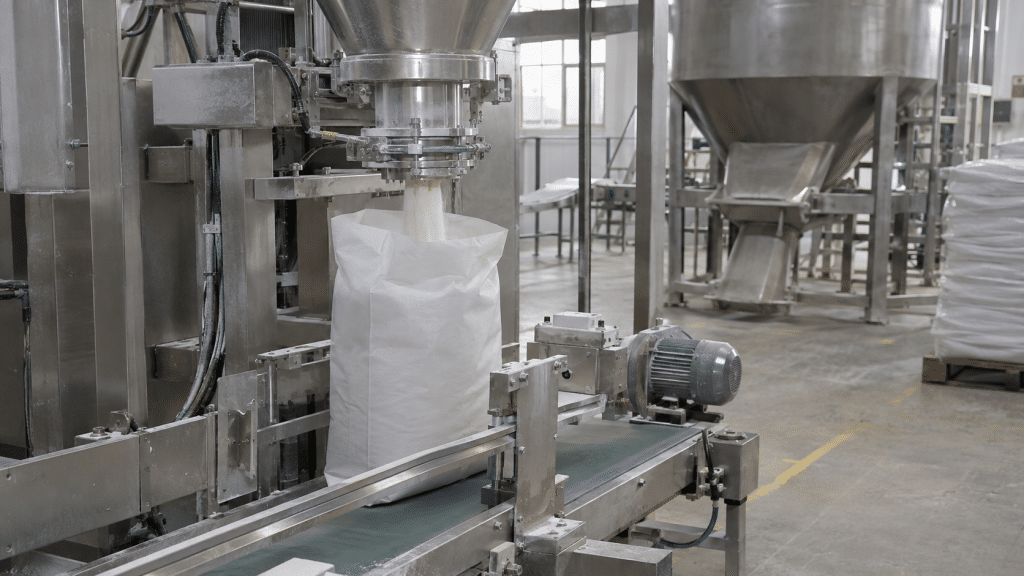
Proper packing helps protect CMC during storage and international transport.
Because CMC can absorb moisture from the air, suppliers should keep the material dry. Furthermore, suitable inner liners can help protect powder from humidity.
Packaging Options for Bulk CMC Export
Suppliers commonly offer CMC in 25 kg multiwall paper bags. Moreover, some grades use paper bags with polyethylene inner liners.
Woven bags with suitable liners may also serve industrial users. For example, certain factories may prefer this packing format because of their handling systems.
In addition, suppliers may offer 500–1,000 kg Big Bags for selected grades and larger orders.
However, food and pharmaceutical products may require special packing materials and hygiene controls.
Therefore, buyers should confirm packaging quality before placing an order.
Palletized packing can also make warehouse handling easier. Nevertheless, pallets take up additional container space.
Consequently, packing choices should reflect both storage needs and freight costs.
Pre-Shipment Quality Checks
Quality checks help confirm whether the product meets the agreed specification.
First, suppliers should confirm the actual chemical identity and commercial grade.
Next, laboratory tests can establish viscosity, moisture, purity and the degree of substitution.
Furthermore, buyers may require tests for sodium chloride, sodium glycolate and particle size.
For example, food and drug producers may also need microbial and impurity reports.
However, a general Technical Data Sheet does not describe the results of every production batch.
Therefore, suppliers should provide a batch-specific Certificate of Analysis.
In addition, independent inspectors can carry out agreed quality and quantity checks before shipment.
Clear batch numbers also support product traceability. As a result, buyers can connect laboratory records with the actual goods.
Finally, packing and weight checks help confirm whether the shipment meets the commercial agreement.
Storage and Workplace Safety
CMC requires clean and dry storage areas. Therefore, warehouse operators should protect bags from water, high humidity and physical damage.
Moreover, fine organic powders may create combustible dust hazards under certain conditions.
For this reason, workers should follow the actual product Safety Data Sheet.
Proper ventilation, for example, can help control dust levels.
Similarly, suitable material handling systems can help reduce unnecessary powder release.
In addition, stock rotation allows warehouses to manage older and newer batches.
Consequently, effective storage practices help maintain product quality throughout the supply chain.
Furthermore, proper packing helps protect product quality during carboxymethyl cellulose export.
Further safety guidance is available from OSHA – Combustible Dust.
10. Carboxymethyl Cellulose Export Logistics and Trade Documents
International CMC trade requires cooperation between suppliers, warehouses, transport firms, customs brokers and shipping lines.
Moreover, packed CMC can travel through established container shipping networks.
However, bag size, powder density and moisture protection needs affect the loading plan.
Therefore, exporters should review cargo details before booking transport.
Turkish Ports and International CMC Shipping
ATABAŞ GLOBAL coordinates international shipments through Mersin, İzmir, Gebze and İstanbul port regions.
For example, Mersin provides access to Eastern Mediterranean shipping routes. Meanwhile, İzmir and Aliağa offer connections through the Aegean region.
Gebze and Kocaeli also provide access to chemical industry areas and container terminals. Furthermore, İstanbul and Ambarlı connect with global shipping networks.
Because each destination has different freight options, we compare suitable loading ports before confirming transport plans.
In addition, we work with international shipping companies such as CMA CGM, Maersk, MSC and Hapag-Lloyd.
Our professional customs brokers also support export records and customs clearance.
Consequently, we can assess suitable shipping routes according to customer needs.
Container Loading and Flexible Delivery
A 20-foot dry container may suit certain packed CMC orders. In contrast, a 40-foot container may provide more space for lower-density products.
Furthermore, high-cube containers offer extra internal height.
However, the final cargo weight depends on bag size, bulk density and transport limits.
Therefore, suppliers should calculate the actual loading capacity before shipment.
Palletized loading may improve warehouse handling. Floor loading, on the other hand, may offer more useful cargo space where packing allows it.
In addition, containers should provide protection against moisture and outside contamination.
Because cargo condition affects product quality, suppliers should inspect containers before loading.
As a result, proper loading plans help protect both the goods and the efficiency of international transport.
International Delivery Terms for CMC Export
Buyers can request different delivery terms according to their commercial needs.
For example, EXW allows buyers to collect the goods from the agreed premises. Under FCA terms, however, the seller delivers the goods to the nominated carrier at the agreed point.
FOB applies when the seller delivers the goods on board the vessel at the loading port.
Similarly, CFR requires the seller to arrange and pay for sea freight to the named destination port.
Under CIF terms, the seller also arranges the required marine insurance. Nevertheless, cargo risk passes to the buyer when the goods are on board the vessel at the loading port.
CPT and CIP provide additional options for different transport methods. Moreover, FCA, CPT and CIP may suit containerized shipments.
DAP may also provide an option when the buyer requires delivery to a named destination before unloading.
Therefore, both parties should confirm the delivery term and named location before signing a contract.
Further information is available from the International Chamber of Commerce – Incoterms Rules.
Carboxymethyl Cellulose Export Documents
Accurate records support international trade and customs procedures.
For example, the Proforma Invoice identifies the initial commercial terms. Meanwhile, the Commercial Invoice records the final transaction details.
The Packing List also provides information about cargo weights and packing.
Furthermore, the Technical Data Sheet describes general product properties, whereas the Certificate of Analysis shows batch-specific test results.
The Safety Data Sheet, in addition, provides relevant handling and safety information.
For sea shipments, the Bill of Lading serves as an important transport document.
Depending on the destination, buyers may also require a Certificate of Origin.
Moreover, independent inspection reports can support agreed quality and quantity checks.
An insurance certificate may also apply when the relevant delivery terms or contract require cargo insurance.
For eligible Türkiye–EU customs union shipments, an A.TR movement certificate may support customs procedures. However, this document does not establish preferential product origin.
In contrast, an EUR.1 certificate may support eligible preferential-origin trade.
Food, drug and oilfield grades may require further technical records. Therefore, both parties should agree on a document checklist before loading.
Chemical Rules and Trade Compliance
ATABAŞ GLOBAL follows applicable international trade restrictions and sanctions requirements.
For this reason, we review product origins, suppliers, customers and shipping arrangements before confirming transactions.
Exports to the European Union, for example, may require a review of REACH and CLP duties.
However, the REACH polymer registration exemption does not remove every duty related to monomers, other substances or supply chain records.
Furthermore, food and pharmaceutical products may require additional market-specific documents.
Because trade rules vary between products and markets, each carboxymethyl cellulose export order requires a separate compliance review.
Therefore, effective freight planning and accurate trade records support reliable carboxymethyl cellulose export from Türkiye.
Official information is available from the European Chemicals Agency – ECHA.
11. Carboxymethyl Cellulose Export and Bulk Supply with ATABAŞ GLOBAL
Successful international CMC supply requires more than a competitive product price.
Moreover, industrial buyers need consistent quality, secure packing, accurate records and suitable delivery dates.
Therefore, ATABAŞ GLOBAL develops supply plans according to each customer’s requirements.
First, we review the intended use and requested product grade.
Next, we assess technical properties, order size and available supply options.
Afterwards, we review packing needs and shipping routes.
Finally, we prepare a commercial offer based on the agreed requirements.
Long-Term CMC Export and Industrial Supply
Regular supply plans can help buyers maintain stable production levels.
For example, a factory may require monthly deliveries rather than one large annual shipment.
Similarly, plants with limited storage space may prefer smaller scheduled orders.
However, product availability and vessel schedules can change during the year.
Therefore, early purchase forecasts help suppliers plan future deliveries.
In addition, clear technical limits help maintain consistent quality between shipments.
Furthermore, buyers and suppliers should agree on the relevant inspection methods before production or cargo preparation.
Consequently, long-term supply plans can help manage stock, quality and transport needs.
Information Required for a Carboxymethyl Cellulose Export Quotation
A detailed Request for Quotation (RFQ) helps us identify suitable products.
First, buyers should specify the product grade and intended industrial use.
For example, a food producer may require E466 compliance, whereas an oilfield company may request CMC-LVT or CMC-HVT.
Next, the buyer should provide the required viscosity and test conditions.
Moreover, the degree of substitution, purity, moisture and pH limits help define the correct product quality.
Particle size and residual salt levels may also affect product selection.
In addition, specialty grades may require further information about microbial limits, impurities or performance tests.
After confirming the technical details, buyers should share the total order quantity and expected monthly demand.
Furthermore, packing requirements help suppliers prepare suitable loading plans.
For instance, the customer may request 25 kg bags, palletized cargo or Big Bags.
The destination country, delivery point and requested Incoterm also help determine freight requirements.
Finally, both parties should agree on shipment dates, inspection needs and trade documents.
Because detailed purchase information reduces uncertainty, it can support faster and more accurate commercial offers.
For carboxymethyl cellulose export from Türkiye, bulk CMC supply, technical inquiries and international shipping solutions, contact ATABAŞ GLOBAL.
12. Frequently Asked Questions About Carboxymethyl Cellulose Export
Product Properties and Technical Quality
What is carboxymethyl cellulose?
CMC is a modified cellulose polymer that helps control viscosity, retain water and bind materials. Moreover, its sodium salt serves many food and industrial uses.
Is sodium CMC different from CMC?
Sodium CMC refers to the sodium salt of carboxymethyl cellulose. However, commercial suppliers often use the shorter name CMC for this product.
Which HS code applies to the product?
Carboxymethyl cellulose and its salts in primary forms generally fall under HS 391231. Nevertheless, prepared mixtures may require another customs code.
How can buyers identify sodium CMC?
Its CAS number is 9004-32-4. In addition, buyers should confirm the actual chemical identity through the product SDS.
Why does the degree of substitution matter?
This value describes the average number of carboxymethyl groups attached to each cellulose glucose unit. Therefore, it helps explain several water-related properties.
Do viscosity grades affect product performance?
Low-viscosity grades generally produce thinner solutions, whereas high-viscosity grades produce thicker solutions under the same test conditions.
Industrial Applications and Product Standards
Where do manufacturers use CMC?
Major uses include food, drilling, detergents, paper, textiles, ceramics and cosmetics. Furthermore, special grades serve battery and mining industries.
Can technical grades serve food production?
Standard technical grades do not automatically meet food safety rules. Therefore, food producers must select products that meet the relevant standards.
What does E466 identify?
E466 identifies sodium carboxymethyl cellulose within the European food additive system. Similarly, INS 466 provides its international food additive number.
How does PAC compare with standard CMC?
Both belong to a related cellulose product group. However, they may have different purity and performance limits.
Does CMC have battery applications?
Selected grades can serve as binders in water-based electrode slurries. Nevertheless, battery producers must confirm the required quality limits before use.
International CMC Trade and Commercial Supply
Which countries lead international CMC exports?
Available 2025 records place China, Finland, the Netherlands, France, Germany and Türkiye among the major national exporters by value. However, these figures cover several grades under the same HS code.
Are there product-specific export quotas?
This analysis does not establish a verified numerical export quota for the selected markets. Since trade rules can change, exporters should check current requirements before shipment.
Is container shipping suitable for CMC?
Suitable packed CMC can travel in dry freight containers. However, suppliers should protect the material from moisture and dirt during transport.
What packing options do suppliers offer?
Common options include 25 kg paper or woven bags with suitable inner liners. Furthermore, larger bags may be available according to the grade and commercial agreement.
Can customers request independent inspections?
Buyers can request independent quality and quantity checks under agreed trade terms. In addition, ATABAŞ GLOBAL can coordinate relevant inspection arrangements.
Does ATABAŞ GLOBAL arrange regular CMC deliveries?
We assess monthly supply plans according to product availability, buyer demand and vessel dates. Consequently, each plan reflects the customer’s commercial and technical needs.
How can international buyers obtain a quotation?
First, customers should share the required grade and technical limits. Next, they should confirm quantity, packing and destination. Finally, ATABAŞ GLOBAL can assess suitable supply and shipping options.
