

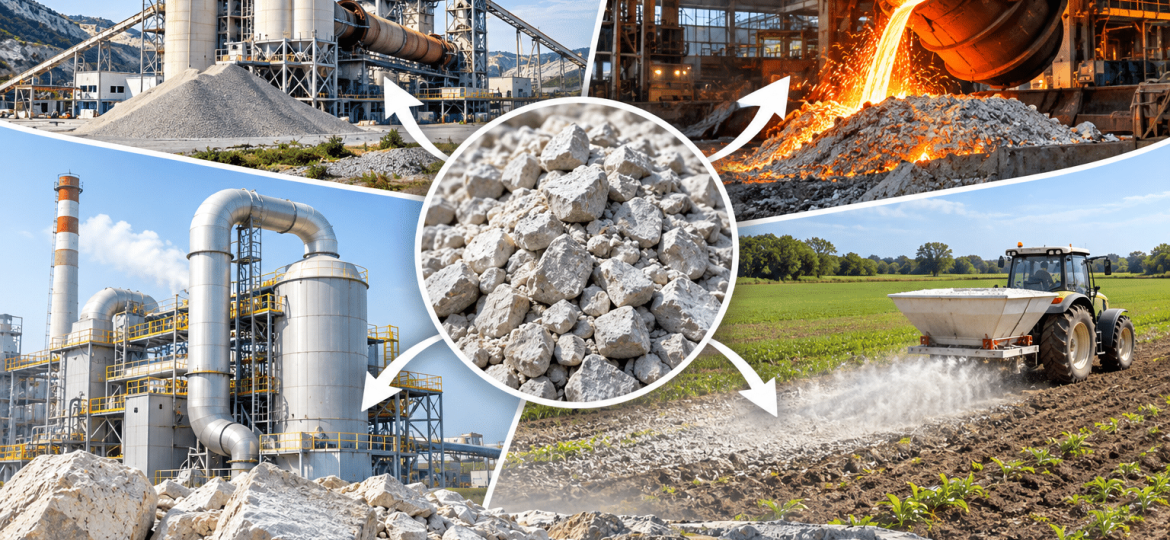
Industrial uses of limestone go far beyond construction. Because limestone consists mainly of calcium carbonate (CaCO₃), many industries use it as a raw material, flux, sorbent and soil treatment product. As a result, limestone plays an important role in cement, iron and steel, flue gas treatment and agriculture.
However, these industries do not need the same type of limestone. Cement plants mainly focus on chemical content and raw-mix needs. In contrast, iron and steel plants look at flux performance and impurity levels. Meanwhile, flue gas treatment systems need suitable reactivity and particle size. Agricultural use, on the other hand, depends on neutralizing value, fineness and soil needs.
Therefore, buyers should not treat industrial limestone as one standard product.
Instead, they should consider calcium carbonate, magnesium, silica, alumina, iron, moisture and particle size based on the final use.
Moreover, quarry geology and processing methods can change these properties.
As a result, choosing the right industrial limestone starts with understanding its use and required properties.
1. What Is Industrial Limestone?
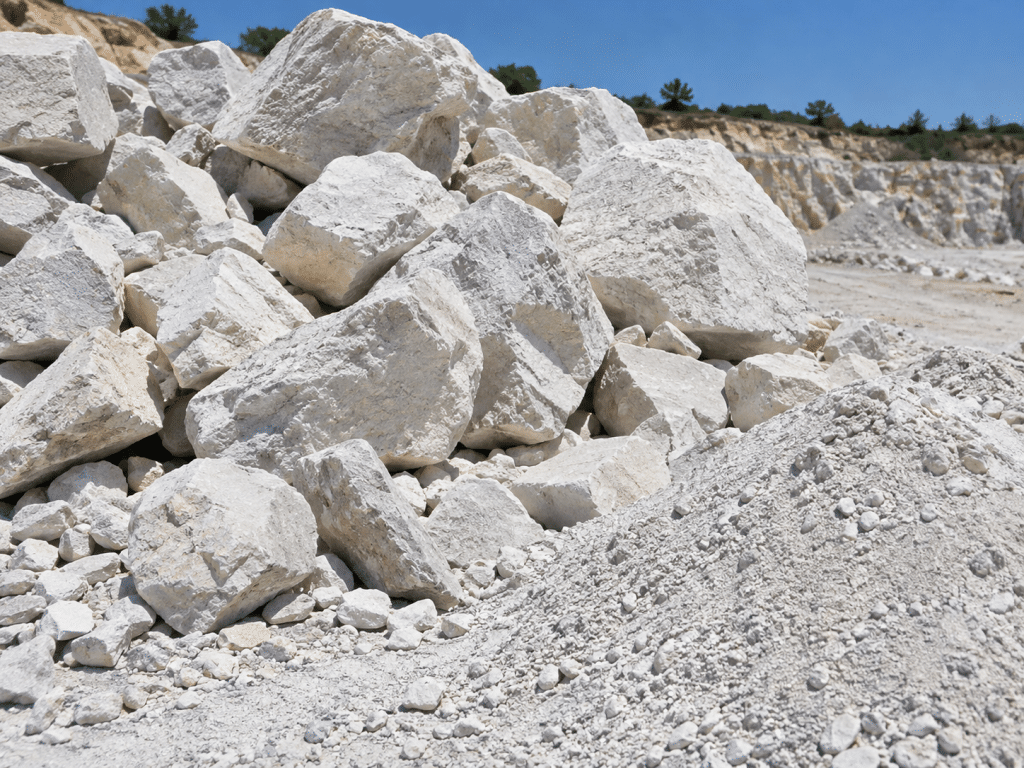
Limestone is a sedimentary carbonate rock made mainly of calcite. Its main chemical component is calcium carbonate (CaCO₃).
However, natural limestone can also contain different amounts of:
- Magnesium compounds
- Silica (SiO₂)
- Alumina (Al₂O₃)
- Iron oxides
- Clay
- Organic matter
- Moisture
- Other minor materials
Therefore, limestone from different deposits can have different chemical and physical properties.
Industrial users usually prepare quarried limestone by crushing, screening or grinding, depending on its final use.
For example, a cement plant may use crushed limestone as a major raw material. Meanwhile, an iron plant may need controlled limestone sizes or lime products made from limestone.
Similarly, flue gas treatment systems may use finely ground limestone. In agriculture, farmers often use ground limestone to treat acidic soils.
As a result, industrial uses of limestone depend on both the natural rock and the way it is processed.
Limestone also changes when heated to high temperatures. During calcination, calcium carbonate breaks down into calcium oxide and carbon dioxide:
CaCO₃ → CaO + CO₂
Therefore, limestone is also the main raw material for quicklime production.
However, limestone and quicklime are different products. Limestone mainly contains CaCO₃, while quicklime mainly contains CaO.
2. Key Properties of Industrial Limestone
Chemical content is one of the main factors when choosing limestone.
In particular, buyers often check calcium carbonate because it shows the amount of carbonate material available for the process.
However, CaCO₃ alone does not show whether a limestone source is suitable.
Depending on the use, buyers may also check:
| Property | Why It Matters |
|---|---|
| Calcium Carbonate (CaCO₃) | Main carbonate component |
| Calcium Oxide Potential | Important after calcination |
| Magnesium Content | Can affect process chemistry |
| Silica (SiO₂) | Important impurity or process component |
| Alumina (Al₂O₃) | Relevant to some industrial processes |
| Iron Oxides | Can affect product chemistry |
| Moisture | Affects handling and processing |
| Particle Size | Affects reaction and handling |
| Reactivity | Important in selected processes |
| Whiteness / Color | Relevant to some special uses |
Moreover, physical needs can vary greatly between industries.
For example, an iron plant may need controlled lump sizes for furnace use. In contrast, an FGD system may need finely ground limestone with controlled particle sizes.
Therefore, limestone requirements should always match the actual process.
3. Industrial Limestone in Cement Production
Cement production is one of the main industrial uses of limestone.
Limestone provides the main source of calcium needed for clinker production.
First, cement producers crush and prepare the limestone. Then, they combine it with materials that provide silica, alumina and iron.
Next, the plant grinds and blends these raw materials to create a controlled raw meal.
During heating, calcium carbonate breaks down during the calcination stage, commonly around 900°C under industrial process conditions.
The main reaction is:
CaCO₃ → CaO + CO₂
After calcination, the material enters hotter parts of the kiln. There, temperatures of about 1,400–1,500°C allow calcium-bearing compounds to form the main clinker minerals.
As a result, limestone chemistry directly affects raw-mix design and clinker production.
Why Limestone Quality Matters in Cement
Cement producers need stable chemical levels in the kiln feed.
Therefore, they commonly monitor:
- CaCO₃
- CaO potential
- SiO₂
- Al₂O₃
- Fe₂O₃
- MgO
- Alkalis
- Sulfur compounds
- Moisture
- Other relevant components
However, the required values depend on the cement plant, quarry and raw-mix design.
For this reason, one limestone specification cannot meet the needs of every cement factory.
Moreover, plants may blend limestone from different quarry areas or use other materials to keep the required raw-meal chemistry.
Therefore, recent laboratory test results are important when choosing limestone for cement production.
4. Limestone in the Iron and Steel Industry
The iron and steel industry is another major user of limestone and lime products.
In ironmaking, limestone can provide calcium-based flux material.
When heated, limestone breaks down and forms calcium oxide. Then, calcium oxide can react with unwanted mineral components and help form slag.
For example, silica can enter the furnace through iron-bearing materials, fuels and other inputs.
A simple reaction is:
CaO + SiO₂ → CaSiO₃
However, real slag contains several compounds. Therefore, actual slag chemistry is more complex than this single reaction.
Still, this simple reaction shows how calcium oxide can combine with silica.
As a result, limestone-derived materials can help form slag and separate unwanted mineral matter from the metal.
Limestone Selection for Iron and Steel
Iron and steel producers may check:
- CaCO₃ content
- CaO potential
- MgO
- SiO₂
- Al₂O₃
- Sulfur
- Phosphorus
- Moisture
- Particle size
- Strength
- Heat behavior
However, the requirements vary according to the furnace and production method.
For example, blast furnace operations may use suitably sized limestone in some systems. In contrast, basic oxygen furnaces, electric arc furnaces and later steel treatment stages commonly use quicklime or dolomitic lime.
Therefore, buyers should clearly distinguish between limestone, quicklime and dolomitic products.
As a result, every steel industry inquiry should state the exact process and required product form.
5. Limestone for Flue Gas Desulfurization
Flue gas treatment is another important industrial use of limestone.
Power plants and other industrial sites can produce sulfur dioxide (SO₂) when they process or burn sulfur-containing materials.
Therefore, many plants use flue gas desulfurization systems to reduce SO₂ emissions.
Wet limestone flue gas desulfurization, commonly called wet limestone FGD, uses limestone as a sorbent.
First, the system grinds limestone to the required size and mixes it with water to create a slurry.
Then, the system brings this slurry into contact with flue gas inside an absorber.
During treatment, sulfur dioxide enters the liquid and reacts through several steps with the calcium-bearing material.
Under forced oxidation conditions, the overall process can be shown with this simplified reaction:
CaCO₃ + SO₂ + ½O₂ + 2H₂O → CaSO₄·2H₂O + CO₂
As a result, the process can produce calcium sulfate dihydrate, commonly known as gypsum.
Therefore, limestone can help reduce sulfur dioxide emissions while also producing a calcium sulfate by-product.
6. Selecting Limestone for FGD Systems
Not every limestone source works in the same way in an FGD system.
For this reason, plant operators may check both chemical purity and reaction behavior.
Important factors can include:
- CaCO₃ content
- Magnesium content
- Insoluble material
- SiO₂
- Moisture
- Particle sizes
- Grindability
- Reactivity
- Slurry behavior
- Trace components where relevant
Moreover, particle size can strongly affect reaction speed. Finer particles usually provide more surface area and can react faster.
However, finer grinding also uses more energy.
Therefore, an FGD plant must balance fineness, reactivity, grinding cost and process needs.
In addition, absorber design and operating conditions affect the best limestone specification.
As a result, suppliers should match FGD limestone to the actual plant needs rather than describe it only as “high-purity limestone.”
7. Agricultural Limestone and Soil Improvement
Agriculture is another important use for processed limestone.
Many soils become acidic because of natural conditions, rainfall, crop removal, fertilizer use and other factors.
When soil becomes too acidic, plants may have more difficulty accessing some nutrients. In addition, soil acidity can affect root growth and soil life.
Therefore, farmers may apply agricultural limestone to raise soil pH and improve growing conditions.
Calcium carbonate reacts with soil acidity and provides a liming effect.
As a result, agricultural limestone can help with:
- Soil pH control
- Better nutrient availability
- Calcium supply
- Better conditions for soil organisms
- More effective fertilizer use in suitable soils
- Long-term soil care
However, limestone is not a complete fertilizer.
Instead, it mainly works as a soil treatment material.
Therefore, farmers should decide application rates through soil tests and local farming guidance.
8. Agricultural Limestone Quality and Fineness
Agricultural limestone performance depends on both chemistry and particle size.
For example, finer limestone usually reacts with soil acidity faster because smaller particles provide more surface area.
However, very fine material can also create more dust during handling.
Therefore, agricultural buyers may consider:
- Calcium carbonate content
- Calcium Carbonate Equivalent (CCE)
- Magnesium content
- Moisture
- Particle size
- Fineness
- Relevant contaminants
- Local farming requirements
CCE shows the acid-neutralizing ability of the material compared with pure calcium carbonate.
In addition, some markets use measures such as Effective Neutralizing Value (ENV) or Relative Neutralizing Value (RNV).
These values can combine chemical neutralizing ability with the effect of particle size.
As a result, they can give buyers a better view of agricultural limestone performance than CaCO₃ content alone.
Moreover, limestone with enough magnesium may also provide magnesium to the soil.
However, farming needs vary by soil, crop and region.
Therefore, soil testing and local recommendations should guide product choice and application rates.
9. Other Industrial Uses of Limestone
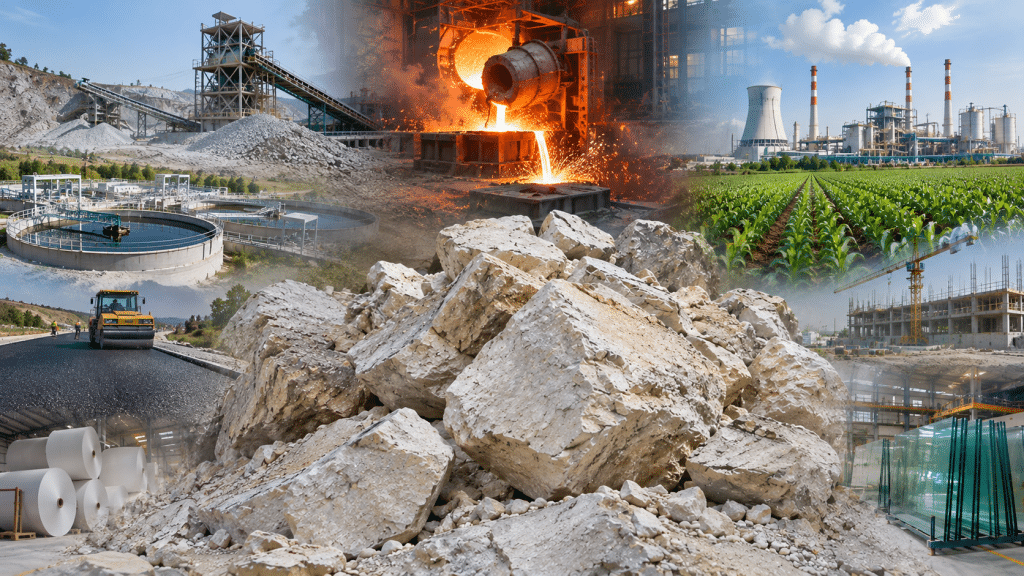
Although cement, steel, FGD and agriculture are major markets, industrial uses of limestone extend into many other areas.
For example, industries may use limestone or limestone-based materials in:
- Lime production
- Glass manufacturing
- Pulp and paper
- Water treatment
- Wastewater treatment
- Chemical processing
- Mineral fillers
- Construction materials
- Asphalt mixtures
- Ground calcium carbonate production
- Precipitated calcium carbonate production
- Building products
However, each use may need different levels of purity, particle size, brightness or reactivity.
For example, glass production may require careful control of iron and other impurities. Meanwhile, mineral filler applications may need controlled grinding and particle size.
Therefore, “industrial limestone” describes a broad group of materials rather than one fixed grade.
10. Industrial Limestone Grades and Particle Sizes
Suppliers can process limestone into different forms based on the target industry.
Common forms include:
| Product Form | General Description | Potential Uses |
|---|---|---|
| Limestone Lumps | Coarse sized stone | Ironmaking, lime production |
| Crushed Limestone | Controlled crushed fractions | Cement, industrial processing |
| Fine Crushed Limestone | Smaller crushed fractions | Blending and processing |
| Ground Limestone | Finely ground material | Agriculture, industrial processes |
| Limestone Filler | Very fine controlled material | Asphalt and selected industrial uses |
| Limestone Powder | Fine processed limestone | FGD, fillers and chemical uses |
However, these descriptions do not define universal particle sizes.
Instead, buyers should state the required particle size, sieve limits or d/D designation where suitable.
Moreover, some industries set limits for the amount of material remaining on certain sieves instead of using standard aggregate size names.
Therefore, particle-size requirements should always match the final use.
11. Quality Control and Industrial Limestone Selection
Choosing industrial limestone requires more than comparing prices.
First, the buyer should identify the exact use.
Next, the technical team should define the required chemical properties.
Then, the buyer should set physical needs such as particle size, moisture and product form.
A professional limestone inquiry may include:
- Intended use
- Required CaCO₃ content
- Required CaO or calculated CaO potential
- Maximum MgO
- Maximum SiO₂
- Maximum Al₂O₃
- Maximum Fe₂O₃
- Sulfur and phosphorus limits where relevant
- Moisture limit
- Required particle size
- Required fineness
- Reactivity where applicable
- Monthly or annual quantity
- Packing or bulk requirement
- Loading rate
- Delivery schedule
- Destination
- Incoterm
- Required laboratory documents
Moreover, buyers should request test results from the actual production source.
For example, X-ray fluorescence (XRF) can help show the elemental content. Likewise, sieve analysis can confirm particle sizes, while moisture tests can check water content.
In addition, buyers should know the difference between a Technical Data Sheet and a Certificate of Analysis.
A TDS normally shows the declared product properties. In contrast, a COA reports actual test results for a sample, batch or production lot, based on the supplier’s quality system.
Therefore, buyers should use suitable laboratory data to confirm whether the offered limestone meets their needs.
Furthermore, a general quarry analysis may not represent every quarry area or production lot.
As a result, regular quality checks and clear product records are especially important for long-term supply.
12. Industrial Limestone Sourcing with ATABAŞ GLOBAL
Industrial limestone sourcing requires coordination between quarry capacity, product needs, processing and logistics.
Therefore, ATABAŞ GLOBAL supports international sourcing and trade coordination for limestone and limestone-based raw materials according to customer and project needs.
Depending on the use, the sourcing process can consider:
- Chemical content
- Required limestone grade
- Particle size
- Crushing and screening capability
- Grinding needs
- Quarry production capacity
- Laboratory documents
- Quality consistency
- Monthly and annual demand
- Bulk availability
- Stock management
- Inland transport
- Port facilities
- Vessel loading capability
- Container shipment where suitable
- Incoterms
- Delivery schedule
Moreover, industrial limestone projects often involve large shipment volumes.
Therefore, logistics can strongly affect the final delivered cost.
For example, quarry-to-port distance, truck capacity, loading systems, port conditions and vessel size can all affect the final price.
As a result, the lowest quarry price does not always provide the lowest delivered cost.
Therefore, ATABAŞ GLOBAL considers both product suitability and logistics when coordinating industrial limestone sourcing.
13. Frequently Asked Questions About Industrial Uses of Limestone
What are the main industrial uses of limestone?
Industrial uses of limestone include cement production, iron and steel production, flue gas desulfurization, agriculture, lime production, water treatment, glass production and mineral filler applications.
Why is limestone important in cement production?
Limestone provides the main source of calcium needed for clinker production. During calcination, calcium carbonate breaks down into calcium oxide and carbon dioxide. Then, calcium-bearing compounds take part in clinker-forming reactions at higher kiln temperatures.
How does the iron and steel industry use limestone?
In some ironmaking operations, limestone provides calcium-based flux material. After calcination, calcium oxide can help form slag and control unwanted mineral matter. However, many steelmaking stages use quicklime rather than raw limestone.
Is limestone the same as quicklime?
No. Limestone mainly contains calcium carbonate (CaCO₃). In contrast, heating limestone during calcination produces calcium oxide (CaO), commonly known as quicklime.
How does limestone help remove sulfur dioxide?
Wet limestone FGD systems use finely ground limestone in a water-based slurry. The calcium-bearing material reacts with sulfur dioxide. Then, under suitable oxidation conditions, the process can produce gypsum.
What limestone properties matter for FGD?
FGD plants may check CaCO₃ content, impurities, particle size, grindability, reactivity and slurry behavior. However, the exact needs depend on the plant and absorber design.
Why do farmers use agricultural limestone?
Agricultural limestone helps neutralize acidic soil and raise soil pH. As a result, it can improve growing conditions and nutrient availability when soil tests show that liming is needed.
What is CCE in agricultural limestone?
Calcium Carbonate Equivalent, or CCE, compares the acid-neutralizing ability of a liming material with pure calcium carbonate. Therefore, it helps buyers compare different agricultural limestone products.
Does particle size matter for agricultural limestone?
Yes. Finer limestone generally reacts with soil acidity faster because it provides more surface area. However, buyers should also consider handling, local rules and soil needs.
Is all high-calcium limestone suitable for every industry?
No. Different industries need different chemical properties, particle sizes, purity levels and reaction behavior. Therefore, high CaCO₃ content alone does not prove that limestone is suitable for a specific process.
What is the difference between high-calcium and dolomitic limestone?
High-calcium limestone mainly contains calcium carbonate with relatively low magnesium content. In contrast, dolomitic limestone contains more magnesium-bearing carbonate minerals.
Can industrial limestone be supplied in bulk?
Yes. Depending on product form, quantity and destination facilities, industrial limestone can move in bulk or through other suitable packing and transport methods.
What information should an industrial limestone RFQ include?
First, the RFQ should state the intended use and required chemical properties. In addition, it should include particle size, quantity, packing or bulk needs, destination, delivery schedule, Incoterm and required quality documents.
