

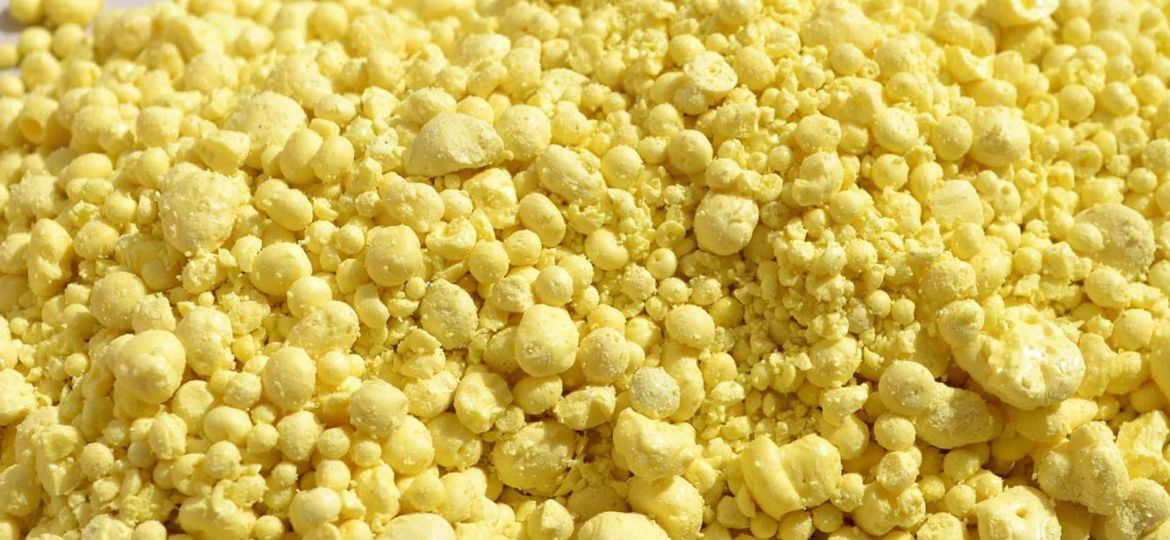
Granular sulfur is a solid form of elemental sulfur that offers practical handling, storage and transport properties. Producers convert sulfur into firm granules to create a free-flowing product that suits large-scale industrial and agricultural supply chains.
Many industries use granular sulfur as a raw material. For example, sulfuric acid production, fertilizer manufacturing and other chemical processes can use elemental sulfur as an input. Agriculture also uses suitable sulfur products as a plant nutrient and as part of soil management programs.
However, granular sulfur does not have one universal commercial specification. Purity, granule size, moisture and other properties can vary by producer, production process and grade. Therefore, buyers should always compare the supplier’s current specification and Certificate of Analysis (CoA) with the needs of their application.
This guide explains granular sulfur, its properties, typical specifications, production, uses, quality factors, storage and commercial purchasing points.
1. What Is Granular Sulfur?
Granular sulfur is elemental sulfur formed into solid granules. Elemental sulfur has the chemical symbol S and an atomic number of 16.
At normal ambient conditions, pure sulfur is a yellow solid. Granulation changes its physical form but does not change the basic identity of elemental sulfur.
The granular form provides several practical advantages for bulk operations. For example, well-made granules can improve flow during loading, unloading and storage compared with very fine sulfur particles.
In simple terms, granular sulfur is elemental sulfur processed into granules for easier commercial handling and use.
Nevertheless, granule properties differ among suppliers. Buyers should check product-specific technical data before choosing a grade.
2. How Is Granular Sulfur Produced?
Producers first obtain sulfur from an appropriate sulfur source. In modern industrial supply chains, sulfur commonly comes from recovery processes associated with oil and natural gas refining.
After recovery and purification, producers can convert molten sulfur into solid particles. Granulation systems control cooling and particle formation to produce granules with suitable size and strength.
The exact production method depends on the plant and technology. However, the main goal remains similar: create solid sulfur particles that can withstand normal transport and handling while limiting excessive fines.
Process control can affect several product properties, including:
- Granule size
- Particle strength
- Fines content
- Moisture
- Flow behavior
- Product consistency
Therefore, buyers should review the actual supplier specification rather than assume that every granular sulfur product has the same physical properties.
3. What Are the Main Properties of Granular Sulfur?
Granular sulfur combines the chemical properties of elemental sulfur with the physical benefits of a granular product.
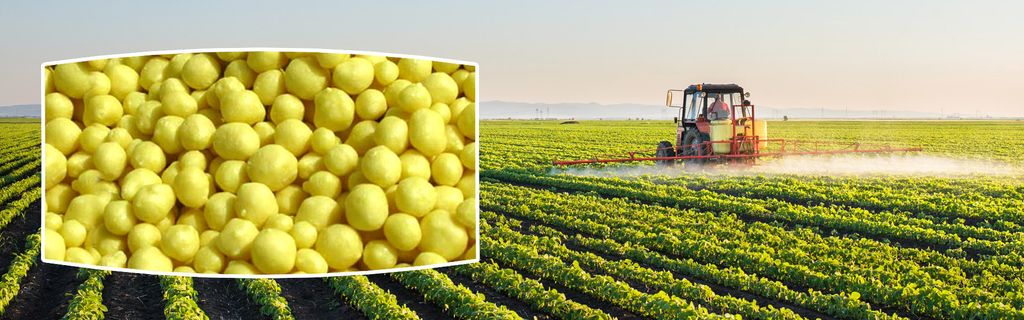
It normally has a yellow appearance, although shade can vary. In addition, its granules provide a larger and more manageable particle form than sulfur powder.
Important properties include:
- Elemental sulfur composition
- Solid granular form
- Yellow appearance
- Low water solubility
- Defined particle-size distribution
- Bulk handling capability
- Combustibility
- Product-specific moisture and impurity levels
Sulfur does not readily dissolve in water. Therefore, its behavior differs from that of readily soluble sulfate fertilizers.
Moreover, sulfur can burn under suitable conditions. Fine sulfur dust can create additional fire and dust-explosion hazards. As a result, facilities must follow suitable safety controls during storage and handling.
4. What Are the Typical Specifications of Granular Sulfur?
Commercial specifications vary according to producer, source, grade and customer requirements. Therefore, the following table provides typical or descriptive parameters, not guaranteed values for every product.
| Parameter | Typical Characteristic |
|---|---|
| Product name | Granular Sulfur |
| Chemical name | Sulfur / Elemental Sulfur |
| Chemical symbol | S |
| CAS number | 7704-34-9 |
| Atomic number | 16 |
| Physical form | Solid granules |
| Appearance | Yellow granules |
| Sulfur content | Commonly high; supplier-specific |
| Purity | Grade and supplier dependent |
| Moisture | Usually controlled; supplier-specific |
| Particle size | Depends on granulation process and specification |
| Fines | Supplier-specific |
| Water solubility | Very low |
| Odor | Generally characteristic or slight; impurities may affect odor |
| Bulk density | Product and particle-size dependent |
| Storage | Cool, dry, suitable and well-managed storage area |
| Shelf life | Depends on packaging and storage conditions |
Buyers should use the supplier’s current technical data sheet and CoA for contractual specifications.
For example, sulfur purity may be very high in some commercial grades. However, a generic percentage should not replace an actual supplier guarantee. Likewise, particle-size ranges can differ significantly between producers.
5. What Is Granular Sulfur Used For?
Granular sulfur serves as a raw material for several industrial and agricultural processes.
Major uses can include:
- Sulfuric acid production
- Fertilizer manufacturing
- Agricultural sulfur applications
- Chemical production
- Mineral processing applications
- Industrial sulfur compounds
- Selected rubber and manufacturing processes after suitable processing
- Other sulfur-based industrial processes
However, the required grade depends on the application.
For example, an industrial chemical process may prioritize sulfur purity and impurity limits. In contrast, an agricultural buyer may focus on nutrient content, particle behavior and suitability for the intended soil program.
Therefore, users should match the sulfur grade to the exact application.
6. Why Is Granular Sulfur Used in Agriculture?
Sulfur is an essential plant nutrient. Plants need it for normal growth and for the formation of certain amino acids, proteins and enzymes.
Granular sulfur can provide elemental sulfur to agricultural systems. However, plants do not take up elemental sulfur directly in the same way they take up sulfate.
Instead, soil microorganisms oxidize elemental sulfur over time and convert it into sulfate forms that plants can use.
Several factors affect this conversion, including:
- Soil temperature
- Soil moisture
- Microbial activity
- Particle size
- Soil conditions
- Contact between sulfur and soil
Consequently, elemental sulfur does not act like an immediately soluble sulfate fertilizer.
Farmers and agronomists should select the product and application rate according to soil tests, crop needs, local conditions and professional agronomic advice.
7. Can Granular Sulfur Help Manage Soil pH?
Elemental sulfur can contribute to lowering the pH of suitable soils as soil microorganisms oxidize it. During this biological process, reactions ultimately generate acidity.
However, the result does not occur instantly.
Soil properties strongly affect how much sulfur a program may require and how quickly pH changes. For instance, soil texture, carbonate content, starting pH, temperature and moisture can all influence the outcome.
Therefore, applying a generic sulfur rate to every field can produce poor results.
A better approach includes:
- Testing the soil.
- Defining the target pH.
- Considering the soil’s buffering capacity.
- Selecting an appropriate sulfur product.
- Following local agronomic guidance.
- Monitoring soil conditions after application.
This approach helps users make more accurate decisions while reducing the risk of unnecessary application.
8. How Does Granule Size Affect Sulfur Performance?
Particle size plays an important role in both handling and agricultural performance.
Larger, stronger granules often provide good physical properties for transport and bulk handling. They can also produce less dust than fine sulfur during normal movement.
However, elemental sulfur must come into close contact with soil before microorganisms can oxidize it effectively. Therefore, the behavior of a granule after application matters.
Some agricultural sulfur products use formulations or granule structures designed to disperse into smaller particles after exposure to moisture. Other products may behave differently.
As a result, buyers should not judge agricultural performance only by the size of the original granule.
Instead, they should evaluate the complete product design, dispersion behavior, particle characteristics and supplier recommendations.
9. What Is the Difference Between Granular Sulfur and Sulfur Powder?
Both products can contain elemental sulfur, but their physical forms differ.
| Feature | Granular Sulfur | Sulfur Powder |
| Physical form | Granules | Fine particles |
| Particle size | Relatively larger | Much smaller |
| Dust generation | Generally lower when granules remain intact | Generally higher |
| Bulk handling | Often easier | Requires stronger dust controls |
| Surface area | Lower for intact large particles | Higher due to fine particle size |
| Agricultural behavior | Depends on granule dispersion and final particle size | Fine particles provide greater direct surface area |
| Dust hazard | Lower than fine powder in normal intact form, but fines can still occur | Higher dust potential |
Granular sulfur can offer handling advantages. Meanwhile, sulfur powder provides a much finer particle form.
Nevertheless, users should not select between them based on particle size alone. Application method, safety controls, product design and intended performance also matter.
10. What Determines Granular Sulfur Quality?
Quality depends on whether the product meets the needs of its intended application.
Important commercial quality factors can include:
- Sulfur content
- Purity
- Moisture
- Granule size distribution
- Granule strength
- Fines content
- Foreign material
- Relevant impurities
- Bulk density
- Flow behavior
- Batch consistency
For bulk buyers, physical quality can matter almost as much as chemical purity.
For example, weak granules may break during repeated handling and create additional fines. This change can affect dust levels, product loss and handling conditions.
Therefore, buyers should evaluate both chemical and physical specifications when qualifying a supplier.
11. Which Specifications Should Buyers Check Before Purchasing?
Buyers should first define the final application. Then, they can identify the technical parameters that matter most.
Sulfur content indicates the amount of sulfur in the product. Buyers should confirm the guaranteed value and test method.
Moisture can affect product quality and handling. Therefore, users should check the supplier’s limit.
Particle-size distribution helps buyers understand the physical profile of the granules. It can also affect handling and application equipment.
Fines content deserves attention because fine sulfur particles increase dust concerns.
Granule strength can matter during bulk transport and repeated material handling.
In addition, buyers may need to review specific impurity limits for their process.
Finally, the CoA should match the agreed purchase specification and clearly state relevant analytical results.
12. How Should Granular Sulfur Be Stored?
Facilities should store granular sulfur in a dry, suitable area away from incompatible materials and ignition sources.
Good housekeeping plays an important role because handling can create sulfur fines and dust. Therefore, operators should prevent unnecessary dust buildup.
Storage planning should consider:
- Fire prevention
- Dust control
- Suitable ventilation
- Clean storage areas
- Protection from contamination
- Control of ignition sources
- Compatible equipment
- Proper housekeeping
- Supplier safety instructions
Operators should also avoid activities that can create unsafe ignition conditions around sulfur dust.
Most importantly, facilities should follow the product-specific Safety Data Sheet (SDS), local fire codes and workplace safety requirements.
13. How Should Granular Sulfur Be Transported and Handled?
Bulk handling systems should aim to protect granule quality while controlling dust.
Conveyors, loaders and transfer points can break granules if the system creates excessive impact. Consequently, poor handling may increase the amount of fines.
Facilities can reduce these problems through suitable equipment design and operating procedures.
Important factors include:
- Minimizing excessive drop heights
- Controlling dust at transfer points
- Preventing contamination
- Maintaining clean equipment
- Avoiding ignition sources
- Following applicable transport requirements
- Training personnel in safe sulfur handling
Transport classification and requirements can depend on the product form, shipment method and applicable jurisdiction. Therefore, shippers should use the current SDS and relevant transport rules for the specific product.
14. How Should Buyers Choose a Granular Sulfur Supplier?
A strong purchasing decision should combine product quality, technical documentation and supply reliability.
First, buyers should define their required sulfur grade. Next, they should compare suppliers against the same technical parameters.
Useful documents may include:
- Product specification
- Certificate of Analysis
- Safety Data Sheet
- Country of origin information
- Particle-size specification
- Moisture specification
- Purity or sulfur-content data
- Relevant impurity information
- Storage guidance
- Transport information
Furthermore, buyers should consider consistency between shipments. A supplier that provides stable particle size and chemical quality can help reduce process variation.
Packaging and logistics also matter. Depending on volume, suppliers may offer bulk shipments or suitable packaged formats.
Therefore, commercial buyers should evaluate the complete supply offer rather than compare price alone.
15. Why Is Granular Sulfur an Important Commercial Raw Material?
Granular sulfur combines the chemical value of elemental sulfur with a physical form designed for practical commercial handling.
Industries can use it as an input for sulfuric acid, fertilizers and other sulfur-based products. Agriculture can also use suitable elemental sulfur products as a sulfur nutrient source and for specific soil management programs.
At the same time, the granular form can simplify storage and bulk movement compared with finer sulfur products.
However, buyers should remember that not every granular sulfur grade has the same properties.
Purity, particle size, moisture, granule strength, fines and impurities can differ between suppliers. As a result, users should select granular sulfur according to a defined specification and the needs of the final application.
A careful review of the supplier’s technical data, CoA and SDS helps buyers choose the correct product while supporting consistent quality, safe handling and reliable process performance
