

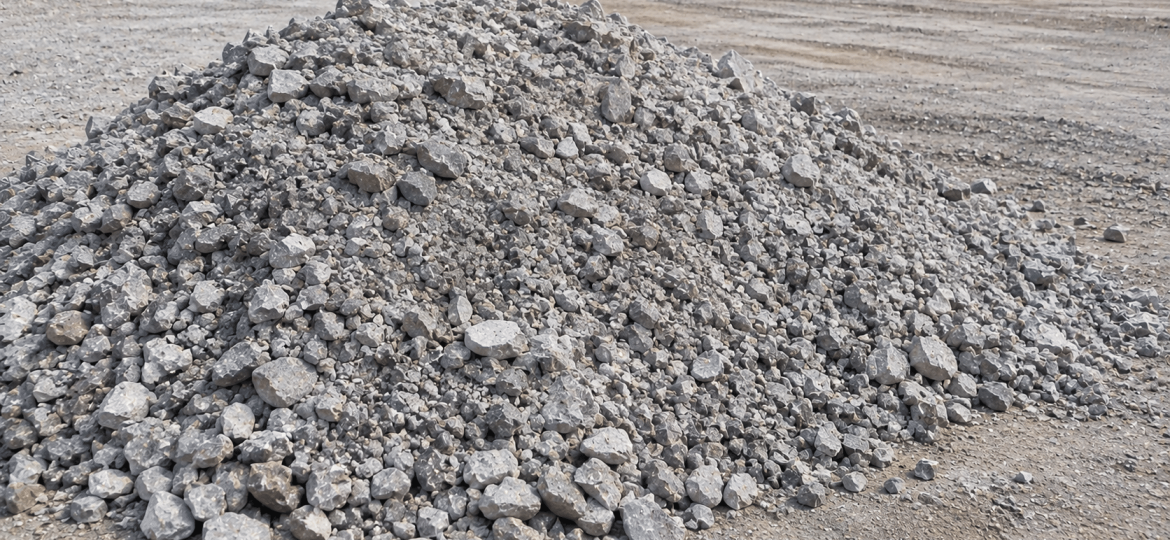
Limestone aggregate for road base plays an important role in road construction and civil engineering projects that require stable, compactable and technically controlled granular materials. Depending on the project design, contractors can incorporate processed limestone aggregate into unbound or hydraulically bound materials for pavement foundations and other civil engineering works.
However, successful performance depends on much more than aggregate size. Grading, fines content, fines quality, particle shape, fragmentation resistance, wear resistance, particle density, water absorption and durability can all influence material suitability.
For European applications, EN 13242 provides the technical framework for aggregates in unbound and hydraulically bound materials for civil engineering work and road construction.
Therefore, engineers and buyers need to evaluate the actual processed material, its declared characteristics and the requirements of the intended application when selecting limestone aggregate for road base.
Moreover, EN 13242 does not provide a complete specification for every finished road-base or subbase mixture. Other standards and national specifications may define additional requirements for the final mixture.
Consequently, aggregate selection should always begin with the project specification and intended end use.
1. What Is Limestone Aggregate for Road Base?
Limestone aggregate for road base consists of crushed and classified limestone that serves as a mineral aggregate in pavement foundations and other civil engineering applications.
Production generally begins when quarry operators extract suitable limestone. Crushing equipment then processes the rock, while screening systems separate it into controlled aggregate fractions.
A typical production sequence includes:
Quarry Extraction → Primary Crushing → Secondary Crushing → Screening → Classification → Quality Control → Stockpiling → Delivery
As a result, producers can manufacture coarse, fine and all-in aggregate fractions for different engineering requirements.
Crushing also creates angular particles that can contribute to particle interlock after placement and compaction. Nevertheless, geological characteristics and processing conditions can significantly influence the final product.
Therefore, project teams should consider the quarry source, crushing configuration, grading and laboratory performance before approving limestone aggregate for road base.
2. Understanding EN 13242
EN 13242 defines characteristics for aggregates intended for unbound and hydraulically bound materials in civil engineering work and road construction.
The standard covers aggregates from natural, manufactured and recycled sources, subject to the relevant requirements.
For limestone applications, important technical areas may include:
| Technical Area | Typical Evaluation |
|---|---|
| Aggregate Size | d/D size designation |
| Grading | Particle-size distribution |
| Fines Content | Material passing the relevant fine sieve |
| Fines Quality | Characteristics of the fine fraction |
| Particle Shape | Flakiness and shape characteristics |
| Crushed Particles | Crushed and broken particle surfaces |
| Angularity | Geometry of relevant aggregate fractions |
| Fragmentation Resistance | Resistance to mechanical breakdown |
| Wear Resistance | Resistance to mechanical wear |
| Particle Density | Density characteristics |
| Water Absorption | Water absorbed by aggregate particles |
| Petrographic Characteristics | Description of aggregate composition |
| Chemical Characteristics | Relevant chemical properties |
| Durability | Resistance to environmental exposure |
However, not every project requires the same category for every characteristic.
Instead, the particular application, end use and applicable project or national requirements determine the necessary properties.
Therefore, simply requesting “EN 13242 limestone” may not provide enough technical information for procurement.
The inquiry should also identify the intended use and required performance categories.
3. Aggregate Sizes and Grading
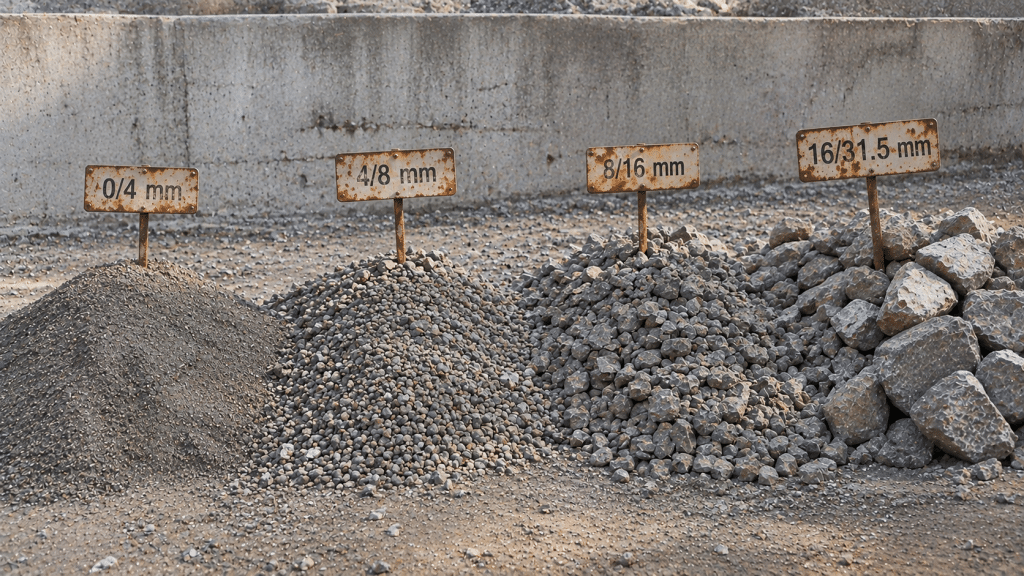
EN 13242 uses the d/D designation to identify aggregate size.
Here, d represents the lower sieve size, while D represents the upper sieve size that defines the aggregate fraction.
Examples can include:
- 0/4 mm
- 4/8 mm
- 8/16 mm
- 16/31.5 mm
- 0/31.5 mm
- 0/63 mm
These examples do not represent universal road-base specifications. The intended application, mixture design and applicable specification determine the actual sizes.
Aggregates may consist of single sizes, all-in materials or combinations of different fractions.
For road construction, grading becomes particularly important because the distribution of coarse and fine particles influences the granular structure of the material.
Well-controlled grading can support effective particle packing and consistent compaction. Conversely, uncontrolled variation may change material behavior during placement.
Therefore, buyers should specify a defined grading requirement for limestone aggregate for road base rather than request only a nominal maximum particle size.
4. Limestone Aggregate for Road Base and Subbase
Road pavements generally contain several layers that transfer traffic loads toward the underlying ground.
Road base and subbase layers form important parts of this pavement structure.
Project designers can specify limestone aggregate for these applications when the processed material satisfies the necessary mechanical, geometrical and durability characteristics.
Road Base
The base layer contributes significantly to load distribution within the pavement structure.
Therefore, this layer often requires aggregate with controlled grading, adequate fragmentation resistance and consistent mechanical properties.
Subbase
The subbase generally sits below the base course and above the prepared foundation or subgrade, depending on the pavement design.
It can contribute to load distribution, provide a stable construction platform and support the overall pavement structure.
However, base and subbase specifications vary between projects and countries.
Consequently, engineers should never approve limestone aggregate for road base solely because a particular particle size is available. They should review the complete project specification.
5. Grading and Compaction Performance
Grading strongly influences how granular aggregate behaves during placement and compaction.
A suitable distribution of particle sizes can create a dense aggregate structure under proper compaction.
Coarser particles contribute to the structural skeleton, while smaller particles occupy part of the void space between larger particles.
However, this does not mean that more fines automatically produce better compaction.
Excessive or unsuitable fines can alter moisture sensitivity and material behavior. Therefore, engineers need to consider both fines content and fines quality.
Moreover, segregation during loading, transport or stockpiling can change the grading that reaches the construction site.
For this reason, producers and contractors should control:
- Crushing consistency
- Screening efficiency
- Stockpile segregation
- Loading practices
- Moisture conditions
- Delivered grading
- Compaction procedures
Consequently, successful field performance depends on both aggregate production and site execution.
6. Fines Content and Fines Quality
EN 13242 addresses both the amount and quality of fines.
The term fines refers to the fine particle fraction associated with material passing the 0.063 mm sieve.
Depending on the aggregate type and required category, laboratories can determine and report the fines content according to the applicable specification.
However, quantity alone does not fully describe fine material.
Where necessary, laboratories can also examine fines quality. Relevant methods may include sand equivalent and methylene blue testing.
These evaluations provide additional information about the nature of the fine fraction.
Therefore, project teams should not assess limestone aggregate for road base only by visual appearance or assume that quarry dust automatically meets project requirements.
Instead, they should compare the amount and characteristics of the fine fraction with the relevant specification.
Moreover, fines can vary as quarry conditions and crushing processes change. Regular production control can therefore support consistency throughout long-term projects.
7. Particle Shape and Crushed Surfaces
Particle geometry can influence aggregate behavior within a compacted granular layer.
Crushing limestone generally creates angular particles and fractured surfaces. However, crusher type, feed material and crushing stages affect the final particle geometry.
Relevant characteristics can include:
- Flakiness index
- Shape index
- Percentage of crushed particles
- Percentage of broken surfaces
- Angularity
Particles with suitable shape characteristics can contribute to mechanical interlock within a compacted aggregate structure.
Conversely, excessive flaky particles may create problems in certain engineering applications.
Therefore, engineers should compare particle shape with the required category rather than rely on visual inspection alone.
In addition, consistent crusher settings can help maintain more uniform product characteristics throughout the supply period.
8. Fragmentation and Wear Resistance
Road-base aggregates experience mechanical stresses during production, transport, placement, compaction and service.
For this reason, many applications require adequate resistance to fragmentation.
Laboratories commonly use the Los Angeles test within the EN aggregate testing framework to assess resistance to fragmentation.
EN 13242 provides categories that allow suppliers and project teams to classify this performance according to the intended application.
However, no single Los Angeles value automatically applies to every road project.
The particular end use and project specification determine the required category.
Projects may also require evaluation of wear resistance where relevant.
Therefore, buyers should specify the required performance category instead of simply asking whether limestone aggregate for road base is “strong enough.”
Moreover, geological variation within a quarry can influence mechanical performance. Periodic testing can therefore help suppliers maintain consistent quality during large or long-term projects.
9. Water Absorption, Density and Durability
Particle density and water absorption provide important information about aggregate characteristics.
Density data can support material calculations and engineering evaluation, while water absorption provides information about the interaction between aggregate particles and moisture.
However, road construction materials must also withstand environmental conditions throughout their service life.
Depending on the project location, relevant exposure can include:
- Rainfall and moisture
- Repeated wetting and drying
- Freeze-thaw cycles
- Temperature variation
- Weathering
- De-icing salts in relevant environments
Therefore, engineers should assess durability according to actual exposure conditions.
For example, a severe freeze-thaw environment may require different aggregate performance from a mild climate.
Consequently, project teams should assess limestone aggregate for road base according to both mechanical performance and environmental exposure.
10. Unbound and Hydraulically Bound Applications
One important aspect of EN 13242 is its coverage of aggregates for both unbound and hydraulically bound materials.
Unbound Materials
An unbound material does not rely on an added hydraulic binder to develop its structural behavior.
Granular materials in pavement base and subbase applications can fall within this broader category when the project follows the relevant specifications.
However, EN 13242 primarily defines aggregate characteristics. Standards such as EN 13285 and national road specifications can provide additional requirements for finished unbound mixtures.
Hydraulically Bound Materials
Hydraulically bound materials incorporate a hydraulic binder into the mixture.
In these applications, aggregate properties remain important because they contribute to the structure and performance of the final material.
Therefore, engineers may need to evaluate the same limestone source differently depending on whether the project uses it in an unbound or hydraulically bound system.
Consequently, buyers should always state the intended application clearly in the procurement specification.
11. Civil Engineering and Structural Fill Applications
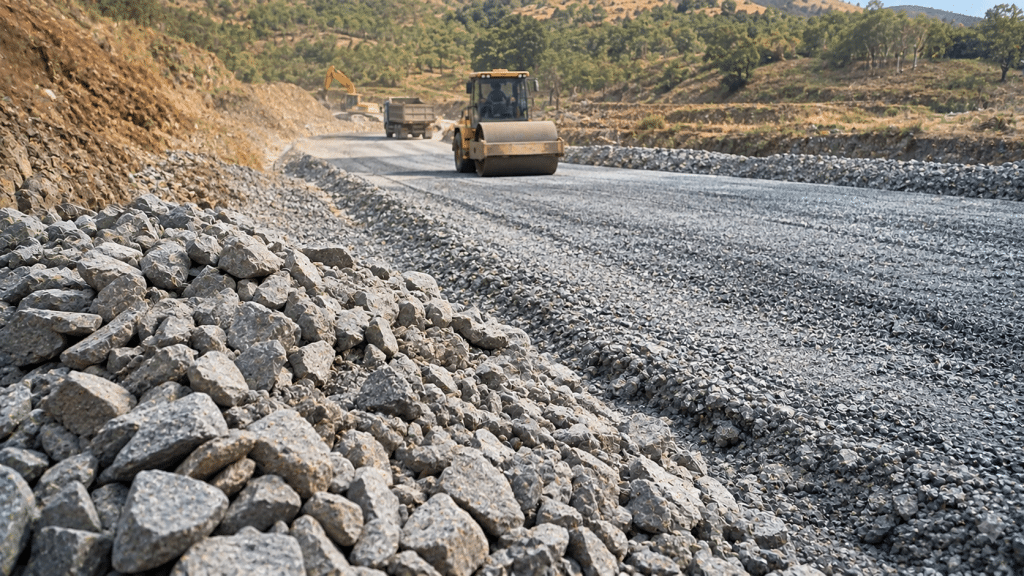
Crushed limestone aggregate can also support various civil engineering applications beyond conventional pavement base and subbase layers.
Depending on project design and local specifications, potential applications may include:
- Working platforms
- General granular construction layers
- Structural backfill
- Selected engineering fill
- Access roads
- Industrial yards
- Hardstanding areas
- Platform construction
- Infrastructure foundations
However, an important distinction is necessary.
EN 13242 provides requirements for aggregates in civil engineering works and road construction. It does not automatically function as a specification for every type of soil or general earth fill.
Therefore, when a project proposes limestone aggregate for an engineering fill application, the designer should confirm the suitability of EN 13242 aggregate and identify any additional geotechnical requirements.
These additional requirements may include compaction criteria, moisture limits, bearing capacity or other project-specific parameters.
As a result, project teams need to define the intended engineering function before approving the material.
12. Quality Control and Limestone Aggregate Supply
Large infrastructure projects require consistent aggregate quality across substantial quantities and extended delivery periods.
Therefore, producers should maintain quality control throughout production rather than rely on one initial sample.
Depending on the project, technical documentation may include:
- Product specification
- Aggregate designation
- Sieve analysis
- Grading curve
- Fines content
- Fines quality
- Flakiness or shape index
- Percentage of crushed particles
- Fragmentation resistance
- Wear resistance
- Particle density
- Water absorption
- Petrographic information
- Relevant chemical test results
- Durability results
- Freeze-thaw information, where necessary
- Declaration of Performance, where applicable
- Relevant conformity documentation
- Country of origin
- Quantity and loading documents
Moreover, suppliers should ensure that documentation corresponds to the actual quarry source and supplied product.
ATABAŞ GLOBAL supports international sourcing and trade coordination for limestone aggregate for road base and other construction materials according to project requirements.
The sourcing process can consider technical specifications, required grading, quarry capacity, monthly demand, laboratory documentation, loading capacity, inland transport, port operations, bulk shipment requirements, Incoterms and destination conditions.
Because aggregates are high-volume materials, logistics can represent a significant part of the delivered cost.
Therefore, buyers should evaluate quarry location, loading method, transport distance, port infrastructure and shipment size together with the material price.
Consequently, technical suitability and logistics feasibility should form part of the same sourcing process.
13. Frequently Asked Questions About EN 13242 Aggregates
What does EN 13242 cover?
EN 13242 defines characteristics for aggregates intended for unbound and hydraulically bound materials in civil engineering work and road construction.
Can contractors use limestone aggregate for road base?
Yes. Contractors can use suitable limestone aggregate for road-base applications when the material meets the grading, mechanical, physical and durability requirements of the project.
Is limestone aggregate suitable for subbase applications?
Yes. Suitable limestone aggregate can serve in subbase applications when it meets the applicable mixture, pavement design and project requirements.
What aggregate sizes are common in road-base applications?
The project specification determines the required sizes. Road construction may use aggregate fractions and all-in materials such as 0/31.5 mm or 0/63 mm, but these examples do not represent universal requirements.
What are fines under EN 13242?
Fines refer to the fine particle fraction associated with material passing the 0.063 mm sieve. Project specifications may address both fines content and fines quality.
Why is grading important for road-base aggregate?
Grading defines the distribution of particle sizes. Therefore, it influences packing, compaction and the granular structure of the material.
What does the Los Angeles test measure?
The Los Angeles test measures resistance to fragmentation. EN 13242 provides performance categories that project teams can select according to the intended application.
Does EN 13242 specify one Los Angeles limit for every road project?
No. The intended end use and applicable project or national specification determine the required category.
What is the difference between EN 13242 and EN 13285?
EN 13242 addresses aggregate characteristics for unbound and hydraulically bound materials. In contrast, EN 13285 addresses requirements for unbound mixtures. Therefore, a road-base project may need to consider both standards depending on the specified material.
Does EN 13242 cover general soil fill?
No. Project teams should not interpret EN 13242 as a general soil specification. When aggregate serves as structural or engineering fill, additional geotechnical and project-specific requirements may apply.
Does EN 13242 include aggregates for hydraulically bound materials?
Yes. Its scope includes aggregates for both hydraulically bound and unbound materials in civil engineering work and road construction.
What information should a limestone aggregate inquiry include?
A professional inquiry should identify the intended application, required aggregate size or grading, relevant EN 13242 categories, mechanical and durability requirements, quantity, delivery schedule, destination and Incoterm.
