

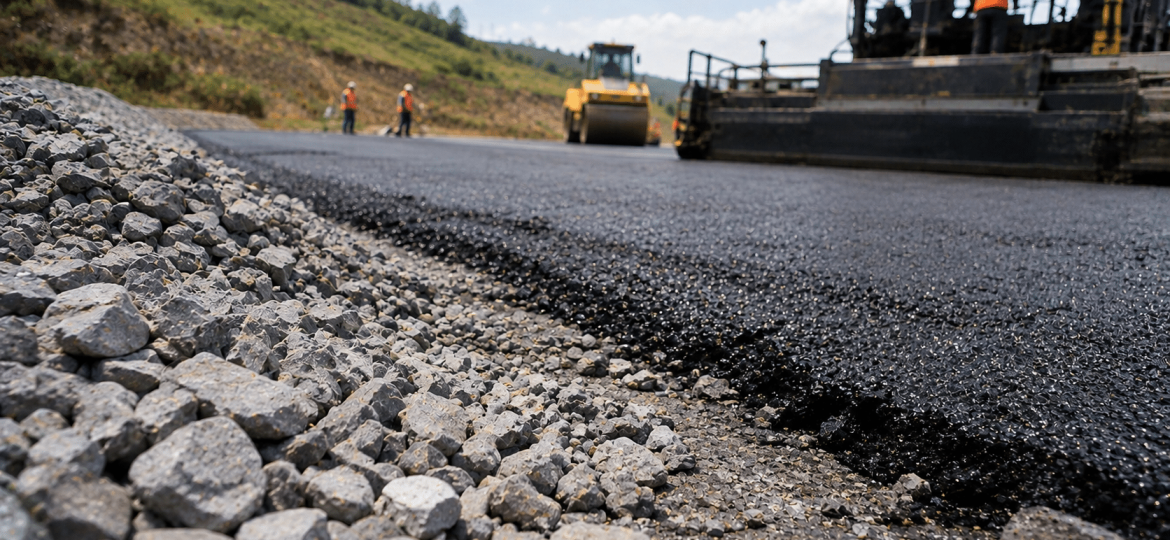
Limestone aggregate for asphalt can be used as a mineral component in bituminous mixtures and road surface applications when the processed material meets the technical requirements of the intended use. Depending on the source and production process, limestone can provide fine aggregate, coarse aggregate and filler fractions for different asphalt mixtures.
However, suitability cannot be determined from the rock type alone. Aggregate size, grading, fines, particle shape, fragmentation resistance, wear resistance, water absorption, polishing resistance and durability can all influence performance.
For European applications, EN 13043 provides the technical framework for aggregates and filler aggregates used in bituminous mixtures and surface treatments for roads, airfields and other trafficked areas. Therefore, buyers and asphalt producers should evaluate the actual properties of the processed aggregate rather than assuming that every limestone source performs in the same way.
Moreover, different pavement layers and surface applications can require different performance categories. Aggregate used in a traffic-exposed surface course, for example, may face more demanding polishing and abrasion requirements than material used in another asphalt layer.
Consequently, selecting the right limestone aggregate for asphalt requires consideration of the mixture design, intended pavement layer, traffic conditions, environmental exposure and applicable project specification.
1. What Is Limestone Aggregate for Bituminous Mixtures?
Limestone aggregate for bituminous mixtures is processed limestone that provides controlled mineral fractions for asphalt and related surface applications.
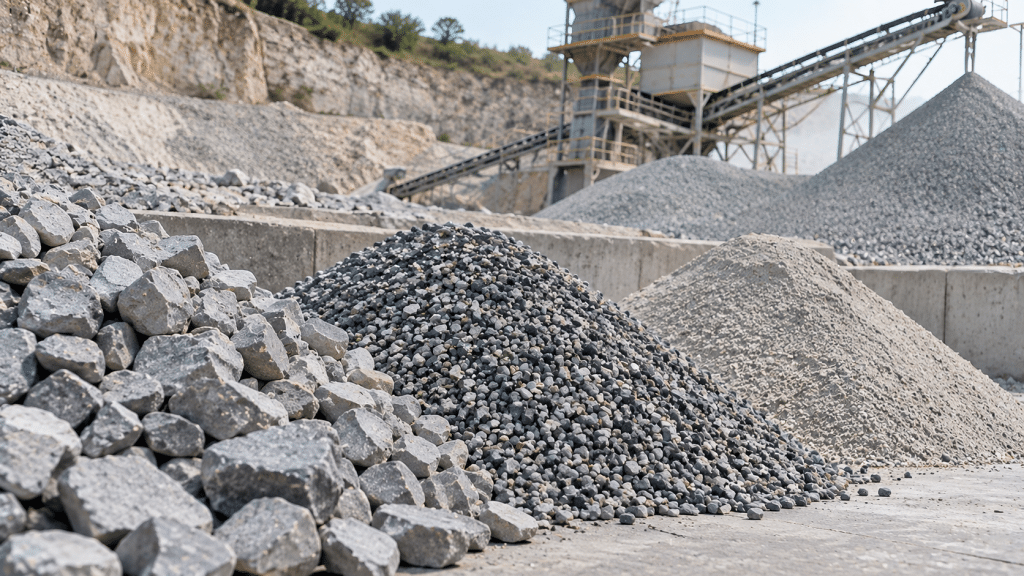
Production typically begins with the extraction of suitable limestone from a quarry. Crushing equipment then reduces the rock to the required dimensions. Afterward, screening systems separate the processed material into defined aggregate fractions.
A typical production sequence includes:
Quarry Extraction → Crushing → Screening → Classification → Quality Control → Stockpiling → Asphalt Plant
As a result, producers can supply different aggregate sizes according to the required mixture design.
Fine aggregate provides smaller mineral particles, while coarse aggregate contributes to the structural skeleton of the mixture. In addition, filler aggregate forms the very fine mineral fraction used in bituminous mixtures.
For limestone aggregate for asphalt, consistent processing remains essential. Changes in crushing, screening or source rock characteristics can alter the properties of the finished aggregate.
Therefore, asphalt producers should evaluate both the source and the processed product before approving regular supply.
2. Understanding EN 13043
EN 13043 covers aggregates and filler aggregates used in bituminous mixtures and surface treatments for roads, airfields and other trafficked areas.
The standard addresses geometrical, physical, mechanical, chemical and durability-related characteristics that may be relevant to the intended application.
Important areas include:
| Technical Area | Typical Evaluation |
|---|---|
| Aggregate Size | d/D size designation |
| Grading | Particle-size distribution |
| Fines Content | Amount of material in the fine fraction |
| Fines Quality | Characteristics of fines |
| Particle Shape | Shape and flakiness characteristics |
| Crushed Particles | Proportion of crushed and broken surfaces |
| Angularity | Characteristics of fine aggregate particles |
| Fragmentation Resistance | Resistance to mechanical breakdown |
| Wear Resistance | Resistance to mechanical wear |
| Particle Density | Density of aggregate particles |
| Water Absorption | Water absorbed by the aggregate |
| Polishing Resistance | Performance under traffic polishing |
| Surface Abrasion | Resistance to surface wear |
| Durability | Performance under relevant environmental conditions |
| Filler Properties | Characteristics of filler aggregate |
However, EN 13043 does not provide one identical performance limit for every asphalt application.
Instead, it provides categories and methods for declaring relevant aggregate characteristics. The required category depends on the intended use and applicable project or national specification.
Therefore, specifying only “EN 13043 aggregate” may not provide enough information for procurement. Buyers should also define the required characteristics and performance categories for the project.
3. Aggregate Sizes and d/D Designation
EN 13043 describes aggregate sizes using the d/D designation.
Here, d represents the lower sieve size and D represents the upper sieve size associated with the aggregate fraction.
Examples of commonly specified fractions include:
- 0/2 mm
- 0/4 mm
- 2/4 mm
- 4/8 mm
- 8/16 mm
Depending on the applicable sieve series and project requirements, other declared sizes can also be used.
Fine aggregate generally has d = 0 and D ≤ 4 mm, while coarse aggregate generally has D > 4 mm and d ≥ 1 mm.
Therefore, buyers should specify aggregate requirements using the appropriate d/D designation rather than informal descriptions such as “small stone” or “medium gravel.”
Moreover, the required fractions depend on the asphalt mixture design. Consequently, one asphalt plant may combine several separately produced aggregate fractions to achieve the required overall grading.
4. Why Grading Matters in Asphalt Production
Grading describes the particle-size distribution of aggregate as the percentage by mass passing specified sieves.
This distribution plays an important role in the mineral structure of an asphalt mixture. Therefore, grading consistency is one of the important considerations when evaluating limestone aggregate for asphalt.
A controlled combination of particle sizes can help create the aggregate skeleton required by the mixture design. Conversely, significant variation in grading may alter the volumetric structure of the mixture.
For this reason, asphalt plants normally combine different aggregate fractions according to an approved mix design.
For example, fine and coarse fractions can be blended with filler to achieve the required overall grading.
However, consistent grading is just as important as the initial design. If the supplied aggregate changes significantly from one production period to another, the asphalt producer may need to adjust the mixture.
Therefore, sieve analysis and regular grading control form an important part of aggregate quality management.
In addition, separately stockpiled fractions should remain properly segregated. Otherwise, cross-contamination can change the material entering the asphalt plant.
5. Particle Shape, Flakiness and Angularity
Particle geometry can influence the way aggregate particles interact within a bituminous mixture.
Crushing limestone generally creates angular particles. Nevertheless, crusher type, crushing stages, feed characteristics and process settings can change the final particle shape.
EN 13043 addresses characteristics such as:
- Flakiness index
- Shape index
- Percentage of crushed and broken surfaces
- Angularity of relevant fine aggregates
These properties can influence aggregate interlock and mixture behavior.
For example, suitably shaped crushed particles can contribute to a stable aggregate skeleton. In contrast, excessive flaky particles may be undesirable for certain applications.
Therefore, particle shape should not be judged only by visual appearance. Where required, laboratory testing should confirm the relevant category.
Moreover, crushing-process control is particularly important because two products originating from the same quarry can have different geometrical characteristics after processing.
Consequently, consistent crushing and screening are essential parts of aggregate production for asphalt applications.

6. Fragmentation and Wear Resistance
Aggregates experience mechanical stresses during crushing, handling, transport, asphalt production, compaction and service.
Therefore, resistance to fragmentation and wear can be important performance characteristics when selecting limestone aggregate for asphalt.
The Los Angeles test is commonly used within the EN aggregate testing framework to assess resistance to fragmentation.
Wear resistance may also need to be declared according to the intended application and relevant specification.
However, the required performance category should reflect the actual end use. An aggregate intended for a demanding trafficked pavement may require a different performance category from material used in a less demanding application.
Therefore, buyers should compare declared test results with project requirements rather than applying one universal limit to every limestone aggregate.
In addition, geological variation within a quarry can influence mechanical properties. For this reason, long-term projects may require periodic testing to confirm production consistency.
7. Polishing Resistance in Trafficked Courses
Polishing resistance deserves particular attention when aggregate will be exposed directly to traffic.
Vehicle tyres repeatedly contact exposed aggregate particles on the pavement surface. Over time, this action can change the microtexture of the aggregate.
Consequently, the polishing characteristics of the stone can become relevant to surface performance.
EN 13043 includes resistance to polishing among the physical characteristics considered for aggregates used in trafficked courses.
However, limestone deposits can differ considerably in mineral composition and physical performance.
Therefore, it would be technically incorrect to assume that every limestone aggregate for asphalt is automatically suitable for every traffic-exposed surface course.
Instead, the actual source should be tested when polishing resistance is required by the applicable specification.
Moreover, high-demand roads may impose more demanding aggregate requirements than lower-traffic applications. Consequently, buyers should always identify the intended pavement layer and traffic conditions before approving the material.
8. Fines and Limestone Filler Aggregate
Very fine mineral particles form an important part of many bituminous mixtures.
Under EN 13043 terminology, fines are the particle-size fraction passing the 0.063 mm sieve.
Filler aggregate, meanwhile, consists predominantly of very fine mineral material and can be used to provide particular properties within construction materials.
Limestone can be processed to produce filler aggregate for bituminous mixtures when the resulting product meets the applicable requirements.
Relevant filler characteristics may include:
- Grading
- Water content
- Particle density
- Stiffening properties
- Bitumen-related characteristics
- Carbonate content, where relevant
- Production consistency
However, uncontrolled dust should not automatically be treated as engineered filler aggregate.
A separately produced filler requires controlled processing and relevant technical evaluation.
Therefore, buyers should distinguish between fines naturally present in an aggregate fraction and a controlled filler product intended for addition to the mixture.
In addition, consistent filler properties can help asphalt producers maintain repeatable mixture production.
9. Density, Water Absorption and Durability
Particle density is an important input for asphalt mixture calculations. Therefore, asphalt producers need reliable density data when determining material proportions and volumetric properties.
Water absorption also provides useful information about the physical characteristics of the aggregate.
For this reason, density, absorption and durability should form part of the technical evaluation of limestone aggregate for asphalt, particularly where project specifications define relevant performance categories.
Furthermore, road aggregates must perform not only during production but throughout the service life of the pavement.
Environmental exposure may include:
- Moisture
- Freeze-thaw cycles
- Temperature changes
- Weathering
- De-icing salts in relevant environments
Consequently, durability requirements should reflect the actual conditions of the project.
For example, an aggregate intended for severe freeze-thaw exposure may require different evaluation from material used in a mild climate.
Therefore, environmental conditions should be considered together with mechanical properties when selecting aggregate.
Moreover, long-term supply requires consistency in these characteristics rather than satisfactory performance from only one initial sample.
10. Limestone Aggregate in Asphalt Pavement Layers
Asphalt pavements may contain several layers, each designed to perform a different function. Therefore, aggregate requirements can vary according to the intended layer.
Surface Course
The surface course is directly exposed to traffic and environmental conditions.
As a result, particle shape, fragmentation resistance, wear, durability and, where required, polishing resistance can become particularly important.
Binder Course
The binder course contributes to the structural system below the surface layer.
Therefore, grading, mechanical performance and aggregate consistency remain important.
Asphalt Base Course
The asphalt base course forms part of the load-bearing pavement structure.
Consequently, aggregate properties should support the designed mixture and structural performance.
However, pavement terminology and technical requirements can vary between national specifications and individual projects.
Therefore, the suitability of limestone aggregate for asphalt should be assessed separately for the intended pavement layer rather than assuming that one material automatically meets the requirements of every layer.
11. Quality Control, Testing and Documentation
Reliable aggregate supply requires more than an initial laboratory test.
First, the quarry should maintain control over the source rock. Then, crushing and screening operations should consistently produce the declared fractions.
Afterward, appropriate testing can verify the required properties.
Depending on the intended application, buyers may request:
- Product specification
- Aggregate size designation
- Sieve analysis
- Grading curve
- Fines content
- Fines quality results
- Flakiness index
- Shape index
- Percentage of crushed particles
- Angularity information
- Fragmentation resistance
- Wear resistance
- Particle density
- Water absorption
- Polishing resistance, where required
- Surface abrasion results, where required
- Durability results
- Petrographic description, where relevant
- Filler aggregate test results
- Declaration of Performance, where applicable
- Relevant conformity documentation
- Country of origin
- Loading and quantity documents
However, technical documents should correspond to the actual source and product being supplied.
Moreover, a historical test report may not represent current production indefinitely. Therefore, continuous or large-volume projects may require agreed sampling frequencies and periodic testing.
As a result, quality documentation should form part of the ongoing supply process.
12. EN 13043 Aggregate Supply with ATABAŞ GLOBAL
International asphalt, infrastructure and road projects require coordination between technical specifications, production capability, commercial terms and logistics.
ATABAŞ GLOBAL supports international sourcing and trade coordination for limestone aggregate for asphalt and other construction materials according to buyer and project requirements.
The sourcing process can consider:
- Intended bituminous mixture
- Surface treatment requirements
- Pavement layer
- EN 13043 requirements
- Required d/D aggregate sizes
- Grading categories
- Fine and coarse aggregate requirements
- Filler requirements
- Particle-shape requirements
- Mechanical performance
- Polishing requirements, where applicable
- Durability requirements
- Laboratory documentation
- Total project quantity
- Monthly demand
- Quarry capacity
- Crushing and screening capacity
- Stock availability
- Loading capacity
- Delivery schedule
- Inland transportation
- Port operations
- Bulk shipment options
- Incoterms
- Destination requirements
First, the technical specification should clearly define the intended use and required aggregate characteristics.
Then, potential supply sources can be evaluated according to technical performance, production capacity and logistics feasibility.
Moreover, aggregates are high-volume materials. Therefore, transport distance, loading method, port capability and shipment size can significantly affect the delivered cost.
Consequently, technical and logistics evaluation should take place together.
ATABAŞ GLOBAL can coordinate sourcing, documentation, commercial terms and logistics requirements as part of the international supply process.
For a broader introduction to aggregate types and applications, buyers can review What Is Limestone Aggregate and Where Is It Used?
For concrete applications, Limestone Aggregate for Ready-Mix and Precast Concrete (EN 12620) provides a separate overview of aggregate requirements for concrete production.
13. Frequently Asked Questions About EN 13043 Aggregates
What does EN 13043 cover?
EN 13043 covers aggregates and filler aggregates for bituminous mixtures and surface treatments used on roads, airfields and other trafficked areas.
Can limestone aggregate be used in bituminous mixtures?
Yes. Limestone aggregate can be used when the characteristics of the processed material satisfy the requirements of the intended mixture and applicable project specification.
Is limestone aggregate for asphalt suitable for every pavement layer?
No. The required properties can vary according to the pavement layer, traffic conditions and project specification. Therefore, limestone aggregate for asphalt should be evaluated according to its intended use rather than approved solely on the basis of rock type.
Does EN 13043 apply only to road asphalt?
No. Its scope includes aggregates and filler aggregates for bituminous mixtures and surface treatments for roads, airfields and other trafficked areas.
What does 0/4 mm aggregate mean?
The designation uses the d/D system. In a 0/4 mm aggregate, 0 represents the lower size designation and 4 mm represents the upper sieve size designation associated with the aggregate fraction.
What are fines under EN 13043?
Fines are the aggregate particle-size fraction that passes the 0.063 mm sieve.
What is filler aggregate?
Filler aggregate is predominantly very fine mineral aggregate used to provide particular properties in construction materials, including bituminous mixtures.
Why is particle shape important?
Particle shape influences how aggregate particles interact within the mineral skeleton. Therefore, characteristics such as flakiness, shape and angularity may be important depending on the application.
What is the Los Angeles test used for?
The Los Angeles test is used to evaluate aggregate resistance to fragmentation. The required performance category depends on the intended application and applicable specification.
Why is polishing resistance important?
Aggregate particles exposed to traffic can gradually become polished. Therefore, relevant pavement specifications may require resistance to polishing for aggregates used in trafficked courses.
Is every limestone aggregate suitable for surface courses?
No. Limestone sources can have different mineralogical and mechanical characteristics. Therefore, the actual material should meet the required polishing, wear, fragmentation, durability and other applicable performance categories.
Does EN 13043 give one fixed specification for every aggregate?
No. EN 13043 defines characteristics, test methods and performance categories. The required categories depend on the intended use and applicable project or national requirements.
What should an EN 13043 aggregate inquiry include?
A professional inquiry should identify the intended use, pavement layer or surface treatment, required d/D sizes, relevant EN 13043 categories, required test results, quantity, delivery schedule, destination and Incoterm.
