

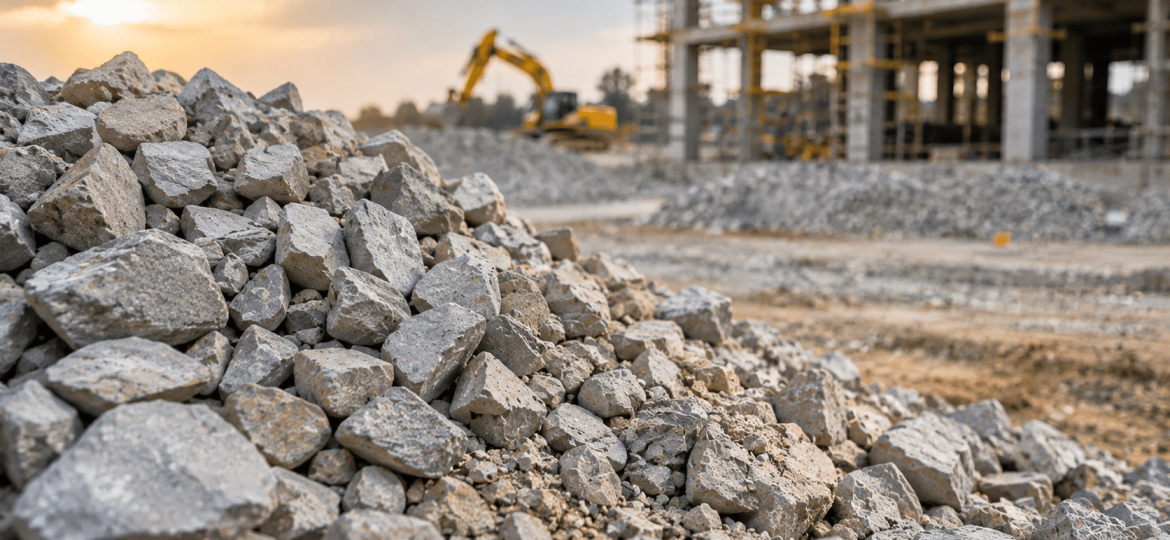
Limestone aggregate is a widely used mineral material for construction, roads and infrastructure projects. Producers obtain it from suitable limestone quarries and process the rock into required particle sizes. As a result, limestone aggregate can serve many applications, including concrete, asphalt, road bases, drainage layers and structural fill.
Limestone is a sedimentary rock made mainly of calcium carbonate (CaCO₃). However, its exact composition and physical properties vary from one geological deposit to another. Therefore, buyers should check both the source rock and the finished aggregate before selecting a product.
Construction projects also require different particle sizes and performance levels. For this reason, limestone aggregate is not a single standard product. Instead, producers can supply fine aggregate, coarse aggregate, graded crushed stone, filler and other size fractions.
Moreover, each application has different technical needs. For example, limestone aggregate for concrete must meet different requirements from material used in asphalt or road sub-base construction. Therefore, selecting the correct grade and size is essential for reliable project performance.
1. What Is Limestone Aggregate?
Limestone aggregate is crushed and graded limestone for construction, infrastructure and selected industrial applications. In other words, producers process natural limestone into controlled sizes that suit specific project needs.
In general, production starts at a suitable limestone quarry. First, operators extract the rock. Next, crushing equipment reduces large stones into smaller sizes. After that, screening systems separate the material into specific particle ranges.
The basic process follows these steps:
Quarry extraction → Primary crushing → Secondary crushing → Screening → Classification → Stockpiling → Loading
Limestone consists mainly of calcium carbonate. In addition, the construction industry uses limestone as a raw material for cement and as aggregate for concrete, asphalt and road works.
However, mineral composition alone does not determine aggregate quality. Strength, particle shape, grading, wear resistance and water absorption also affect performance. Consequently, two limestone sources may perform differently even when both contain high levels of calcium carbonate.
Therefore, buyers should always evaluate the material according to its final use.
2. Limestone Aggregate Production: From Quarry to Finished Product
Production begins with suitable quarry rock. First, operators extract limestone from the geological deposit. Then, the raw stone enters primary crushing equipment.
Next, secondary or tertiary crushers reduce the material further when required. Screening systems then separate the crushed stone according to particle size. If necessary, producers repeat the crushing and screening process to achieve the required grading.
The main production stages generally include:
- Quarry extraction
- Primary crushing
- Secondary or tertiary crushing
- Screening
- Size classification
- Quality control
- Separate stockpiling
- Loading and dispatch
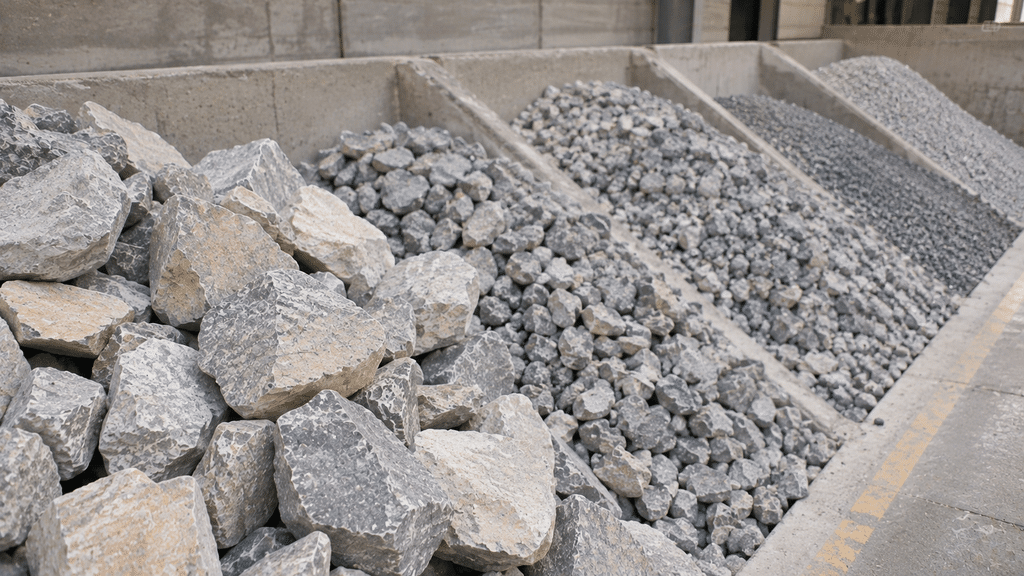
As a result, one quarry can produce several aggregate fractions for different applications.
For example, fine material can serve concrete, asphalt or filler applications. Meanwhile, larger fractions may suit road construction, drainage and other civil works.
However, particle size alone does not define the final application. Physical and mechanical properties also matter. Therefore, controlled crushing, screening and quality checks are essential for maintaining consistent product characteristics.
In addition, separate stockpiling helps prevent different size fractions from mixing before loading. Consequently, buyers can receive material that more closely matches the requested grading.
3. Limestone Aggregate Types, Grades and Particle Sizes
Producers classify limestone aggregate according to particle size, grading and intended use. Consequently, buyers can select different fractions for specific construction requirements.
Typical commercial categories include:
| Aggregate Type | General Description | Typical Applications |
|---|---|---|
| Fine Aggregate | Small particle fractions | Concrete, mortar and selected asphalt applications |
| Coarse Aggregate | Larger crushed stone fractions | Concrete and structural applications |
| Graded Aggregate | Controlled mix of particle sizes | Road base and infrastructure |
| Crushed Stone / Mıcır | Mechanically crushed limestone | Concrete, asphalt and road construction |
| Filler | Very fine mineral material | Asphalt and construction products |
| By-pass Material | Material with a broader grading range | Selected fill and infrastructure works |
| Large Stone | Larger controlled stone fractions | Drainage and civil works |
However, commercial names such as mıcır, filler and by-pass may describe different size ranges in different markets. For this reason, buyers should state the actual particle-size range when requesting an offer.
For example, a project may require 0/4 mm, 4/12 mm, 12/22 mm or another specific grading. Nevertheless, these sizes are only examples. The final grading should always follow the project design, mix design and relevant standard.
In addition, buyers should consider whether they need a single-size fraction or a controlled combination of sizes. Therefore, a clear sieve or grading requirement can reduce misunderstandings during sourcing.
4. Key Physical and Technical Properties
Selecting suitable limestone aggregate requires more than checking particle size. First, the material must provide the mechanical performance required by the project.
In addition, consistent grading is important because changes in particle distribution can affect concrete, asphalt and road layers. Moreover, moisture, fines and particle shape can influence handling and final performance.
Important properties include:
| Property | Why It Matters |
|---|---|
| Particle Size Distribution | Shows whether the grading suits the application |
| Particle Shape | Affects packing, workability and interlocking |
| Fines Content | Can affect concrete, asphalt and road performance |
| Particle Density | Supports mix and quantity calculations |
| Water Absorption | Affects moisture behavior and mix design |
| Fragmentation Resistance | Shows resistance to mechanical breakdown |
| Wear / Abrasion Resistance | Important for demanding applications |
| Moisture Content | Affects storage, batching and commercial weight |
| Rock Characteristics | Help define the nature of the source stone |
| Chemical Composition | Important for selected applications |
| Cleanliness | Helps control clay, dust and unwanted material |
Furthermore, each application requires different performance levels.
For example, concrete aggregate may require checks for grading, particle shape, fines, water absorption and strength. EN 12620 provides a technical framework for aggregates used in concrete.
On the other hand, asphalt and road-base applications follow different requirements. Therefore, buyers should match the product with the correct project specification and standard.
5. Crushed Limestone Applications in Construction
Crushed limestone serves a wide range of construction and infrastructure applications. In particular, builders use it in concrete, asphalt, roads, drainage systems and fill works.
| Sector | Typical Use | Main Function |
|---|---|---|
| Ready-Mix Concrete | Fine and coarse aggregate | Provides structure and volume |
| Precast Concrete | Controlled aggregate fractions | Supports consistent production |
| Asphalt | Crushed aggregate and mineral fractions | Forms the mineral structure of the mix |
| Road Construction | Base and sub-base layers | Helps distribute loads |
| Infrastructure | Graded fill and granular layers | Supports ground preparation |
| Drainage | Selected coarse fractions | Helps water move through the layer |
| Construction Fill | Suitable graded material | Supports filling and leveling |
| Cement Industry | Limestone raw material | Supports cement production |
| Industrial Uses | Selected limestone fractions | Serves application-specific needs |
For example, ready-mix concrete plants can use suitable fine and coarse limestone fractions. Meanwhile, road projects can use graded crushed limestone in base and sub-base layers.
In addition, asphalt producers can use suitable crushed limestone in bituminous mixtures. Therefore, the material plays an important role in both building construction and large infrastructure projects.
However, the correct aggregate type depends on the final application. Consequently, buyers should not select a product based only on particle size or visual appearance.
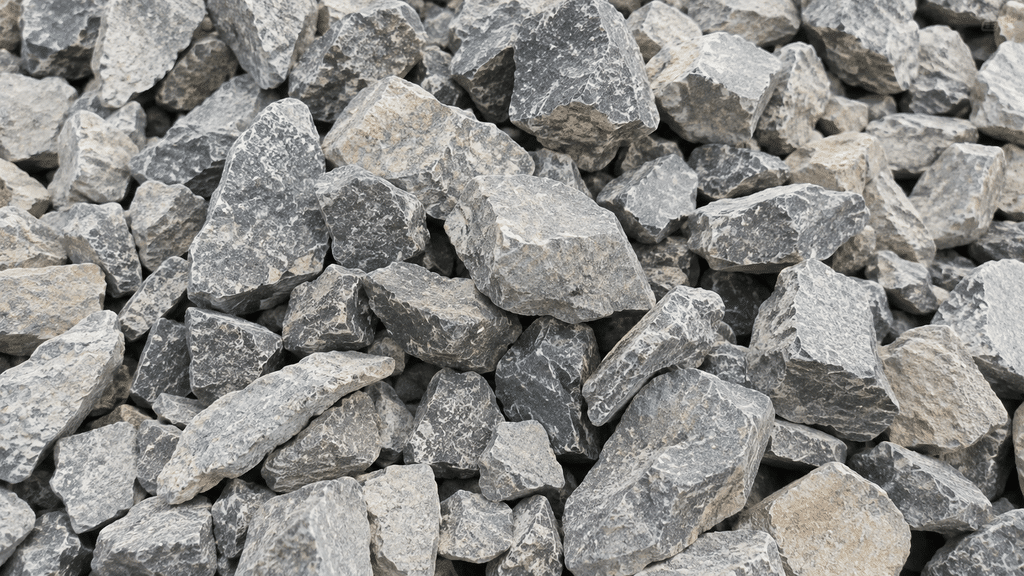
6. Limestone Aggregate for Ready-Mix and Precast Concrete
Concrete mainly contains cementitious material, water and aggregate. Therefore, aggregate quality can directly affect concrete performance and production consistency.
Suitable crushed limestone can provide both fine and coarse aggregate. However, the material must meet the requirements of the concrete mix and the relevant standard.
In Europe, EN 12620 covers aggregates for concrete. In particular, the standard addresses several physical, mechanical and chemical characteristics.
Important factors include:
- Aggregate size
- Grading
- Fines content
- Particle shape
- Fragmentation resistance
- Wear resistance
- Particle density
- Water absorption
- Chemical properties
For example, inconsistent grading can change the behavior of a concrete mix. Similarly, excessive fines may affect production conditions.
Therefore, the term “limestone” alone does not prove that an aggregate suits every concrete application. Instead, buyers should review technical test results and project requirements.
Moreover, consistent supply can be important for large ready-mix and precast operations. For this reason, buyers may also need to evaluate quarry capacity and production control.
For more detailed information, buyers can review the dedicated topic Limestone Aggregate for Ready-Mix and Precast Concrete – EN 12620.
7. Use in Asphalt and Road Construction
Limestone aggregate can also serve asphalt and road construction projects. In fact, aggregate forms a major part of the mineral structure of asphalt mixtures.
Therefore, particle size, shape, strength and surface properties play important roles. In addition, consistent grading helps asphalt producers maintain the required mixture structure.
For example, crushed and angular particles can improve interlocking within a suitable mixture. Moreover, controlled particle distribution can support the performance of the final asphalt layer.
However, limestone deposits do not all provide identical performance. As a result, producers and buyers must test material intended for demanding asphalt applications.
For European asphalt applications, EN 13043 provides an important technical framework for aggregates used in bituminous mixtures and surface treatments.
Therefore, asphalt buyers should evaluate the required grading and technical values before placing an order. In addition, they should compare actual test results with the project specification.
A dedicated technical article on Limestone Aggregate for Asphalt and Road Construction – EN 13043 can provide further details about these requirements.
8. Crushed Limestone for Road Base, Drainage and Fill
Roads contain several layers below the final pavement. Together, these layers help distribute loads and create a stable foundation for the road structure.
Depending on project design and material quality, graded crushed limestone can serve in:
- Road base
- Sub-base
- Granular layers
- Structural fill
- General fill
- Platform preparation
- Site leveling
- Selected drainage layers
For these uses, grading plays an important role. Moreover, strength, particle shape, fines content and durability can affect layer performance.
For example, a road base may require controlled particle sizes so that the material compacts efficiently. Meanwhile, a drainage layer may require a different grading to support water movement.
In addition, technical requirements can change according to traffic loads, road design and local project conditions. Therefore, the same aggregate may not suit every layer of a road structure.
For European civil engineering and road applications, EN 13242 covers aggregates for unbound and hydraulically bound materials.
Consequently, buyers should define both the intended road layer and the required technical standard before ordering material.
9. Why Is Crushed Limestone Widely Used?
Several practical factors make crushed limestone important for construction.
First, producers can crush and screen suitable limestone efficiently. Therefore, one quarry can produce several particle-size ranges.
Second, crushed stone can provide angular particles. As a result, these particles can create useful interlocking in many road and construction applications.
Moreover, limestone has a broad range of uses. Depending on its quality, the same geological resource can support aggregate, cement, lime and other industrial applications.
Another advantage is grading flexibility. For example, producers can prepare fine material for one application and larger crushed stone for another.
However, limestone quality varies between deposits. Therefore, buyers should not assume that every source provides the same strength, wear resistance, water absorption or chemical properties.
Instead, buyers should compare technical test results before selecting the final source. Consequently, technical evaluation remains important even when two suppliers offer the same nominal particle size.
10. Standards, Testing and Quality Documents
Technical standards help buyers and suppliers define clear performance requirements. Therefore, choosing the correct standard is an important part of aggregate sourcing.
Three European standards are especially relevant:
| Standard | Main Application |
|---|---|
| EN 12620 | Aggregates for concrete |
| EN 13043 | Aggregates for bituminous mixtures and surface treatments |
| EN 13242 | Aggregates for unbound and hydraulically bound materials used in civil engineering and roads |
However, a geological description alone does not confirm compliance. For this reason, buyers should review the declared technical performance of the actual product.
Depending on the project, they may request:
- Product specification
- Sieve analysis
- Test reports
- Rock or source information
- Chemical analysis
- Particle density
- Water absorption
- Fragmentation resistance
- Abrasion or wear results
- Fines content
- Moisture information
- Declaration of Performance, where applicable
- CE-related documents, where applicable
- Country of origin
- Loading and quantity documents
In addition, individual projects may set stricter limits than a general standard. Therefore, buyers should compare product documents with the project specification before confirming an order.
Moreover, buyers should check whether test reports represent the actual material offered. As a result, technical and commercial evaluations can remain aligned throughout the purchasing process.
11. Limestone Aggregate Supply with ATABAŞ GLOBAL
Large construction and infrastructure projects often need more than a material price. For example, buyers may require technical confirmation, large-volume planning, loading schedules and international logistics.
ATABAŞ GLOBAL supports international sourcing and trade coordination for construction materials and industrial raw materials, including limestone aggregate.
Depending on the project, the process can cover:
- Aggregate type
- Required particle sizes
- Project specification
- Applicable standard
- Required quantity
- Quarry and supply options
- Technical documents
- Test reports
- Loading location
- Delivery schedule
- Incoterms
- Inland transport
- Port operations
- Bulk logistics
- Destination requirements
First, the project requirements should define the correct product. Then, suitable supply options can be evaluated according to technical and commercial criteria.
In addition, logistics planning can cover inland transport, port operations and bulk shipment requirements. Therefore, the sourcing process should consider the full supply chain rather than only the ex-quarry material price.
ATABAŞ GLOBAL focuses on connecting project demand with suitable supply options. Moreover, the company can coordinate technical, commercial and logistics requirements during the sourcing process.
Consequently, buyers can consider technical suitability, available volume, supply continuity and delivery conditions together.
For large-volume projects, this approach is particularly important because logistics can have a major effect on the final delivered cost.
12. What Should Buyers Check Before Ordering?
Before requesting a quotation, buyers should clearly define the final application.
First, state whether the limestone aggregate will serve concrete, asphalt, road base, sub-base, drainage, fill or another use. Next, specify the required particle-size range and applicable standard.
Buyers should generally provide:
- Intended use
- Aggregate type
- Required grading
- Required quantity
- Applicable standard
- Mechanical requirements
- Chemical requirements, if relevant
- Required test methods
- Required certificates
- Monthly or total project volume
- Loading point
- Destination
- Delivery method
- Incoterm
- Required delivery schedule
Moreover, large projects should consider quarry output and loading capacity. A technically suitable source must also supply the required volume within the project schedule.
Transport is another important factor. Because limestone aggregate is a high-volume bulk material, freight can represent a major part of the delivered cost.
In addition, buyers should evaluate loading methods and shipment frequency when planning large-volume orders. Therefore, logistics should form part of the sourcing strategy from the beginning.
Consequently, buyers should evaluate quality, quantity, logistics and total delivered cost together.
13. Frequently Asked Questions
What is limestone aggregate?
Limestone aggregate is crushed and graded limestone for construction, road and selected industrial applications. Therefore, producers can supply it in several particle sizes according to the intended use.
Where is limestone aggregate used?
It is commonly used in concrete, asphalt, road construction, base and sub-base layers, drainage and fill applications. In addition, limestone serves as a raw material for cement and several industrial processes.
What is limestone mainly made of?
Limestone consists mainly of calcium carbonate (CaCO₃). However, its exact composition can vary between geological deposits.
Can crushed limestone be used in concrete?
Yes. Suitable crushed limestone can provide fine and coarse aggregate for ready-mix and precast concrete. However, buyers should check grading, physical properties and project requirements. In Europe, EN 12620 provides an important technical framework.
Is limestone aggregate suitable for asphalt?
Yes. Suitable limestone aggregate can serve asphalt mixtures. However, the material must meet the required mechanical and physical properties. Therefore, buyers should evaluate it according to the asphalt mix design and relevant standard.
What limestone aggregate sizes are available?
Producers can offer fine, coarse, graded, filler and larger stone fractions. For example, projects may request 0/4 mm, 4/12 mm or 12/22 mm. However, available sizes and project requirements can vary.
Which standards apply to construction aggregates?
The correct standard depends on the application. EN 12620 covers aggregates for concrete. Meanwhile, EN 13043 applies to aggregates for bituminous mixtures and surface treatments. In addition, EN 13242 covers aggregates for unbound and hydraulically bound civil engineering and road applications.
What information should buyers include in an inquiry?
Buyers should state the application, particle-size range, technical standard, required quantity, destination and delivery terms. In addition, they should specify any required tests, certificates or documentation.
