

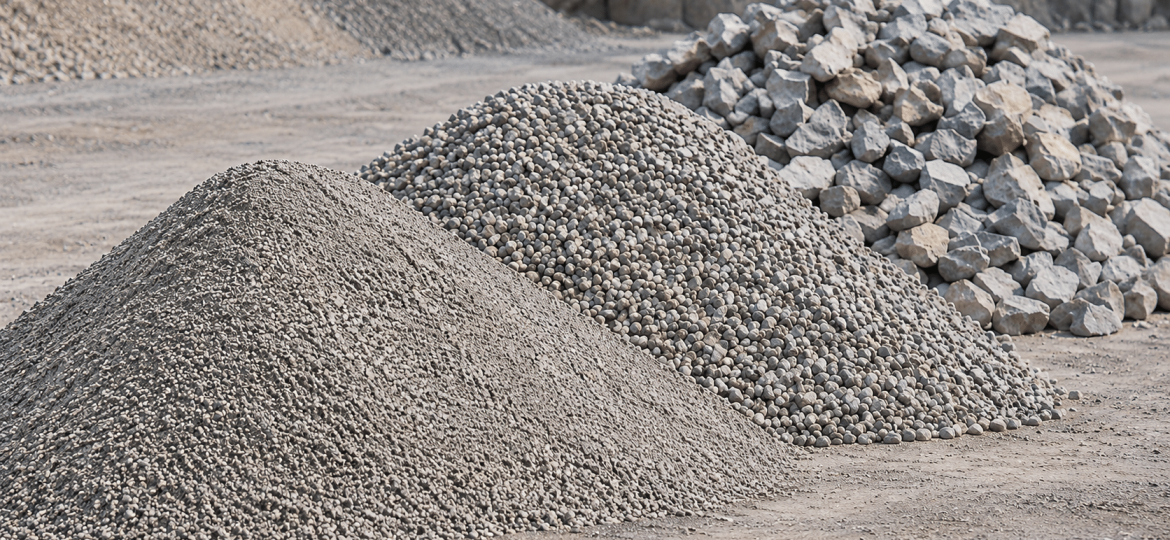
Limestone aggregate plays an important role in ready-mix and precast concrete production. When the source rock has suitable characteristics and the finished aggregate meets project requirements, crushed limestone can provide both fine and coarse fractions for concrete mixtures.
However, concrete performance depends on much more than the geological name of the aggregate. Particle size distribution, fines content, particle shape, density, water absorption, fragmentation resistance and chemical characteristics can all influence material selection.
For this reason, concrete producers need consistent aggregate properties as well as reliable supply. In European applications, EN 12620 provides the main technical framework for aggregates used in concrete.
Moreover, ready-mix plants and precast manufacturers may have different production priorities. Ready-mix operations often focus on stable batching, workability and continuous supply. Meanwhile, precast plants may place additional emphasis on dimensional consistency, surface quality and repeatable production.
Therefore, buyers should select limestone aggregate according to the concrete mix, production process, structural requirements and applicable specifications rather than particle size alone.
1. What Is Limestone Aggregate for Concrete?
Limestone aggregate for concrete is processed limestone that provides suitable fine, coarse or combined aggregate fractions for concrete production.
First, producers extract suitable limestone from a quarry. Then, crushing equipment reduces the rock to the required dimensions. After that, screening systems separate the material into controlled particle-size fractions.
The typical process includes:
Quarry extraction → Crushing → Screening → Classification → Quality Control → Stockpiling → Concrete Plant
As a result, producers can prepare different aggregate fractions for specific concrete mix designs.
For example, fine crushed limestone can form part of the smaller aggregate fraction. Meanwhile, larger particles can provide coarse aggregate.
However, the source rock must provide suitable technical characteristics. Therefore, concrete producers should evaluate both geological quality and finished aggregate performance before approving a source.
In addition, consistent processing helps control grading and particle characteristics. Consequently, a stable quarry and crushing operation can support more predictable concrete production.
2. EN 12620 Requirements for Concrete Aggregates
EN 12620 establishes requirements for aggregates used in concrete. It addresses geometrical, physical and chemical characteristics as well as conformity, designation and related product information.
Therefore, compliance cannot be determined simply by confirming that the material is limestone.
Important areas covered by the standard include:
| Technical Area | Typical Evaluation |
|---|---|
| Aggregate Size | Defined particle-size fractions |
| Grading | Particle-size distribution |
| Fines | Content and quality of very fine particles |
| Particle Shape | Shape characteristics of aggregate particles |
| Fragmentation Resistance | Resistance to mechanical breakdown |
| Wear Resistance | Resistance to mechanical wear |
| Particle Density | Density characteristics |
| Water Absorption | Amount of water absorbed by aggregate |
| Chemical Characteristics | Relevant chemical constituents |
| Durability | Performance where relevant to the intended use |
| Product Control | Consistency and conformity of production |
However, EN 12620 does not mean that every aggregate must meet one identical numerical limit for every property.
Instead, required categories depend on the intended use, project specification and applicable national or technical requirements.
Therefore, buyers should identify the required categories and declared performance before confirming a material.
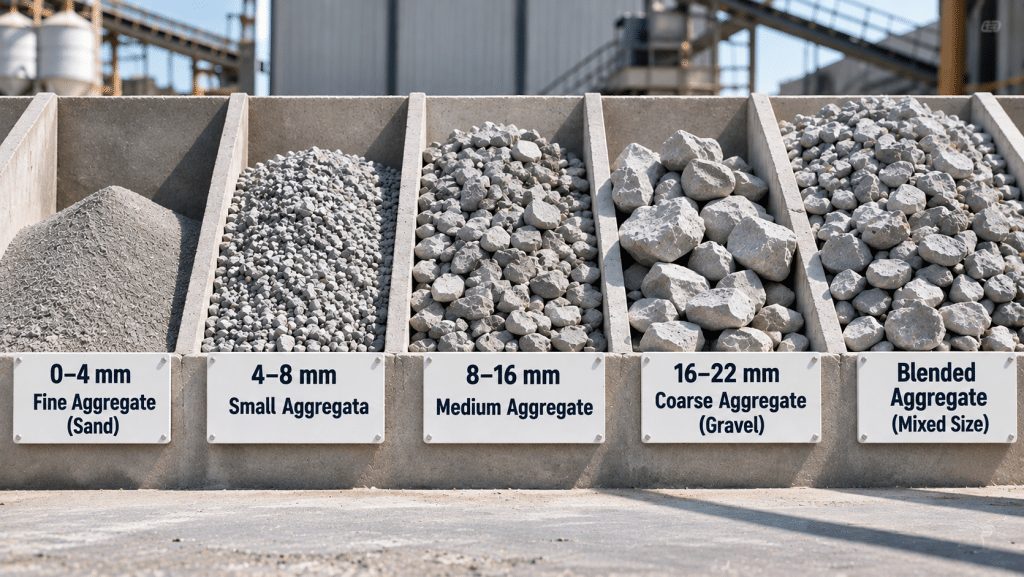
3. Fine and Coarse Limestone Aggregate Sizes
Concrete mixtures generally combine different aggregate fractions to create a controlled particle structure.
Fine aggregate fills smaller spaces within the mixture. Meanwhile, coarse aggregate forms a significant part of the concrete skeleton.
Typical commercial size fractions may include:
| Aggregate Fraction | Example Size | Typical Role |
|---|---|---|
| Fine Aggregate | 0/4 mm | Fine fraction in concrete |
| Small Coarse Aggregate | 4/8 mm | Intermediate concrete fraction |
| Coarse Aggregate | 8/16 mm | Common structural concrete fraction |
| Larger Coarse Aggregate | 16/22 mm or similar | Selected concrete applications |
| Combined Grading | Project-specific | Optimized mix design |
These dimensions are examples rather than universal requirements.
For this reason, concrete producers should define aggregate sizes according to their mix design, batching system, concrete application and relevant specification.
Moreover, different plants may combine several fractions to achieve the required overall grading. As a result, the same quarry may need to supply multiple aggregate sizes for one concrete plant.
Therefore, a quotation should state the requested d/D size designation rather than using only general terms such as “small stone” or “coarse aggregate.”
4. Why Grading Matters in Concrete Production
Grading describes the particle-size distribution of aggregate. In practical terms, it shows how much material passes through specified sieve sizes.
A controlled grading can help particles fit together more efficiently. As a result, concrete producers can manage the aggregate skeleton and overall mixture more consistently.
For example, an unsuitable distribution may create excessive gaps between particles. Consequently, the mix may require adjustments to other components to achieve the intended fresh and hardened concrete properties.
On the other hand, a suitable combination of fine and coarse fractions can support efficient packing.
Grading consistency also matters from batch to batch. If the aggregate distribution changes significantly, the concrete plant may need to adjust the mix.
Therefore, buyers should review sieve analysis results and monitor consistency during regular supply.
In addition, large-volume projects should consider production variability over time rather than relying on a single sample.
5. Fines Content and Particle Shape
Very fine particles can influence aggregate behavior in concrete. Under EN 12620 terminology, fines relate to the fraction passing the specified fine sieve.
However, the quantity of fines alone does not provide the complete picture. Their nature and quality may also matter.
For this reason, concrete producers should evaluate fines according to the applicable specification and intended use.
Particle shape is another important factor.
Crushed limestone generally produces angular particles. Depending on the crushing process, however, particle geometry can vary.
Shape characteristics can influence:
- Aggregate packing
- Concrete workability
- Interparticle friction
- Mix consistency
- Pumping behavior
- Surface finish
- Compaction
Therefore, crushing equipment and production control can be just as important as the geological source.
Moreover, excessive flaky or poorly shaped particles may be undesirable for certain concrete applications. Consequently, buyers may request relevant particle-shape test results before approving a source.
6. Density, Water Absorption and Moisture Control
Particle density is an important aggregate characteristic because concrete mix designs rely on accurate material proportions.
Water absorption also requires attention. Aggregate pores can absorb part of the available water, while surface moisture can add water to the mixture.
As a result, uncontrolled aggregate moisture can influence batching accuracy.
For example, wet fine aggregate may introduce additional water into the mixer. Conversely, relatively dry and absorptive aggregate may take up part of the mixing water.
Therefore, concrete plants commonly monitor aggregate moisture and adjust batching when necessary.
In addition, consistent water absorption characteristics help producers manage mix designs more predictably.
For ready-mix plants, this becomes especially important when production volumes are high and environmental conditions change throughout the day.
Precast operations also benefit from tight moisture control because repeatability between production cycles is often essential.
7. Strength, Fragmentation and Wear Resistance
Concrete aggregate must withstand mechanical stresses during production, placement and service.
For this reason, resistance to fragmentation is an important technical characteristic. It helps indicate how aggregate responds to mechanical breakdown.
Wear resistance may also matter depending on the intended concrete application.
However, buyers should avoid assuming that all limestone deposits provide identical mechanical performance.
Geological formation, mineral structure, fractures and other natural characteristics can affect the behavior of the source rock.
Therefore, laboratory testing should support material selection for demanding applications.
Moreover, technical requirements should match the actual end use. An aggregate intended for one concrete application may face different requirements from material intended for another.
Consequently, buyers should compare declared values with the project specification rather than relying on generic descriptions such as “hard limestone.”
8. Limestone Aggregate in Ready-Mix Concrete
Ready-mix concrete plants require reliable aggregate supply because aggregate represents a major proportion of the concrete mixture by volume.
Therefore, consistency is critical.
A ready-mix plant may receive several aggregate fractions and store them in separate bins. During batching, the plant combines these materials according to the approved mix design.
Important considerations include:
- Consistent grading
- Controlled fines
- Stable moisture
- Suitable particle shape
- Reliable density data
- Required mechanical properties
- Clean stockpiles
- Separation between fractions
- Continuous supply capacity
For example, contamination between fine and coarse stockpiles can alter the grading entering the batching system.
Similarly, sudden moisture changes can affect water calculations.
Therefore, quarry production, transport and storage should work together as one controlled supply chain.
In addition, high-volume ready-mix operations need dependable delivery schedules. Consequently, buyers should evaluate not only technical compliance but also daily production and logistics capacity.
9. Crushed Limestone for Precast Concrete
Precast concrete manufacturing requires repeatable production conditions. Plants manufacture concrete elements under controlled factory conditions, so consistency between batches becomes particularly important.
Depending on the plant, precast products may include:
- Structural elements
- Beams
- Columns
- Panels
- Pipes
- Blocks
- Pavers
- Kerbs
- Other manufactured concrete products
Aggregate selection depends on the specific product and mix design.
For example, particle-size distribution can influence how concrete flows into molds and around reinforcement. Meanwhile, aggregate shape and fines may affect workability and surface appearance.
In addition, precast producers may use highly controlled batching systems. Therefore, changes in aggregate moisture or grading can require production adjustments.
Consistent limestone aggregate can support repeatable manufacturing when its technical characteristics match the required concrete specification.
However, producers should approve the actual aggregate through testing and mix evaluation rather than selecting it solely because it comes from limestone.

10. Quality Control, Testing and Documentation
Reliable concrete aggregate supply requires ongoing quality control.
First, the quarry and processing plant should control the source material. Then, crushing and screening operations should maintain the declared product fractions.
After production, appropriate testing can verify relevant aggregate characteristics.
Depending on the project, buyers may request:
- Product specification
- Sieve analysis
- Particle-size distribution
- Fines content
- Fines quality information
- Particle-shape results
- Particle density
- Water absorption
- Fragmentation resistance
- Wear resistance
- Chemical test results
- Petrographic information, where required
- Durability information, where applicable
- Declaration of Performance, where applicable
- Relevant conformity documentation
- Country of origin
- Loading and quantity documents
However, buyers should ensure that documents correspond to the actual material and production source offered.
Moreover, one historical laboratory report may not be sufficient for a long-term supply program.
Therefore, large or continuous contracts may require periodic testing and agreed quality-control procedures.
As a result, technical documentation becomes part of supply management rather than simply a document exchanged before the first shipment.
11. Ready-Mix vs. Precast: Different Production Priorities
Ready-mix and precast producers both require suitable concrete aggregates. However, their operational priorities can differ.
| Requirement | Ready-Mix Concrete | Precast Concrete |
|---|---|---|
| Grading Consistency | Very important | Very important |
| Moisture Control | Important for batching | Important for repeatability |
| Supply Continuity | Critical for daily production | Critical for production planning |
| Surface Finish | Depends on application | Often particularly important |
| Dimensional Repeatability | Project-dependent | Often highly important |
| Pumpability / Workability | Frequently important | Depends on production process |
| Stockpile Management | Essential | Essential |
| Multiple Size Fractions | Common | Common |
| Technical Documentation | Required by project | Required by project |
Therefore, aggregate suppliers should understand the buyer’s production process before preparing an offer.
For example, a precast plant producing architectural elements may focus strongly on appearance and consistency. Meanwhile, a large ready-mix operation may prioritize continuous supply across several concrete grades.
Consequently, there is no single limestone aggregate specification that automatically suits every concrete producer.
12. Limestone Aggregate Supply with ATABAŞ GLOBAL
International concrete and construction projects require technical coordination as well as commercial planning.
ATABAŞ GLOBAL supports international sourcing and trade coordination for limestone aggregate and other construction materials.
The sourcing process can consider:
- Concrete application
- Ready-mix or precast use
- EN 12620 requirements
- Required aggregate fractions
- Grading specification
- Required test results
- Total project quantity
- Monthly demand
- Quarry capacity
- Loading capacity
- Delivery schedule
- Inland transportation
- Port operations
- Bulk shipment options
- Incoterms
- Destination requirements
First, the buyer’s technical requirements should define the product. Then, suitable supply sources can be evaluated according to technical performance and available capacity.
Moreover, large aggregate contracts require careful logistics planning because transport can represent a significant part of the delivered cost.
Therefore, ATABAŞ GLOBAL can coordinate sourcing, technical documentation, commercial terms and logistics requirements as part of the overall supply process.
For buyers who need a broader introduction to the material, our guide What Is Limestone Aggregate and Where Is It Used? explains the main aggregate types, particle sizes and construction applications.
13. Frequently Asked Questions About Concrete Aggregates
What is EN 12620?
EN 12620 is a European standard covering aggregates for concrete. It addresses relevant geometrical, physical and chemical characteristics as well as conformity and product information requirements.
Can limestone aggregate be used in ready-mix concrete?
Yes. Suitable limestone aggregate can provide fine and coarse fractions for ready-mix concrete. However, the material must meet the required project specification and applicable aggregate requirements.
Is crushed limestone suitable for precast concrete?
Yes, provided its properties suit the precast mix and finished product requirements. Therefore, producers should evaluate grading, particle shape, fines, density, water absorption, mechanical performance and other relevant characteristics.
What sizes are commonly used for concrete?
Concrete plants may use fractions such as 0/4 mm, 4/8 mm, 8/16 mm and other project-specific sizes. However, the correct fractions depend on the mix design and production requirements.
Why is aggregate grading important?
Grading defines particle-size distribution. Therefore, it influences aggregate packing and can affect the behavior and consistency of the concrete mixture.
Why does water absorption matter?
Aggregate can absorb water into its pores. In addition, surface moisture can introduce extra water into the concrete mix. Therefore, concrete producers need to account for aggregate moisture conditions during batching.
Does EN 12620 set one specification for every concrete aggregate?
No. Required categories and declared properties depend on the intended application and applicable project or national requirements. Therefore, buyers must define the relevant requirements for the concrete being produced.
What documents should buyers request?
Depending on the project, buyers may request sieve analysis, grading information, fines results, particle density, water absorption, fragmentation and wear results, chemical information, relevant conformity documents and source details.
What should a limestone aggregate inquiry include?
A professional inquiry should state the intended concrete application, required aggregate sizes, EN 12620 requirements or project specification, quantity, delivery schedule, destination, Incoterm and required technical documents.
