

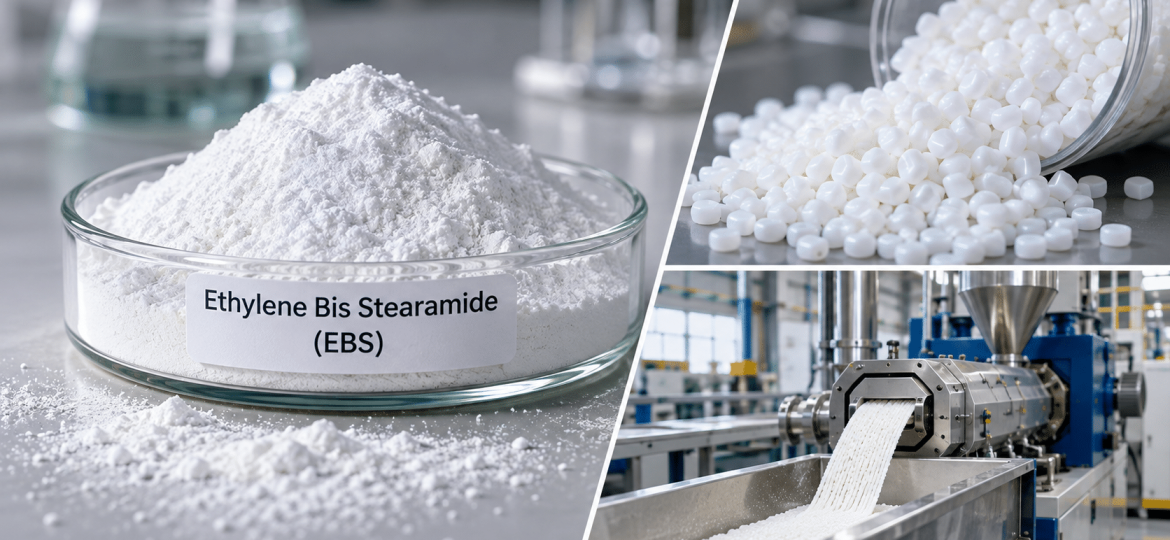
Ethylene Bis Stearamide (EBS) is a synthetic wax widely used in plastics, rubber, masterbatch, coatings, and other industrial products. It works as a lubricant, dispersing aid, and mold release agent in many formulations. In addition, it can help reduce sticking and improve the handling of selected materials.
Manufacturers value EBS wax for its high melting point, low water solubility, and useful surface properties. As a result, it supports several production methods, including extrusion, injection molding, and compounding.
However, product performance depends on the grade, particle size, dosage, and final formulation. Therefore, buyers should compare technical data before selecting a product.
This article explains the properties, production methods, applications, major manufacturers, and sourcing factors of Ethylene Bis Stearamide. It also explores its role in industrial manufacturing and the Turkish chemical market.
1. What Is Ethylene Bis Stearamide?
Ethylene Bis Stearamide is a synthetic fatty acid bis-amide made from stearic acid and ethylenediamine. It belongs to a group of materials known as amide waxes.
The chemical formula is C₃₈H₇₆N₂O₂, while its molecular weight is approximately 593.0 g/mol. In addition, its CAS number is 110-30-5.
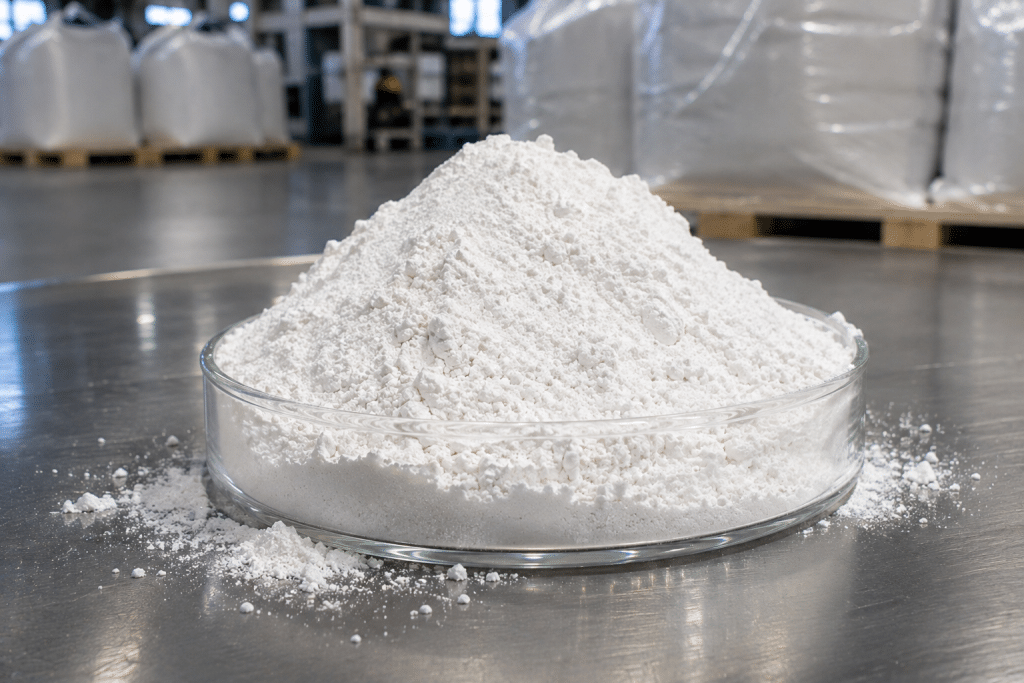
The material usually appears as a white or slightly off-white powder, bead, or granular solid. Furthermore, it has a relatively high melting point compared with many common fatty acid lubricants.
Because of these features, manufacturers use EBS to help control friction and improve processing in selected materials.
For example, plastic producers add it to certain polymer compounds, while pigment makers use suitable grades to support dispersion. As a result, the same chemical can serve several functions across different industries.
2. Ethylene Bis Stearamide Technical Properties
Technical properties help determine how EBS wax behaves during production. However, commercial grades may differ in purity, particle size, and other quality factors.
The following table provides a general overview.
| Property | Typical Information |
|---|---|
| Chemical Name | Ethylene Bis Stearamide |
| Abbreviation | EBS |
| CAS Number | 110-30-5 |
| EC Number | 203-755-6 |
| Chemical Formula | C₃₈H₇₆N₂O₂ |
| Molecular Weight | Approximately 593.0 g/mol |
| Appearance | White to off-white solid |
| Physical Forms | Powder, beads, or granules |
| Melting Range | Commonly around 140–146°C |
| Relative Density | Approximately 0.97–1.00 |
| Water Solubility | Practically insoluble |
| Chemical Class | Fatty acid bis-amide |
| Main Functions | Lubrication, dispersion, and mold release |
These figures describe common commercial characteristics rather than fixed limits for every grade.
For example, some producers specify a melting range of 141.5–145°C. Meanwhile, other grades may have a slightly wider range.
In addition, acid value, amine value, moisture, and particle size can vary between products. Therefore, buyers should review the Technical Data Sheet (TDS), Safety Data Sheet (SDS), and Certificate of Analysis (COA) before ordering.
3. Main Properties and Benefits of EBS Wax
Ethylene Bis Stearamide offers several useful properties in industrial production. However, each application requires a suitable grade and dosage.
Internal and External Lubrication
EBS can act as both an internal and external lubricant in selected polymer systems.
Internal lubrication helps reduce friction within the material during processing. Meanwhile, external lubrication helps limit friction between the material and equipment surfaces.
As a result, suitable formulations may achieve smoother processing and improved material flow.
Mold Release Performance
Some molded products can stick to equipment surfaces. Therefore, manufacturers use release agents to help remove finished parts.
EBS wax can support mold release in selected plastics and rubber products. In addition, it may help reduce surface defects caused by sticking.
Pigment and Filler Dispersion
Pigments and fillers must spread evenly throughout a formulation. Otherwise, the finished product may show uneven color or inconsistent performance.
EBS can help improve dispersion in suitable systems. Consequently, manufacturers may achieve more uniform blends and better processing results.
Anti-Blocking Properties
Some films, granules, and molded products tend to stick together during handling or storage.
For this reason, suitable EBS grades can serve as anti-blocking additives. However, the effect depends on the base material and operating conditions.
Surface Quality
EBS may help improve surface smoothness and appearance in selected formulations.
Furthermore, suitable grades can support consistent processing and reduce unwanted friction.
Nevertheless, manufacturers should test the final product because excessive dosage may affect adhesion, printing, or other surface properties.
4. Ethylene Bis Stearamide Uses Across Industries
Many industries use Ethylene Bis Stearamide as a processing aid or functional additive.
For example, plastic manufacturers often focus on lubrication, while pigment producers need effective dispersion.
The table below summarizes its main industrial applications.
| Industry | Common Applications | Main Function |
|---|---|---|
| Plastics | ABS, PVC, PS, PE, PP, and engineering polymers | Lubrication and processing |
| Masterbatch | Color and filler concentrates | Pigment dispersion |
| Rubber | Molded rubber and elastomer compounds | Mold release and lubrication |
| Paints and Coatings | Selected liquid and powder coatings | Dispersion and surface control |
| Printing Inks | Pigment-based ink systems | Dispersion and slip |
| Adhesives | Selected adhesive formulations | Anti-blocking and processing |
| Powder Metallurgy | Metal powder processing | Lubrication and release |
| Foundry Materials | Selected resin-bonded systems | Processing and release |
| Asphalt Products | Selected modified formulations | Functional processing additive |
As shown above, EBS can perform different roles depending on the application.
However, a grade designed for plastic processing may not be suitable for a coating or ink system. Therefore, buyers should match product specifications with their actual production needs.
5. Ethylene Bis Stearamide in Plastics and Polymer Processing
Plastics represent an important application area for EBS wax.
Manufacturers use suitable grades in polymer compounding, extrusion, injection molding, and other processes. In particular, EBS can help manage friction and support material flow.
EBS in PVC Processing
PVC manufacturers use lubricants to help control friction during processing.
Ethylene Bis Stearamide can form part of a suitable PVC lubricant system. In addition, it may help reduce sticking between the compound and processing equipment.
However, PVC performance depends on the full stabilizer and lubricant package. Therefore, producers should test EBS alongside other additives before setting the final dosage.
EBS in ABS and Polystyrene
ABS and polystyrene producers may use EBS to support melt processing and mold release.
For example, suitable grades can help reduce friction during injection molding and extrusion.
Furthermore, improved release behavior may support more consistent production.
Nevertheless, the results depend on polymer grade, temperature, equipment, and formulation.
EBS in Polyethylene and Polypropylene
PE and PP manufacturers use processing aids in selected compounds and masterbatch products.
EBS can help with lubrication and the distribution of certain fillers or pigments. As a result, it may support more even mixing in suitable systems.
However, it is important to check compatibility with the polymer and the final product requirements.
EBS in Engineering Plastics
Selected engineering polymers also use EBS-based processing aids.
For example, certain polyamide, polycarbonate, and other technical compounds may benefit from improved lubrication or release.
In addition, high-temperature processing requires careful grade selection. Therefore, manufacturers should confirm thermal behavior under their actual production conditions.
6. EBS Wax in Masterbatch, Pigments and Coatings
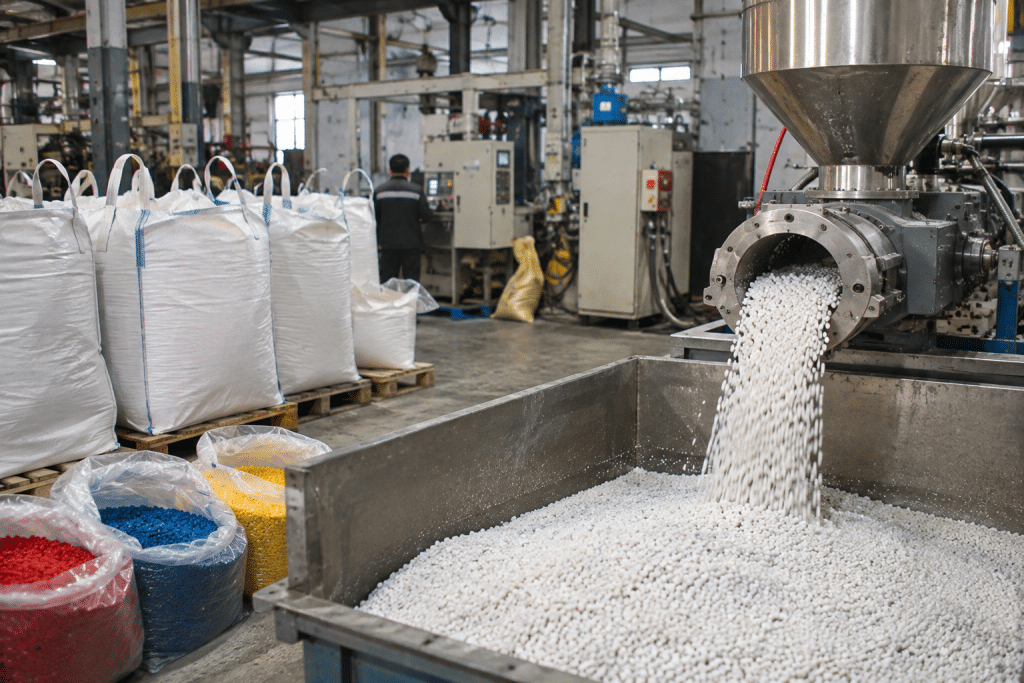
Masterbatch producers need to distribute pigments and fillers evenly within a polymer carrier.
However, poor dispersion can create color differences, visible particles, and processing problems.
EBS wax can help improve pigment wetting and distribution in suitable formulations. As a result, it may support more uniform color and better processing.
Color Masterbatch
Color masterbatch contains concentrated pigments within a carrier resin.
Therefore, producers need additives that help distribute pigment particles during mixing.
Suitable EBS grades can support this process. In addition, they may help reduce friction during compounding.
Filler Masterbatch
Mineral fillers can affect material flow and mixing behavior.
For this reason, manufacturers may use EBS alongside other processing aids.
However, performance depends on filler type, loading, carrier resin, and equipment.
Paints and Powder Coatings
Selected coating systems use amide waxes to help control dispersion and surface properties.
For example, EBS may support pigment distribution and surface performance in suitable coating formulations.
Furthermore, fine-particle grades can offer different behavior from larger beads.
Therefore, coating manufacturers should evaluate particle size, compatibility, and the final finish before choosing a grade.
Printing Inks
Ink producers need even pigment distribution and controlled surface behavior.
EBS can serve as a functional additive in selected ink systems. In addition, it may help improve slip and reduce unwanted surface friction.
Nevertheless, the final effect depends on the binder, solvent system, and printing method.
7. Ethylene Bis Stearamide in Rubber and Other Materials
EBS also serves industries beyond conventional plastics.
Rubber and Elastomers
Rubber compounds often need lubricants and mold release agents.
Therefore, suitable EBS grades can help reduce sticking during selected molding processes.
In addition, they may support material handling and processing.
However, rubber producers should check the effect on curing, adhesion, and final mechanical properties.
Powder Metallurgy
Metal powder processing requires controlled friction during pressing and shaping.
EBS can serve as a lubricant in selected powder metallurgy systems. As a result, it may help reduce friction during compaction and part release.
Nevertheless, manufacturers must consider lubricant removal and the later heat treatment process.
Foundry Applications
Some resin-bonded foundry systems use wax-based additives to support processing and release.
For example, EBS may serve as a lubricant in selected shell-molding formulations.
However, the right grade and dosage depend on the resin and operating conditions.
Adhesives and Asphalt Products
Certain adhesive systems use EBS for anti-blocking and processing control.
Likewise, some modified asphalt products use amide waxes as functional additives.
Nevertheless, these applications require formulation-specific testing. Therefore, buyers should confirm performance rather than assume that one grade suits every use.
8. How Is Ethylene Bis Stearamide Produced?
Manufacturers commonly produce Ethylene Bis Stearamide through a reaction between stearic acid and ethylenediamine.
During the reaction, the materials form amide bonds and release water.
The simplified reaction is:
2 Stearic Acid + Ethylenediamine → Ethylene Bis Stearamide + 2 Water
However, commercial production requires careful control of temperature, reaction conditions, and raw material quality.
After the reaction, producers may process the material into powder, beads, or granules.
In addition, some manufacturers offer different particle sizes for specific applications.
The production method and raw materials can affect several quality points:
- Melting range
- Acid value
- Amine value
- Moisture
- Color
- Particle size
- Residual impurities
- Batch consistency
As a result, products with the same CAS number may show different processing behavior.
Therefore, industrial buyers should compare the technical specifications of each commercial grade.
9. Major EBS Wax Manufacturers and Global Supply Markets
Several chemical manufacturers produce Ethylene Bis Stearamide or related fatty amide wax products.
Examples of established companies and product lines include:
| Manufacturer | Relevant Product or Activity |
|---|---|
| PMC Biogenix | Kemamide EBS and related amide waxes |
| Kao Corporation | KAO WAX EB series |
| KLK OLEO | PALMOWAX EBS products |
| Struktol | Polymer processing additives, including EBS-based grades |
These examples help buyers identify established participants in the wider market.
However, product availability, manufacturing locations, and commercial arrangements can change. Therefore, buyers should confirm current grades and supply options directly.
International Supply Markets
Malaysia, Japan, the United States, and China are among the countries with established companies or product offerings in the EBS and fatty amide wax sector.
In addition, international chemical distributors help connect producers with industrial buyers in other markets.
However, global supply conditions can change due to feedstock costs, production capacity, freight, and demand.
For this reason, buyers should compare more than the quoted product price.
Important factors include grade consistency, technical support, packing, lead time, and delivery terms.
Customs Classification
Ethylene Bis Stearamide is an organic amide compound. However, customs classification can depend on the product’s chemical form, composition, and national tariff rules.
Therefore, buyers should not rely on a single HS or GTIP code without checking the relevant customs tariff.
In addition, trade figures for broad chemical groups may include products other than EBS.
As a result, general customs data should not be presented as exact Ethylene Bis Stearamide trade volume unless the product scope is clear.
10. Ethylene Bis Stearamide Market and Demand in Türkiye
Türkiye has established plastics, masterbatch, rubber, coatings, and industrial manufacturing sectors.
Consequently, these industries create demand for processing aids, lubricants, dispersants, and related chemical additives.
EBS wax can serve several of these markets.
For example, masterbatch producers may use it to support pigment dispersion. Meanwhile, plastic compounders may focus on lubrication and mold release.
In addition, rubber and coating manufacturers may require application-specific grades.
However, demand varies according to production levels, polymer consumption, raw material costs, and supply conditions.
Main Buyer Industries in Türkiye
Potential industrial buyer groups include:
- Plastic compound manufacturers
- Color and filler masterbatch producers
- PVC product manufacturers
- ABS and engineering plastic processors
- Rubber and elastomer producers
- Paint and powder coating manufacturers
- Printing ink manufacturers
- Industrial additive distributors
These groups represent relevant application markets rather than confirmed buyers of a particular EBS grade.
Furthermore, different companies may use alternative lubricants or dispersants.
Therefore, suppliers should identify the buyer’s actual formulation needs before preparing an offer.
Market and Import Data
Reliable product-level import analysis requires the correct customs classification and a clear product definition.
However, broad tariff categories may contain several organic chemical products.
For this reason, import values under a wider code should not be treated as exact EBS demand.
Instead, buyers can assess market opportunities through verified trade records, sector activity, and direct industrial inquiries.
11. Industrial EBS Wax Sourcing with ATABAŞ GLOBAL
Industrial buyers need reliable technical information and clear commercial terms when sourcing chemical additives.
Therefore, ATABAŞ GLOBAL evaluates Ethylene Bis Stearamide inquiries according to product grade, application, required quantity, and delivery conditions.
For example, a masterbatch producer may require a fine powder grade. Meanwhile, another manufacturer may prefer beads for easier handling and feeding.
In addition, buyers may need specific limits for acid value, moisture, or particle size.
The following table outlines the main information needed for a sourcing inquiry.
| Requirement | Buyer Information |
|---|---|
| Product | Ethylene Bis Stearamide (EBS) |
| CAS Number | 110-30-5 |
| Application | Plastics, masterbatch, rubber, coatings, or other use |
| Product Form | Powder, beads, or granules |
| Grade | Industrial or application-specific |
| Melting Range | Required technical limits |
| Acid and Amine Values | Required maximum values |
| Particle Size | Required mesh or particle range |
| Quantity | MT per order or monthly demand |
| Packaging | 25 kg bags, Big Bags, or agreed packing |
| Destination | Country, port, or delivery location |
| Delivery Terms | EXW, FOB, CFR, or agreed terms |
| Documents | TDS, SDS, and COA |
| Supply Plan | Spot purchase or regular supply |
Furthermore, buyers should share any special quality requirements or production test results.
Clear information helps suppliers identify suitable grades. As a result, the sourcing process can become more efficient.
Through its international trade activities, ATABAŞ GLOBAL can review EBS sourcing requests and discuss commercial supply options based on availability and buyer requirements.
12. EBS Wax Quality, Packaging and Storage
Quality control plays an important role in industrial EBS applications.
Therefore, buyers should check the chemical and physical properties of the selected grade before placing an order.
Quality Control
Important quality parameters include:
- Appearance and color
- Melting range
- Acid value
- Amine value
- Moisture content
- Volatile matter
- Particle size
- Ash content, where relevant
- Batch consistency
In addition, buyers should review the current TDS, SDS, and COA.
For example, a masterbatch producer may need a specific particle size for good dispersion. Meanwhile, a polymer processor may focus on melting behavior and lubrication.
Therefore, quality limits should reflect the final application.
Packaging Options
Manufacturers commonly offer EBS in industrial bags. For example, 25 kg bags are available for several commercial grades.
Some suppliers may also provide Big Bags or other suitable packing formats.
However, packaging options depend on the producer, grade, and order quantity.
For this reason, buyers should confirm the packing method and loading plan before shipment.
Storage and Handling
EBS should remain in a clean, cool, and dry storage area.
In addition, operators should protect the material from moisture, excessive heat, and contamination.
Furthermore, fine powders may create airborne dust during handling. Therefore, workers should follow the supplier’s SDS and use suitable dust-control measures.
Proper storage and handling help maintain product quality during transport and warehouse operations.
For industrial EBS inquiries, ATABAŞ GLOBAL can review technical requirements, available grades, packaging, and delivery terms.
Frequently Asked Questions About Ethylene Bis Stearamide
What is Ethylene Bis Stearamide?
Ethylene Bis Stearamide is a synthetic fatty acid bis-amide wax. Manufacturers use it as a lubricant, dispersing aid, mold release agent, and anti-blocking additive in selected industrial products.
What is EBS wax used for?
EBS wax is used in plastics, masterbatch, rubber, coatings, inks, and other materials. In addition, certain grades support powder metallurgy and foundry applications.
What is the melting point of Ethylene Bis Stearamide?
Commercial EBS grades commonly have a melting range around 140–146°C. However, the exact range depends on the producer and product grade.
Is Ethylene Bis Stearamide soluble in water?
EBS is practically insoluble in water. Therefore, it does not behave like a water-soluble processing additive.
Why is EBS used in plastic manufacturing?
Plastic manufacturers use EBS to help reduce friction, improve mold release, and support processing. Furthermore, suitable grades can help distribute certain pigments and fillers.
What is the difference between EBS wax and PE wax?
EBS is a fatty acid bis-amide, while polyethylene wax consists mainly of low-molecular-weight polyethylene chains. As a result, their chemical structures and performance differ.
Both can serve as processing aids. However, the better choice depends on the polymer, application, and required properties.
Can EBS improve pigment dispersion?
Yes, suitable EBS grades can support pigment dispersion in selected masterbatch, coating, and ink systems. Nevertheless, the result depends on the formulation and processing method.
Is EBS suitable for food-contact applications?
Certain EBS uses may be permitted under specific food-contact regulations. However, approval depends on the jurisdiction, intended use, product grade, and applicable conditions.
Therefore, buyers must verify the relevant regulatory requirements and obtain suitable supplier documents before using EBS in food-contact materials.
What should buyers check before purchasing EBS wax?
Buyers should review the melting range, acid value, amine value, moisture, particle size, and application requirements. In addition, they should confirm product documents, packaging, quantity, and delivery terms.
Can ATABAŞ GLOBAL support Ethylene Bis Stearamide sourcing?
ATABAŞ GLOBAL can evaluate industrial sourcing inquiries based on grade, specifications, quantity, and destination. Furthermore, buyers can share their technical requirements to discuss suitable commercial supply options.
