

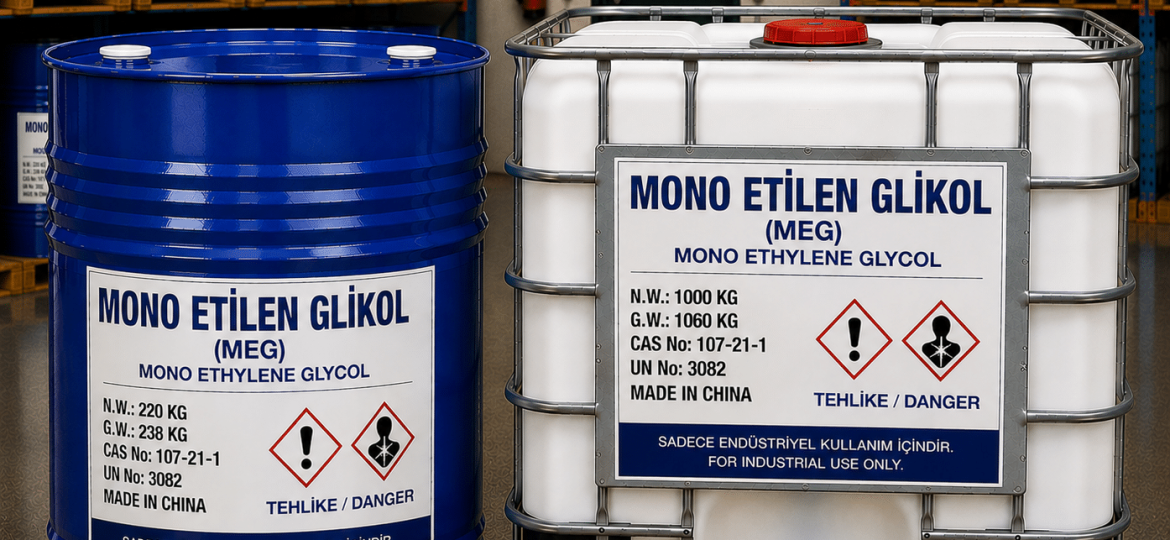
Monoethylene Glycol (MEG), also known as ethylene glycol, is an important petrochemical intermediate used extensively in polyester, polyethylene terephthalate (PET), automotive coolant, heat-transfer fluid, resin, and other industrial applications. Its complete miscibility with water, relatively high boiling point, and chemical functionality make it a valuable raw material across global manufacturing supply chains.
For industrial buyers, purchasing MEG requires more than comparing prices. Purity, water content, diethylene glycol (DEG) content, product origin, documentation, packaging, logistics, and supply consistency can directly affect downstream manufacturing.
A professional procurement process should therefore begin with a clearly defined technical specification, followed by supplier verification and appropriate commercial due diligence.
1. What Is Monoethylene Glycol?
Monoethylene Glycol is the simplest member of the ethylene glycol family. Its molecular formula is C₂H₆O₂, its CAS number is 107-21-1, and its molecular weight is approximately 62.07 g/mol.
In pure form, the substance is a clear, colorless, syrupy liquid. It contains two hydroxyl groups and is completely miscible with water at 20°C. These characteristics allow it to function both as a chemical intermediate and as a component in various industrial formulations.
Commercial MEG is available in grades designed for different applications. Requirements can vary significantly between polyester production, PET manufacturing, antifreeze formulations, heat-transfer systems, and specialty chemical processes.
For this reason, buyers should always define the intended application before requesting a commercial quotation.
2. How Is MEG Produced?
Industrial production generally begins with ethylene. Producers first convert ethylene into ethylene oxide and then react the ethylene oxide with water to produce ethylene glycol.
The process can also generate higher glycols, including diethylene glycol (DEG) and triethylene glycol (TEG). Separation and purification processes are therefore necessary to achieve the required final product quality.
Modern production facilities carefully control reaction conditions, separation, purification, and quality testing. This is particularly important because downstream industries may establish strict requirements for purity, moisture, color, acidity, and related impurities.
From a buyer’s perspective, the most important consideration is whether the finished material consistently meets the technical specification agreed upon between the supplier and purchaser.
3. Key Physical and Chemical Properties
MEG has several characteristics that explain its importance in industrial applications.
Its normal boiling point is approximately 197.4°C, while its normal freezing point is approximately −11.2°C. The specific gravity of pure material is approximately 1.1153 at 20/20°C, and its dynamic viscosity is approximately 19.83 mPa·s at 20°C.
The liquid is completely miscible with water at 20°C. Its vapor pressure is relatively low at ordinary temperatures, at approximately 0.067 hPa at 20°C, while its refractive index is approximately 1.4306 at 25°C.
These figures represent established physical properties under defined conditions. They should not be confused with contractual specifications for individual commercial grades.
When comparing offers, industrial purchasers should always evaluate the specification supplied for the exact product being offered.
4. Why Is It Important for Polyester and PET Production?
One of the most significant applications of MEG is the production of polyester and polyethylene terephthalate.
Manufacturers use ethylene glycol as a major feedstock in producing polyester polymers. These materials are subsequently converted into polyester fibers, PET resins, films, bottles, containers, textiles, and numerous other products.
Polyester fibers have extensive applications in clothing, home textiles, industrial fabrics, and technical materials. PET resin is widely used in packaging, bottles, films, and molded products.
Feedstock consistency is particularly important in these manufacturing processes. Variations in water content, color, impurities, or glycol composition can affect processing conditions and final product characteristics.
As a result, professional polyester and PET manufacturers generally evaluate more than headline purity when approving a raw-material supplier.
5. Major Industrial Applications
Although polyester and PET production represent major areas of demand, MEG has a considerably broader industrial role.
It is widely associated with automotive antifreeze and coolant formulations because glycol-water mixtures can provide useful freezing-point and heat-transfer characteristics when properly formulated.
The chemical is also used in industrial heat-transfer fluids and can serve as a raw material or processing component in resins, water-based adhesives, latex paints, asphalt emulsions, textile processing, paper, leather, and other industrial applications.
Another established application involves certain electrolytic capacitor systems, where ethylene glycol can function as part of the electrolyte formulation.
The appropriate grade depends on the intended application. A product suitable for one manufacturing process should not automatically be assumed to meet the technical or regulatory requirements of another.
Buyers should therefore review the applicable Technical Data Sheet (TDS), Safety Data Sheet (SDS), and product specification before use.
6. Technical Specifications Buyers Should Know
The table below provides useful reference information for industrial procurement. Physical constants represent typical properties of pure MEG, while commercial quality limits can vary according to producer, grade, manufacturing location, and intended application.
| Parameter | Reference Information |
|---|---|
| Product Name | Monoethylene Glycol |
| Common Abbreviation | MEG |
| Alternative Name | Ethylene Glycol |
| CAS Number | 107-21-1 |
| Molecular Formula | C₂H₆O₂ |
| Molecular Weight | 62.07 g/mol |
| Appearance | Clear, colorless, syrupy liquid |
| Normal Boiling Point | Approx. 197.4°C |
| Normal Freezing Point | Approx. −11.2°C |
| Specific Gravity at 20/20°C | Approx. 1.1153 |
| Dynamic Viscosity at 20°C | Approx. 19.83 mPa·s |
| Refractive Index at 25°C | Approx. 1.4306 |
| Vapor Pressure at 20°C | Approx. 0.067 hPa |
| Miscibility with Water at 20°C | Completely miscible |
| Purity | Grade and supplier dependent |
| Water Content | Grade and supplier dependent |
| DEG Content | Grade and supplier dependent |
| Acidity | Grade and supplier dependent |
| Color | Defined according to commercial grade |
| Documentation | TDS, SDS, and COA as required |
For example, certain high-purity Monoethylene Glycol commercial grades specify purity of at least 99.8 wt%, with controlled limits for water and DEG. These figures should not be treated as universal requirements for every product.
The supplier’s current specification and the parameters agreed upon in the sales contract should determine commercial acceptance.
7. Understanding Purity and Product Quality
Purity is important, but a single percentage does not provide a complete picture of product quality.
Depending on the application, purchasers may need to evaluate water content, DEG concentration, acidity, color, appearance, and trace impurities alongside the main assay.
The importance of each parameter varies according to downstream production requirements. Polyester and PET manufacturers, for example, may require particularly consistent feedstock because variations can influence processing performance and final product characteristics.
Consistency between shipments also matters. Material that repeatedly conforms to an agreed specification Monoethylene Glycol can reduce unnecessary process adjustments and support predictable production.
For significant orders, buyers may request representative samples, batch documentation, or independent testing before final approval.
A technically informed purchasing decision should therefore focus on fitness for purpose rather than purity alone.
8. What Should a Certificate of Analysis Show?
A Certificate of Analysis (COA) Monoethylene Glycol provides analytical information related to a specific product or batch.
Depending on the agreed specification, it may report purity, water content, DEG concentration, acidity, color, appearance, and other relevant quality parameters.
The document should identify the product and provide sufficient batch or lot information to maintain traceability. Buyers should compare the reported results directly with the specification established in the purchase agreement.
A COA should not be confused with a Safety Data Sheet (SDS). The COA addresses analytical and quality information, while the SDS provides information about hazards, handling, storage, exposure controls, personal protection, and emergency procedures.
For large-volume or high-value transactions, the parties may also establish independent sampling, inspection, and testing procedures in the contract.
9. Storage, Handling, and Product Integrity
Proper storage protects both personnel and product quality.
Industrial users should store MEG in suitable equipment and prevent contamination from water, dirt, incompatible substances, or residues left by previous products. Monoethylene Glycol Tanks, pipelines, pumps, seals, and transfer equipment should be suitable for the material and the operating conditions.
Bulk receivers should establish procedures for tank cleanliness, sampling, lot identification, transfer operations, and inventory management.
Closed transfer systems can help preserve product integrity and reduce unnecessary occupational exposure.
Storage and handling requirements should always follow the current supplier SDS, applicable regulations, and the facility’s own risk assessment.
Product quality management should therefore continue throughout transportation, unloading, storage, and use rather than ending when the material leaves the production facility.
10. Safety and Responsible Industrial Use
MEG requires controlled professional handling.
Ethylene glycol is harmful if swallowed, and significant exposure can cause serious health effects. Industrial facilities should therefore implement appropriate procedures for handling, storage, exposure prevention, spill response, and emergency management.
Personnel working with the material should receive appropriate training and use personal protective equipment according to the current SDS and workplace risk assessment.
Safe chemical management also includes suitable transfer procedures, appropriate ventilation where required, emergency preparedness, waste management, and measures designed to prevent unintended exposure.
The intended use should be evaluated before purchasing because regulatory and product-stewardship requirements may vary between applications and jurisdictions.
The supplier’s current SDS should always serve as the primary safety reference for the specific material being purchased.
11. Packaging and International Logistics
Packaging and transportation arrangements depend on order volume, supplier capabilities, origin, destination, and customer requirements.
Commercial quantities may be supplied in suitable drums, intermediate bulk containers (IBCs), or approved bulk transportation systems. Large-volume transactions commonly require specialized chemical logistics.
Equipment cleanliness is especially important. Contamination from previous cargoes, moisture, or incompatible materials can compromise product quality even when the material originally met specification.
Before shipment, the buyer and seller should clearly establish the quantity, packaging or bulk format, loading point, destination, applicable Incoterm, inspection procedure, and required documentation.
International contracts should also define responsibility for freight, insurance where applicable, customs documentation, transfer of risk, and delivery obligations.
Clear logistics terms help reduce uncertainty and commercial disputes.
12. How to Buy MEG in Bulk
Effective bulk procurement begins with a precise inquiry.
Instead of requesting only a “MEG price,” buyers should provide the required grade, quantity, destination, delivery basis, and intended application. If specific limits for purity, water, DEG, color, or other parameters are essential, they should also appear in the inquiry.
This allows suppliers to prepare commercially comparable offers.
A professional quotation should clearly identify the product, specification, quantity, origin where applicable, price basis, delivery terms, packaging or bulk arrangement, payment conditions, and expected shipment schedule.
Technical documentation should also be available for review.
For recurring orders, purchasers should evaluate whether the supplier can maintain both quality and volume over time. Reliable continuity of supply can be more valuable than a minor short-term price difference.
13. Choosing a Reliable MEG Supplier
Supplier evaluation should combine technical, commercial, and logistical due diligence.
Buyers should verify the counterparty’s legal identity, product source, supply capability, technical documentation, and ability to deliver the agreed quantity and quality.
Clear communication is another important indicator. A professional supplier should identify any deviation from the requested specification before an order is finalized rather than substituting another grade without proper disclosure.
International transactions also require clear agreement on payment terms, Incoterms, inspection procedures, documentation, loading arrangements, and delivery responsibilities.
At Atabaş, the objective is to support international buyers through a structured approach to industrial raw-material sourcing, commercial coordination, and supply-chain requirements.
For secure and professionally coordinated MEG procurement, contact Atabaş to discuss your required specifications, quantity, destination, and delivery terms.
14. Commercial Buying Guidance and Final Considerations
A successful purchase requires technical verification and commercial discipline.
Before confirming an order, buyers should know exactly which grade they require, whether the offered specification matches the intended application, which documents will accompany the material, and how product conformity will be verified.
Quantity, origin, delivery terms, payment conditions, shipment schedule, inspection requirements, and logistics responsibilities should also be clearly documented.
Price remains important, but the lowest quotation does not automatically represent the lowest overall procurement cost. Inconsistent quality, inadequate documentation, unreliable delivery, contamination, or contractual uncertainty can create substantially greater costs downstream.
MEG is a well-established global industrial raw material, but commercial offers are not interchangeable. Product quality, consistency, documentation, logistics, and counterparty reliability should all form part of the final purchasing decision.
For international buyers seeking a professionally coordinated supply process, Atabaş can be contacted to evaluate MEG requirements and discuss suitable commercial supply options.
