

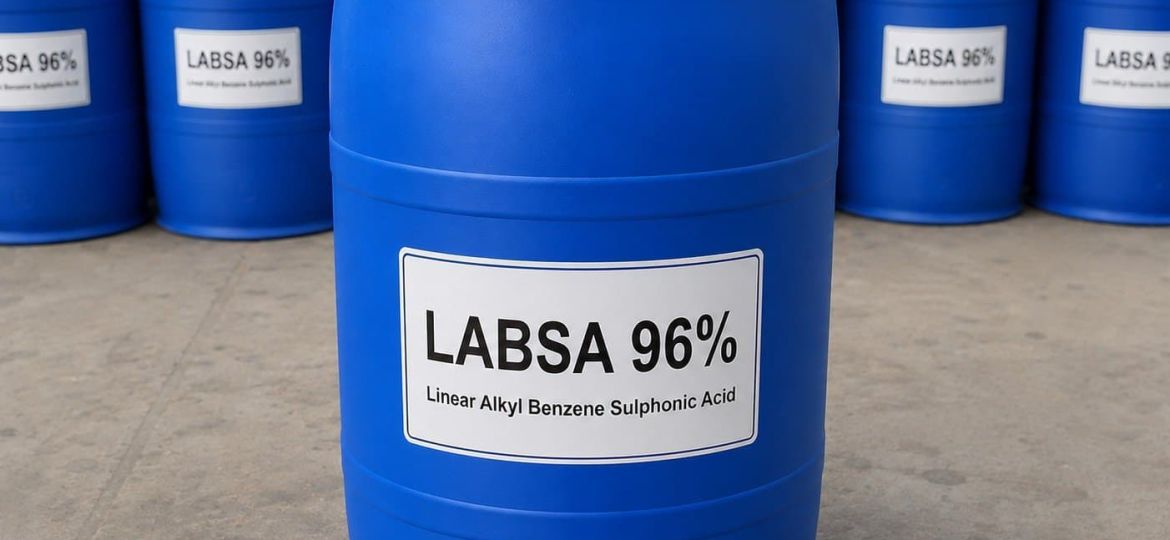
LABSA is an important raw material in the detergent and cleaning industry. Manufacturers use it to produce many household and industrial cleaning products. It offers strong cleaning power, flexible use, and good performance in large-scale production.
The chemical industry knows LABSA as Linear Alkylbenzene Sulfonic Acid. Manufacturers mainly use it in laundry detergents, dishwashing products, surface cleaners, and industrial cleaning products. In addition, some industries use it in textile and special chemical applications.
This guide explains its main properties, technical specifications, uses, quality factors, storage needs, and role in global trade.
What Is LABSA?
LABSA stands for Linear Alkylbenzene Sulfonic Acid. Producers make it by sulfonating linear alkylbenzene. It belongs to the group of anionic surfactant raw materials.
The product plays an important role in detergent production because it helps create effective cleaning systems. After neutralization, it can help remove grease, oil, and dirt from different surfaces. Moreover, it can support wetting and foaming in many cleaning formulas.
Manufacturers value this material for several reasons. First, it works well in many detergent formulas. Second, companies can use it in high-volume production. Finally, it offers a practical balance between performance and cost.
As a result, detergent manufacturers around the world continue to use it as a major raw material.
LABSA Technical Specifications
Technical values can change according to the manufacturer, production method, and product grade. Therefore, buyers should always check the supplier’s current Technical Data Sheet (TDS) and Certificate of Analysis (COA).
The following table shows common reference values for LABSA 96% grade.
| Specification | Typical / General Value |
|---|---|
| Chemical Name | Linear Alkylbenzene Sulfonic Acid |
| Abbreviation | LABSA |
| Product Type | Anionic surfactant raw material |
| Active Matter | Typically ≥ 96% |
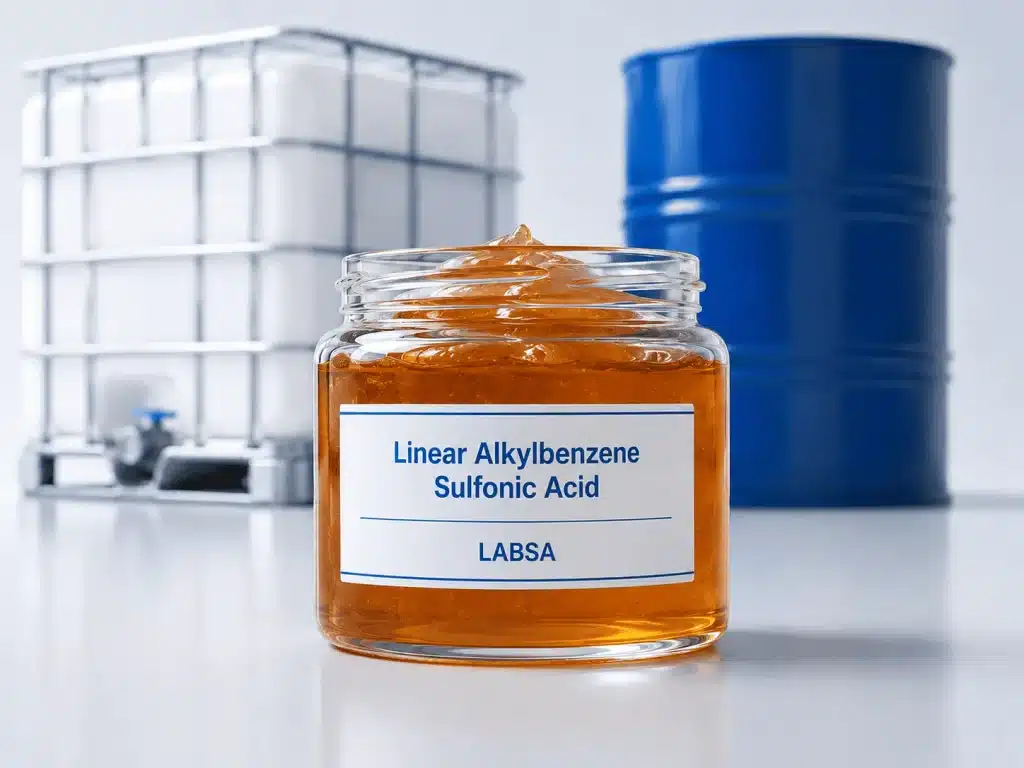
| Appearance | Brown to dark brown viscous liquid |
| Free Sulfuric Acid | Typically ≤ 1.5% |
| Unsulfonated Matter / Free Oil | Typically ≤ 2.0% |
| Water Content | Depends on grade and manufacturer |
| Chemical Character | Acidic |
| Main Application | Detergent and cleaning products |
These figures provide a general industry reference. However, suppliers may offer different specifications. Therefore, buyers should confirm the exact values before placing an order.
In addition, industrial buyers should request a batch-specific COA. This document helps them compare the delivered material with the agreed product specifications.
What Is LABSA Used For?
Manufacturers mainly use this material to create effective cleaning systems. It helps lower surface tension and allows cleaning agents to work more effectively on dirty surfaces.
After proper neutralization, the material can help remove grease and other soils. In addition, it can improve wetting and support the desired foam level of a cleaning product.
Manufacturers can also adjust the amount according to the final formula. For example, they can combine it with other surfactants, builders, and additives to achieve different cleaning results.
Therefore, its role can change from one formula to another. A laundry detergent may require one type of surfactant balance, while an industrial cleaner may need another.
Where Is LABSA Used?
The detergent industry represents the main application area. However, manufacturers can also use the material in other suitable chemical processes.
The table below summarizes its common applications.
| Industry / Application | Main Purpose |
|---|---|
| Powder Laundry Detergents | Supports cleaning performance |
| Liquid Laundry Detergents | Works as a main or supporting surfactant |
| Dishwashing Detergents | Helps remove grease and food soils |
| General-Purpose Cleaners | Supports wetting and cleaning |
| Industrial Cleaners | Helps remove demanding dirt and grease |
| Textile Chemicals | Supports suitable cleaning and wetting processes |
| Special Chemical Formulas | Provides cleaning, wetting, or dispersion functions |
The correct amount depends on the final product and its performance goals. Therefore, manufacturers should test the complete formula before full-scale production.
Why Is LABSA Important in Detergent Manufacturing?
Raw materials directly affect detergent quality. They can influence cleaning power, foam, viscosity, stability, and production cost.
LABSA gives manufacturers a flexible option for many detergent formulas. Moreover, producers can combine it with different ingredients to meet specific market needs.
For example, a manufacturer may develop one formula for household laundry products and another for professional cleaning. Although both products may use similar raw materials, their final formulas can differ greatly.
Consistency also matters. Changes in active matter, free acid, color, or unsulfonated matter may affect the finished product. Therefore, manufacturers should check incoming raw materials regularly.
A reliable supply also helps factories keep production stable. Consequently, many industrial buyers evaluate both technical quality and supply performance when choosing a supplier.
Key Benefits of LABSA
This raw material offers several practical benefits for detergent and cleaning product manufacturers.
First, it supports strong cleaning performance. Therefore, manufacturers can use it in products designed to remove grease and common soils.
Second, it offers wide formulation flexibility. Companies can combine it with other raw materials to create products for different cleaning needs.
Moreover, it suits large-scale manufacturing. This makes it relevant for factories that produce high volumes of detergents and cleaning products.
It also has an established global supply chain. As a result, industrial buyers can source the material from several producing regions.
However, product quality can vary between suppliers. Buyers should therefore compare technical specifications as well as price.
Key Quality Parameters
Price plays an important role in chemical purchasing. However, price alone does not show the true value of a raw material.
Buyers should also review several technical factors.
- Active matter content
- Free sulfuric acid level
- Unsulfonated matter
- Water or moisture content
- Color and appearance
- Batch consistency
- TDS, SDS, and COA documents
- Packaging options
- Storage requirements
- Delivery conditions
Active matter is especially important because it can directly affect formulation calculations. Likewise, free sulfuric acid and unsulfonated matter can influence product quality.
In addition, buyers should compare different batches over time. Consistent raw material quality helps manufacturers keep their finished products within the required standards.
Therefore, a strong quality control process can reduce production problems and improve long-term purchasing results.
LABSA Storage, Handling and Transportation
Companies should handle this product carefully because of its acidic nature. Safe handling protects employees, equipment, and product quality.
First, companies should use compatible tanks, pumps, pipes, and containers. They should also follow the storage conditions in the supplier’s Safety Data Sheet.
Moreover, workers should wear the required personal protective equipment. The SDS provides guidance about suitable protection, first aid, spills, and safe handling.
Companies should also keep the product away from incompatible materials. In addition, they should train workers on emergency procedures.
Transportation rules may vary by product grade, concentration, destination, and local law. Therefore, companies should always review the latest SDS and relevant transport rules before shipment.
For international orders, buyers and suppliers should also confirm packaging, labeling, documentation, and transport requirements before loading.
LABSA Import and Export Markets
Global trade data can help buyers understand supply patterns. However, customs data requires careful interpretation.
Trade databases often place chemical products within broad HS categories. For example, HS 340211 covers anionic organic surface-active agents other than soap. This category can include LABSA as well as other anionic surfactant products.
Therefore, the following figures show the wider trade environment. They should not be treated as exact trade volumes for one single chemical.
In 2024, the following countries ranked among the leading suppliers to Turkey under HS 340211:
| Leading Supplier to Turkey | 2024 Trade Value | Quantity |
|---|---|---|
| Germany | USD 15.77 million | 7.79 million kg |
| Egypt | USD 11.19 million | 9.32 million kg |
| Italy | USD 7.47 million | 4.90 million kg |
| France | USD 2.11 million | 1.07 million kg |
| Iran | USD 2.06 million | 2.30 million kg |
Turkey imported about USD 53.32 million and 32.84 million kg under this category in 2024.
Meanwhile, Turkey also exported large volumes under the same HS category.
| Leading Export Market from Turkey | 2024 Trade Value | Quantity |
|---|---|---|
| Serbia* | USD 8.34 million | 5.14 million kg |
| Russian Federation | USD 7.25 million | 2.93 million kg |
| Syria | USD 6.94 million | 5.95 million kg |
| Iraq | USD 6.19 million | 4.84 million kg |
| Egypt | USD 2.58 million | 1.64 million kg |
*The source data uses the historical destination label “Serbia, FR (Serbia/Montenegro).”
Turkey exported about USD 48.85 million and 31.30 million kg under this category in 2024.
These figures show active two-way trade in anionic surfactants and related products. Moreover, Turkey’s location gives suppliers access to markets in Europe, the Middle East, North Africa, and nearby regions.
Several factors can shape these trade flows. For example, freight costs, local detergent production, regional demand, supply availability, and delivery times can influence purchasing decisions.
Major Markets in the Global Supply Chain
The global surfactant market connects closely with the detergent, home care, textile, and industrial cleaning sectors. Therefore, regions with large manufacturing bases often create strong demand for surfactant raw materials.
Europe remains an important market because it has a large chemical and consumer goods industry. Meanwhile, Asia also plays a major role due to its large manufacturing base and growing consumer markets.
The Middle East and North Africa are also important for regional trade. These regions combine detergent production, growing demand, and access to nearby export markets.
For example, Egypt exported about USD 102.79 million and 50.98 million kg under HS 340211 in 2024. Turkey, Brazil, Tunisia, Spain, and Libya ranked among its notable destination markets in this category.
As a result, buyers can find supply opportunities across several regions. However, the lowest price does not always offer the best overall value.
Buyers should also consider freight, lead times, product quality, production capacity, and supply security.
How to Choose a LABSA Supplier
Choosing the right supplier requires both technical and commercial checks.
First, buyers should compare the product specification with their production needs. They should check active matter, free sulfuric acid, unsulfonated matter, appearance, and other key values.
Next, they should review the supplier’s documents. A current TDS explains the technical properties, while an SDS provides safety information. In addition, a batch-specific COA shows the test results for the actual shipment.
Buyers should also review the commercial terms. For international purchases, important points include:
- Price and payment terms
- Incoterms
- Country of origin
- Minimum order quantity
- Production capacity
- Packaging options
- Loading port
- Lead time
- Transit time
- Shipping documents
- Customs classification
- Supply continuity
Moreover, communication can make a major difference. A supplier that responds quickly and provides clear documents can reduce delays during purchasing and shipment.
Therefore, professional buyers should consider the total supply package rather than simply choosing the lowest quotation.
Packaging and Bulk Supply
Suppliers can offer different packaging options depending on order size, transport needs, and available facilities.
Common commercial solutions may include drums, IBCs, and bulk tanker shipments. However, the exact options depend on the supplier and product grade.
Large-volume users may prefer bulk shipments because they can reduce packaging and handling needs. In contrast, smaller manufacturers may choose drums or IBCs for greater flexibility.
Buyers should also check whether their storage and unloading systems can handle the selected packaging type.
For exports, both parties should confirm packaging requirements before shipment. In addition, they should review local transport rules and destination-country requirements.
Careful planning can reduce handling problems and help the material arrive in suitable condition.
Frequently Asked Questions About LABSA
What does LABSA stand for?
LABSA stands for Linear Alkylbenzene Sulfonic Acid. Manufacturers mainly use it as a raw material for detergent and cleaning product production.
What is LABSA mainly used for?
Manufacturers mainly use it in laundry detergents, dishwashing products, surface cleaners, and industrial cleaning formulas. In addition, some industrial processes may use its surfactant properties.
What does LABSA 96 mean?
The term usually refers to a commercial grade with about 96% active matter. However, specifications can vary between manufacturers. Therefore, buyers should always check the current TDS and COA.
Which documents should buyers request?
Industrial buyers should request a Technical Data Sheet (TDS), Safety Data Sheet (SDS), and Certificate of Analysis (COA). In addition, international buyers may need origin, transport, customs, or other regulatory documents.
Why do LABSA prices vary?
Several factors affect pricing. For example, raw material costs, energy prices, production location, order size, packaging, freight rates, and market demand can change the final price.
Moreover, Incoterms can significantly affect quotations. Therefore, buyers should compare offers on the same delivery basis.
What should buyers check before importing LABSA?
Buyers should first confirm technical specifications and required quantities. Next, they should check packaging, Incoterms, lead time, transport conditions, customs requirements, and documents.
Finally, they should evaluate the supplier’s ability to provide consistent quality over time. This approach can reduce supply risks and support stable production.
Conclusion
LABSA plays an important role in the global detergent and cleaning industry. Manufacturers value it because it supports effective cleaning, offers flexible use, and works well in large-scale production.
However, buyers should look beyond price when selecting a product and supplier. They should compare active matter, free acid, unsulfonated matter, batch consistency, technical documents, packaging, and delivery conditions.
Moreover, international buyers should consider freight, lead times, customs requirements, and supply continuity. These factors can have a major effect on the real cost and reliability of a purchase.
Therefore, a well-planned sourcing process should combine consistent quality, suitable technical specifications, competitive commercial terms, and reliable logistics. This approach helps manufacturers build a stable and efficient raw material supply chain.
