

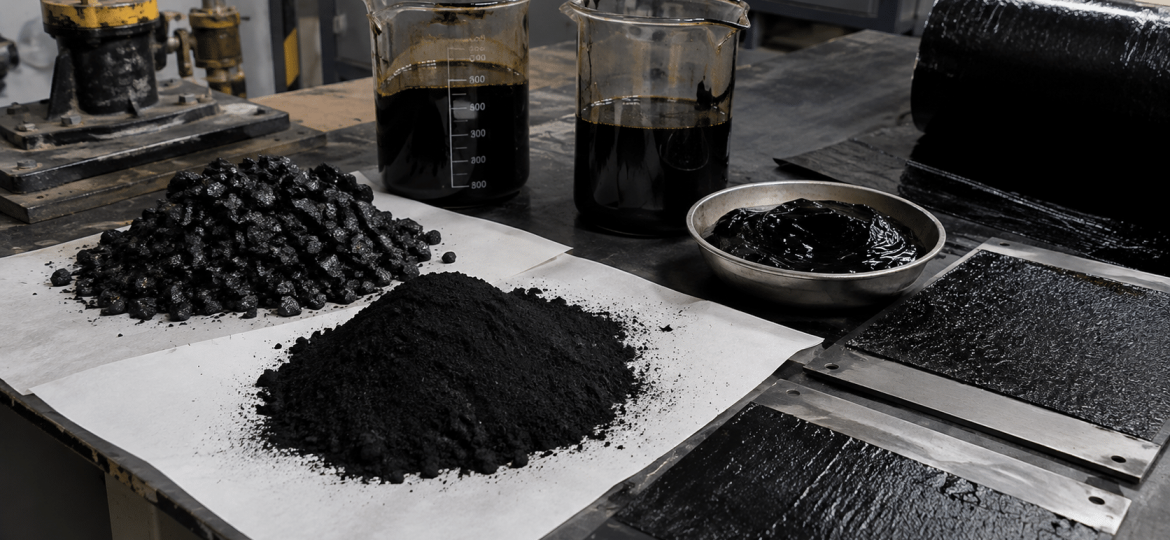
Pipe coating gilsonite prices depend on product quality, ash content, particle size, softening point, order quantity and delivery terms. Therefore, industrial buyers should consider technical performance alongside the purchase price because raw material quality directly affects the finished coating.
Gilsonite is a natural hydrocarbon material that manufacturers use in protective coatings, bituminous compounds and waterproofing products. Moreover, its high softening point and low water absorption make it suitable for various industrial applications.
For example, manufacturers can use selected grades in pipe enamels, protective mastics, primers and insulation tapes. Similarly, waterproofing producers can use natural asphaltite to improve the physical properties of compatible bitumen mixtures.
However, different applications require different product grades. For this reason, buyers should evaluate technical specifications before comparing commercial offers.
In addition, packaging, storage and shipping conditions can affect the total purchasing cost. Consequently, industrial buyers should assess the complete supply process rather than focus only on the raw material price.
ATABAŞ GLOBAL provides industrial sourcing and international supply solutions according to customer requirements. Furthermore, we coordinate packaging, quality control and international shipping to support individual orders and regular supply programs.
1. What Is Pipe Coating Gilsonite?
Pipe coating gilsonite is a naturally occurring solid hydrocarbon that belongs to the asphaltite group. However, unlike conventional petroleum bitumen, this material comes from natural geological deposits.
Its structure contains a high proportion of carbon and organic compounds. Consequently, gilsonite can modify the physical properties of compatible bituminous materials.
For example, manufacturers can add suitable grades to increase hardness and softening point. In addition, the material can help reduce unwanted flow at higher temperatures.
Nevertheless, natural mineral deposits may contain different amounts of inorganic material. Therefore, processing methods and grade selection play an important role in product quality.
| Product Information | Description |
|---|---|
| Commercial Name | Pipe Coating Gilsonite |
| Alternative Name | Natural Asphaltite |
| Other Names | Natural Asphalt, Natural Bitumen |
| Product Category | Industrial Hydrocarbon Materials |
| General HS Code | 2714.90 |
| Physical Form | Powder or granules |
| Appearance | Black |
| Material Source | Natural mineral deposits |
| Water Solubility | Insoluble |
| Main Function | Modification of protective coating compounds |
Moreover, pipe coating grades generally require controlled mineral content and particle size because these properties influence production performance.
For instance, excessive mineral residue may affect the physical consistency of a mixture. Similarly, unsuitable particle sizes can reduce mixing efficiency.
As a result, manufacturers should select materials according to their production methods and finished product requirements.
- Important: Gilsonite serves as an additive within a protective coating system rather than a complete corrosion protection product.
2. Physical and Chemical Properties of Coating-Grade Gilsonite
Gilsonite has several physical and chemical properties that make it useful in industrial coating production. In particular, its relatively high softening point helps manufacturers develop compounds for selected operating conditions.
Furthermore, its carbon-rich structure contributes to the hardness of compatible mixtures. Similarly, low water absorption can support the moisture barrier properties of suitable formulations.
However, the exact chemical content varies between natural deposits and commercial grades. Therefore, buyers should review product-specific test results rather than rely only on general material descriptions.
| Property | Industrial Importance |
|---|---|
| High Carbon Content | Supports selected binder properties |
| High Softening Point | Helps improve thermal stability |
| Low Water Absorption | Supports moisture resistance |
| Water Insolubility | Suitable for selected waterproofing mixtures |
| Brittleness | Allows crushing and grinding |
| Organic Binder Compatibility | Supports suitable coating formulations |
| Controlled Mineral Content | Helps maintain product consistency |
| Adjustable Particle Size | Supports different mixing requirements |
| Natural Hydrocarbon Structure | Provides an alternative binder modifier |
For example, a fine powder grade may mix more evenly within a suitable binder. Meanwhile, a grade with a higher softening point may help improve resistance to thermal deformation.
In addition, controlled moisture levels can support stable processing conditions because excess moisture may affect certain production methods.
Nevertheless, excessive hardness can reduce flexibility in some coating systems. Therefore, manufacturers should balance all relevant properties during product development.
Moreover, laboratory trials can help identify the most suitable material grade. As a result, manufacturers can reduce the risk of technical problems during commercial production.
3. Technical Specifications and Their Impact on Gilsonite Prices
Technical specifications directly influence pipe coating gilsonite prices because industrial buyers require different levels of purity, fineness and material consistency.
For instance, low-ash grades may require more selective sourcing. Similarly, finer particles may increase grinding and classification costs.
Moreover, special softening point requirements can affect product availability. Therefore, buyers should clearly define their technical needs before requesting a quotation.
Typical Pipe Coating Gilsonite Specifications
| Technical Parameter | Typical Specification | Test Method |
|---|---|---|
| Appearance | Black powder | Visual inspection |
| Softening Point (Ring and Ball) | 150–200°C | ASTM D36 |
| Ash Content | Max. 5% | ASTM D3174 |
| Moisture Content | Max. 1% | ASTM D95 |
| Solubility in TCE | Min. 97% | ASTM D2042 |
| Particle Size | 200 mesh grade | Sieve analysis |
| Water Solubility | Insoluble | Product-specific analysis |
| Water Absorption | Low | Application-specific testing |
| Typical Addition Rate | 5–25% of compound | Formulation-specific |
| Packaging | 25 kg bags or 1 MT Big Bags | Commercial specification |
These values illustrate a commercial coating-grade specification. However, they do not establish a universal standard for every gilsonite product.
Moreover, the required particle-size distribution may differ according to the mixing equipment. For example, some manufacturers require a defined percentage passing through a specified sieve.
Consequently, the term 200 mesh alone may not provide enough information for every application.
Influence of Technical Properties on Quality
| Technical Property | Effect on Production |
|---|---|
| Ash Content | Influences mineral residue in the mixture |
| Softening Point | Affects temperature-related behaviour |
| Moisture Content | Influences processing stability |
| Particle Size | Affects mixing and material distribution |
| Solubility | Helps assess binder compatibility |
| Batch Consistency | Supports stable production quality |
| Organic Content | Influences the behaviour of compatible compounds |
Furthermore, buyers should confirm the actual grade through a Technical Data Sheet and Certificate of Analysis. In addition, laboratory results should represent the material prepared for the order.
For example, two products may have similar softening points but different ash levels. Likewise, differences in particle size may influence the final coating quality.
Therefore, buyers should compare all relevant technical values before approving a new product grade.
As a result, both parties can agree on clear quality limits before completing the purchase.
For further information about material testing methods, visit ASTM International.
- Quality requirement: The final commercial specification must follow the agreed technical requirements and batch-specific laboratory results.
4. Gilsonite Production Process and Manufacturing Costs
Gilsonite production begins with the extraction of natural asphaltite from mineral deposits. Subsequently, processing facilities prepare the raw material for different industrial uses.
First, producers evaluate the mineral source and raw material quality. Next, they crush the material into smaller particles.
Afterwards, grinding and screening operations help achieve the required particle size. Finally, laboratory checks confirm whether the material meets the target specification.
The general production process follows this sequence:
Mineral Extraction → Raw Material Selection → Crushing → Grinding → Screening → Quality Control → Packaging → Storage
| Production Stage | Main Purpose |
|---|---|
| Mineral Extraction | Obtaining natural asphaltite |
| Raw Material Selection | Identifying suitable mineral quality |
| Crushing | Reducing large mineral pieces |
| Grinding | Producing fine powder grades |
| Screening | Controlling particle size |
| Classification | Separating different commercial grades |
| Laboratory Testing | Confirming technical properties |
| Packaging | Preparing material for industrial supply |
| Storage | Protecting product quality before shipment |
Moreover, natural mineral characteristics can vary within the same source. Therefore, producers need suitable quality control during processing.
For example, differences in mineral content may affect ash levels. Similarly, changes in grinding conditions may influence particle-size distribution.
Furthermore, screening helps separate oversized particles from the required powder grade. Consequently, this process can support more consistent material quality.
In addition, fine grinding may increase production costs because it requires additional processing.
As a result, processing requirements directly influence pipe coating gilsonite prices.
However, additional processing does not automatically make a product suitable for every industrial use. For this reason, manufacturers should select grades according to their actual technical needs.
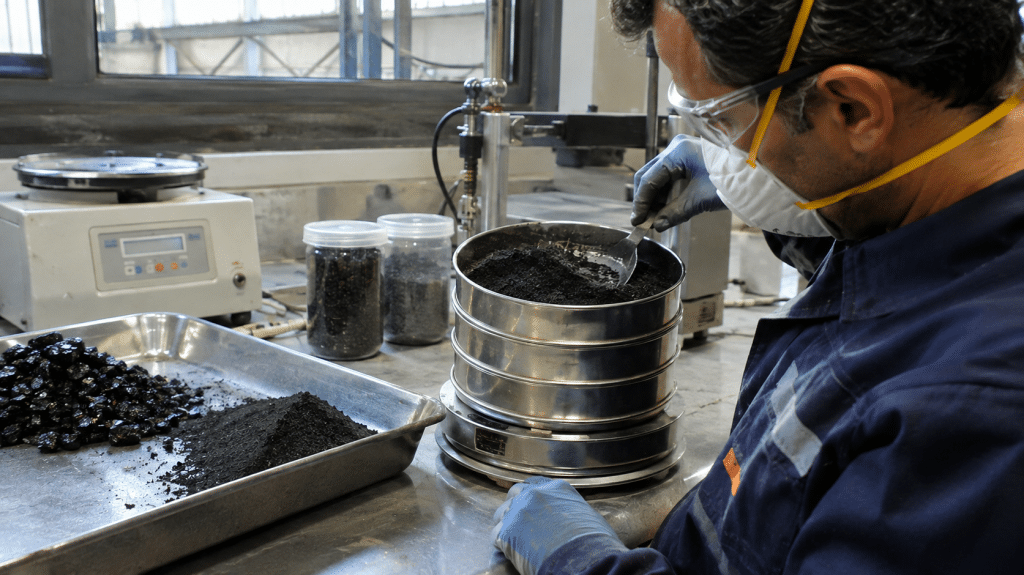
5. Industrial Applications of Pipe Coating Gilsonite
Pipe coating gilsonite serves several industries that manufacture bituminous protective materials. In particular, its physical properties make it suitable for selected pipeline coating and waterproofing compounds.
For example, pipe enamel producers may use gilsonite to improve hardness and heat resistance. Meanwhile, waterproofing manufacturers can use suitable grades to modify binder properties.
Furthermore, maintenance companies may require compatible bituminous materials for existing coating systems.
| Industrial Application | Primary Function |
|---|---|
| Oil Pipeline Coatings | Modification of protective compounds |
| Natural Gas Pipeline Coatings | Support for external protective layers |
| Underground Steel Pipes | Development of moisture barrier compounds |
| Water Transmission Pipes | Selected external coating applications |
| Pipe Coating Enamels | Hardness and softening point modification |
| Bituminous Primers | Modification of compatible binders |
| Pipe Wrapping Tapes | Improvement of selected adhesive properties |
| Pipeline Repair Mastics | Control of hardness and material flow |
| Waterproofing Membranes | Modification of bituminous mixtures |
| Foundation Waterproofing | Support for protective barrier materials |
| Bridge Deck Protection | Modification of suitable mastics |
| Roofing Compounds | Improvement of selected thermal properties |
| Industrial Metal Coatings | Development of protective compounds |
| Industrial Insulation | Modification of compatible protective mixtures |
However, different applications require different performance levels. Therefore, manufacturers should evaluate the intended use before selecting a particular grade.
For instance, pipeline repair materials may require a different balance of hardness and flexibility from roofing compounds.
Similarly, waterproofing membrane manufacturers may need different particle sizes because their production methods vary.
Moreover, product selection should reflect the project’s technical standards. For example, modern pipeline systems may require epoxy or multilayer polymer coatings instead of bituminous products.
Consequently, gilsonite does not suit every pipeline protection system.
For this reason, ATABAŞ GLOBAL reviews customer specifications and intended applications during the initial sourcing process.
6. Gilsonite in Oil, Gas and Water Pipeline Protection
Industrial pipelines often operate under demanding environmental conditions. In particular, buried steel pipes face prolonged exposure to soil, moisture and changing temperatures.
Therefore, engineers use suitable protective coating systems to reduce direct contact between the metal surface and its surrounding environment.
Gilsonite can contribute to selected bituminous coating mixtures. Moreover, its physical properties may help improve hardness and resistance to unwanted material flow.
Oil and Natural Gas Pipelines
Oil and gas pipeline projects require coating systems that match their operating conditions and technical standards.
For example, suitable bituminous compounds may contain gilsonite as a binder modifier. In addition, compatible repair mastics can support certain maintenance operations.
However, operating temperature, soil conditions and mechanical stress can affect coating performance. Therefore, engineers should evaluate the complete protective system rather than the additive alone.
Furthermore, existing pipelines may require repair materials that match the original protective coating. Consequently, material compatibility becomes especially important during maintenance work.
Water Transmission Pipelines
Water transmission infrastructure may also require protection for external steel surfaces. For instance, selected bituminous coatings can provide a barrier against moisture and soil exposure.
Moreover, gilsonite may support the physical properties of compatible external coating compounds.
In addition, suitable protective materials can help reduce direct exposure to environmental conditions.
Nevertheless, products intended for direct contact with drinking water require separate safety and regulatory checks.
For this reason, buyers must distinguish between external pipe protection and internal potable water applications.
- Application requirement: Gilsonite does not independently replace corrosion protection systems, cathodic protection or project-specific coating requirements.
7. Industrial Benefits and Performance Advantages
Manufacturers use natural asphaltite because it can modify several physical properties of suitable bituminous compounds.
For example, higher hardness may help reduce unwanted deformation. Similarly, an increase in softening point may support better thermal stability.
Furthermore, compatible mixtures may benefit from improved resistance to material flow. In addition, controlled particle size can support more consistent mixing.
| Potential Benefit | Industrial Contribution |
|---|---|
| Increased Hardness | Supports resistance to deformation |
| Higher Softening Point | Improves selected thermal properties |
| Reduced Material Flow | Supports dimensional stability |
| Low Water Absorption | Contributes to moisture barrier properties |
| Binder Compatibility | Allows use in suitable mixtures |
| Improved Coating Consistency | Supports controlled production |
| Adhesion Support | May improve bonding in compatible formulations |
| Raw Material Flexibility | Provides additional formulation options |
| Controlled Particle Size | Supports mixing efficiency |
However, increasing one property can affect another. For instance, a higher gilsonite content may increase hardness while reducing flexibility.
Therefore, manufacturers should establish a suitable balance between hardness, adhesion and flexibility.
Moreover, the correct dosage depends on the other materials within the mixture. As a result, manufacturers cannot apply the same formulation to every coating product.
In addition, the quality of surface preparation influences the performance of the finished coating. Consequently, even a high-quality raw material cannot correct every application defect.
Similarly, coating thickness and application conditions can affect long-term performance.
For this reason, laboratory trials and finished-product tests remain essential.
8. Pipe Coating Gilsonite Prices and Global Market Factors
Pipe coating gilsonite prices vary according to technical quality, processing requirements and international market conditions.
Unlike some widely traded commodities, coating-grade gilsonite does not have one universally applicable exchange price. Instead, suppliers generally prepare commercial offers according to the requested grade and delivery terms.
Moreover, two products with similar names may have different ash levels, softening points and particle sizes. Therefore, their prices may differ even when both suppliers describe them as coating-grade gilsonite.
Main Factors Affecting Coating-Grade Gilsonite Prices
| Pricing Factor | Effect on Product Cost |
|---|---|
| Ash Content | Lower mineral content may increase sourcing costs |
| Softening Point | Special temperature requirements can affect availability |
| Particle Size | Fine grinding may increase processing costs |
| Product Purity | Higher purity may require more selective sourcing |
| Moisture Content | Drying and storage requirements influence costs |
| Mineral Source | Extraction and raw material costs vary |
| Processing Method | Additional processing can increase production costs |
| Order Quantity | Larger orders may offer unit cost advantages |
| Packaging | Bags, Big Bags and pallets affect costs |
| Inspection | Additional quality checks may increase expenses |
| Inland Transport | Distance to the loading port affects costs |
| Ocean Freight | Shipping route and carrier rates influence final prices |
| Exchange Rates | Currency changes can affect commercial offers |
| Delivery Terms | Different Incoterms include different cost elements |
In addition, changes in energy and transport costs can affect international supply. As a result, quotations may have limited validity periods.
For example, a supplier may offer a competitive product price while the shipping route involves high freight costs. In contrast, another supply option may have a higher material price but a lower total delivered cost.
Similarly, larger orders may reduce certain unit costs because suppliers can distribute handling expenses across greater quantities.
However, larger purchases may also require additional storage capacity. Therefore, buyers should consider their actual production demand when selecting order quantities.
Consequently, industrial buyers should compare complete commercial offers rather than focus only on the price per metric ton.
Current Pipe Coating Gilsonite Prices
Current prices require a shipment-specific commercial assessment because product grades and logistics costs vary.
Furthermore, public customs values may include different natural asphalt products under the same HS code. Consequently, these figures cannot provide an exact market price for coating-grade gilsonite.
In addition, international freight rates may change between quotation and shipment dates. Therefore, buyers should confirm the validity period of each commercial offer.
ATABAŞ GLOBAL prepares individual quotations according to product quality, order volume, packaging and delivery location.
- Pricing information: Contact ATABAŞ GLOBAL for current FOB, FCA, CFR or CIF price quotations based on your actual purchasing requirements.
9. Pipe Coating Gilsonite Prices Compared with Other Grades
Different gilsonite grades have different processing requirements. Therefore, buyers should compare products according to their intended industrial use.
For example, raw lump gilsonite generally requires less grinding than fine powder. Meanwhile, micronized grades may require additional processing and tighter particle-size control.
Similarly, low-ash products may require more selective mineral sourcing. Consequently, these differences can influence the final purchase price.
Indicative Grade and Cost Comparison
| Gilsonite Grade | Processing Level | Indicative Relative Cost |
|---|---|---|
| Raw Lump Gilsonite | Basic preparation | Lower |
| Granular Gilsonite | Crushing and classification | Lower to medium |
| Standard Powder Gilsonite | Grinding and screening | Medium |
| Asphalt Modifier Grade | Application-specific preparation | Medium |
| Drilling Grade Gilsonite | Controlled technical properties | Specification-dependent |
| Pipe Coating Gilsonite | Controlled coating-grade properties | Medium to higher |
| Low-Ash Gilsonite | Selective sourcing and quality control | Generally higher |
| Micronized Gilsonite | Fine grinding and classification | Generally higher |
| Special Technical Grade | Customer-specific preparation | Specification-dependent |
This table shows general cost differences rather than verified market prices. However, actual price relationships may change depending on product availability and commercial conditions.
Moreover, lower-priced grades do not always provide the lowest production cost.
For instance, a manufacturer may need additional processing when a product has an unsuitable particle size. Similarly, excessive mineral residue may create difficulties within certain coating mixtures.
In addition, inconsistent material quality may increase the need for production adjustments. Consequently, these additional costs can reduce the initial purchasing advantage.
Therefore, the purchase price represents only one part of the total industrial cost.
For this reason, buyers should assess pipe coating gilsonite prices alongside material performance, processing costs and finished-product quality.
10. Calculating Pipe Coating Gilsonite Prices and Total Supply Costs
Industrial buyers often compare quotations on different delivery terms. However, an EXW offer and a CIF offer include different transport responsibilities.
Therefore, a direct comparison between their prices may produce misleading results.
The total procurement cost may include:
Product Price + Packaging + Inland Transport + Port Costs + Inspection + Ocean Freight + Insurance + Destination Costs
Moreover, the exact calculation depends on the agreed Incoterm and commercial contract.
FOB, CFR and CIF Gilsonite Prices
| Delivery Term | Commercial Scope |
|---|---|
| EXW | Product collection from the agreed premises |
| FCA | Delivery to the nominated carrier |
| FOB | Delivery on board the vessel at the loading port |
| CFR | Product and ocean freight to the destination port |
| CIF | Product, ocean freight and agreed marine insurance |
| CPT | Carriage paid to the named destination |
| CIP | Carriage and insurance paid to the named destination |
For example, a buyer who receives an FOB quotation must normally arrange the main ocean freight. In contrast, a CIF quotation includes the seller’s obligation to arrange ocean freight and insurance to the named destination port.
Nevertheless, the transfer of cargo risk does not always occur at the final destination. Therefore, buyers should understand the agreed Incoterm before confirming the order.
Furthermore, container shipments may suit FCA, CPT or CIP delivery terms. As a result, both parties should select the appropriate Incoterm according to the actual transport method.
Illustrative Cost Calculation
The following example demonstrates how different supply costs affect a commercial quotation. However, these figures are hypothetical and do not represent current market prices.
| Cost Component | Example Cost (USD/MT) |
|---|---|
| Packed Product at Warehouse | 400 |
| Inland Transportation | 25 |
| Export and Port Costs | 20 |
| Inspection Allocation | 5 |
| Ocean Freight | 65 |
| Marine Insurance | 3 |
| Illustrative CIF Cost | 518 |
For example, a change in freight rates would directly influence the final CIF cost. Similarly, different packaging options could affect both cargo weight and handling expenses.
In addition, buyers may need to calculate import duties, taxes and local delivery costs at the destination.
Consequently, the CIF price does not always represent the complete landed cost.
Moreover, comparing pipe coating gilsonite prices on the same delivery basis can improve purchasing decisions. Therefore, buyers should review the full cost structure before selecting a supply option.
Further information about international delivery terms is available from the International Chamber of Commerce.
11. Quality Control, Packaging and Safe Storage
Consistent quality plays an important role in industrial raw material supply because manufacturers need stable production conditions.
Therefore, buyers should establish clear technical limits before confirming a purchase.
For example, two grades may have similar softening points but different ash content. Similarly, differences in particle size may affect mixing and finished coating performance.
Quality Control Requirements
| Quality Check | Main Purpose |
|---|---|
| Ash Content Test | Verification of mineral residue |
| Moisture Test | Confirmation of water content |
| Softening Point Test | Assessment of thermal properties |
| Sieve Analysis | Verification of particle size |
| Solubility Test | Assessment of selected material properties |
| Visual Inspection | Review of appearance and contamination |
| Batch Identification | Product traceability |
| Weight Verification | Confirmation of shipment quantity |
| Independent Inspection | Contract-specific quality verification |
Furthermore, laboratory results should represent the actual production batch. Consequently, buyers should request current product analysis rather than rely only on general technical data.
In addition, independent inspection may provide further quality and quantity checks when the contract requires them.
For this reason, buyers and suppliers should agree on inspection methods before shipment.
Industrial Packaging Options
| Packaging Type | Typical Capacity | Main Advantage |
|---|---|---|
| Industrial Bags | 25 kg | Controlled dosing and smaller production batches |
| Big Bags | 1,000 kg | High-volume industrial handling |
| Palletized Bags | According to loading plan | Easier storage and transport |
| Customized Packaging | As agreed | Customer-specific requirements |
In addition, proper packaging helps protect fine powder against moisture and contamination. Moreover, clear batch labels support warehouse control and product traceability.
For example, smaller bags may suit controlled production batches. In contrast, Big Bags may offer a practical solution for high-volume manufacturing facilities.
Furthermore, packaging choices influence container loading and warehouse handling. Therefore, industrial buyers should select suitable packaging according to their equipment and storage capacity.
Safe Storage and Handling
Fine gilsonite powder can create combustible dust hazards under certain conditions. Therefore, companies should follow the product-specific Safety Data Sheet and relevant workplace safety requirements.
Similarly, suitable ventilation, dust control and proper storage can help reduce handling risks.
In addition, companies should protect packaging from moisture and physical damage. Consequently, suitable storage conditions help maintain product quality before industrial use.
For further occupational safety information, visit OSHA – Combustible Dust.
- Safety requirement: Industrial users must follow the actual product SDS when handling, storing or processing powdered gilsonite.
12. Bulk Gilsonite Prices and International Supply with ATABAŞ GLOBAL
Purchasing industrial gilsonite requires more than finding a competitive supplier. Instead, buyers need suitable technical quality, reliable documentation, flexible shipment planning and consistent supply.
Therefore, ATABAŞ GLOBAL develops commercial solutions according to the customer’s specific purchasing requirements.
First, we evaluate the requested grade and intended application. Next, we review product availability, order quantity and packaging preferences.
Furthermore, we assess international transport options according to the destination and delivery schedule. Finally, we prepare commercial quotations based on the agreed product and logistics requirements.
International Supply and Delivery Services
ATABAŞ GLOBAL coordinates international shipments through Mersin, İzmir, Gebze and İstanbul port regions.
Moreover, we work with established international shipping companies such as CMA CGM, Maersk, MSC and Hapag-Lloyd.
In addition, our professional customs brokerage partners support export documentation and customs procedures.
As a result, we can evaluate suitable shipping options for both individual orders and long-term industrial supply programs.
However, delivery periods depend on product availability, cargo readiness and carrier schedules. Therefore, we review each order individually and plan flexible shipment periods according to customer needs.
For example, buyers with urgent requirements may prefer the earliest suitable vessel schedule. Meanwhile, customers with regular monthly demand may require a more structured supply program.
Furthermore, alternative loading ports can provide additional shipping options. Consequently, our logistics planning considers both delivery deadlines and overall transport costs.
How to Request Pipe Coating Gilsonite Prices
A detailed Request for Quotation helps us evaluate pipe coating gilsonite prices more accurately because product specifications and delivery conditions directly affect commercial costs.
For this reason, industrial buyers should provide the following information whenever possible:
| Required Information | Description |
|---|---|
| Product Grade | Required gilsonite type |
| Intended Application | Pipe coatings or other industrial uses |
| Ash Content | Maximum acceptable percentage |
| Softening Point | Required temperature range |
| Moisture Content | Maximum acceptable percentage |
| Particle Size | Required mesh or micron grade |
| Technical Specification | Required quality limits |
| Order Quantity | Total requirement in metric tons |
| Monthly Demand | Recurring supply requirements |
| Packaging | Industrial bags or Big Bags |
| Destination | Country and delivery port |
| Delivery Terms | Requested Incoterm |
| Delivery Schedule | Target shipment period |
| Inspection | Required quality control procedures |
| Documentation | Required technical and commercial documents |
Furthermore, reference samples and detailed specifications can support a more accurate product assessment. Consequently, both parties can identify suitable grades before completing commercial negotiations.
In addition, early communication about delivery requirements helps us evaluate available shipping routes.
Moreover, ATABAŞ GLOBAL follows applicable international trade restrictions and sanctions requirements. Accordingly, we review product origins, trading partners and transport arrangements before confirming transactions.
For this reason, our international supply approach combines technical suitability, commercial planning and professional logistics coordination.
For current pipe coating gilsonite prices, technical specifications, bulk purchasing opportunities and international delivery solutions, contact ATABAŞ GLOBAL.
13. Frequently Asked Questions About Pipe Coating Gilsonite Prices and Applications
Product Properties and Industrial Use
What is pipe coating gilsonite?
Pipe coating gilsonite is a natural asphaltite that manufacturers use to modify selected bituminous protective compounds. In particular, it can help improve hardness, softening point and resistance to unwanted material flow.
What are the main applications of coating-grade gilsonite?
Manufacturers use suitable grades in pipe enamels, protective mastics, primers, insulation tapes and waterproofing products. Moreover, some compatible industrial coating mixtures can benefit from its physical properties.
Is gilsonite the same as petroleum bitumen?
No, because gilsonite comes from natural mineral deposits, whereas conventional petroleum bitumen generally comes from crude oil refining. Therefore, their physical properties and production methods differ.
Does gilsonite improve the heat resistance of pipe coatings?
Suitable grades can increase the softening point of compatible bituminous mixtures. However, the final thermal performance depends on the complete coating system. Consequently, manufacturers should verify the finished product through appropriate tests.
How much gilsonite should manufacturers add to a coating mixture?
Some coating formulations use approximately 5–25% gilsonite. Nevertheless, the correct addition rate depends on the binder, technical requirements and finished-product performance. Therefore, laboratory trials should determine the final formulation.
Gilsonite Prices and Commercial Purchasing
What are the current pipe coating gilsonite prices?
Current prices depend on ash content, softening point, particle size, order quantity and delivery terms. In addition, packaging and freight costs influence the final quotation. Therefore, buyers should request a current commercial offer.
Why are low-ash gilsonite grades generally more expensive?
Low-ash grades may require more selective sourcing and tighter quality control. Moreover, processing requirements can increase production costs. As a result, these grades may have a higher commercial value.
Does particle size affect gilsonite prices?
Yes, because finer grades may require additional grinding and classification. Furthermore, specific particle-size limits can influence production costs and product availability.
What is the minimum order quantity for gilsonite?
There is no universal minimum order quantity because commercial conditions vary. Instead, the practical purchase volume depends on product availability, packaging, transport costs and commercial conditions.
Supply, Quality Control and Delivery
Can buyers request gilsonite samples before placing an order?
Sample arrangements depend on product availability and commercial conditions. Nevertheless, sample testing provides a useful way to evaluate binder compatibility. As a result, buyers can assess product suitability before large-scale purchases.
Can ATABAŞ GLOBAL arrange independent inspections?
We can coordinate independent quality and quantity checks according to the agreed commercial terms. In addition, customers can request relevant laboratory results and technical documentation.
Which documents should gilsonite buyers request?
In particular, buyers should request a Technical Data Sheet, Certificate of Analysis and Safety Data Sheet. Moreover, international shipments may require additional customs and transport documents.
Can ATABAŞ GLOBAL supply gilsonite regularly?
We evaluate recurring supply programs according to monthly demand, product availability and shipping schedules. Furthermore, flexible shipment planning can help customers manage their industrial raw material requirements. Consequently, each supply program reflects the customer’s specific needs.
How can buyers obtain a current price quotation?
First, provide the required product grade and technical specification. Next, confirm the order quantity, packaging and delivery destination. Finally, ATABAŞ GLOBAL can assess pipe coating gilsonite prices and prepare a suitable commercial offer.
