

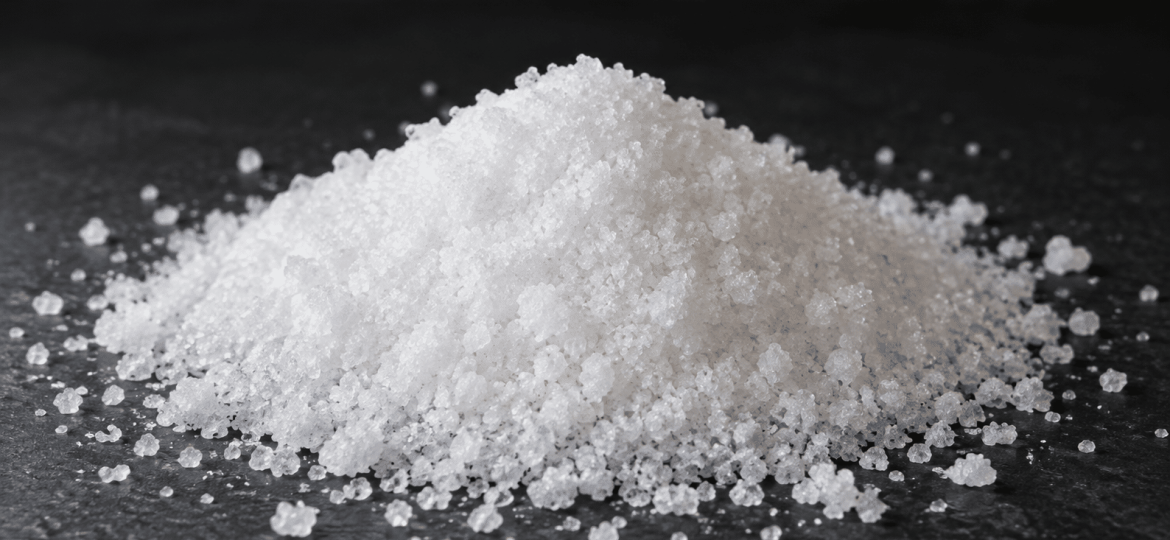
Ammonium sulfate is an important inorganic salt used mainly in agriculture and chemical production. It provides both nitrogen and sulfur, which makes it especially valuable as a fertilizer raw material.
The product usually appears as a white or light-colored crystalline solid. In addition, it dissolves readily in water. Commercial fertilizer grades commonly provide about 21% nitrogen and 24% sulfur.
Agriculture represents its main market. However, the material also serves several industrial processes, including chemical production, fermentation, water treatment, textile processing, and other technical applications.
Because product quality can differ by producer and grade, buyers should review nutrient content, moisture, acidity, particle size, physical form, and technical documents before ordering.
1. What Is Ammonium Sulfate?
Ammonium sulfate is an inorganic salt with the chemical formula (NH4)2SO4. It consists of ammonium and sulfate ions and has a molecular weight of about 132.14 g/mol.
The material normally appears as a white, odorless solid and dissolves well in water. Its CAS Registry Number is 7783-20-2.
In agriculture, the product provides two important plant nutrients. Nitrogen supports plant growth, while sulfur plays an important role in plant nutrition and protein formation.
Moreover, the product can help meet sulfur needs in soils where this nutrient is limited. For this reason, it has become an important fertilizer source in many agricultural markets.
2. Main Properties of Ammonium Sulfate
The product combines useful chemical and physical properties with a high nutrient value.
Commercial fertilizer grades generally contain around 21% nitrogen and 24% sulfur. The nitrogen occurs in ammonium form, while sulfur occurs in sulfate form.
In addition, the material has good water solubility. Therefore, plants can access its nutrients after the product dissolves under suitable soil conditions.
Its physical form can vary by grade. For example, suppliers may offer crystalline, granular, standard, or fine products.
| Property | General Information |
|---|---|
| Chemical Formula | (NH4)2SO4 |
| CAS Number | 7783-20-2 |
| Molecular Weight | 132.14 g/mol |
| Typical Appearance | White to light-colored crystalline or granular solid |
| Nitrogen (N) | About 21% in common fertilizer grades |
| Sulfur (S) | About 24% in common fertilizer grades |
| Water Solubility | High |
| Common Forms | Crystalline / granular / fine |
| Main Market | Fertilizer and agriculture |
Exact properties depend on the producer and commercial grade. Therefore, buyers should use the supplier’s current technical documents for final approval.
3. Technical Specifications
Commercial specifications can change according to production route, grade, particle size, and intended use.
For example, FAO fertilizer specifications set minimum total nitrogen at 20% on a dry basis and minimum sulfur at 23%, while a commercial crystalline grade from UBE specifies at least 21% nitrogen and 24% sulfur. This difference shows why buyers should not treat one specification as universal.
A representative fertilizer-grade specification is shown below:
| Parameter | Representative Specification |
|---|---|
| Nitrogen (N) | 21% min. |
| Total Sulfur (S) | 24% min. |
| Water | 0.3% max. |
| Free Acidity as H2SO4 | 0.05% max. |
| Color | White |
| Physical Form | Crystalline solid |
| Particle Size >0.5 mm | 75% min. |
| Particle Size ≤0.25 mm | 5% max. |
These figures represent a commercial crystalline specification and should not be treated as a universal standard. Therefore, buyers should always compare the Technical Data Sheet (TDS) and batch Certificate of Analysis (CoA) with their own requirements.
4. How Is Ammonium Sulfate Produced?
Manufacturers can produce the material through several industrial routes.
One direct method uses a reaction between ammonia and sulfuric acid. After the reaction, producers control crystallization to obtain the required solid product.
In addition, several chemical processes generate the material as a co-product. Production linked to caprolactam and other chemical intermediates can create commercial volumes.
The production route may influence color, particle form, moisture, acidity, and other quality factors. Therefore, industrial buyers should evaluate the actual specification instead of selecting a product only by its chemical name.
After production, manufacturers may use crystallization, drying, screening, granulation, or other finishing steps. As a result, the market offers products with different particle sizes and handling properties.
5. What Is Ammonium Sulfate Used For?
Agriculture is the largest application area. However, the product also has several technical and industrial uses.
| Application Area | Typical Function |
|---|---|
| Agriculture | Nitrogen and sulfur fertilizer |
| Fertilizer Blending | Raw material for fertilizer mixtures |
| Chemical Manufacturing | Process material or chemical intermediate |
| Fermentation | Nutrient source in suitable processes |
| Water Treatment | Process chemical in selected applications |
| Textile Processing | Process additive in selected systems |
| Paper Industry | Used in selected processing applications |
| Flame-Retardant Systems | Component in selected formulations |
| Laboratory Processes | Reagent and protein fractionation applications |
| Food Processing | Processing or fermentation aid when the correct approved grade is used |
The required quality can differ greatly between these applications. Therefore, an agricultural or technical grade should not automatically be considered suitable for food, pharmaceutical, or other regulated uses.
6. Use as a Nitrogen and Sulfur Fertilizer
Fertilizer use represents the main commercial application.
A common fertilizer grade provides approximately 21% nitrogen and 24% sulfur. Therefore, growers can supply two important nutrients through one dry fertilizer product.
The nitrogen comes in ammonium form. Meanwhile, sulfur comes in sulfate form, which provides a plant-available sulfur source.
This nutrient combination can be useful where crops need both nitrogen and sulfur. In addition, the fertilizer has an acidifying effect on soil over time. As a result, it can be useful in selected alkaline or high-pH soil conditions.
However, fertilizer programs should not rely on a general rule alone. Soil conditions, crop type, climate, nutrient needs, and application method all affect the correct fertilizer plan.
For this reason, growers should base application rates on soil or plant analysis and local agronomic advice.
7. Use in Fertilizer Blends
The product also works as a raw material in fertilizer production and bulk blending.
Because it supplies both nitrogen and sulfur, manufacturers can combine it with other fertilizer materials to build specific nutrient programs.
Granule size becomes especially important in dry blends. If components have very different particle sizes, segregation can occur during transport and application.
Therefore, buyers often check particle size distribution, moisture, product strength, and flow properties when selecting material for blending.
In addition, low moisture and good physical condition can support easier storage and handling.

8. Industrial and Technical Applications
Although agriculture dominates demand, the material also serves several industrial markets.
For example, chemical producers can use it in the manufacture of other compounds and as a process material. It also has uses in fermentation, water treatment, textile processing, paper-related processes, and selected flame-retardant systems.
Laboratories also use the salt in protein fractionation and other technical processes.
In addition, some regulated food applications use approved grades as processing or fermentation aids. However, these applications require the correct quality standard and regulatory status.
Therefore, buyers should clearly state the intended use when requesting a quotation. This step helps suppliers identify the correct grade and documentation.
9. Leading Ammonium Sulfate Import Markets
International trade is significant because agricultural demand and production capacity vary widely between regions.
According to World Bank WITS data for HS 310221, the leading reported import markets by trade value in 2024 included Brazil, the United States, Indonesia, Turkey, and Malaysia.
| Rank | Importing Country | 2024 Import Value | Reported Quantity |
|---|---|---|---|
| 1 | Brazil | US$1.082 billion | — |
| 2 | United States | US$359.97 million | 1.073 million tonnes |
| 3 | Indonesia | US$171.06 million | 1.099 million tonnes |
| 4 | Turkey | US$150.72 million | — |
| 5 | Malaysia | US$133.02 million | 879,926 tonnes |
The table uses reported gross import values under HS 310221. Missing quantity figures are shown as “—” rather than estimated.
Brazil clearly led the reported import market by value in 2024. Meanwhile, the United States and Indonesia also recorded large trade flows. Turkey ranked among the major importing countries as well.
Trade patterns can change from year to year. Therefore, buyers should use current customs data when making market or sourcing decisions.
10. Leading Exporting Countries
Production capacity is also concentrated in several major exporting markets.
World Bank WITS data show that China dominated global exports under HS 310221 in 2024. Belgium, Canada, the United States, and the Netherlands were also major country-level exporters.
| Rank | Exporting Country | 2024 Export Value | Reported Quantity |
|---|---|---|---|
| 1 | China | US$2.544 billion | 17.124 million tonnes |
| 2 | Belgium | US$226.74 million | 1.130 million tonnes |
| 3 | Canada | US$151.23 million | 409,121 tonnes |
| 4 | United States | US$96.18 million | 470,011 tonnes |
| 5 | Netherlands | US$62.38 million | 382,344 tonnes |
The European Union also reported exports of about US$288.31 million. However, it is an aggregate reporting economy rather than a single country. Therefore, the table excludes the EU total to avoid mixing an economic bloc with individual countries.
China’s position was especially strong. In fact, its reported 2024 exports reached more than 17 million tonnes.
Moreover, China shipped large volumes to markets such as Brazil, Myanmar, Indonesia, Vietnam, and Turkey. This trade structure highlights the strong link between large-scale production and fertilizer demand across agricultural markets.
11. Turkey’s Role in the Market
Turkey represents an important regional import market.
In 2024, Turkey reported imports worth approximately US$150.72 million under HS 310221. China supplied the largest share, with about US$121.82 million and more than 714,000 tonnes.
Belgium followed with approximately US$12.66 million. Spain, Italy, and Russia were also among Turkey’s main suppliers.
| Main Supplier to Turkey | 2024 Import Value | Reported Quantity |
|---|---|---|
| China | US$121.82 million | 714,043 tonnes |
| Belgium | US$12.66 million | 69,036 tonnes |
| Spain | US$6.35 million | 31,280 tonnes |
| Italy | US$3.97 million | 23,605 tonnes |
| Russia | US$2.38 million | 13,509 tonnes |
Therefore, supplier origin, freight conditions, seasonal demand, port access, and delivery planning can all influence purchasing decisions in the Turkish market.
12. How to Check Product Quality
A low purchase price does not always mean a better buying decision.
First, buyers should check nitrogen and sulfur content. Next, they should review moisture, free acidity, particle size, appearance, and physical condition.
Particle size is particularly important for fertilizer blending and spreading. Meanwhile, excessive moisture may affect storage and flow.
Buyers should also request the TDS, SDS, and CoA. In addition, regulated applications may require further quality or compliance documents.
Production route and grade can also matter. Therefore, purchasing teams should define their technical requirements before comparing offers from different suppliers.
13. Storage, Handling and Safety
Good storage protects product quality and supports safe handling.
Companies should keep the material in a dry area and protect it from moisture and contamination. In addition, packaging should remain closed and in good condition during storage.
Bulk and bagged products may require different handling systems. Therefore, companies should select equipment according to particle form, packaging, and delivery method.
Workers should follow the current Safety Data Sheet (SDS) and use suitable workplace controls and personal protective equipment where required.
Finally, companies should follow local rules for storage, transport, labeling, environmental protection, and occupational safety.
14. How to Buy Ammonium Sulfate Safely
Industrial purchasing should begin with the required specification rather than price alone.
First, buyers should define the intended use and required grade. Then, they should compare nitrogen and sulfur content, moisture, acidity, particle size, packaging, origin, and product documents.
Commercial factors are also important. For example, buyers should review availability, minimum order quantity, delivery time, Incoterms, freight costs, payment terms, and supply continuity.
For international orders, logistics can have a major effect on the final cost. Therefore, procurement teams should evaluate both product price and total delivered cost.
Reliable documentation also reduces purchasing risk. A clear TDS, SDS, CoA, and shipping document set can support a smoother procurement process.
Atabaş supports industrial buyers by bringing product requirements, supply conditions, documentation, commercial terms, and logistics needs together in a well-managed purchasing process.
For companies that value secure sourcing and professional supply management, Atabaş offers a reliable choice for Ammonium sulfate procurement.
