

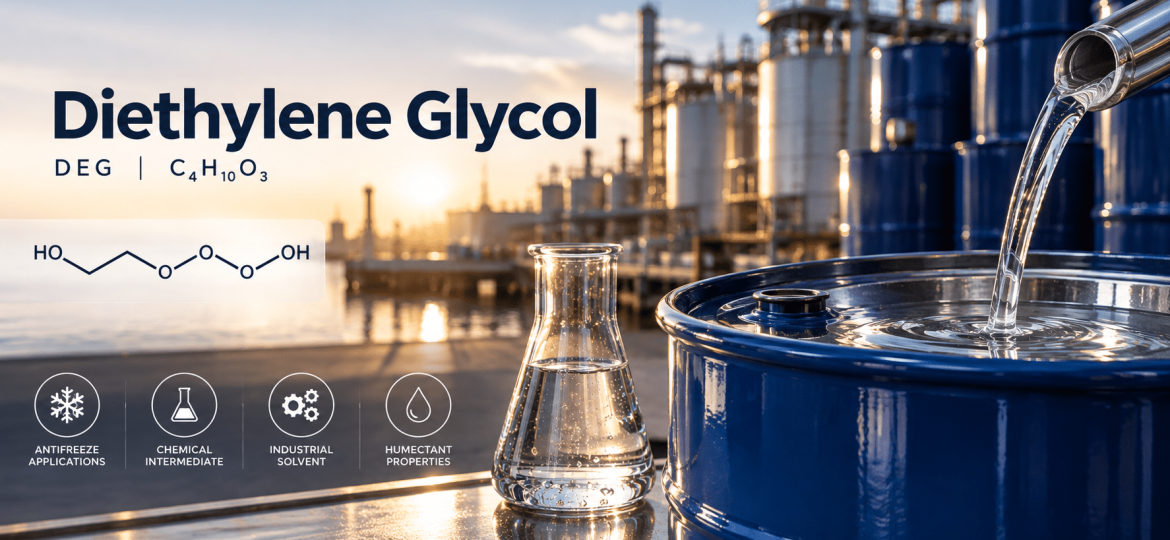
Diethylene Glycol is an important raw material for many industrial applications. Manufacturers use it in resins, coatings, adhesives, printing inks, plasticizers, textile processing, and other chemical production processes.
Its chemical formula is C4H10O3, and the industry often calls it DEG, Diglycol, or 2,2′-Oxydiethanol. It is usually available as a clear and colorless liquid.
Its wide range of applications makes this product important in international chemical trade. However, technical requirements can change according to the application. Purity, water content, color, and other properties can affect production performance.
For this reason, companies should evaluate technical specifications, product documents, origin, and supply conditions before purchasing.
1. What Is Diethylene Glycol?
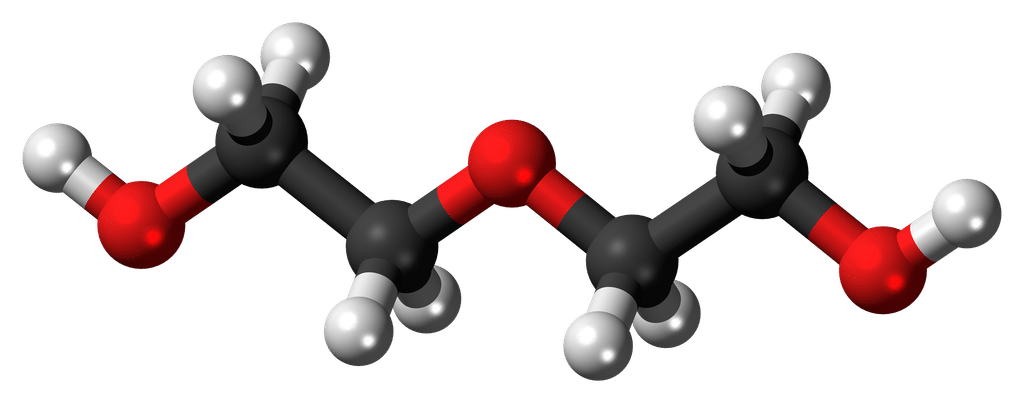
Diethylene Glycol is an organic compound from the glycol family. It contains hydroxyl groups and an ether group in its molecular structure. Its molecular formula is C4H10O3, while its molar mass is approximately 106.12 g/mol.
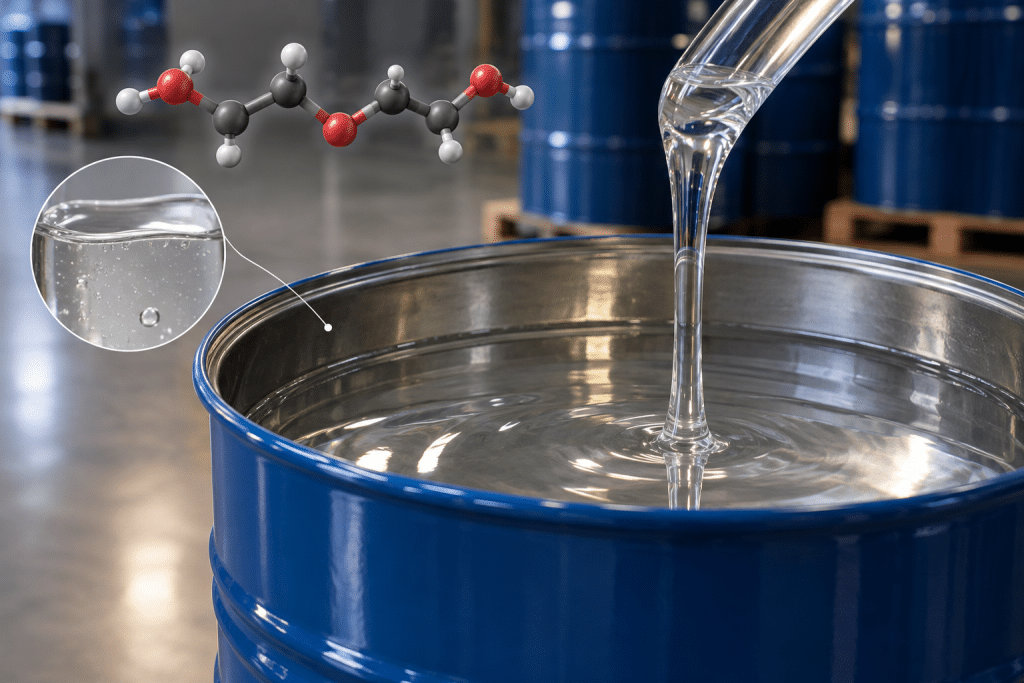
The product generally appears as a clear and colorless liquid. It is also hygroscopic, which means that it can absorb moisture from the surrounding environment.
DEG mixes well with water and many polar organic compounds. In addition, its relatively high boiling point makes it useful in several industrial processes.
These properties allow manufacturers to use the material both as a chemical intermediate and as a formulation component.
2. Main Properties of Diethylene Glycol
Chemical composition alone does not determine whether a product is suitable for an industrial process. Physical properties and product quality also matter.
Purity can affect the performance of the final formulation. Likewise, water content can influence processes that require controlled moisture levels.
Color, acidity, density, and impurities can also become important depending on the application.
Therefore, industrial buyers should compare the product specification with their own production requirements before placing an order.
3. Diethylene Glycol Technical Specifications
Technical specifications can change according to the manufacturer, production site, and grade. Therefore, buyers should always check the current Technical Data Sheet and Certificate of Analysis.
A typical commercial specification may include the following values:
| Property | Typical Specification |
|---|---|
| Product Name | Diethylene Glycol |
| Abbreviation | DEG |
| CAS Number | 111-46-6 |
| HS Code | 290941 |
| Molecular Formula | C4H10O3 |
| Molecular Weight | 106.12 g/mol |
| Appearance | Clear, colorless liquid |
| Purity | Min. 99.5% |
| Water Content | Max. 0.20% |
| Color | Max. 20 APHA |
| Ash | Max. 0.005% |
| Acidity as Acetic Acid | Max. 0.005% |
| Density at 25°C | Approx. 1.115–1.120 g/cm³ |
| Distillation Range | Approx. 240–250°C |
| Physical Form | Liquid |
These figures provide a general reference for commercial material. However, companies should use the supplier’s current specification and batch Certificate of Analysis when making purchasing decisions.
4. How Do Manufacturers Produce Diethylene Glycol?
Manufacturers generally obtain DEG during ethylene glycol production.
The process starts with ethylene oxide and water. Their reaction can produce several glycol products, including Monoethylene Glycol, Diethylene Glycol, and Triethylene Glycol.
Producers then separate these materials through suitable industrial processes.
Production conditions can influence product purity and other technical features. Therefore, commercial grades may show small differences between manufacturers.
For industrial buyers, consistent production quality is especially important. Stable raw material properties help companies maintain predictable manufacturing conditions.
5. What Is Diethylene Glycol Used For?
Many industries use DEG because of its solvent properties, chemical structure, and ability to control moisture.
Its applications include resin production, coatings, printing inks, adhesives, plasticizers, textile processing, paper processing, and selected chemical formulations.
The following table summarizes several common industrial applications:
| Industry | Main Application |
|---|---|
| Polyester Resins | Chemical intermediate and raw material |
| Paints and Coatings | Solvent and formulation component |
| Printing Inks | Solvent and moisture control |
| Adhesives | Formulation component |
| Plasticizers | Chemical intermediate |
| Textile Industry | Processing and moisture control |
| Paper Industry | Humectant and processing aid |
| Leather Industry | Processing component |
| Chemical Manufacturing | Intermediate for downstream products |
| Gas Treatment | Selected dehydration applications |
Each industry has different technical requirements. Therefore, companies should choose the product according to the application rather than only by price.
6. Use in Polyester Resin Production
The resin industry represents an important application area for DEG.
Its molecular structure allows manufacturers to use it as a chemical intermediate in selected polyester systems. In these processes, the material can become part of the final polymer structure.
However, resin performance depends on the complete formulation. Raw material ratios, processing conditions, temperature, and other components can influence the final result.
For this reason, manufacturers should evaluate the selected grade under their actual production conditions.
7. Use in Paints, Coatings, and Printing Inks
Paint, coating, and ink manufacturers use different solvents and formulation components to control product performance.
DEG can serve as a solvent or processing component in suitable formulations. Its relatively low volatility compared with lighter solvents can also provide advantages in selected processes.
In printing inks, moisture control and solvent behavior may affect processing performance.
Still, manufacturers should consider the complete formulation. Compatibility with resins, pigments, additives, and other raw materials remains important.
8. Use in Adhesives and Plasticizers
Adhesive manufacturers can use glycol-based raw materials in selected formulations. Their role depends on the chemistry and performance requirements of the final adhesive.
DEG can also serve as an intermediate in the production of certain plasticizers and downstream chemicals.
These applications show why the product has value beyond its direct solvent properties. Manufacturers can use its chemical structure to produce other industrial materials.
Therefore, buyers should select the appropriate grade according to both the production process and final product requirements.
9. Global Diethylene Glycol Import Markets
International trade plays an important role in the global supply of DEG.
According to 2024 international trade data under HS Code 290941, China was the largest reported country importer by value. The United States, Germany, and Italy also represented important markets.
| Major Import Market | 2024 Import Value | Reported Quantity |
|---|---|---|
| China | USD 275.25 million | 437.08 million kg |
| United States | USD 91.57 million | 139.75 million kg |
| Germany | USD 86.59 million | 99.34 million kg |
| Italy | USD 77.87 million | 93.68 million kg |
| Turkey | USD 57.74 million | Approx. 77 million kg |
Import demand can change according to industrial production, local capacity, prices, freight costs, and downstream market conditions.
For this reason, companies should evaluate both trade statistics and current market conditions when planning international purchases.
10. Leading Diethylene Glycol Exporting Countries
Production capacity and access to petrochemical raw materials play an important role in international DEG supply.
In 2024, the United States, Canada, Belgium, Saudi Arabia, and China ranked among the important reported exporters under HS Code 290941.
| Major Exporting Country | 2024 Export Value | Reported Quantity |
|---|---|---|
| United States | USD 120.12 million | 155.48 million kg |
| Canada | USD 97.43 million | 148.61 million kg |
| Belgium | USD 80.79 million | 89.84 million kg |
| Saudi Arabia | USD 71.15 million | 141.44 million kg |
| China | USD 34.01 million | 35.44 million kg |
Export value alone does not determine the best supply source. Product quality, freight costs, delivery times, packaging, and commercial terms also influence purchasing decisions.
Therefore, international buyers should evaluate the complete supply conditions before choosing a source.
11. Turkey’s Role in the Diethylene Glycol Market
Turkey has a strong manufacturing base in plastics, resins, coatings, textiles, chemicals, and other industrial sectors. As a result, the country imports significant quantities of glycol-based raw materials.
In 2024, Turkey reported approximately USD 57.74 million in imports under HS Code 290941.
The main reported supply sources included the United States, Iran, and Saudi Arabia.
| Supply Country | 2024 Import Value to Turkey |
|---|---|
| United States | USD 19.44 million |
| Iran | USD 19.24 million |
| Saudi Arabia | USD 15.27 million |
| Russia | USD 1.90 million |
| Other Asia, nes | USD 1.13 million |
Turkey’s location also provides access to markets in Europe, the Middle East, North Africa, Central Asia, and the Balkans.
Therefore, the country can serve both as an industrial consumption market and as a regional distribution point for chemical raw materials.
12. How to Check Diethylene Glycol Quality
Industrial buyers should review several technical properties before purchasing.
Purity is one of the main factors. However, water content, color, acidity, density, and impurities can also influence production.
Batch consistency becomes especially important for companies that operate continuous production lines. Changes in raw material properties may affect processing conditions and final product quality.
Buyers should therefore review the Technical Data Sheet (TDS) and Safety Data Sheet (SDS). They should also request a Certificate of Analysis (CoA) when necessary.
These documents help purchasing and technical teams compare the product with their own requirements.
13. Storage, Handling, and Safety
Proper storage helps maintain product quality.
Because DEG can absorb moisture, companies should keep containers properly closed and protect the material from unnecessary exposure to atmospheric humidity.
Companies should also use suitable storage systems and follow the current Safety Data Sheet. Workers should use appropriate personal protective equipment according to the workplace risk assessment.
Ingestion can cause serious health effects. Therefore, companies must prevent accidental consumption and uncontrolled exposure.
Local regulations may set additional requirements for storage, labeling, handling, and transport. Buyers and users should always follow the latest supplier information and applicable regulations.
14. How to Buy Diethylene Glycol Safely
Companies should consider more than price when buying Diethylene Glycol. A reliable purchasing process starts with clear technical requirements.
Buyers should check purity, water content, origin, manufacturer information, packaging, supply capacity, product documents, and delivery conditions.
International buyers should also evaluate Incoterms, freight costs, customs requirements, lead times, and required trade documents.
Clear communication between the supplier and buyer can reduce purchasing risks and help prevent delivery problems.
For safe and reliable sourcing, you can choose Atabaş. Atabaş supports industrial buyers by bringing product requirements, supply conditions, documentation, international trade, and logistics needs together in a professionally managed purchasing process.
15. Why Is Diethylene Glycol Important for Industry?
Diethylene Glycol has an important place in modern industry because it supports several manufacturing sectors.
Manufacturers use it in resins, coatings, inks, adhesives, plasticizers, textiles, paper processing, and other chemical applications. Its chemical structure, solvent properties, and moisture-control characteristics support this wide range of uses.
Global trade also shows strong industrial demand. Major importing and exporting countries connect producers with manufacturers across Asia, Europe, North America, and the Middle East.
Still, successful use starts with the right product selection. Companies should evaluate specifications, product documents, origin, packaging, and supply stability before making a purchase.
A strong supply process is equally important. Reliable sourcing, clear specifications, correct documentation, and well-planned logistics can help companies maintain production continuity.
For businesses that value secure sourcing and professional supply management, Atabaş offers a reliable choice for Diethylene Glycol procurement.
