

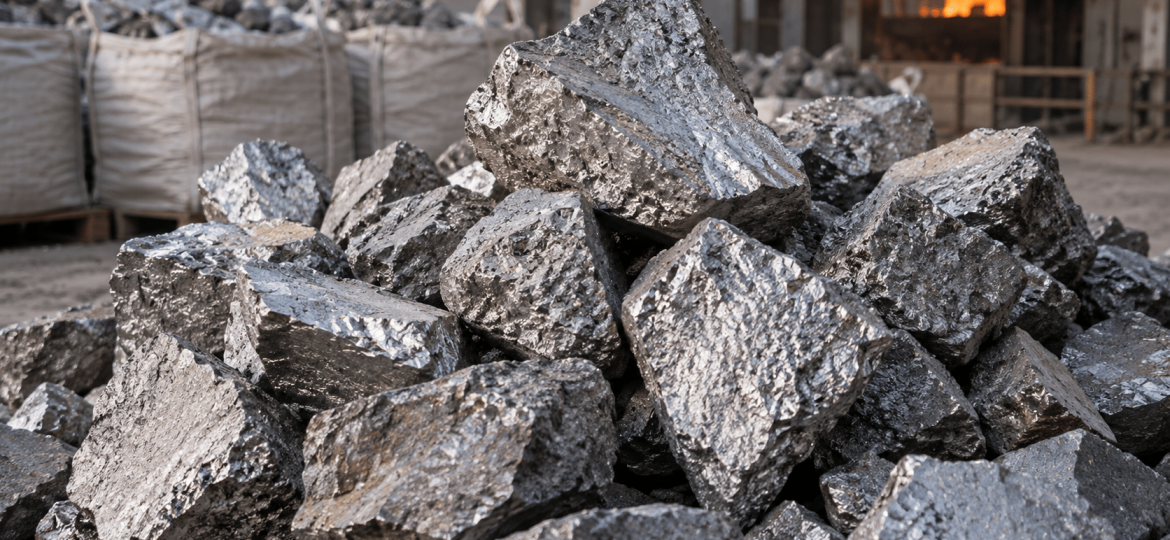
Ferro Aluminium is an iron-aluminium alloy mainly used in steelmaking, foundries and other metallurgical processes. The alloy combines aluminium’s strong affinity for oxygen with the density and handling advantages of an iron-based material. Therefore, steel producers commonly use it when they need controlled aluminium addition and efficient deoxidation.
The aluminium content can vary according to the required grade. For example, commercial products include FeAl30, FeAl35, FeAl50 and higher-aluminium grades. As a result, buyers can select a composition that matches their production process.
Atabas Global supplies ferroalloys and metallurgical raw materials for international industrial requirements. Chemical composition, sizing, packaging and commercial terms can be evaluated according to customer specifications and destination markets.
What Is Ferro Aluminium?
Ferro Aluminium, often referred to as FeAl or ferroaluminum, consists mainly of iron and aluminium. Producers manufacture different grades by adjusting the aluminium-to-iron ratio and controlling unwanted elements.
The alloy has an important role in steel production because aluminium has a strong affinity for oxygen. As a result, it can remove dissolved oxygen from molten steel and support the production of clean, controlled steel grades.
Moreover, its iron content gives the material different physical characteristics from pure aluminium. In particular, some grades have a higher density than pure aluminium. This property can improve penetration into molten steel and help distribute aluminium more effectively.
However, no single composition applies to every industrial process. Therefore, buyers should define the required aluminium content, impurity limits, particle size and physical form before placing an order.
Ferro Aluminium Chemical Composition and Specifications
Commercial specifications vary between manufacturers and end-use requirements. The following table provides representative grades commonly available in the market.
| Parameter | FeAl30 | FeAl35 | FeAl50 | FeAl70 |
|---|---|---|---|---|
| Aluminium (Al) | ≥30% | ≥35% | Approx. 50–60%* | ≥70% |
| Carbon (C) | ≤0.50% | ≤0.50% | ≤0.80%* | ≤0.30% |
| Silicon (Si) | ≤0.50% | ≤0.50% | ≤0.30–1.00%* | ≤1.00% |
| Manganese (Mn) | ≤0.70% | ≤0.70% | As agreed | ≤1.00% |
| Copper (Cu) | ≤0.30% | ≤0.30% | As agreed | ≤0.50% |
| Sulfur (S) | According to grade | According to grade | ≤0.05%* | According to specification |
| Phosphorus (P) | According to grade | According to grade | ≤0.05%* | According to specification |
| Iron (Fe) | Balance | Balance | Balance | Balance |
*FeAl50 specifications can vary by producer. Commercial FeAl50 grades may use approximately 47–53% or 50–60% aluminium depending on the agreed product standard.
These values should serve as commercial reference points rather than one universal standard. Consequently, customers should confirm the final chemical analysis with the supplier before purchasing.
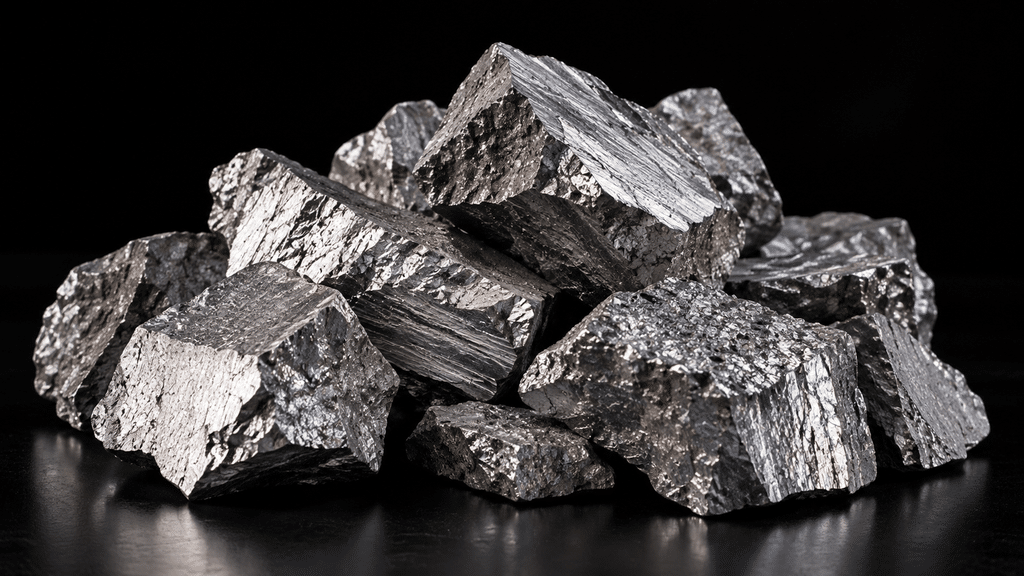
Physical form also matters. Depending on the application, suppliers can provide the material as lumps, piglets, granules or powder. Particle size should match the customer’s furnace, feeding system and addition method.
Key Properties of Ferro Aluminium
The alloy combines the properties of iron and aluminium in a form suitable for industrial metallurgical processes.
Its main characteristics include:
- strong deoxidation capability;
- controlled aluminium addition;
- higher density than pure aluminium in several commercial grades;
- good penetration into molten steel;
- potential for improved aluminium recovery;
- controlled alloying performance;
- availability in different aluminium concentrations;
- suitability for various steel grades.
For example, commercial FeAl30 and FeAl35 products can reach densities around 5.5–5.8 g/cm³. Their density allows them to penetrate molten steel more effectively than low-density pure aluminium.
Furthermore, manufacturers can control the alloy composition and particle size. Therefore, steel plants can select a grade according to their production targets rather than relying on a single standard material.
Where Is Ferro Aluminium Used?
Steelmaking represents the largest industrial application. However, the material also serves foundry, alloying, welding and specialty metallurgical processes.
| Application | Main Function | Industrial Benefit |
|---|---|---|
| Steelmaking | Deoxidation | Helps remove dissolved oxygen from molten steel |
| Killed Steel Production | Aluminium addition and deoxidation | Supports homogeneous steel and limits gas porosity |
| Low-Carbon Steel | Chemistry control | Supports demanding steel production requirements |
| Alloy Steel | Alloy adjustment | Provides controlled aluminium addition |
| Foundries | Melt treatment and alloying | Supports controlled metallurgical composition |
| Continuous Casting | Deoxidation | Helps manage oxygen before casting |
| Welding Materials | Alloy ingredient | Used in selected welding consumable formulations |
| Refractory Applications | Specialty material | Used in specific refractory formulations |
| Specialty Metallurgy | Alloying addition | Provides iron and aluminium in a controlled form |
The required grade changes according to the application. Therefore, customers should select the product according to technical requirements rather than aluminium content alone.
Role in Steel Deoxidation
Deoxidation is one of the most important stages of steelmaking. Dissolved oxygen can react during solidification and create unwanted inclusions, porosity or other quality problems.
Aluminium acts as a powerful deoxidizer because it reacts readily with oxygen. When steelmakers add an iron-aluminium alloy to molten steel, aluminium reacts with dissolved oxygen and forms aluminium oxide.
The process reduces the amount of free oxygen in the melt. Consequently, steelmakers can achieve better control over the final steel structure and quality.
In addition, ferroaluminum can offer a density advantage over pure aluminium. Historical technical literature describes commercial material with roughly 35–40% aluminium as having about twice the density of pure aluminium. This allows deeper penetration into the molten steel and can improve contact during deoxidation.
Ferro Aluminium in Killed Steel Production
Killed steel requires extensive deoxidation before casting. Producers remove enough oxygen to limit gas evolution during solidification. As a result, the steel develops a more uniform internal structure.
Iron-aluminium alloys can provide aluminium for this deoxidation process. Therefore, steelmakers use suitable grades when they require controlled aluminium recovery and stable process performance.
Killed steels serve many demanding industries. Depending on the steel grade, these applications can include automotive parts, engineering components, pressure-related applications and structural products.
However, aluminium addition requires careful control. Excess aluminium can also affect inclusion characteristics and downstream processing. For this reason, steel plants calculate the addition according to melt chemistry and final product requirements.
Advantages for Metallurgical Operations
A ferroalloy must deliver more than the correct chemical analysis. It also needs predictable handling and recovery during production.
Ferro Aluminium can offer several process advantages:
- efficient oxygen removal;
- better penetration into molten steel compared with pure aluminium in suitable grades;
- controlled aluminium recovery;
- lower handling losses under suitable operating conditions;
- consistent chemical composition;
- easier dosing through selected particle sizes;
- flexible grade selection.
In addition, higher density can help the alloy enter the melt instead of remaining at the surface. This behavior can improve contact between the deoxidizer and molten steel.
Nevertheless, actual performance depends on grade, temperature, addition practice, slag conditions and steel chemistry. Therefore, plants should determine the final addition rate through their own process controls.
How Is Ferro Aluminium Added to Molten Steel?
Steelmakers can add the alloy during different stages of secondary metallurgy or steel treatment. The correct point depends on the production route and target chemistry.
Operators typically calculate the addition according to:
- dissolved oxygen level;
- target aluminium content;
- steel grade;
- melt weight;
- expected aluminium recovery;
- slag conditions;
- temperature;
- previous deoxidation practice.
Particle size also influences dissolution. Large lumps may suit certain ladle operations, while smaller particles or granules can support faster dissolution. Powder grades, meanwhile, serve specialized applications.
Therefore, buyers should communicate their addition method to the supplier. This information helps determine the most suitable product size and form.
Quality Factors Buyers Should Check
International buyers should evaluate both technical and commercial factors before purchasing.
Important parameters include:
| Quality Factor | Why It Matters |
|---|---|
| Aluminium Content | Determines alloying and deoxidation capacity |
| Iron Content | Defines the balance of the alloy |
| Carbon | May affect sensitive steel grades |
| Silicon | Requires control in specific steel compositions |
| Sulfur | Important for steel quality requirements |
| Phosphorus | Often subject to strict limits |
| Particle Size | Influences handling and dissolution |
| Batch Consistency | Supports stable production |
| Certificate of Analysis | Confirms chemical composition |
| Packaging | Supports safe storage and transport |
In addition, customers should define acceptable tolerances before shipment. Clear specifications reduce disputes and help suppliers select the correct grade.
A professional request for quotation should include the target aluminium percentage, impurity limits, particle size, required quantity, packaging and destination.
Packaging, Storage and Handling
Packaging depends on the product form and shipment size. Commercial materials may move in smaller industrial bags or one-metric-ton jumbo bags. Suppliers can also offer other packaging formats according to customer requirements.
Storage conditions require attention. The material should remain dry and protected from excessive moisture. In addition, facilities should prevent contamination from other raw materials.
Workers must follow the applicable safety data sheet and plant procedures. They should also use suitable personal protective equipment during handling.
When operators add any material to molten metal, they must carefully control moisture. Proper storage and handling therefore contribute directly to operational safety.
Global Import Markets
International trade analysis requires an important clarification. The Harmonized System does not provide a dedicated six-digit HS code exclusively for Ferro Aluminium. HS heading 7202 covers ferroalloys, while HS 720299 represents “other ferro-alloys” that do not have their own specific subheading.
Therefore, the table below uses HS 720299 – Ferro-alloys, n.e.c. as a broad market indicator. The figures must not be interpreted as Ferro Aluminium-only import statistics.
Based on 2024 WITS/UN Comtrade data, the leading reported import markets in this wider category include:
| Major Import Market | 2024 Import Value* | 2024 Quantity* |
|---|---|---|
| China | USD 257.91 million | 148.39 million kg |
| India | USD 101.53 million | 68.69 million kg |
| European Union | USD 74.57 million | 37.45 million kg |
| United States | USD 51.26 million | 21.97 million kg |
| Japan | USD 42.98 million | 22.34 million kg |
| Germany | USD 31.01 million | 15.90 million kg |
| Türkiye | USD 28.40 million | 14.17 million kg |
*2024 HS 720299 data. This category includes other ferroalloys and does not represent Ferro Aluminium alone.
China and India rank prominently in this broader trade category. Moreover, the United States, Japan and several European markets maintain substantial metallurgical industries. These countries can therefore represent relevant target markets for specialized ferroalloys.
However, companies should use product-level shipment research and direct market analysis before making FeAl-specific commercial decisions.
Global Export Markets
Production capability, raw material access, energy costs and metallurgical infrastructure influence global ferroalloy supply.
In 2024, the leading exporters reported under the broader HS 720299 category included:
| Major Exporting Country | 2024 Export Value* | 2024 Reported Quantity* |
|---|---|---|
| China | USD 441.33 million | 136.99 million kg |
| Brazil | USD 165.79 million | Not reported in WITS ranking |
| Slovenia | USD 34.15 million | 14.07 million kg |
| France | USD 32.81 million | 41.16 million kg |
| United States | USD 31.76 million | 10.84 million kg |
| India | USD 20.18 million | 11.68 million kg |
| Spain | USD 13.56 million | 4.74 million kg |
*2024 HS 720299 data. These figures cover the wider “other ferro-alloys” category and should not be presented as Ferro Aluminium-only exports.
China leads this broader export category by a significant margin. Brazil also records substantial export value, while several European countries and the United States participate actively in international supply.
Still, Ferro Aluminium sourcing patterns can differ from the overall HS 720299 ranking. Therefore, buyers should verify actual manufacturers, product grades, production capacity and shipment history before selecting a supplier.
How to Select the Right Grade
The correct grade depends primarily on the amount of aluminium required in the process.
FeAl30 and FeAl35 can suit operations that need moderate aluminium content combined with relatively high density. FeAl50 provides a more balanced iron-to-aluminium composition. Meanwhile, higher-aluminium grades can supply more aluminium per unit of alloy.
The technical team should consider:
- target aluminium content;
- maximum carbon level;
- silicon tolerance;
- sulfur and phosphorus limits;
- required particle size;
- addition method;
- expected recovery rate;
- steel grade;
- packaging requirements.
Cost per tonne alone does not provide a complete comparison. Instead, buyers should consider aluminium recovery, process efficiency, consistency and total consumption.
As a result, the lowest quoted price may not always provide the lowest production cost.
Ferro Aluminium Supply from Atabas Global
Atabas Global supports international companies with ferroalloy and metallurgical raw material sourcing. The commercial approach focuses on matching customer specifications with suitable supply and logistics solutions.
For Ferro Aluminium enquiries, customers can provide:
- required FeAl grade;
- target aluminium percentage;
- maximum impurity limits;
- required particle size or form;
- monthly or annual quantity;
- preferred packaging;
- destination port or delivery address;
- required certificates;
- preferred Incoterm.
This information allows the commercial team to evaluate the requirement more accurately.
Furthermore, technical specifications should remain clear from quotation through shipment. This approach helps maintain consistency and reduces risks in international industrial procurement.
Frequently Asked Questions
What is Ferro Aluminium used for?
It is mainly used for deoxidation and controlled aluminium addition in steelmaking. It can also serve foundry, alloying, welding, refractory and other specialty metallurgical applications.
What does FeAl mean?
FeAl refers to an iron-aluminium alloy. Commercial names such as FeAl30, FeAl35, FeAl50 and FeAl70 generally indicate different aluminium content levels.
Why is it used instead of pure aluminium?
Certain grades have a higher density than pure aluminium. Therefore, they can penetrate molten steel more effectively and support controlled aluminium recovery. The exact benefit depends on the grade and production process.
Which grade is best for steelmaking?
There is no universal best grade. The correct choice depends on the steel chemistry, target aluminium level, deoxidation practice, recovery rate and plant conditions.
Which countries are important in international trade?
A dedicated global HS-6 category does not exist for this product. In the broader HS 720299 “other ferro-alloys” category, China, India, the United States, Japan and major European markets rank prominently on the import side. China, Brazil, Slovenia, France and the United States rank among leading exporters in 2024. These rankings are market indicators and not product-exclusive FeAl statistics.
Conclusion
Ferro Aluminium plays an important role in modern steelmaking and metallurgical production. Its combination of aluminium and iron provides an effective route for deoxidation, controlled aluminium addition and alloy adjustment.
The material is available in several grades, including FeAl30, FeAl35, FeAl50 and high-aluminium variants. Therefore, buyers should select the grade according to their steel chemistry, process conditions and required aluminium recovery.
Reliable sourcing also requires more than chemical composition. Particle size, impurity limits, batch consistency, packaging, certificates and logistics all influence commercial performance.
