

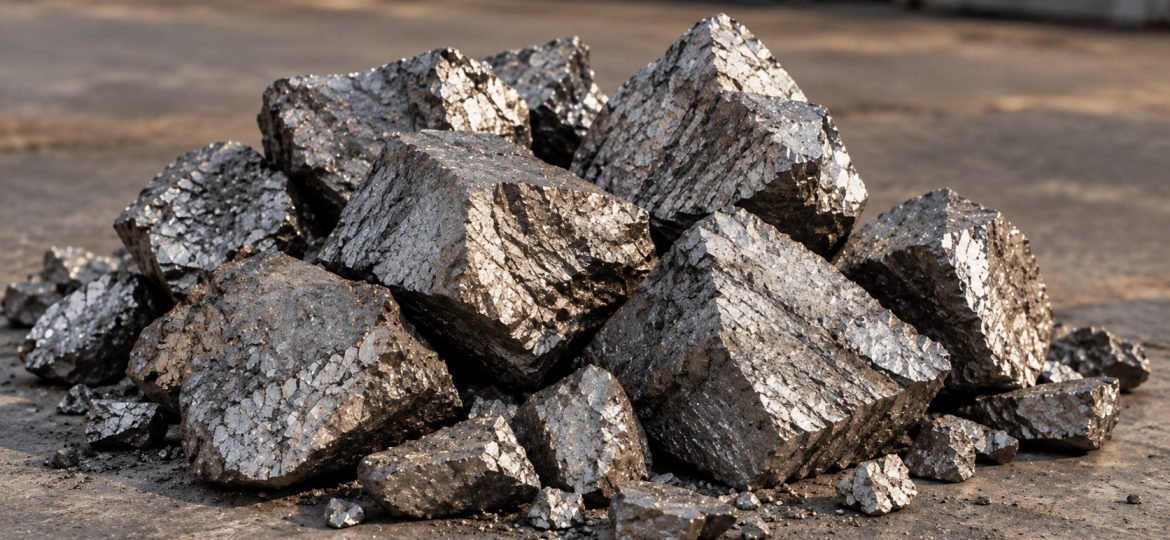
Ferro Titanium is an iron-titanium ferroalloy that steelmakers use to introduce titanium into molten steel. The alloy plays an important role in steel refining because titanium has a strong affinity for nitrogen, carbon and oxygen. Therefore, controlled additions can help steel producers manage chemistry and achieve specific material properties.
The product comes in different titanium grades and particle sizes. As a result, buyers need to consider more than titanium content alone. Carbon, aluminium, silicon, phosphorus, sulfur and size distribution can also affect product suitability.
Steelmaking remains the main field of use. However, the alloy also serves stainless steel, specialty steel, welding materials and selected foundry applications. Moreover, international trade connects major steel markets with specialized ferroalloy producers.
For industrial buyers, the right grade combines stable chemistry, suitable sizing, reliable documents and secure supply.
1. What Is Ferro titanium?
Ferro Titanium, often written as FeTi, is an alloy of iron and titanium. Commercial grades contain different levels of titanium depending on the production route and final application.
High-titanium grades such as FeTi70 represent an important part of the commercial market. Other grades with lower titanium levels also serve specific steelmaking needs.
Steelmakers add FeTi to molten metal rather than relying on pure titanium for many routine metallurgical operations. This approach provides a practical way to introduce a measured amount of titanium into an iron-based melt.
Titanium reacts strongly with several elements in steel. In particular, it can form stable compounds with nitrogen and carbon. Consequently, metallurgists use titanium additions to control inclusions, refine structure and support the required steel chemistry.
Still, the correct effect depends on dosage, melt conditions and the final steel grade. For this reason, plants should define the target chemistry before selecting a commercial grade.
2. Main Grades and Technical Specifications
Commercial Ferro Titanium specifications can vary between producers and applications. Therefore, buyers should evaluate each grade according to the required steel chemistry and production process. Titanium content remains the main selection factor; however, aluminium, carbon, silicon, phosphorus and sulfur can also affect performance.
The following table provides representative industrial ranges rather than one universal specification.
| Grade | Titanium (Ti) | Aluminium (Al) | Silicon (Si) | Carbon (C) | Phosphorus (P) | Sulfur (S) |
|---|---|---|---|---|---|---|
| FeTi30 | Approx. 25–35% | Grade dependent | Controlled | Controlled | Low | Low |
| FeTi40 | Approx. 35–45% | Grade dependent | Controlled | Controlled | Low | Low |
| FeTi50 | Approx. 45–55% | Grade dependent | Controlled | Controlled | Low | Low |
| FeTi70 | Approx. 65–75% | Commonly controlled to a low level | Controlled | Controlled | Low | Low |
| Low-Al FeTi | Customer specification | Reduced Al | Controlled | Controlled | Low | Low |
| Iron (Fe) | Balance | — | — | — | — | — |
The exact specification should always come from the agreed Technical Data Sheet and purchase contract. In addition, buyers may set tighter limits for aluminium, carbon or other elements when producing sensitive steel grades.
Particle size also matters. Depending on the plant and feeding system, suppliers may offer lumps, crushed material or smaller granules. Therefore, a complete Ferro Titanium purchase specification should state both chemical limits and size distribution.
3. Key Properties of the Alloy
The metallurgical value of Ferro Titanium comes mainly from titanium’s high chemical activity.
Titanium readily interacts with nitrogen and carbon in molten steel. Under suitable conditions, it can form titanium nitrides and titanium carbides. Moreover, titanium has a strong affinity for oxygen. These reactions make the alloy valuable for steel producers that need better control over melt chemistry.
| Property | Metallurgical Importance |
|---|---|
| Strong affinity for nitrogen | Supports nitrogen control through stable titanium compounds |
| Strong affinity for carbon | Enables titanium carbide formation under suitable conditions |
| Affinity for oxygen | Supports deoxidation and inclusion control |
| Grain-related effects | Can support grain control in selected steels |
| Controlled titanium source | Allows measured Ti additions to iron-based melts |
| Several available grades | Helps match the alloy to different steel chemistries |
| Solid ferroalloy form | Supports industrial storage, dosing and furnace addition |
However, titanium is highly reactive. Therefore, addition practice and timing can influence recovery.
Steelmakers should calculate the required amount according to the target titanium level, melt chemistry and expected recovery rather than using one fixed addition rate for every heat.
4. How Is Ferro Titanium Produced?
Manufacturers can produce Ferro Titanium through different metallurgical routes. The chosen method depends on target titanium content, raw material availability and required impurity limits.
One route uses titanium-bearing raw materials together with iron-bearing material and reducing agents. Another important commercial route uses titanium scrap or other titanium-bearing feedstock.
The use of titanium scrap can help recover valuable metal from industrial material streams. Therefore, the ferroalloy sector can provide an outlet for suitable titanium-bearing secondary raw materials.
After alloy formation, manufacturers cool and break the material. Next, they crush and screen it according to the required size. Finally, quality teams analyze the product chemistry and confirm the relevant limits.
Careful raw material selection matters because unwanted elements can enter the final alloy. Consequently, buyers should review the full chemical analysis instead of focusing only on titanium content.
5. Where Is Ferro Titanium Used?
Steel production accounts for the main industrial demand for Ferro Titanium. Nevertheless, the alloy serves several processes within the wider metals industry.
| Industry / Application | Main Function | Typical Purpose |
|---|---|---|
| Carbon Steel | Titanium addition | Chemistry and inclusion control |
| Stainless Steel | Alloying addition | Controlled titanium content |
| Special Steel | Alloy adjustment | Target material properties |
| Microalloyed Steel | Titanium addition | Grain and precipitation control |
| Low-Alloy Steel | Metallurgical treatment | Chemistry optimization |
| Welding Materials | Alloy component | Controlled composition |
| Foundry Applications | Selected melt treatment | Chemistry adjustment |
| Steel Refining | Nitrogen and oxygen interaction | Melt quality control |
| Continuous Casting | Inclusion / chemistry management | Stable processing |
| Specialty Metallurgy | Titanium source | Precise alloy addition |
The required grade changes with the application. For example, a plant producing sensitive specialty steel may need tighter aluminium or carbon limits than a general steel application.
Therefore, buyers should match the product specification to the actual process.
6. Role in Steelmaking
Ferro Titanium provides steelmakers with a practical way to introduce controlled amounts of titanium into molten steel. Even a carefully measured addition can influence the behavior of nitrogen, carbon and inclusions in the melt.
Titanium can bind with nitrogen and form stable nitrides. Likewise, it can interact with carbon and form carbides. These compounds can influence grain structure and material behavior when metallurgists manage the process correctly.
In addition, titanium can react with oxygen. Therefore, it may contribute to deoxidation and inclusion control in selected steelmaking practices.
Steel producers also use titanium in stabilized stainless steels and various special grades where the final chemistry requires a defined titanium level.
However, timing remains important. If a producer adds the alloy under unsuitable conditions, titanium recovery may fall because of its high reactivity. As a result, technical teams coordinate the addition with melt temperature, oxygen level, slag conditions and other alloy additions.
7. Grain Control and Steel Performance
Grain structure has a direct effect on many steel properties. Therefore, steelmakers carefully manage grain growth during production and heat treatment.
Titanium can form fine precipitates with nitrogen and carbon. Under suitable conditions, these particles can help limit unwanted grain growth. As a result, Ferro Titanium can support the production of steels that require controlled microstructure.
However, the final result depends on the whole alloy system. Carbon, nitrogen, aluminium and other microalloying elements all influence precipitation behavior.
For this reason, FeTi should form part of a wider metallurgical plan rather than act as an isolated additive.
Precise dosing also matters. Too little titanium may fail to deliver the target effect. Meanwhile, excessive or poorly controlled additions can create unwanted compounds or affect processing.
Therefore, steelmakers need consistent alloy chemistry from one batch to another.
8. Importance of Aluminium, Carbon and Other Impurities
Titanium content often receives the most attention during Ferro Titanium purchasing. However, secondary elements can be just as important for certain applications.
Aluminium is a key example. Some steel grades require tight aluminium control. Therefore, buyers may request low-aluminium FeTi when standard material could introduce too much aluminium into the melt.
Carbon also matters, especially when the final steel has a strict carbon target. Silicon, phosphorus and sulfur require similar attention. Their acceptable limits depend on the steel grade and production route.
| Element | Why Buyers Monitor It |
|---|---|
| Titanium | Determines the main alloying value |
| Aluminium | Important for Al-sensitive steel chemistry |
| Carbon | Critical for low-carbon applications |
| Silicon | Can influence final melt chemistry |
| Phosphorus | Usually requires a low limit |
| Sulfur | Important for steel cleanliness and quality |
| Iron | Main carrier and balance element |
Consequently, comparing two offers only by titanium percentage can lead to a poor purchasing decision. A complete chemical analysis provides a much stronger basis for technical and commercial evaluation.
9. Major Import Markets
International Ferro Titanium trade connects major steel-producing regions with specialized ferroalloy suppliers. HS 720291 covers ferro-titanium and ferro-silico-titanium. Therefore, public customs data provides a useful market indicator, although the classification includes both related product groups.
According to 2024 World Bank WITS / UN Comtrade data, the leading reporting import markets included the following:
| Rank | Import Market | 2024 Import Value | Quantity |
|---|---|---|---|
| 1 | Germany | US$37.98 million | 8,731 tonnes |
| 2 | Netherlands | US$23.00 million | 5,649 tonnes |
| 3 | Japan | US$19.95 million | 4,333 tonnes |
| 4 | Estonia | US$18.07 million | 5,039 tonnes |
| 5 | Brazil | US$17.28 million | 3,799 tonnes |
| 6 | South Korea | US$14.73 million | 3,348 tonnes |
The European Union as a bloc reported approximately US$67.84 million and 16,283 tonnes of imports in 2024. Because the EU is not a single country, the table keeps it outside the country ranking.
These markets connect closely with steel production, specialty metals, engineering and industrial manufacturing. However, buyers should remember that HS 720291 includes both ferro-titanium and ferro-silico-titanium.
10. Major Export Markets
The international Ferro Titanium supply chain has a strong European presence. In 2024, Estonia and the United Kingdom led reported country-level exports under HS 720291. Latvia, Poland and the Netherlands also recorded notable volumes.
| Rank | Exporting Country | 2024 Export Value | Quantity |
|---|---|---|---|
| 1 | Estonia | US$55.09 million | 12,093 tonnes |
| 2 | United Kingdom | US$44.77 million | 9,855 tonnes |
| 3 | Latvia | US$26.39 million | 6,388 tonnes |
| 4 | Poland | US$15.76 million | 3,563 tonnes |
| 5 | Netherlands | US$13.13 million | 2,926 tonnes |
| 6 | India | US$13.10 million | 3,083 tonnes |
The European Union as a bloc exported approximately US$30.55 million and 6,906 tonnes under the same code in 2024. Its main destinations included Brazil, Japan, Türkiye, Argentina and Mexico.
These figures help buyers understand the wider supply structure. Still, they should not treat every tonne under HS 720291 as FeTi alone because the customs code also includes ferro-silico-titanium.
11. Türkiye and Ferro Titanium Trade
Türkiye represents both an import market and a regional trading point for titanium-bearing ferroalloys.
In 2024, Türkiye reported US$10.31 million of imports and about 2,629 tonnes under HS 720291. Russia, the United Kingdom, Estonia, India and Latvia ranked among the main reported origins.
| Main Supplier to Türkiye | 2024 Value | Quantity |
|---|---|---|
| Russia | US$4.58 million | 1,248 tonnes |
| United Kingdom | US$2.17 million | 491 tonnes |
| Estonia | US$1.35 million | 314 tonnes |
| India | US$0.74 million | 220 tonnes |
| Latvia | US$0.60 million | 141 tonnes |
Meanwhile, Türkiye reported approximately US$1.42 million and 391 tonnes of exports under the same customs code. The Netherlands and Algeria represented the two largest reported destinations, followed by Switzerland, the United States and Italy.
This trade pattern reflects Türkiye’s position near major European, Middle Eastern and North African steel markets.
12. Quality Control, Packaging and Storage
Reliable Ferro Titanium performance starts with consistent quality. Therefore, buyers should request a Certificate of Analysis for each batch or shipment.
Moreover, the certificate should confirm the main titanium level and all agreed impurity limits.
A professional quality review should cover:
- titanium content;
- aluminium limit;
- carbon limit;
- silicon content;
- phosphorus and sulfur;
- particle size distribution;
- batch consistency;
- origin;
- packaging;
- Technical Data Sheet;
- Safety Data Sheet;
- Certificate of Analysis.
Particle size deserves special attention because it affects handling, feeding and dissolution.
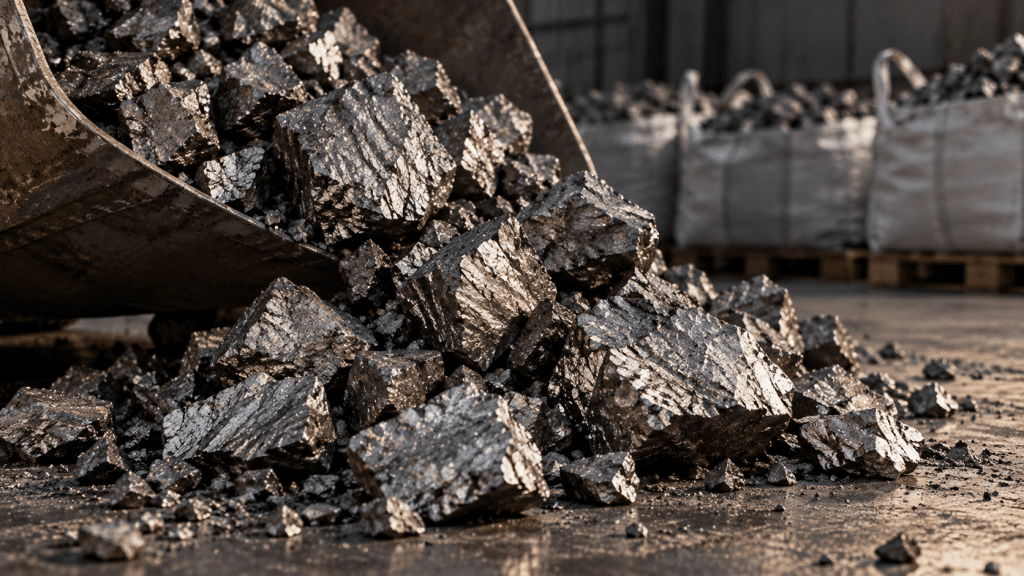
Packaging depends on product size, shipment volume and customer needs. Industrial supply may use drums, bags or bulk bags where technically suitable.
Companies should keep the material dry and protect it from contamination. In addition, workers should follow the current Safety Data Sheet and local workplace rules during handling.
Good storage practice protects both product quality and operational safety.
13. How to Select the Right Ferro Titanium Grade
The right Ferro Titanium grade depends on steel chemistry, production conditions and the required titanium addition.
First, buyers should define the target titanium range. Next, they should set maximum limits for aluminium, carbon, silicon, phosphorus and sulfur. Then, they should choose the correct particle size.
A complete request for quotation should normally include:
- Required FeTi grade
- Target titanium content
- Maximum impurity limits
- Required particle size
- Quantity
- Packaging
- Destination
- Incoterm
- Required documentation
- Delivery schedule
Price remains important. However, purchasing teams should also compare usable titanium content, chemical consistency, logistics and supplier reliability.
For example, a lower-cost alloy may create additional process costs if its chemistry varies significantly between batches. Therefore, technical value should remain part of every commercial comparison.
14. Why Ferro Titanium Matters to Modern Metallurgy
Modern steel production requires tighter control over chemistry, inclusions and microstructure. Ferro Titanium gives metallurgists a controlled titanium source for these requirements.
Its strong interaction with nitrogen, carbon and oxygen supports its role in several steelmaking processes. Moreover, producers can select different FeTi grades according to titanium content and impurity requirements.
The global market also has an established supply structure. Europe, the United Kingdom, India and other producing regions connect with major steel markets across Europe, Asia and the Americas.
For buyers, however, successful sourcing requires more than finding available material. The right product must match the required chemistry, size, documentation, packaging and delivery plan.
For commercial enquiries, contact Atabaş Global with your target chemistry, required grade, particle size, quantity, packaging and destination.
15. Conclusion
Ferro Titanium provides steelmakers with a practical and controlled source of titanium. Its interaction with nitrogen, carbon and oxygen explains its importance in steel refining, alloy adjustment and selected microstructure-control processes.
Still, buyers should not select material by titanium percentage alone. Aluminium, carbon, silicon and other elements can influence whether a grade fits the intended steel.
Furthermore, particle size, batch consistency, documentation and logistics affect industrial performance and total purchasing cost.
A well-defined specification therefore creates the foundation for reliable supply. By combining technical requirements with quality control and commercial planning, industrial buyers can select the right FeTi grade for their production needs.
