

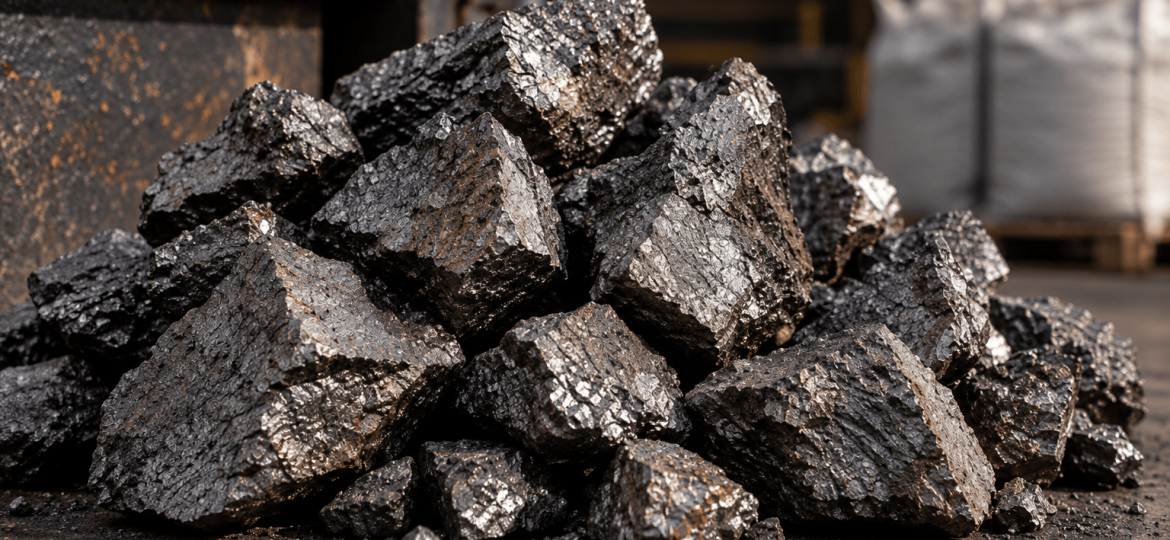
Ferro Boron is an iron-boron alloy that provides a controlled source of boron for steelmaking and advanced metallurgy. Although steel producers normally require only a small amount of boron, this element can have a strong effect on hardenability and final material performance.
Product quality depends on boron content, carbon level, impurities, particle size and production consistency. Therefore, buyers should select the grade according to the final application rather than price alone.
In particular, the steel industry values FeB for controlled boron addition. However, suitable grades also serve cast iron, specialty alloys, magnetic materials and other advanced metallurgical applications. As a result, accurate chemistry and reliable sourcing play an important role in industrial use.
1. What Is Ferro Boron?
Ferro Boron, also known as FeB or ferroboron, is a ferroalloy made mainly from iron and boron. Producers manufacture several grades with different boron and carbon levels.
The alloy provides an effective way to introduce boron into iron-based melts. In steel production, even a small amount of boron can change hardening behavior when producers control the chemistry correctly.
However, the required composition depends on the application. Standard steelmaking, low-carbon steel and advanced material production may each require different grades.
Therefore, buyers should define the target boron content, maximum carbon level, impurity limits and particle size before approving a product.
2. Main Grades and Properties
Commercial grades generally differ according to their boron concentration and impurity limits. ASTM analytical methods for ferroboron cover material containing approximately 12% to 24% boron, while commercial suppliers offer several grades within this wider range.
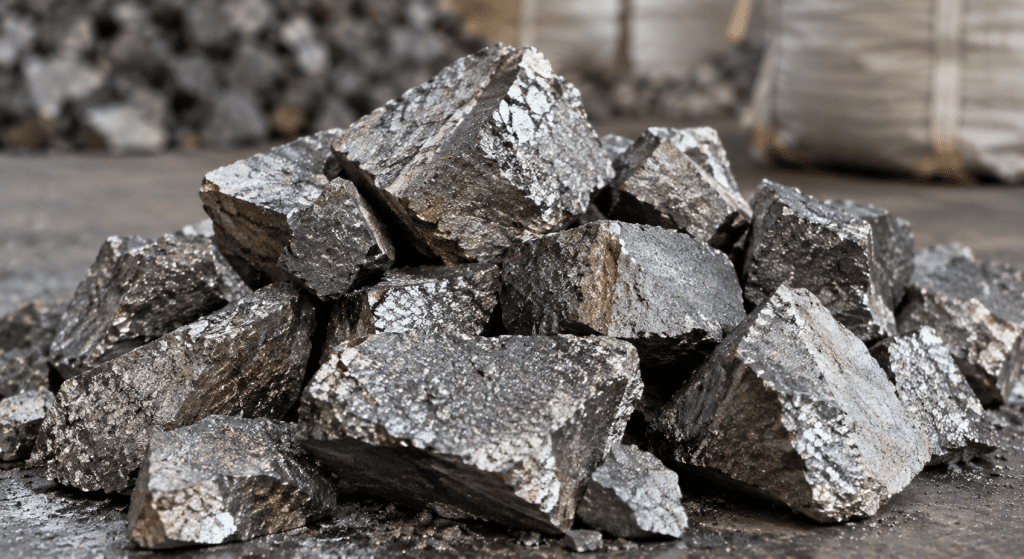
Common commercial names include FeB14, FeB16, FeB18 and FeB20.
| Grade | Typical Boron (B) | General Character | Typical Application Focus |
|---|---|---|---|
| FeB14 | 12–15% | Lower boron grade | General metallurgical use |
| FeB16 | 15–17% | Medium boron grade | Steel and alloy production |
| FeB18 | 17–19% | Common commercial grade | Steelmaking and alloying |
| FeB20 | 19–21% | Higher boron grade | Controlled high-boron addition |
| Low-Carbon FeB | Grade-specific | Reduced carbon content | Carbon-sensitive steels and specialty alloys |
These ranges provide a practical commercial guide rather than one universal specification. The actual limits can vary between producers.
Carbon also deserves attention. For example, a standard grade and a low-carbon grade with similar boron content may behave differently in a process where final carbon chemistry has strict limits.
Therefore, purchasing teams should compare the complete chemical specification instead of relying only on the grade name.
3. Ferro Boron Technical Specifications
Boron content alone does not define product quality. Carbon, silicon, aluminium, phosphorus, sulfur and particle size can also influence technical suitability.
A practical specification review may include the following parameters:
| Parameter | Typical / Reference Requirement | Why It Matters |
|---|---|---|
| Boron (B) | Approx. 12–24%, grade dependent | Defines the main alloying value |
| Carbon (C) | Grade dependent | Important for carbon-sensitive steel |
| Silicon (Si) | Controlled by specification | Can affect final melt chemistry |
| Aluminium (Al) | Controlled by specification | Important in sensitive applications |
| Phosphorus (P) | Low / specification dependent | Requires control for steel quality |
| Sulfur (S) | Low / specification dependent | Important for clean steel production |
| Iron (Fe) | Balance | Main carrier element |
| Particle Size | Customer / process dependent | Affects feeding and dissolution |
| Physical Form | Lumps, granules or crushed material | Selected according to addition method |
ASTM methods cover the chemical analysis of ferroboron within approximately the 12–24% boron range. Nevertheless, commercial limits for carbon and other elements vary by grade and producer.
For this reason, buyers should request a current Technical Data Sheet and Certificate of Analysis before final approval.
4. How Is Ferro Boron Produced?
Manufacturers produce ferroboron by reducing boron-bearing raw materials and combining the resulting boron with iron under controlled metallurgical conditions.
Industrial production commonly uses high-temperature reduction methods. The exact process can vary according to the target boron content, carbon level and purity.
After alloy formation, producers cool and crush the material. Next, they screen it into the required particle sizes.
Quality control follows the production stage. Manufacturers test boron and relevant impurities before releasing the batch.
However, not every FeB grade provides the same performance. Raw materials, furnace conditions, reduction technology and crushing methods can all affect the final product.
Therefore, consistent production and batch control remain important for industrial buyers.
5. Where Is Ferro Boron Used?
Steelmaking represents the main application, but the material also supports several other metallurgical processes.
| Application | Typical Role |
|---|---|
| Carbon Steel | Boron microalloying and hardenability control |
| Alloy Steel | Controlled boron addition |
| Heat-Treatable Steel | Supports hardening response |
| Wear-Resistant Steel | Helps achieve required hardness after heat treatment |
| Heat-Resistant Steel | Alloy chemistry adjustment |
| Cast Iron | Selected alloying applications |
| Specialty Steel | Controlled boron addition |
| Amorphous Alloys | Boron-bearing alloy component |
| Nanocrystalline Materials | Raw material for selected advanced alloys |
| Magnetic Materials | Boron source in selected magnetic alloy systems |
The correct application depends on product chemistry and final material requirements. Therefore, manufacturers should determine the suitable grade through technical evaluation and production testing.
6. Use in Steelmaking and Hardenability Control
Steelmaking is one of the most important markets for this alloy.
Boron can improve steel hardenability even at very low levels when the steel chemistry and heat treatment support its effect. In simple terms, hardenability describes how effectively steel can develop hardness below its surface during heat treatment.
This property matters in components with larger cross-sections. A suitable boron-treated steel can achieve the required hardened structure deeper into the component.
As a result, manufacturers use boron-treated steels in demanding automotive, machinery, construction, mining and engineering applications.
However, more boron does not automatically mean better steel. Producers need only a controlled amount of effective boron. Oxygen and nitrogen can also interact with boron and reduce the amount available for the intended metallurgical effect.
Therefore, steelmakers coordinate boron addition with deoxidation, nitrogen control and the overall alloy design.
7. Use in Specialty Steels and Advanced Alloys
FeB also serves applications beyond conventional carbon and alloy steel.
For example, specialty steel producers can use it when they require accurate boron adjustment. In addition, selected grades can support heat-resistant and wear-resistant alloy systems.
Advanced material producers may also use boron-bearing iron alloys in amorphous and nanocrystalline materials. These materials can provide useful magnetic and electrical properties for specialized applications.
Moreover, boron plays an important role in neodymium-iron-boron magnetic systems. NdFeB magnets support electric motors, industrial equipment, electronics and many high-performance technologies.
However, advanced applications often require tighter chemical control. Carbon, aluminium, silicon and other impurities may have strict limits.
For this reason, high-purity or low-carbon grades can become important when conventional steelmaking specifications are not sufficient.
8. Why Boron Content and Carbon Level Matter
Selecting the right grade starts with chemistry.
The boron percentage determines how much alloy the producer needs to reach the target boron level. Therefore, consistent boron content helps technical teams calculate additions more accurately.
Carbon requires equal attention. Standard FeB grades may work well in many steel applications. However, low-carbon or ultra-low-carbon production can require tighter carbon limits.
Impurities also matter. Silicon, aluminium, sulfur and phosphorus can affect the final chemistry, especially in tightly controlled specialty steels.
As a result, professional buyers should compare products through a full chemical analysis.
A lower price per tonne does not always mean a lower production cost. Poor chemistry consistency can change recovery, increase adjustment requirements and create production risk.
Therefore, technical value and batch consistency should remain part of every commercial comparison.
9. Major Import Markets
International trade data for Ferro Boron require careful interpretation.
There is no globally consistent six-digit HS category that isolates FeB from every other ferroalloy. In international trade statistics, the product may fall under HS 720299 – Ferro-alloys, n.e.s., depending on the national tariff structure and declaration.
Therefore, the following 2024 WITS/UN Comtrade figures provide broader market context rather than Ferro Boron-only import data.
| Rank | Importing Market | 2024 Import Value | Reported Quantity |
|---|---|---|---|
| 1 | China | US$257.91 million | 148,391 tonnes |
| 2 | India | US$101.53 million | 68,686 tonnes |
| 3 | United States | US$51.26 million | 21,974 tonnes |
| 4 | Japan | US$42.98 million | 22,336 tonnes |
| 5 | Germany | US$31.01 million | 15,899 tonnes |
| 6 | Türkiye | US$28.40 million | 14,169 tonnes |
The European Union also reported approximately US$74.57 million in imports under HS 720299. However, the EU represents an economic bloc rather than a single country, so it is excluded from the country ranking.
These markets include major steel, automotive, engineering and advanced manufacturing industries. Nevertheless, the figures cover other ferroalloys as well. Therefore, companies should use product-level customs data when they need a precise FeB market analysis.
10. Major Exporting Countries
The same HS-code limitation applies to exports.
According to World Bank WITS 2024 records for HS 720299, the leading country-level exporters by reported trade value included:
| Rank | Exporting Country | 2024 Export Value | Reported Quantity |
|---|---|---|---|
| 1 | China | US$441.33 million | 136,991 tonnes |
| 2 | Brazil | US$165.79 million | Not reported in WITS ranking |
| 3 | Slovenia | US$34.15 million | 14,068 tonnes |
| 4 | France | US$32.81 million | 41,163 tonnes |
| 5 | United States | US$31.76 million | 10,841 tonnes |
| 6 | India | US$20.18 million | 11,684 tonnes |
China holds a strong position in this wider specialty ferroalloy category. Brazil also records significant export value, while European and North American producers contribute to international supply.
Still, buyers should not interpret these figures as a Ferro Boron-only export ranking. HS 720299 includes several ferroalloys.
Product-specific shipment data provide additional context. For example, commercial shipment data for July 2024–June 2025 identify China, South Korea and Japan among major origins for shipments described specifically as ferro boron under HS 720299. However, shipment-count databases use different methods from official customs-value statistics and should therefore serve as a secondary market indicator.
11. How to Check Ferro Boron Quality
Quality control should begin with the final application.
For steelmaking, buyers should first confirm the required boron range. Next, they should review carbon, silicon, aluminium, sulfur and phosphorus limits.
Particle size also affects handling and dissolution. Therefore, the material should match the plant’s feeding system and addition practice.
A professional quality review should include:
- Technical Data Sheet (TDS)
- Safety Data Sheet (SDS)
- Certificate of Analysis (CoA)
- Boron content
- Carbon limit
- Relevant impurity limits
- Particle size distribution
- Batch identification
- Country of origin
- Packaging specification
Consistency between batches is equally important. Large variations in boron or impurity levels can force steelmakers to adjust addition rates and process conditions.
Therefore, purchasing teams should evaluate both the specification and the supplier’s ability to maintain it.
12. Storage, Handling and Safety
Proper storage helps maintain product quality and safe handling.
Companies should keep the material in a dry and covered area. Moisture control matters, especially because the product may later enter high-temperature metallurgical processes.
Packaging should also protect the alloy from contamination during transport and storage.
Depending on particle size, handling may generate dust or small fragments. Therefore, workers should follow the current Safety Data Sheet and use suitable personal protective equipment.
Facilities must also follow local workplace, storage and transport rules.
For international shipments, buyers should confirm packaging type, net weight, pallet requirements and loading method before dispatch.
13. How to Buy the Right Ferro Boron
A professional purchasing process starts with the final application rather than the commercial grade name.
First, buyers should define the target boron level. Next, they should determine the maximum carbon and impurity limits. Then, they should select the particle size that fits the feeding and melting process.
A complete request for quotation should include the required FeB grade, chemical composition, particle size, monthly or annual quantity, packaging, destination and preferred Incoterm.
Documentation should support the purchasing decision as well. A current TDS, SDS and CoA can help technical teams compare suppliers on the same basis.
Logistics also influence total cost. Therefore, buyers should review origin, loading method, shipment size, lead time, freight and delivered cost instead of comparing only the ex-works price.
Atabaş supports industrial buyers by bringing technical requirements, documentation, commercial terms and international logistics together within a structured procurement process.
14. Why Is Ferro Boron Important for Modern Metallurgy?
Ferro Boron creates value because a relatively small boron addition can produce a significant metallurgical effect.
Its most important role lies in steelmaking, where controlled boron levels can support hardenability and heat-treatment performance. However, selected grades also serve specialty steels, wear-resistant materials, advanced alloys and magnetic material systems.
Moreover, modern industries increasingly require tighter chemical control. Automotive components, industrial machinery, energy technologies and advanced materials all depend on predictable raw material quality.
For this reason, FeB should not be treated as a simple commodity purchase. Chemical consistency, carbon control, particle size, documentation and supply reliability can directly affect production performance.
For companies that value secure sourcing and professional supply management, Atabaş can support Ferro Boron procurement according to technical specifications, required quantity, packaging and destination.
