

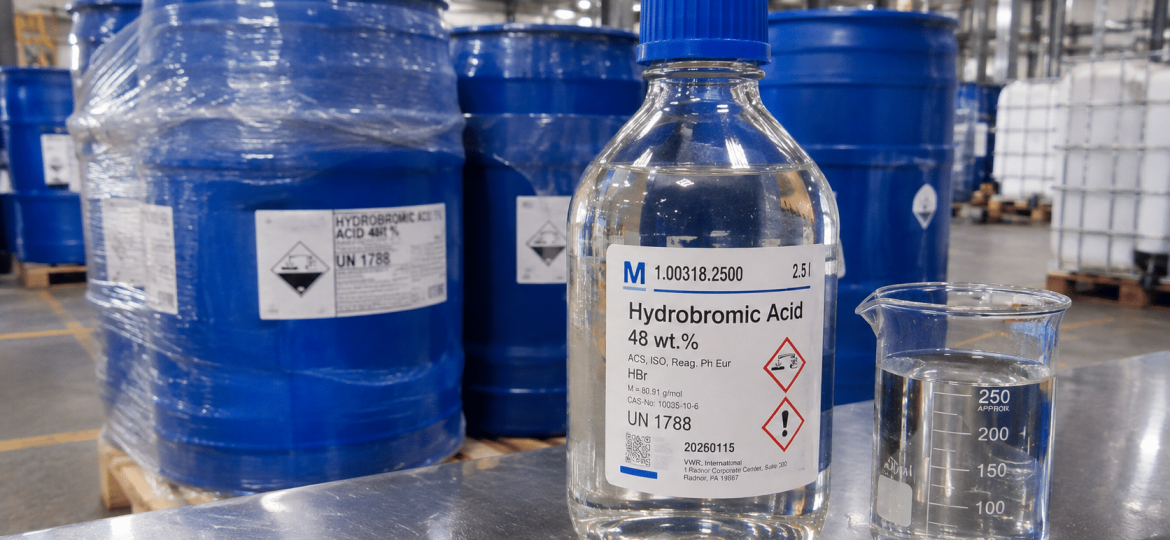
Hydrobromic Acid is a strong inorganic acid widely used in chemical synthesis, pharmaceutical manufacturing, bromide production and specialty chemical processes. Also known as hydrogen bromide solution, it consists of hydrogen bromide (HBr) dissolved in water. Because it provides a highly reactive source of bromide ions, the material plays an important role in many industrial reactions.
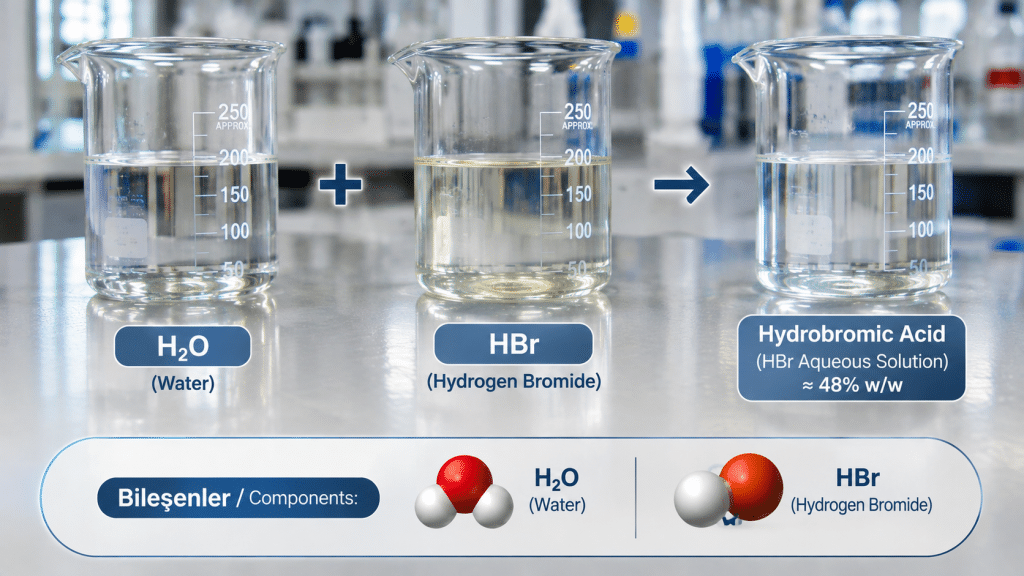
Its chemical formula is HBr, its CAS number is 10035-10-6, and its molecular weight is approximately 80.91 g/mol. Moreover, commercial Hydrobromic Acid is commonly supplied as an aqueous solution, while approximately 48% HBr is a widely recognized commercial and reagent concentration. In addition, higher-concentration solutions are available for selected industrial applications.
However, Hydrobromic Acid is highly corrosive. Therefore, buyers must evaluate concentration, purity, impurities, packaging, storage, transport classification and application requirements before purchase.
1. What Is Hydrobromic Acid?
Hydrobromic Acid is an aqueous solution of hydrogen bromide. Hydrogen bromide itself is a colorless gas under normal conditions. However, it dissolves readily in water and forms a strong acidic solution.
Commercial solutions normally appear colorless to pale yellow and have a sharp, irritating odor. Moreover, the solution is highly corrosive. Therefore, proper handling, storage and material compatibility are important in industrial environments.
The product may appear under several commercial and technical names:
- Hydrobromic Acid
- Hydrogen Bromide Solution
- Hydrogen Bromide, Aqueous
- HBr Solution
- Aqueous Hydrogen Bromide
However, Hydrobromic Acid should not be confused with anhydrous hydrogen bromide. Although both share the HBr formula, their physical forms, packaging and handling requirements differ significantly. Therefore, buyers should clearly state whether they require an aqueous acid solution or anhydrous hydrogen bromide when requesting a quotation.
2. Typical Technical Properties and Specifications
Commercial specifications depend on concentration, purity grade, producer and intended application. Therefore, buyers should review the supplier’s current Technical Data Sheet (TDS), Safety Data Sheet (SDS) and Certificate of Analysis (COA) before confirming an order.
| Property | Typical / Reference Information |
|---|---|
| Chemical Name | Hydrobromic Acid |
| Chemical Formula | HBr |
| CAS Number | 10035-10-6 |
| Molecular Weight | Approx. 80.91 g/mol |
| Commercial Form | Aqueous solution |
| Appearance | Colorless to pale yellow liquid |
| Odor | Sharp / pungent |
| Common Commercial Concentration | Approx. 48% HBr |
| Higher Concentration | Available for selected industrial applications |
| Solubility | Highly soluble in water |
| Acid Character | Strong inorganic acid |
| UN Number – Hydrobromic Acid Solution | UN 1788 |
| Main Hazard | Corrosive |
| Storage | Compatible, tightly closed containers under suitable conditions |
Approximately 48% HBr is one of the most established commercial concentrations. In addition, the constant-boiling aqueous mixture contains approximately 47.6% HBr at atmospheric pressure. As a result, concentrations close to 48% are common in industrial and reagent supply.
However, these values provide general guidance only. Actual specifications may vary according to grade and producer. Therefore, the agreed TDS and COA should define the final product requirements.
3. Main Hydrobromic Acid Grades and Concentrations
Hydrobromic Acid is available in different purity levels and concentrations. Therefore, buyers should select the product according to the intended chemical process rather than concentration alone.
| Grade / Type | Typical Characteristics | Common Applications |
|---|---|---|
| 48% Hydrobromic Acid | Common aqueous commercial concentration | General chemical synthesis |
| Higher-Concentration HBr Solution | Higher active acid content | Selected industrial processes |
| Technical Grade | Industrial purity specification | Bromide salts, chemical processing |
| Reagent Grade | Controlled analytical impurities | Laboratory and chemical synthesis |
| High-Purity Grade | Tighter impurity limits | Fine chemicals and sensitive synthesis |
| Application-Specific Grade | Specification adapted to end use | Pharmaceutical and specialty processes |
For example, 48% material is widely used because it offers an established concentration for many chemical processes. Meanwhile, higher-concentration products may suit selected industrial applications.
Technical grade material may focus on parameters required for large industrial processes. On the other hand, reagent and high-purity grades generally have tighter impurity limits.
Therefore, buyers should not assume that two products with the same HBr concentration offer the same quality or process performance.
4. Key Chemical and Industrial Properties
Several characteristics explain the industrial importance of Hydrobromic Acid. In particular, its strong acidity and ability to provide bromide ions make it useful in many chemical reactions.
Strong Acidity
First, HBr in water behaves as a strong acid. Therefore, it can support acid-catalyzed reactions and processes that require a strong acidic medium.
Effective Bromide Source
Hydrobromic Acid provides bromide ions for many chemical reactions. As a result, it serves as an important raw material for producing inorganic and organic bromine compounds.
High Water Solubility
Hydrogen bromide dissolves readily in water. Consequently, aqueous solutions provide a practical form for many industrial processes.
High Reactivity
The acid reacts with bases and many other chemicals. Moreover, reactions with bases can release significant heat. Therefore, process compatibility must be checked before use.
Corrosive Nature
Hydrobromic Acid can attack many metals. In addition, reactions with certain metals may release hydrogen gas. Therefore, storage tanks, transfer systems, pumps and packaging must use suitable materials.
5. Where Is Hydrobromic Acid Used?
Hydrobromic Acid serves several industrial sectors because it combines strong acidity with an effective source of bromide ions.
| Industry | Typical Application | Main Function |
|---|---|---|
| Chemical Manufacturing | Organic and inorganic synthesis | Acid / bromide source |
| Pharmaceuticals | Intermediate and API-related synthesis | Chemical reagent |
| Bromide Production | Manufacture of bromide salts | Bromide source |
| Fine Chemicals | Specialty synthesis | Reaction reagent |
| Agrochemicals | Intermediate production | Chemical raw material |
| Catalysis | Selected chemical reactions | Acid catalyst |
| Specialty Chemicals | Bromination and downstream chemistry | Process reagent |
| Laboratory Chemicals | Analytical and synthesis applications | Reagent |
For example, manufacturers can use the acid to prepare different bromide compounds. Meanwhile, pharmaceutical and fine chemical producers may use it during multi-stage synthesis.
In addition, HBr can support selected chemical reactions as an acid reagent or catalyst. Therefore, the required purity can vary significantly between applications.
6. Hydrobromic Acid in Chemical and Pharmaceutical Manufacturing
Chemical synthesis represents one of the main application areas for Hydrobromic Acid. In organic chemistry, HBr can support reactions that introduce bromine-containing groups into chemical structures. Therefore, it can serve as an important reagent in the production of downstream intermediates.
Moreover, bromide chemistry plays a role in pharmaceutical, fine chemical and specialty chemical value chains. However, impurity control becomes increasingly important in sensitive applications.
For example, high-purity applications may require control of chloride, iodide, sulfate, sulfite, iron and other trace impurities. Therefore, pharmaceutical and fine chemical buyers should not evaluate material only by HBr concentration.
Instead, they should also consider:
- Assay
- Chloride
- Iodide
- Sulfate
- Sulfite
- Iron
- Heavy metals
- Residue
- Color
- Batch consistency
As a result, a technically cheaper product may not always provide the lowest overall process cost. If impurities affect downstream production, a higher-quality grade may provide better process efficiency.
7. Production and Quality Control
Industrial Hydrobromic Acid is generally produced by preparing hydrogen bromide and absorbing it into water under controlled conditions. After production, manufacturers control concentration and impurity levels according to the required grade.
Because purity requirements vary by application, quality control plays an important role in commercial supply. Therefore, manufacturers may test several parameters before releasing a batch.
| Quality Parameter | Why It Matters |
|---|---|
| HBr Assay | Confirms active acid concentration |
| Appearance | Helps identify contamination or discoloration |
| Chloride | Important impurity parameter |
| Iodide | Important for higher-purity grades |
| Sulfate | Can affect sensitive processes |
| Sulfite | Controlled in certain specifications |
| Iron | Important for color and sensitive synthesis |
| Heavy Metals | Important for high-purity applications |
| Residue | Indicates non-volatile contamination |
| Batch Consistency | Supports stable industrial processing |
In addition, buyers should request a current COA rather than relying only on a general product description. Moreover, the COA should match the grade stated in the commercial offer.
Finally, buyers should compare the actual batch values with the agreed specification before accepting the material. As a result, quality differences can be identified before the product enters production.
8. Packaging, Storage and Transportation
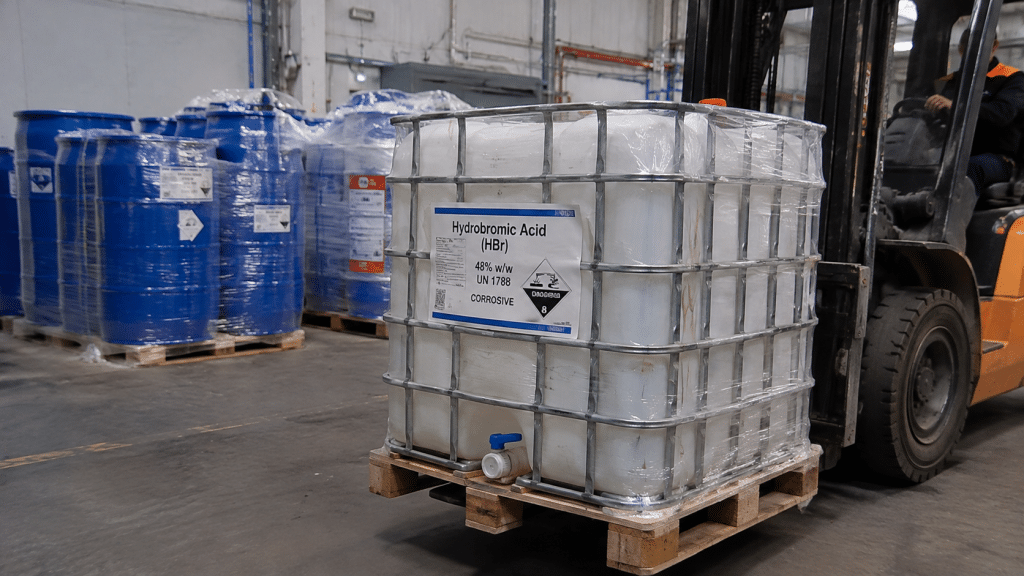
Hydrobromic Acid requires careful packaging and logistics because it is corrosive. Therefore, the correct packaging depends on concentration, quantity, transport mode and applicable dangerous-goods rules.
Industrial supply may use suitable:
- Chemical-resistant drums
- Compatible IBC systems
- Specialized bulk containers
- Dedicated tank systems for larger volumes
However, packaging selection should always follow the exact SDS and applicable transport rules.
Hydrobromic Acid solution is commonly associated with UN 1788 for transport. In addition, the material is classified as corrosive. Therefore, buyers should confirm the correct transport details for the exact product before shipment.
Storage planning should also consider chemical compatibility. For example, the material can react strongly with bases, oxidizing agents and various metals.
Therefore, buyers should verify:
- Container material
- Closure system
- Ventilation requirements
- Storage conditions
- Chemical segregation
- Secondary containment
- UN classification
- SDS
- Transport documentation
- Loading method
- Destination regulations
Moreover, the acid should remain in compatible and tightly closed containers under suitable storage conditions. Finally, local regulations and the supplier’s SDS should guide all handling and storage procedures.
9. Global Hydrobromic Acid Import and Export Market
International trade statistics for Hydrobromic Acid require careful interpretation because the product does not have a globally isolated six-digit HS category in the standard trade data commonly used for international comparisons.
Instead, trade may appear within the broader HS 281119 – Other inorganic acids, not elsewhere specified category. Therefore, HS 281119 figures should not be presented as exact global Hydrobromic Acid trade volumes.
| Market Indicator | Interpretation |
|---|---|
| HS Category | 281119 |
| Description | Other inorganic acids, n.e.s. |
| Hydrobromic Acid Coverage | May fall within the broader category |
| Product-Specific Accuracy | Limited |
| Best Use of Data | General trade direction and market context |
Nevertheless, this customs category can provide useful information about wider trade flows for inorganic acids. However, country rankings under HS 281119 should be treated as market indicators rather than direct rankings of Hydrobromic Acid producers or exporters.
Therefore, industrial buyers should combine customs information with producer documentation, technical specifications, verified supply capability and commercial information.
As a result, sourcing decisions can reflect the actual product rather than a broad customs category.
10. Hydrobromic Acid Market in Türkiye
Türkiye has industrial demand for inorganic acids and bromine-based chemical inputs across chemical manufacturing, pharmaceuticals, fine chemicals and other processing sectors.
Broader HS 281119 trade data can provide some market context. However, this customs heading includes several inorganic acids and is not limited to Hydrobromic Acid. Therefore, the figures should not be treated as exact HBr import volumes.
For Turkish industrial buyers, sourcing decisions should instead focus on the exact HBr grade and supply conditions.
Important commercial criteria include:
- Required concentration
- Purity
- Impurity limits
- Producer documentation
- TDS
- SDS
- COA
- Packaging
- Dangerous-goods logistics
- Country of origin
- Delivery schedule
- Customs classification
- Storage capability
- Commercial terms
Moreover, the exact GTİP classification should be confirmed before import. Because commercial form and customs interpretation can affect classification, buyers should review the product with their customs consultant.
In addition, dangerous-goods logistics can affect freight options and delivery costs. Therefore, logistics should be evaluated before the final purchase decision.
11. Industrial Hydrobromic Acid Sourcing with ATABAŞ GLOBAL
ATABAŞ GLOBAL supports international sourcing and trade coordination for industrial chemicals and raw materials, including Hydrobromic Acid requirements.
Depending on the buyer’s application, the sourcing process can include coordination of:
- Required HBr concentration
- Purity grade
- Technical specifications
- Impurity limits
- Packaging
- Required quantity
- Origin options
- Producer documentation
- TDS and SDS
- Certificate of Analysis
- Commercial terms
- Incoterms
- Loading schedule
- Dangerous-goods logistics
- Destination requirements
ATABAŞ GLOBAL does not position itself as the manufacturer or official distributor of every product within its sourcing portfolio. Instead, the company focuses on matching industrial demand with suitable international supply options.
In addition, the sourcing process can coordinate technical, commercial and logistics requirements between the parties. Therefore, buyers can evaluate the complete supply structure rather than comparing only the quoted price per metric ton.
As a result, technical suitability, documentation, logistics and commercial terms can all form part of the final sourcing decision.
12. What Buyers Should Check Before Purchasing Hydrobromic Acid
Before placing an order, buyers should define both technical and commercial requirements.
First, confirm the required HBr concentration. For example, a process designed around 48% material may require adjustments if another concentration is supplied.
Second, define the required purity grade. Technical-grade material and high-purity material can have very different impurity specifications.
Third, buyers should review the current technical documentation.
Important purchasing checks include:
- HBr assay
- Required concentration
- Appearance
- Chloride level
- Iodide level
- Sulfate and sulfite limits
- Iron content
- Heavy metals
- Residue
- TDS
- SDS
- COA
- Packaging material
- Net weight
- Country of origin
- Production date
- Shelf life
- Storage requirements
- UN classification
- Loading location
- Incoterm
- Delivery schedule
In addition, buyers should confirm whether the packaging is compatible with the exact concentration supplied. Moreover, dangerous-goods transport requirements should be checked before finalizing freight.
Finally, the commercial contract should clearly identify the concentration, grade and agreed technical specification. As a result, both buyer and seller can evaluate the shipment against the same quality criteria.
13. Frequently Asked Questions About Hydrobromic Acid
What is Hydrobromic Acid?
Hydrobromic Acid is an aqueous solution of hydrogen bromide (HBr). It is a strong inorganic acid. Therefore, manufacturers use it in chemical synthesis, bromide production and other industrial processes.
What is the CAS number of Hydrobromic Acid?
The CAS number is 10035-10-6. In addition, its molecular formula is HBr, while its molecular weight is approximately 80.91 g/mol.
What concentration is Hydrobromic Acid normally supplied at?
Approximately 48% HBr is a widely established commercial and reagent concentration. However, other concentrations may also be available for specific industrial applications.
What color is Hydrobromic Acid?
Commercial aqueous solutions are generally colorless to pale yellow. However, appearance requirements can vary by grade. Therefore, buyers should check the producer’s specification and COA.
What is Hydrobromic Acid used for?
Manufacturers use it in chemical synthesis, bromide production, pharmaceutical intermediates, fine chemicals and specialty chemical processes. In addition, HBr can act as an acid reagent or catalyst in selected reactions.
Is Hydrobromic Acid corrosive?
Yes. Hydrobromic Acid is highly corrosive. Therefore, suitable storage, packaging, protective systems and handling procedures are essential.
What documents should buyers request?
Buyers should normally request a current TDS, SDS and COA. Moreover, they should confirm concentration, impurity limits, packaging, origin and transport information before purchase.
What is the HS code for Hydrobromic Acid?
International trade data may place the product within the broader HS 281119 – Other inorganic acids, n.e.s. category. However, this category is not exclusive to Hydrobromic Acid. Therefore, buyers should confirm the applicable GTİP/HS classification with their customs consultant before customs declaration.
