

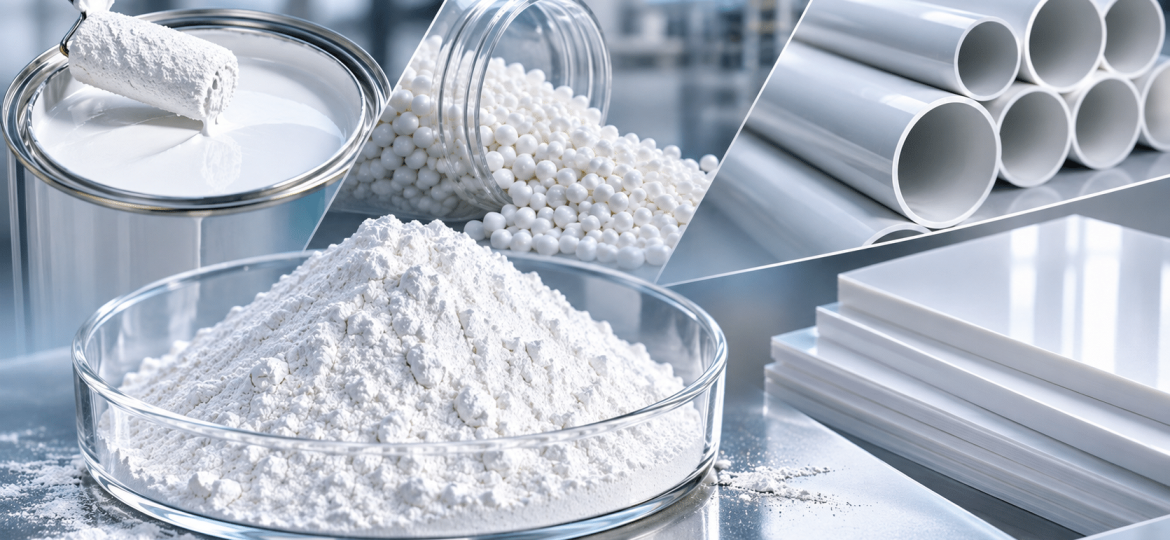
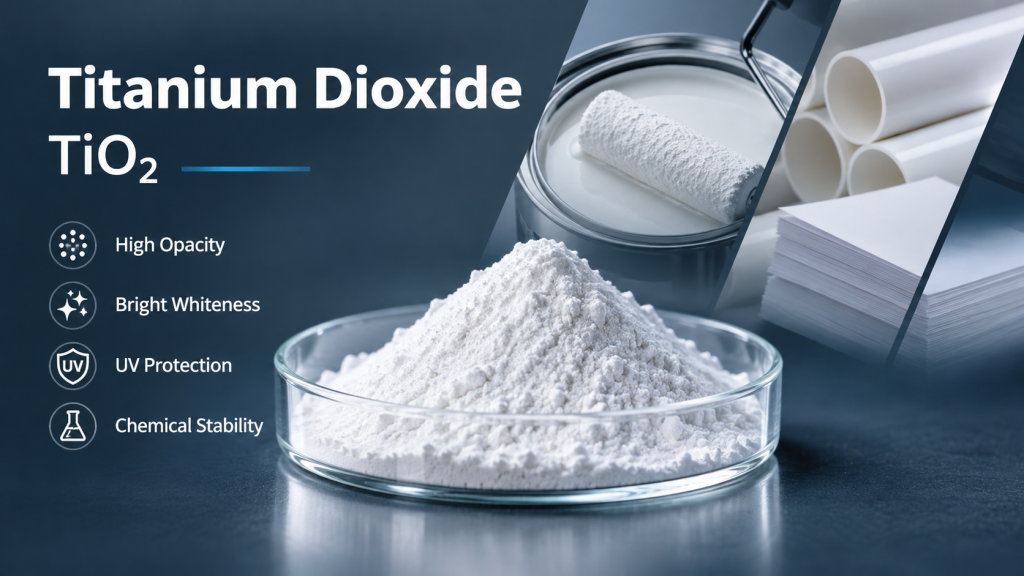
Titanium Dioxide (TiO₂) is one of the most widely used white pigments in the global chemical industry. Manufacturers rely on this material for its high opacity, strong light-scattering ability, brightness, and chemical stability. As a result, it plays a key role in paints, coatings, plastics, paper, inks, and many other products.
In addition, certain grades offer useful UV protection and surface properties. However, the performance of Titanium Dioxide depends on its crystal form, particle size, surface treatment, and purity. Therefore, industrial buyers must select the right grade for each application.
This article explains the main properties, grades, production methods, industrial uses, quality standards, and supply markets of Titanium Dioxide. It also examines industrial demand in Türkiye and the main factors that buyers should consider when sourcing this material.
1. What Is Titanium Dioxide?
Titanium Dioxide is an inorganic chemical compound with the formula TiO₂. It occurs naturally in several mineral forms, including rutile, anatase, and brookite.
However, industrial producers mainly use rutile and anatase forms. These crystal structures have different physical properties and serve different market needs.
The material usually appears as a fine white powder. Moreover, its high refractive index allows it to scatter visible light very well. As a result, manufacturers use it to give products a bright white color and strong hiding power.
Titanium Dioxide also offers good chemical stability in many common uses. Nevertheless, its behavior depends on the grade, surface treatment, and operating conditions.
2. Titanium Dioxide Technical Properties
The physical and chemical properties of Titanium Dioxide influence its performance in industrial products. Therefore, buyers should review the technical data before choosing a grade.
| Property | Typical Information |
|---|---|
| Chemical Name | Titanium Dioxide |
| Chemical Formula | TiO₂ |
| CAS Number | 13463-67-7 |
| Molecular Weight | 79.87 g/mol |
| Appearance | White powder |
| Main Crystal Forms | Rutile and Anatase |
| Density | Approximately 3.8–4.3 g/cm³, depending on crystal form |
| Refractive Index | Approximately 2.5 for Anatase and 2.7 for Rutile |
| Water Solubility | Practically insoluble |
| Main Function | White pigment and opacifier |
| Common Applications | Paints, plastics, paper, inks, and coatings |
These figures provide general technical information. However, commercial grades may differ in particle size, TiO₂ content, surface treatment, and other quality factors.
For this reason, buyers should always review the producer’s Technical Data Sheet (TDS), Safety Data Sheet (SDS), and Certificate of Analysis (COA).
3. Rutile and Anatase Titanium Dioxide Grades
Rutile and Anatase are the two main crystal forms used in commercial Titanium Dioxide products.
Although both forms share the same chemical formula, their crystal structures create different performance features.
Rutile Titanium Dioxide
Rutile grades offer high opacity, strong light scattering, and good durability in suitable formulations. Therefore, manufacturers commonly use them in paints, coatings, plastics, and outdoor products.
In addition, many commercial rutile pigments include surface treatments that improve dispersion and weather resistance.
As a result, Rutile Titanium Dioxide is often the preferred choice for products that need strong hiding power and long-term color performance.
Anatase Titanium Dioxide
Anatase grades also provide white color and useful optical properties. However, they generally have a lower refractive index than rutile grades.
For example, some paper, fiber, and indoor applications use anatase grades. In addition, selected anatase materials serve as inputs in chemical and technical processes.
Nevertheless, grade selection depends on the required product properties rather than crystal form alone.
| Feature | Rutile | Anatase |
|---|---|---|
| Crystal Structure | Tetragonal | Tetragonal |
| Refractive Index | Higher | Lower |
| Hiding Power | Generally stronger | Generally lower |
| Weather Resistance | Strong in suitable treated grades | Often less suitable for long-term outdoor exposure |
| Common Uses | Coatings, plastics, and outdoor products | Paper, fibers, and selected indoor products |
| Photocatalytic Activity | Grade dependent | Often higher in suitable grades |
Therefore, buyers should compare actual product data and test the grade in their final formulation.
4. Main Properties and Benefits of Titanium Dioxide
Titanium Dioxide offers several valuable properties for industrial production. However, the importance of each feature depends on the final application.
High Opacity and Hiding Power
The material scatters visible light very effectively. As a result, it helps coatings and plastics hide the surface or material beneath them.
Moreover, suitable particle size and good dispersion can improve pigment performance.
Bright White Color
Titanium Dioxide provides high brightness and whiteness. Therefore, manufacturers use it to improve the appearance of many finished products.
For example, white paints, plastic films, and paper coatings often rely on this property.
UV Protection
Selected grades can absorb and scatter ultraviolet radiation. Consequently, they can help protect certain polymer and coating systems from UV exposure.
However, the level of protection depends on grade selection and formulation design.
Chemical Stability
Titanium Dioxide offers good stability under many common industrial conditions. In addition, suitable grades can support long-term color performance.
Nevertheless, producers should check compatibility with other raw materials and process conditions.
Dispersion and Processing
Good dispersion helps achieve even color and stable product quality. Therefore, manufacturers should select grades that match their processing equipment and formulation needs.
5. Titanium Dioxide Applications Across Industries
Titanium Dioxide serves many industrial markets because of its optical and physical properties.
For example, paint producers need strong hiding power, while plastic manufacturers often focus on color, dispersion, and process stability.
| Industry | Common Applications | Main Function |
|---|---|---|
| Paints and Coatings | Decorative and industrial paints | Opacity and whiteness |
| Plastics | PVC, PE, PP, and masterbatch | White pigment and UV management |
| Paper | Paper coatings and specialty grades | Brightness and opacity |
| Printing Inks | Packaging and printing | Color and hiding power |
| Rubber | Selected rubber products | Pigment |
| Construction | Coatings and building products | Whiteness and opacity |
| Ceramics | Glazes and ceramic products | Color and optical properties |
| Chemical Industry | Selected technical processes | Functional raw material |
As shown above, the same chemical can serve different functions. However, each industry requires specific technical properties.
Therefore, manufacturers should choose the appropriate grade based on application tests and product data.
6. Titanium Dioxide in Paints and Coatings
Paints and coatings represent a major application area for pigment-grade Titanium Dioxide.
Manufacturers use the material to achieve high opacity, brightness, and a uniform white appearance.
Furthermore, suitable grades help improve hiding power in decorative and industrial coatings.
Rutile pigments are common in many coating systems. In particular, surface-treated grades can offer good durability in exterior applications.
However, pigment performance also depends on the binder, additives, pigment concentration, and dispersion process.
For this reason, paint manufacturers should test the selected grade in the full formulation.
Important selection factors include:
- Hiding power
- Whiteness
- Tinting strength
- Dispersion behavior
- Weather resistance
- Surface treatment
- Oil absorption
- Compatibility with the coating system
In addition, producers should review the required finish and expected service conditions.
7. Titanium Dioxide in Plastics and Masterbatch
Plastic manufacturers use Titanium Dioxide to produce white and colored polymer products.
For example, PVC pipes, plastic profiles, films, sheets, and masterbatch can contain suitable TiO₂ grades.
In addition to whiteness, the pigment can provide opacity and help manage UV exposure in certain products.
PVC Applications
PVC producers use pigment-grade Titanium Dioxide in pipes, profiles, sheets, and other finished products.
Furthermore, suitable rutile grades can support color stability and outdoor performance.
However, the final result depends on the PVC formulation, processing temperature, and other additives.
Polyethylene and Polypropylene
PE and PP manufacturers use Titanium Dioxide in films, molded parts, and polymer compounds.
In particular, masterbatch producers need grades that disperse well and provide even color.
As a result, particle characteristics and surface treatment play an important role in grade selection.
Masterbatch Production
White masterbatch contains a concentrated amount of pigment in a suitable carrier resin.
Therefore, producers must evaluate pigment loading, dispersion, carrier compatibility, and processing behavior.
In addition, good dispersion helps reduce visible defects and improve color consistency.
8. How Is Titanium Dioxide Produced?
Industrial producers mainly use two processes to manufacture pigment-grade Titanium Dioxide: the sulfate process and the chloride process.
Both methods can produce useful commercial grades. However, they differ in raw materials, production steps, waste streams, and process needs.
Sulfate Process
The sulfate process uses suitable titanium-bearing raw materials and sulfuric acid.
During production, the process converts titanium compounds into intermediate materials before forming Titanium Dioxide.
Furthermore, producers control several stages to achieve the required crystal form and pigment properties.
This method can produce both rutile and anatase grades, depending on the process.
Chloride Process
The chloride process uses suitable titanium-rich raw materials and chlorine-based process steps.
The process forms titanium tetrachloride as an intermediate. Subsequently, controlled oxidation produces Titanium Dioxide.
This route mainly produces rutile pigment grades.
However, product quality depends on process control, raw material quality, and final treatment.
Surface Treatment
After producing the pigment, manufacturers may apply inorganic or organic surface treatments.
For example, selected coatings can improve dispersion, weather resistance, and compatibility with other ingredients.
As a result, surface treatment often plays an important role in the final performance of commercial grades.
9. Major Titanium Dioxide Manufacturers and Global Supply Markets
Several international chemical companies produce Titanium Dioxide pigments for industrial applications.
Established manufacturers include:
| Manufacturer | Main Product Area |
|---|---|
| Chemours | Titanium Dioxide pigments |
| Tronox | Titanium Dioxide and titanium feedstocks |
| Kronos Worldwide | Titanium Dioxide pigments |
| LB Group | Titanium Dioxide pigments |
| Venator | Specialty pigments and Titanium Dioxide |
These companies have established roles in the wider pigment industry. However, their current production sites, product ranges, and supply options may change.
Therefore, buyers should confirm available grades, technical documents, and delivery capacity before placing an order.
International Supply Markets
China, Germany, the United States, Japan, and other major chemical-producing markets play roles in the global Titanium Dioxide supply chain.
However, production volume and trade flows can change due to demand, energy costs, plant operations, and trade measures.
In addition, customs data requires careful review.
HS 282300 covers titanium oxides, while HS 320610 covers pigments and preparations based on Titanium Dioxide that contain at least 80% Titanium Dioxide by weight, calculated on dry matter.
Therefore, these classifications do not always represent the same commercial product group.
As a result, buyers should compare trade data only after checking the relevant customs scope.
10. Titanium Dioxide Market and Industrial Demand in Türkiye
Türkiye has a broad manufacturing base in paints, coatings, plastics, masterbatch, construction materials, paper, and other industrial products.
Consequently, these industries create demand for white pigments and related chemical raw materials.
In particular, paint and plastic manufacturers require grades that meet strict color, opacity, and process needs.
Furthermore, local demand depends on industrial output, raw material costs, exchange rates, and global supply conditions.
When reviewing import statistics, buyers should distinguish between titanium oxides under HS 282300 and pigment preparations under HS 320610.
However, neither category should automatically be treated as a complete measure of all Titanium Dioxide used by Turkish manufacturers.
For this reason, trade data should serve as a market indicator rather than a substitute for product-level supply analysis.
In addition, buyers should consider supplier reliability, technical quality, delivery time, and commercial terms.
11. Industrial Titanium Dioxide Sourcing with ATABAŞ GLOBAL
Industrial buyers need clear technical and commercial information before they can compare supply offers.
Therefore, ATABAŞ GLOBAL reviews Titanium Dioxide sourcing inquiries based on the intended application, required grade, specifications, quantity, and delivery needs.
For example, a paint manufacturer may need a different grade from a plastic masterbatch producer.
Likewise, buyers may require specific surface treatments, particle characteristics, or quality documents.
The following information helps support a clear sourcing request.
| Requirement | Buyer Information |
|---|---|
| Product | Titanium Dioxide |
| Crystal Form | Rutile or Anatase |
| Application | Paints, plastics, paper, inks, or other use |
| Grade | Application-specific industrial grade |
| Specifications | Required technical limits |
| Quantity | MT per order or monthly demand |
| Packaging | Bags, Big Bags, or producer-standard packing |
| Destination | Country, port, or delivery location |
| Delivery Terms | EXW, FOB, CFR, or agreed terms |
| Documents | TDS, SDS, and COA |
| Supply Plan | Spot purchase or regular supply |
Furthermore, buyers should share any special testing or approval needs.
Clear product details help reduce delays during sourcing. As a result, suppliers can prepare more accurate offers.
Through its international trade activities, ATABAŞ GLOBAL can evaluate sourcing requests and discuss suitable commercial options based on product availability.
12. Quality Control, Packaging and Storage
Product quality plays a major role in the performance of Titanium Dioxide.
Therefore, industrial buyers should review both chemical and physical properties before placing an order.
Quality Control
Important checks may include:
- TiO₂ content
- Crystal form
- Whiteness
- Tinting strength
- Hiding power
- Particle size
- Surface treatment
- Oil absorption
- Moisture content
- Dispersion behavior
- Batch consistency
In addition, buyers should request the current TDS, SDS, and COA.
For example, a coating producer may focus on hiding power and weather resistance. Meanwhile, a masterbatch producer may place greater value on dispersion and polymer compatibility.
Therefore, quality checks should reflect the intended use.
Packaging
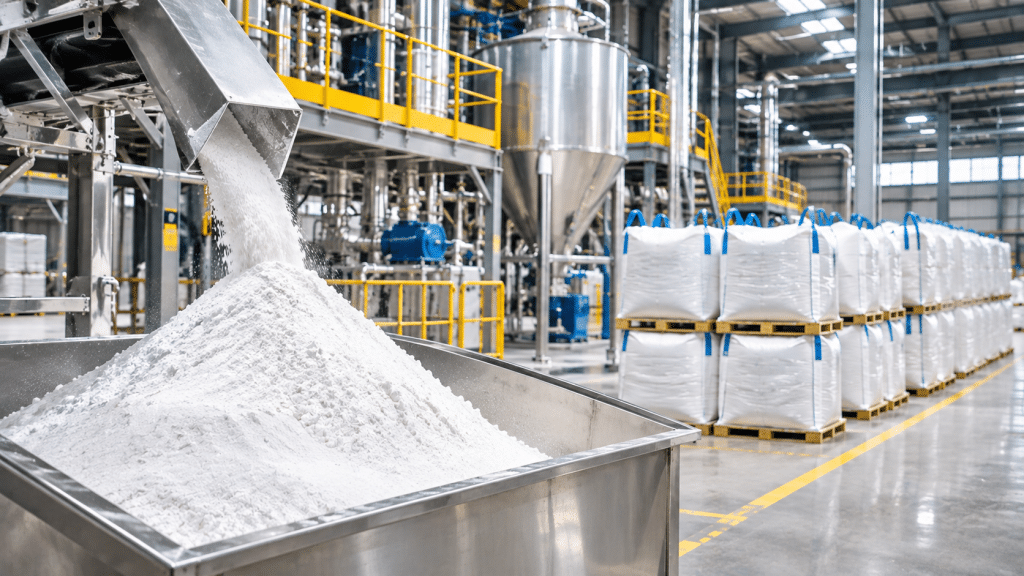
Manufacturers commonly supply Titanium Dioxide in industrial bags or other suitable packing formats.
However, the exact packaging depends on the producer, grade, and order size.
For this reason, buyers should confirm packaging and loading details before shipment.
Storage and Handling
Operators should store the material in a clean, dry area and protect it from moisture and contamination.
In addition, warehouse teams should follow the producer’s storage and safety guidance.
Since fine powders can create airborne dust, workers should use suitable handling methods and controls.
As a result, good storage and handling practices help protect product quality and support safe operations.
For industrial supply inquiries, ATABAŞ GLOBAL can review grade, technical data, order volume, packaging, and delivery terms.
Frequently Asked Questions About Titanium Dioxide
What is Titanium Dioxide used for?
Manufacturers use Titanium Dioxide mainly as a white pigment in paints, coatings, plastics, paper, and inks. In addition, selected grades serve other industrial and technical uses.
What is the difference between Rutile and Anatase Titanium Dioxide?
Rutile generally offers stronger light scattering and suits many outdoor pigment uses. Meanwhile, Anatase serves selected indoor, paper, fiber, and technical applications.
Is Titanium Dioxide soluble in water?
No. Titanium Dioxide is practically insoluble in water. Therefore, it remains a solid pigment in many water-based and solvent-based systems.
Why is Titanium Dioxide used in paints?
Paint manufacturers use it for whiteness, opacity, and hiding power. Furthermore, suitable grades help support long-term coating performance.
Why do plastic manufacturers use Titanium Dioxide?
Plastic manufacturers use it to create white color and opacity. In addition, suitable grades can help manage UV exposure in selected polymer products.
What are the main Titanium Dioxide production methods?
The two main industrial methods are the sulfate process and the chloride process. However, each method uses different raw materials and production steps.
What should buyers check before purchasing Titanium Dioxide?
Buyers should review crystal form, TiO₂ content, particle size, whiteness, surface treatment, dispersion, and technical documents. In addition, they should confirm packaging, supply capacity, and delivery terms.
Which HS codes are used for Titanium Dioxide?
HS 282300 covers titanium oxides. Meanwhile, HS 320610 covers certain pigments and preparations based on Titanium Dioxide. Therefore, the correct code depends on the product’s form and composition.
