

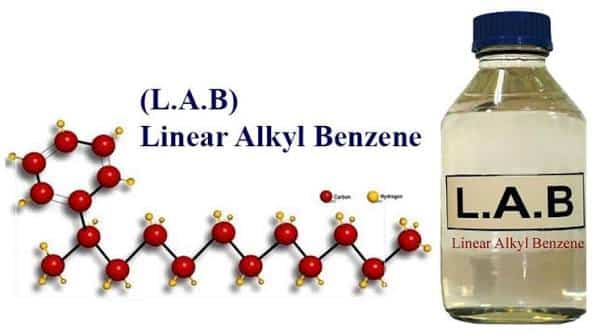
Linear Alkyl Benzene, or LAB, plays a key role in the global detergent industry. Manufacturers mainly use it to produce Linear Alkylbenzene Sulfonic Acid (LABSA), which forms the basis of many cleaning products.
However, choosing LAB involves more than checking a product name and price. Buyers also need to consider purity, carbon range, water content, sulfonation performance, origin, shipping terms and documents.
Therefore, this guide answers the main questions buyers and manufacturers ask about Linear Alkyl Benzene. It covers technical specifications, production, applications, LABSA, quality, storage, pricing and international sourcing.
Most importantly, it explains what you should check before placing an LAB order.
1. What Is Linear Alkyl Benzene?
Linear Alkyl Benzene is an organic petrochemical material that contains a benzene ring linked to a mainly linear alkyl chain.
Commercial LAB normally contains a mix of related compounds rather than one single compound. C10–C13 is a common carbon range for detergent-grade material.
The detergent industry values LAB because manufacturers can convert it into LABSA. They can then neutralize LABSA to produce Linear Alkylbenzene Sulfonate, commonly called LAS.
The basic chain looks like this:
Linear Paraffins → Linear Olefins → LAB → LABSA → LAS → Detergents
As a result, LAB connects the petrochemical sector directly with the detergent and cleaning industries.
Commercial C10–C13 LAB commonly uses CAS No. 67774-74-7.
2. What Are the Typical LAB Specifications?
Technical specifications can vary between producers and grades. Therefore, buyers should always check the current Technical Data Sheet (TDS), Certificate of Analysis (CoA) and agreed contract limits before accepting a shipment.
The table below gives a practical reference for typical commercial C10–C13 LAB.
| Property | Unit | Typical Reference |
|---|---|---|
| Product | — | C10–C13 Linear Alkyl Benzene |
| CAS Number | — | 67774-74-7 |
| Appearance | — | Clear liquid |
| Density at 15°C | g/ml | Approx. 0.860 |
| Saybolt Color | — | Approx. +30 |
| APHA Color | Hazen | Approx. 5 |
| Bromine Index | mg/100 g | Approx. 1 |
| Average Molecular Weight | g/mol | Approx. 235 |
| 2-Phenyl Alkanes | wt.% | Approx. 27 |
| Paraffins | wt.% | Approx. 0.1 |
| Tetralins and Indans | wt.% | Approx. 0.5 |
| Water | ppm | Approx. 25 |
| Viscosity at 100°F | cSt | Approx. 3.2 |
| Flash Point | °C | Approx. 128 |
| Sulfonability | wt.% | Approx. 98.5 |
| Refractive Index at 20°C | — | Approx. 1.482 |
| Acidity | mg KOH/g | Approx. 0.05 |
| Total Linear Alkylbenzene | wt.% | Above 90 |
| Total Branched Alkylbenzene | wt.% | Below 7 |
These values offer a useful market reference. However, they do not guarantee the specification of every cargo.
For that reason, buyers should define the required limits before they sign a contract. In addition, they should compare the cargo’s test results with those limits.
This simple process helps reduce quality risks.
3. How Do Manufacturers Produce LAB?
LAB production starts with suitable linear paraffins.
First, the production process converts linear paraffins into linear mono-olefins through dehydrogenation. Next, the process combines these olefins with benzene during the alkylation stage. Finally, the plant separates and controls the product to meet the required commercial grade.
In simple terms:
Linear Paraffins → Linear Olefins → Alkylation with Benzene → LAB
During production, manufacturers control several important factors. For example, they monitor carbon distribution, phenyl isomers, paraffin levels, water and other components.
These controls matter because LAB must perform well during the next production stage.
In other words, good production control supports more stable downstream processing.
4. What Is Linear Alkyl Benzene Used For?
Manufacturers mainly use LAB to produce LABSA and LAS-based surfactants.
As a result, its downstream applications reach many everyday cleaning products.
Laundry detergents: LAB-based surfactants support cleaning performance in powder and liquid detergent formulas.
Dishwashing products: These surfactants help cleaning formulas deal with grease and food residues.
Household cleaners: Manufacturers use related surfactants in many general cleaning products.
Industrial cleaning: Professional cleaning products also use anionic surfactant systems in a wide range of applications.
Textile processing: LAB-derived surfactants can support washing and wetting processes.
Chemical formulations: Producers may also use related materials in other industrial applications.
Therefore, LAB has a much larger role than its name may suggest.
Consumers rarely see the raw material itself. Yet the chemistry that starts with LAB reaches a huge range of cleaning products around the world.
5. What Is the Difference Between LAB, LABSA and LAS?
LAB, LABSA and LAS belong to the same value chain. However, they are different products.
| Product | Full Name | Main Role |
|---|---|---|
| LAB | Linear Alkyl Benzene | Raw material for LABSA |
| LABSA | Linear Alkylbenzene Sulfonic Acid | Surfactant intermediate |
| LAS | Linear Alkylbenzene Sulfonate | Surfactant used in cleaning products |
The process follows a clear path:
LAB → Sulfonation → LABSA → Neutralization → LAS
First, a producer sulfonates LAB to make LABSA. Then, the producer can neutralize LABSA to make LAS.
This difference is important when requesting a quotation.
For example, a company with its own sulfonation unit may need LAB. On the other hand, a detergent producer may want LABSA or another downstream material.
Therefore, always state the exact product when sending an inquiry.
6. Why Does LAB Quality Matter?
Quality directly affects production planning.
A sulfonation plant needs a stable raw material to maintain consistent operating conditions. Therefore, manufacturers and buyers often review several LAB parameters before purchase.
Sulfonability helps buyers assess how much of the material can take part in the intended process.
Water content also matters because chemical plants need to control moisture carefully.
Paraffin content gives buyers another useful quality indicator.
Bromine index provides information related to unsaturated components.
2-Phenyl content helps describe the product’s isomer profile.
Carbon distribution shows how the different carbon-chain groups appear in the material.
Color can support routine quality checks.
Finally, total linear alkylbenzene content remains one of the key figures in a commercial specification.
For these reasons, price alone cannot define a good purchase.
Instead of asking only, “How much does LAB cost?”, a buyer should also ask:
“What specification can you supply, from which origin, with what documents and under which delivery terms?”
That question leads to a much stronger purchasing decision.
7. What Are the Main Properties of LAB?
Commercial LAB normally appears as a clear liquid under normal handling conditions.
A typical C10–C13 grade has a density near 0.86 g/ml. Its average molecular weight is usually around 235 g/mol, although actual values depend on the grade and producer.
In addition, commercial LAB has relatively low viscosity. This property supports efficient bulk-liquid handling when operators use suitable equipment.
Key characteristics include:
- Clear liquid appearance
- Mainly linear alkylbenzene content
- A defined carbon-chain range
- Good suitability for sulfonation
- Low water content under normal specifications
- Properties suitable for bulk chemical handling
However, buyers should not use general online data to make final safety or process decisions.
Instead, always check the supplier’s latest TDS, SDS and CoA.
8. How Should You Store and Transport LAB?
Good storage protects product quality.
First, use clean tanks and suitable transfer equipment. Contamination from a previous cargo may affect the material. Therefore, tank and line cleanliness deserves careful attention.
Second, limit contact with water and other unwanted materials.
In addition, operators should use pumps, hoses, pipes and valves that suit the product.
For safe handling, follow the current Safety Data Sheet. The SDS provides guidance on protective equipment, fire safety, exposure controls and other handling needs.
Depending on the shipment size and route, suppliers may arrange suitable tank trucks, ISO tanks or bulk marine transport.
However, the best logistics method depends on several factors, including:
- Shipment volume
- Loading point
- Destination
- Available infrastructure
- Delivery terms
- Local rules
Therefore, buyers should discuss logistics early in the purchasing process rather than after they agree on a price.
9. What Affects the Price of LAB?
LAB does not have one fixed global price.
Instead, market conditions change its value over time.
Benzene prices can affect production economics. Likewise, linear paraffin costs and wider energy markets can influence the supply chain.
In addition, regional supply and demand play an important role.
Other price factors include:
- Product origin
- Technical specification
- Order volume
- Spot or contract purchase
- Freight rates
- Loading costs
- Destination
- Incoterm
- Insurance
- Inspection
- Payment terms
- Shipment period
Therefore, buyers should avoid comparing quotations by price alone.
For example, an FOB quotation and a CIF quotation do not cover the same costs. Likewise, two cargoes may have different specifications or origins.
A better comparison looks at the complete offer:
Product + Specification + Quantity + Origin + Price + Incoterm + Freight + Inspection + Documents + Payment Terms
This approach gives buyers a clearer view of the real cost.
10. What Should You Check Before Buying LAB?
Before placing an order, create a clear purchase requirement.
Start with the technical specification. Define the limits your production process needs.
Next, state the quantity in metric tons.
Then, provide the destination port and country. This information helps the supplier evaluate freight and logistics.
You should also define:
- Preferred Incoterm
- Target shipment date
- Required origin, if applicable
- Inspection requirements
- Required certificates
- Packaging or bulk needs
- Payment terms
- Spot or long-term demand
In addition, check local import and customs rules before shipment.
A complete inquiry helps both buyer and seller work faster.
Instead of sending:
“Please send LAB price.”
Send:
Product: Linear Alkyl Benzene (LAB)
Grade: C10–C13
Quantity: 1,000 MT
Destination: [Port, Country]
Incoterm: CIF
Shipment: [Month/Year]
Specification: Attached
Inspection: Third-party inspection required
As a result, the commercial team can assess your request with far less back-and-forth communication.
11. Which Documents Do LAB Buyers Need?
International chemical trade requires accurate documents.
The exact requirements depend on the contract, origin and destination. However, an LAB shipment may include:
- Commercial Invoice
- Packing List or cargo document
- Bill of Lading
- Certificate of Analysis
- Certificate of Origin
- Certificate of Quantity
- Safety Data Sheet
- Technical Data Sheet
- Inspection report
- Insurance documents, when applicable
- Customs documents
In addition, the Sale and Purchase Agreement should clearly define the product, quality, volume, price basis, delivery term and payment schedule.
This point matters because a successful shipment needs both the right product and the right paperwork.
For example, good-quality material can still face delays when documents contain errors.
Therefore, buyers should review document requirements before loading.
12. How Do You Choose a Reliable LAB Supplier?
A reliable supplier should offer more than an attractive price.
First, check the company’s trading background and legal identity.
Next, examine how the supplier handles specifications. A professional counterparty should clearly define the product before the transaction moves forward.
Also consider its ability to manage:
- International logistics
- Quality control
- Third-party inspection
- Shipping documents
- Commercial contracts
- Cross-border transactions
- Clear communication
Furthermore, buyers should consider the cost of poor execution.
A delayed cargo may affect production. Likewise, off-spec material may create processing problems. Incorrect documents can also slow customs clearance.
Therefore, the cheapest offer may not always deliver the lowest total cost.
For an industrial buyer, reliable execution can be as important as the price itself.
13. Why Source LAB Through Atabaş Global?
Buying Linear Alkyl Benzene across international markets requires several processes to work together.
Product quality matters. However, logistics, documentation, inspection and commercial terms matter too.
Atabaş Global has operated in international commodity trading since 1981. Over the years, the company has built trade relationships across more than 55 countries and works with a broad range of physical commodities, including petrochemicals and industrial raw materials.
For LAB buyers, this experience supports a structured purchasing process.
Atabaş can approach the transaction around the buyer’s actual requirement rather than treating LAB as a simple price quote.
That process starts with the specification.
Next come the required volume, origin, destination and Incoterm.
Then, the parties can define the commercial structure, documents, inspection needs and shipment schedule.
As a result, buyers gain a clearer path from inquiry to physical delivery.
Atabaş also works with formal commercial agreements and can coordinate independent inspection according to the agreed transaction structure.
This approach becomes especially valuable when buyers source across borders.
After all, buying LAB is not only about finding material.
It is about finding the right grade, at workable commercial terms, with the documents and logistics needed to move it successfully.
14. How Can You Order Linear Alkyl Benzene from Atabaş?
If your company needs LAB for detergent production, LABSA manufacturing, chemical processing or distribution, start by sending Atabaş a clear requirement.
Include:
- Product grade
- Required specification
- Quantity
- Destination port
- Destination country
- Preferred Incoterm
- Shipment period
- Preferred origin, if applicable
- Inspection needs
- Required documents
- Payment terms
The Atabaş commercial team can then evaluate the request and discuss the available trade structure with you.
A good LAB purchase should give you more than material.
It should give your company confidence in quality, terms, documentation and delivery.
That is especially important when the raw material supports continuous production.
So, if you are looking for a Linear Alkyl Benzene supplier for an upcoming shipment or long-term requirement, contact Atabaş Global today.
Send your required specification, volume and destination to Atabaş and request a commercial offer.
Your next LAB shipment starts with the right specification and the right trading partner. Contact Atabaş Global to discuss your order.
