

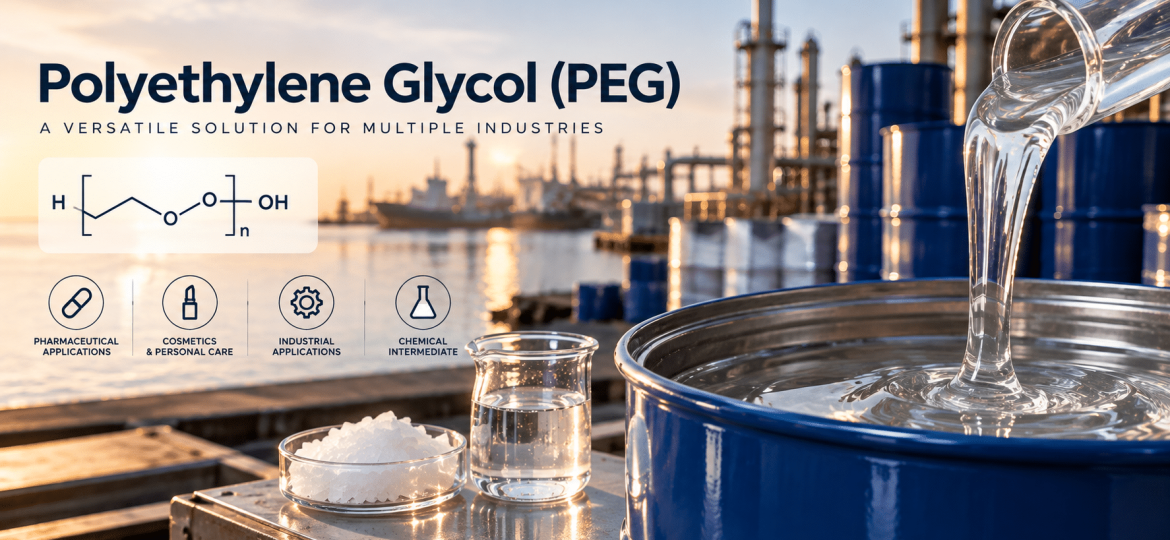
Polyethylene Glycol is a versatile chemical raw material used in many industrial applications. It belongs to the polyether family and is widely known as PEG. Because it is available in different molecular weights, manufacturers can select grades for many different production needs.
Low molecular weight PEG grades are usually liquids. In contrast, the product becomes more viscous, waxy, or solid as molecular weight increases. Therefore, manufacturers can choose different PEG grades according to the required physical and process properties.
PEG products are used in coatings, adhesives, textiles, ceramics, rubber, plastics, paper, metalworking, personal care, and chemical production.
However, choosing the correct grade is important. For this reason, buyers should consider molecular weight, physical form, viscosity, water content, hydroxyl value, quality grade, and final use before purchasing.
1. What Is Polyethylene Glycol?
Polyethylene Glycol is a polyether commonly produced from ethylene oxide. Its general chemical structure can be shown as H-(O-CH2-CH2)n-OH.
PEG does not refer to only one fixed molecular weight. Instead, it describes a family of products with different average molecular weights. Common commercial grades include PEG 200, PEG 300, PEG 400, PEG 600, PEG 1000, PEG 1500, PEG 2000, PEG 3000, PEG 3350, PEG 4000, PEG 6000, and PEG 8000.
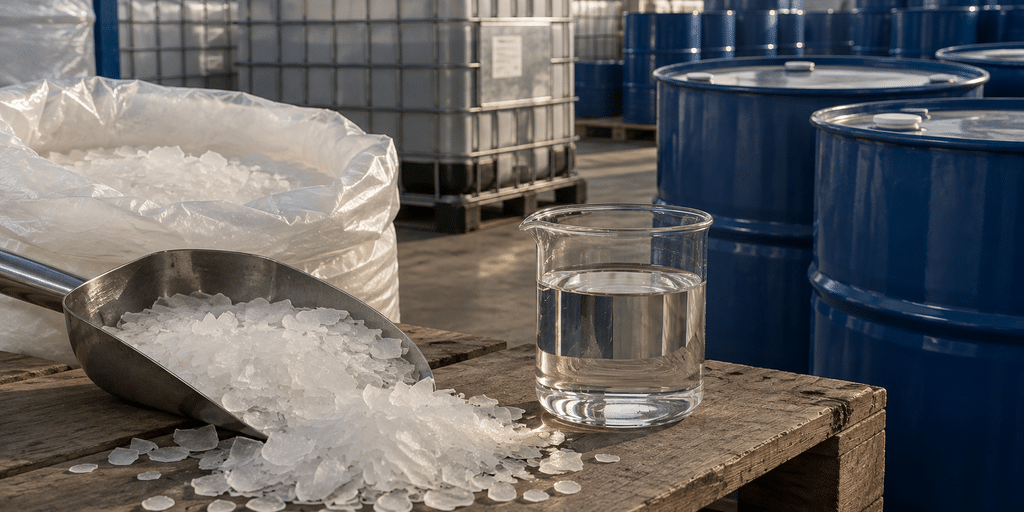
As molecular weight increases, physical properties also change. For example, lower grades are mainly liquids. Medium grades become more waxy, while higher grades are generally available as solids, flakes, or powders.
As a result, manufacturers can select a grade that matches their process needs.
2. How Is Polyethylene Glycol Classified?
The industry mainly classifies PEG products according to their average molecular weight.
In general, the number after PEG gives a practical guide to the approximate molecular weight. Therefore, grades within the same product family can have very different physical and process properties.
| PEG Grade | Approx. Molecular Weight | Typical Physical Form | General Character |
|---|---|---|---|
| PEG 200 | ~200 | Liquid | Low viscosity |
| PEG 300 | ~300 | Liquid | Low to medium viscosity |
| PEG 400 | ~400 | Liquid | Clear, viscous liquid |
| PEG 600 | ~600 | Viscous liquid / semi-solid | Medium viscosity |
| PEG 1000 | ~1,000 | Semi-solid / waxy | Soft, waxy form |
| PEG 1500 | ~1,500 | Waxy solid | Medium molecular weight |
| PEG 2000 | ~2,000 | Solid / flakes | Waxy solid |
| PEG 3000 | ~3,000 | Solid / flakes | Firmer solid |
| PEG 3350 | ~3,350 | Powder / flakes / solid | High molecular weight |
| PEG 4000 | ~4,000 | Flakes / powder / solid | High molecular weight |
| PEG 6000 | ~6,000 | Flakes / powder / solid | Hard, waxy solid |
| PEG 8000 | ~8,000 | Powder / solid | Very high molecular weight |
Exact molecular weight ranges and physical forms can vary by producer. For this reason, buyers should always check the latest Technical Data Sheet before approving a product.
3. Polyethylene Glycol Technical Properties
Technical properties vary according to molecular weight and product grade. Therefore, one fixed specification cannot accurately represent the whole PEG family.
| Property | Low Molecular Weight PEG | Medium Molecular Weight PEG | High Molecular Weight PEG |
|---|---|---|---|
| Typical Form | Liquid | Viscous / waxy / semi-solid | Solid / flakes / powder |
| Molecular Weight | Lower | Medium | Higher |
| Water Solubility | High | High | Generally high |
| Viscosity | Lower | Medium to high | Depends on grade and test method |
| Moisture Absorption | Higher | Medium | Generally lower |
| General Use | Carrier / process aid | Binder / lubricant | Binder / solid formulation aid |
Commercial specifications may also include hydroxyl value, water content, pH, color, acidity, viscosity, and molecular weight range.
However, exact limits vary by manufacturer and grade. Therefore, buyers should use the producer’s current Technical Data Sheet (TDS) and batch Certificate of Analysis (CoA) for final product approval.
4. How Is Polyethylene Glycol Produced?
Manufacturers generally produce PEG through a controlled reaction involving ethylene oxide.
During production, process conditions affect polymer chain length. As a result, producers can make products with different average molecular weights.
Lower molecular weight grades can remain liquid under normal conditions. However, the material becomes more viscous as chain length increases. Higher grades eventually develop a waxy or solid form.
After the main production stage, additional steps may include filtration, purification, finishing, or flaking. The exact process depends on the target grade.
Therefore, good process control is important. Consistent production helps keep product properties within the required quality range.
5. What Is Polyethylene Glycol Used For?
PEG has a wide range of uses because different grades provide different properties.
For example, lower molecular weight products may work as carriers or process components. In contrast, higher grades may provide binding, lubrication, or formulation support.
| Industry | Typical Function |
|---|---|
| Paints and Coatings | Formulation and processing aid |
| Adhesives | Formulation and plasticizing support |
| Textile | Lubricant and processing aid |
| Ceramics | Binder and processing aid |
| Rubber | Lubricant and process component |
| Plastics | Processing and formulation support |
| Paper | Processing component |
| Metalworking | Lubrication and formulation support |
| Personal Care | Carrier, humectant, or formulation component depending on grade |
| Chemical Manufacturing | Intermediate and formulation raw material |
| Cleaning Products | Formulation and solubility support |
| Industrial Lubricants | Lubrication and processing support |
Therefore, companies should select the product grade according to the needs of the final application.
6. Low Molecular Weight PEG Grades
PEG 200, PEG 300, and PEG 400 are common low molecular weight grades. They are mainly available in liquid form.
For example, PEG 200 has relatively low viscosity. Therefore, it may work as a carrier, solvent, or process component in suitable systems.
PEG 300 provides similar properties with a slightly higher molecular weight. Meanwhile, PEG 400 is one of the best-known liquid grades and offers useful water compatibility.
PEG 600 is closer to the transition between lower and medium molecular weight grades. As a result, its physical form may change depending on temperature and product specification.
Overall, these grades are useful when a process requires liquid or more fluid PEG properties.
7. Medium Molecular Weight PEG Grades
As molecular weight increases, PEG develops a stronger waxy or solid character.
PEG 1000 generally has a soft, wax-like form. In comparison, PEG 1500 can provide a firmer physical structure.
PEG 2000 and PEG 3000 move further toward solid properties because of their higher molecular weights.
Depending on the application, these products may work as binders, lubricants, carriers, or processing aids.
In addition, temperature can affect physical form and flow properties. Therefore, companies should consider both storage and operating conditions.
8. High Molecular Weight PEG Grades
High molecular weight PEG products are generally solid. Depending on the manufacturer, they may be supplied as flakes, powders, granules, or waxy solids.
This group includes grades such as PEG 3000, PEG 3350, PEG 4000, PEG 6000, and PEG 8000.
As molecular weight rises, physical and process properties also change. Therefore, different grades can serve as binders, lubricants, processing aids, or formulation components in suitable systems.
However, the grade number alone is not enough for final selection. Buyers should also review molecular weight range, hydroxyl value, water content, physical form, and quality grade.
9. Use in Paints and Coatings
PEG products can perform several functions in paint and coating formulations.
Selected grades may support processing and formulation control. In addition, they can contribute to lubrication, plasticizing, or other required properties in suitable systems.
However, molecular weight plays an important role in product selection. Therefore, manufacturers should choose a grade according to the final formulation and process conditions.
Application tests can also help confirm whether the selected product meets the required performance.
10. Use in Adhesives, Ceramics, Plastics and Rubber
Selected PEG grades can provide formulation and process support in adhesive production.
Similarly, ceramic manufacturers may use suitable grades as binders or processing aids.
In plastics and rubber, PEG products can support lubrication and other process needs. However, the exact function depends on the formulation and selected grade.
Because every production system is different, companies should test the product before large-scale use.
As a result, manufacturers can select a grade based on actual process performance rather than molecular weight alone.
11. Use in Textile, Paper and Metalworking Applications
Textile manufacturers use different process chemicals to support smooth and controlled production. Suitable PEG grades may provide lubrication and processing support.
Similarly, selected grades can work as process or formulation components in paper production.
Metalworking is another possible application area. For example, water compatibility and lubrication properties may support selected formulations.
However, compatibility with other raw materials remains important. Therefore, manufacturers should evaluate the complete chemical system before use.
12. How to Select the Right PEG Grade
Molecular weight is one of the main factors in PEG selection.
In general, viscosity and solid character increase as molecular weight rises. Meanwhile, lower molecular weight grades show more liquid properties.
| Requirement | General Grade Direction |
|---|---|
| Low viscosity | PEG 200–400 |
| Liquid physical form | PEG 200–400 |
| Higher viscosity | PEG 600 and medium grades |
| Waxy / semi-solid form | PEG 600–2000 |
| Solid form | PEG 3000 and above |
| Binder function | Medium to high molecular weight grades |
| Carrier / solvent behavior | Lower molecular weight grades |
| Solid formulation processing | Higher molecular weight grades |
However, this table provides only general guidance. Final product selection should depend on technical data and application tests.
In addition, buyers should consider the complete process rather than focusing on only one technical value.
13. Quality Control, Storage and Safety
Quality requirements vary according to the selected PEG grade and final application.
For example, buyers may need to check average molecular weight, hydroxyl value, water content, pH, acidity, viscosity, color, and physical form.
Therefore, purchasing teams should review the Technical Data Sheet (TDS), Safety Data Sheet (SDS), and Certificate of Analysis (CoA).
Storage conditions also depend on physical form. Liquid products may require suitable tanks, drums, or IBCs. In contrast, solid grades should use packaging that protects the material from moisture and contamination.
Temperature can also affect some grades. For this reason, companies should follow the producer’s storage instructions and keep containers properly closed.
Finally, workers should follow the current SDS and all local rules for handling, labeling, storage, and transport.
14. What Should Buyers Consider When Purchasing Polyethylene Glycol?
Price should not be the only factor when purchasing PEG.
First, buyers should define the required molecular weight, physical form, and application. Next, they should review viscosity, hydroxyl value, water content, quality grade, and packaging.
After that, purchasing teams can compare the producer, origin, technical documents, availability, delivery time, Incoterms, and total cost.
Quality grade also requires careful attention. For example, an industrial product and a grade intended for a regulated application may have different production standards and document requirements.
In addition, international buyers should consider logistics and supply continuity. A reliable supply chain can reduce production risks and support better purchasing plans.
For safe and reliable ordering, companies can choose Atabaş. Atabaş supports industrial buyers by bringing product requirements, grade selection, documentation, commercial terms, and logistics together in a well-managed purchasing process.
15. Why Is Polyethylene Glycol Important for Industry?
Polyethylene Glycol provides an important advantage because manufacturers can choose from a wide range of molecular weights within the same product family.
Lower molecular weight grades provide liquid properties for selected processes. In contrast, medium grades offer more waxy characteristics, while higher molecular weight products provide solid forms for different production needs.
As a result, manufacturers can match the product more closely to their process requirements.
PEG products serve many industries, including coatings, adhesives, ceramics, textiles, rubber, plastics, paper, metalworking, personal care, and chemical manufacturing.
Moreover, successful purchasing depends on more than product availability. Buyers should consider quality, technical specifications, documents, packaging, origin, logistics, and supply continuity.
For businesses that value secure sourcing and professional supply management, Atabaş offers a reliable choice for Polyethylene Glycol procurement across different PEG grades.
